Showing posts with label Olivier Assayas. Show all posts

Friday, October 20, 2017

Blu-ray/DVDebut for Olivier Assayas' genre-jumping jumble, PERSONAL SHOPPER


Yes, Kristen Stewart is always an interesting actress to watch, and after putting her through the paces -- and then some -- while helping her win a first-ever César award for an American actress via his remarkable Clouds of Sils Maria, French filmmaker Olivier Assayas (shown below) has collaborated again with Ms Stewart on a movie that, while never uninteresting, unfortunately never comes together in any genuinely meaningful way.

Instead, PERSONAL SHOPPER offers so much genre jumping -- from ghost story to murder mystery to fashion-plate parade to technology thriller to identity crisis to (no? yes!) a look at the French real estate market -- that by the time this film has come to its dead-halt finale, and the would-be ghost has answered the all-important question via a certain number of knocks, if you have not already given up in frustration or nodded off to dreamland, you're likely moan aloud, as I did, "Yeah, I figured as much. But so fucking what?!"

Now, M. Assayas has genre-jumped previously. Demonlover, in fact, is one of his most remarkable, ugly and joyous treasures. But here, as writer (of screenplay and dialog) as well as the director, he is working primarily in the English language, as he did in Clean and Boarding Gate, two of his least successful films. And he simply does not possess a gift for this. His dialog is too often ordinary and lifeless when it ought to be precise and probing.

Ms Stewart (shown above and below) is saddled with way too much of this tiresome dialog, and since she is a subtle but not particularly versatile actress, and since her character here is the most important thing in the film, that dialog ought to help her explore and deepen that character. It does not.

Rather, it allows the actress -- who relies to an awfully great extent to a single expression, or if we're lucky maybe two (to which all the stills above and below will attest) -- to simply "be herself" -- which is believable enough, all right, but not very interesting or meaningful in this case.

Her character, Maureen, has recently lost her brother to untimely death, and it would appear that his ghost may be trying to communicate with her (being a "medium" to the spirit world seem to run in their family).

So we get occasional "appearances" by this spirit world, and between shopping trips for her uber-wealthy client, someone/thing is also trying to reach her via cell phone. Because of this, we get rather lengthy texted conversations (M. Assayas proves better with texting dialog than with the speaking version).

Eventually Maureen discovers a dead body, the police are called in, and the murderer (there's really been only a single suspect here, so any "mystery" proves pretty paltry) is quickly caught. Then we're off to Africa for a bit more soul-searching. Trouble is, there just isn't much soul to search.

The movie is almost entirely comprised of Ms Stewart, and the actress is always a pleasure to watch -- even here, without much of a story to surround her. Nothing we see or hear seems all that substantial or even believable.

So I suspect that, in the case of this new film, Assayas was simply diddling or doodling away the time, trying to come up with a story, situation and character that will make his cobbled-together and rather goofy ideas cohere. He doesn't manage this, but he'll bounce back. He always does. (Summer Hours, for example, is one of the richest family/possessions films ever.)

Meanwhile Personal Shopper, from The Criterion Collection and running a too-long 105 minutes, arrives this coming Tuesday, October 24, on Blu-ray and DVD, for purchase and/or rental. 

Wednesday, April 8, 2015

CLOUDS OF SILS MARIA: Olivier Assayas' great film about women, celebrity, aging, performance


One of the strengths of filmmaker Olivier Assayas (shown below) is how he manages to make his movies so often seem off-the-cuff, almost improvised, while at the same time bringing home their themes gently but fluently. His new movie CLOUDS OF SILS MARIA manages this particularly well, as did Summer Hours and Something in the Air.

Occasionally he'll come a cropper (remember Boarding Gate), when his themes never coalesce into believability, or with Clean, in which his command of the English language was not nearly up to the level it appears to have reached in his latest endeavor. He'll also surprise/shock us now and again with something memorably crazy like Demonlover, where themes (the evils of globalization) are hammered home rather bluntly but the movie is such bizarre, devilish fun that we don't care. In Clouds of Sils Maria, Assayas is working at or near his zenith, and the result is bravura.

This writer/director has long shown a special affinity for women, their needs and desires, along with how they "operate." I'd say he's done this better than most male directors. He also, as might be expected, understands quite a bit about international movie-making, celebrity and (as he just this year turned 60) aging.  His new film juggles all these themes with such wit, dexterity and expositional slight-of-hand that you can only sit back and marvel at his splendid dialog, lovely visuals and the wonderful performances he gets from his three women stars -- and everyone else in this terrific movie.

The three women here would seem to represent the ages of the late teens, 20s and 40s -- with Juliette Binoche (two photos above, who has worked with the writer and director several times before), as Maria, the oldest of the three (Ms Binoche just turned 50 last year); Kristen Stewart (above, and now 25 years old) as Valentine, Maria's smart, unusually truth-telling personal assistant; and Chloë Grace Moretz (below, who is currently at the end of her teen years) as a young actress named Jo-Ann, who has just risen to the realm of superstardom.

I give the actual age of these three performers not to be dishy but because the line between art and life in this film seems intentionally unclear, sometimes transparently so. In a scene or two in which Maria and Val have line rehearsals for a play in which Maria will star, you may initially imagine the pair are simply talking about their own lives, rather than reading dialog, so attuned to art mimicking life is M. Assayas.

That play is a sequel to an earlier play -- which became a hit film, thereby sending Maria's star into orbit some decades back -- involving a young girl and the older woman who becomes her mentor and lover. Having won initial acclaim playing the young girl, now the actress is set to perform the role of the older woman. That the younger woman will be played by the hugely successful Jo-Ann simply adds to the repressed trauma that our aging actress must face.

The men who inhabit, somewhat cursorily, these women's lives are written in brief, smart strokes and portrayed very well by a number of fine actors (including Lars Eidinger, above, right, as the play's hotshot director; Hanns Zischler as an old and much-loathed co-star; Johnny Flynn, below, left, as Jo-Ann's current wunderkind writer boyfriend; and Brady Corbet, who has a marvellous little penultimate scene with Binoche involving, yes, age and acting. The film's first "event," in fact, has to do with a man, the playwright in question, who gave Maria her start. Yet the guys are all satellites; it's the women who command and control the film.

They do this by questioning, arguing, insisting, relenting -- then rethinking the whole thing. It's a brilliant conception on Assayas' part, and the execution is sterling. Ms Binoche is so real (and often not so nice), alternately appealing and wise and then annoying and foolish. Her Maria is struggling, and she makes us a party to that struggle. Ms Moretz, one of our most interesting young actresses, is delightful here: as poised and gracious in person as her character is lewd and insulting during her forays with the media. (The movie's various prattle about "the industry" and how it works is generally hilarious.) Moretz represents youth in all its passion and eagerness, as well as its indiscretions and selfishness -- and she nails this state of mind and action beautifully.

Most surprising of all, however, is Ms Stewart, who has given a number of good performances in her career, but nothing that matches this one. She is so alert and on-point throughout, so "unglamorous" and real, full of surprise and spiked intelligence that she all but steals the movie. You can understand why the French were so floored that they gave her their Best Supporting Actress award -- the first time in history that an American has won a César.

What M. Assayas has done, finally, is to give us a look at performing in its many incarnations -- in theater, film, rehearsal, and life (that's right: we do indeed perform for friends, family and even strangers). Yet how thoughtful and egalitarian is this filmmaker, as he allows his characters to stop, start again, grow and finally change. One of the prize scenes comes near the end, as Maria and Jo-Ann face each other down regarding how to play a certain scene. The result is a kind of blessed few moments that allow the pivotal character (and us) to more deeply relate and understand.

Oh, yes-- what about those titular clouds? They are said to exist at early morning hours as air masses move around the mountain range of Sils Maria -- the gorgeous area of Switzerland in which much of the film takes place -- creating a kind of billowy "snake." The trek to see this phenomenon that Maria and Val make leads to one of the movie's several climaxes. It's a wonder, as is most of this amazing, mysterious movie.

From Sundance Selects/IFC Films and running a just-about-perfect 124 minutes, Clouds of Sils Maria opens this Friday, April 10, in New York City at IFC Center and the Lincoln Plaza Cinemas, with openings in the top national markets throughout April and early May 

Monday, April 29, 2013

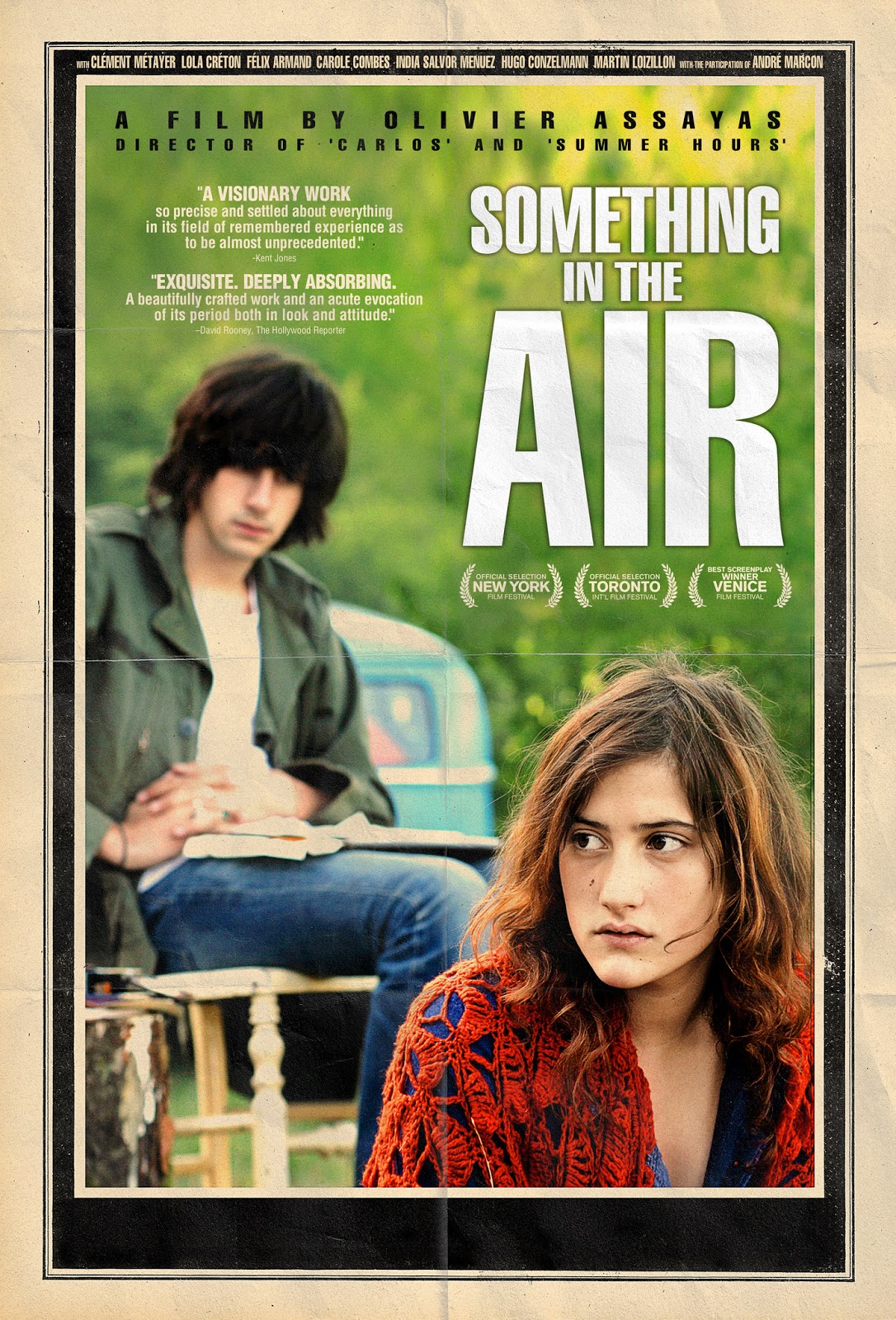
SOMETHING IN THE AIR: Olivier Assayas' buoyant look at post-'68 protest in France


It bubbles, it flows, it rarely stops moving, and it's full of youthful French passion for... well, all kinds of things from sex to politics to philosophy to protest to travel. With his new movie, SOMETHING IN THE AIR, critically acclaimed (and sometimes even popular) French filmmaker Olivier Assayas captures part of, maybe the heart of, the student rebellion that first hit France in 1968 and then exploded around Europe and America.

Assayas' film is set in the very early 1970s, when he himself was a teenager. Perhaps this is why (and about as well as I have seen it done) the filmmaker, shown at left, is able to capture the kind of shimmering spirit of that time in this film full of characters that appear, act, speak and connect, then disappear, only to (sometimes) appear again and reconnect. Or not. Something in the Air is full of near constant movement and incident but (as a compatriot of mine pointed out immedi-ately after the screening) almost zero "interiority." This lack was not a criticism of the film, either, as the kids we see and whose activities we follow are full of youthful zest and plenty of ideas -- most of them unformed. But they certainly feel things. And so they act, but for god's sake, don't ask them why. They'll figure that out later, maybe in a decade or two.
If they live that long.

Most of these kids, it appears, are scions of the French bourgeoisie, so protest, along with their next meal, comes pretty easily. This is not to say they are not committed. It's just that their commitment might change or move around a bit. Is it to the ideas of Lenin? Or Trotsky? Or simply to art? Or to each other? And how much, finally, does this even matter?

We don't necessarily learn the answers. Nor do the kids. But we're there, with them, as these questions crop up. Assayas begins his film in the middle of things, and he ends there, too. This will annoy viewers who insist on comfortable beginnings and some nice closure at the finale. Yet there is so much going on in this film, that events themselves render boredom impossible. Stylistically, the film is almost consistently pleasurable. And if you have even a lick of interest in or experience with protest, I think the movie will grab you where it hurts (where it thrills, too).

Many of the characters we see flit by too fast and remain surface-only to care much about, and this is perfectly all right somehow. The quintet who count most register strongly, and that's enough. These would include our hero, Gilles (played by Clément Métayer, above, right); his friend, Alain (Félix Armand) and his girl (India Salvor Menuez, below, with red hair); and our two heroines, Christine (played by Lola Créton, above, sleeping, and recently seen in Goodbye First Love and earlier in Bluebeard) and Laure (gorgeous newcomer Carole Combes, shown at bottom).

Music is near-constant here and a lot of fun to hear, for the musical choices are indeed choice. Along the way, our little group is faced with its own choices: will it be art or commerce, painting or politics, commitment or forget it? Gee, maybe one can manage both. We bourgeoisie usually prefer it that way.

Something in the Air, from Sundance Selects and running 122 minutes, opens this Friday, May 3, in New York (at the Lincoln Plaza Cinemas and IFC Center) and in Los Angeles (at Laemmle's Royal Theater). The film will also be available come May 9 nationwide via Sundance Selects’ video-on-demand platform, available to over 50 million homes in all major markets.

Wednesday, October 20, 2010

Assayas' CARLOS -- the guy and the film -- though worth seeing, disappoints

After wading through nearly six hours of CARLOS, in which exposition is followed by event, followed by exposition followed by event, and still feeling like I was getting a high-school-level treatise on one of the world's most famous terrorists, all I can say is that the great critical acclaim for Olivier Assayas' made-for-French-television film must be based on the fact that, yes, he did it. He's managed to pull together a lot of facts (along with some conjecture) and spliced them into a reasonably interesting, rapid-paced whole. Yet that very pacing -- due to the exposition/event style in which Assayas has chosen to tell his tale, often in very short scenes, together with a screenplay that manages to amass and then connect most of the dots using dialog that never rises above the prosaic -- eventually grows tremendously tiresome.

English is not Assayas' most productive language -- witness Clean -- and though he evidently had some help with the screenplay from Dan Franck, the whole thing is serviceable, if that. Working with his longtime editor Luc Barnier (as well as a new one, Marion Monnier) Assayas (shown at right) must have shot reams of footage in order to assemble what we see here. And yet, other than a few scenes of martial/relationship spatting, in which the principals emote, soap-opera style, much of the dialog is kept to an expository, emotionless level.  When, from time to time, Carlos is deprived of his role as top-gun terrorist or of his home base, his emotions rise; and a couple of scenes of the terrorist takeovers (one at an OPEC conference, shown below, another at an Embassy), there are higher moments, though even some of these ring a bit hollow, if not entirely fake: After a Japanese terrorist has pumped a lot of lead into a portrait of Georges Pompidou, a French official informs the gunman a bit haughtly that Monsieur P. died some months previous.

Part of the problem here is that, while the majority of Carlos's dialog is in English, it is English spoken by heavily-accented actors, each with his or her own special brand -- French, German, Hispanic, Middle-Eastern -- so that inevitably some (for me, much) of the dialog is lost. As soon as our ears become acclimated to one type of accent, another replaces it. I have no doubt that English is, and was during the time frames depicted, the international language, so it was necessary for Carlos and his crew, dealing with so many representatives from so many different countries, to speak it. I wish they could have spoken it a bit better -- or that English sub-titles has been provided throughout . (Fortunately, we watched Carlos via DVR from the Sundance Channel so we could track back again and again to catch a word or phrase that was missed.)

Assayas does here what he does in so many other of his films: shoot a bunch of scenes and hope they hang together. Sometimes they do (Demonlover, Summer Hours), sometimes not (Boarding Gate, Les destinées). His interest, as it often seems to be, is in showing us the world and how it impacts upon individual people and countries. Or, in the case of Carlos, how he impacts upon it. Fair enough, but in his choice of scenes, he's given us too much that's standard-issue, and he has not brought any kind of dramatic arc to the proceedings. It's all "and then this happened, and then this, and then this."

In Édgar Ramírez (above), the filmmaker has found an actor who, though much better-looking than the original, has a similar "beefy" quality that works well. A impressive as Ramírez is, the screenplay never lets him be seen at all fully. Instead he's preaching, scolding, attacking and fucking (or being serviced orally). He's always "on," as befits a character who was as much PR as anything else. The supporting cast is fine, as far as it can go -- which is generally only to the point of "Let's get this exposition out there." Even the film's quieter scenes (one of the better takes place between two revolutionaries, one who wants out -- below -- the other who wants him to stay), have a manufactured quality about them because they need to always be spilling out ever more exposition.

We hop around from country to country (though both the middle-eastern exteriors and European interiors seems awfully alike: hard to believe there was so little difference between the swank hotels and bars of western and eastern Europe).  We see how nations who seem to be divided on almost everything else, join hands when it comes to getting rid of Carlos and his crew. As usual, its about power -- who has it and how to keep it.  (And what's with Assayas' choice of music -- which continually calls undue attention to itself?)

Feminism was on the move during Carlo's time, and indeed he gives a bit of lip-service to it, while remaining without a doubt one of the true MCP's of the day. Of the primary women shown in Carlos -- Nada (below, played by Julia Hummer) and Magdalena (played by Nora von Waldstätten, above, left) -- the first is portrayed as an angry, little-girl nutcase and the second as a needy, whiny bitch. Earlier in the film, one of his women holds her own with the guy, taking him down verbally during dinner in a fancy restaurant. Well, enough of her!  Later a woman appears who might register more strongly (in addition to all else, she can shoot) but even she is soon relegated to courier status for the remainder of the film.

Interestingly enough, many of the characters here you will have seen elsewhere: Hans-Joachim Klein in Jessica Yu's Protagonist, Jacques Vergès in Barbet Schroeder's Terror's Advocate, and several, I think, in  The Baader Meinhof Complex -- to my mind, a much better piece of filmmaking.  In each of those films (granted, the first two are documentaries), characters seems stronger and events more memorable. It's as if, reversing the standard line, "he can't see the forest for the trees," Assayas proves fine with the forest, less so with its individual members (Baader Meinhof managed to get them both). Except, of course, for Carlos himself. This fellow, a very imposing tree whose trunk turned out to be cardboard, remains one more reason why the "revolution" never happened.

Carlos, from IFC Films, in the full 330-minute version, is playing currently in NYC at the IFC Center through Tuesday, November 2 only.  The shortened, 2-1/2-hour version is playing at the Lincoln Plaza Cinema -- though I can't imagine how condensed and exposition/event heavy this version must be! Starting October 20, it's also available On-Demand until January 20, 2011. (Though not yet, I think, in the NYC metropolitan area. We'll have to wait until after the theatrical run.)