Showing posts with label terrorist movies. Show all posts

Monday, June 9, 2014

Home grown terrorism in Israel: Nadav Lapid's intriguing POLICEMAN opens in NYC and L.A.


A most interesting ensemble character study, as well as a study in home-grown terrorism, Israeli entitlement, and that country's enormous income gap between rich and poor (hmmm... that's timely), POLICEMAN-- an unsettling documentary-like narrative movie from Israeli filmmaker Nadav Lapid-- is finally hitting theaters here in the USA, thanks to Corinth Releasing. First seen in 2011 (it played the NY Film Fest that year), the movie has appeared at ten festivals internationally and seen theatrical release in a number of countries, though not in Israel itself, where it only played the Jerusalem Film Fest (and won the Best Screenplay award). This should not surprise, since the movie tackles some thorny Israeli problems that, I suspect, have only grown worse since then.

Mr. Lapid, shown at right, does a lot of things right in this, his second full-length film. He captures the unassuming prerogative of power shown by his band of young Israeli policemen, whether they are racing their motorcycles, shouting out their own names on a mountaintop, or mercilessly beating up a young man who has stolen a bouquet off a gravesite. These guys are the elite; they know it, and they want to make certain we know it, too. We only really get to know two of these policeman at all well: Yaron (played by Yiftach Klein), a fellow whose wife is pregnant, and Ariel (played by Gal Hoyberger), who has cancer and will probably be dead sometime soon.

Not surprisingly, our boys are being charged with heavy-duty misconduct (they're responsible for the death of Arab family members), and Yaron (shown above) is chosen as the guy who will ask Ariel (below, right) if he'll sign a confession that he did the deed (as Ariel is currently undergoing medical treatment, he cannot be brought up on charges).

We spend time with these guys at work and play, meet their women and listen to them chatting in their macho manner. Nothing particularly deep, mind you, but as about as deep as men of this occupation appear to get (in the movies, at least).

Cut to night, and a gang of teenagers who, for no particular reason we can ascertain, proceed to destroy a nearby car. The owner of the car, who is watching all this from a distance, seems surprisingly non-plussed at this. She is played by an attractive and rather wholesome looking actress named Yaara Pelzig (above), so when we learn that she is part of a group of young radicals planning some sort of terrorist attack (they go target practicing outside), we are surprised.

Now we spend time with this little radical group and get to know its leader (Michael Aloni, above, of Out in the Dark), and at least one of his followers (Michael Moshonov, below, of Lebanon) and even the follower's father (Menashe Noy of Big Bad Wolves), who was himself a revolutionary back in the day, but who, when he learns of his son's intentions, tries to dissuade the young man. There is also a fraught romance going on -- one of those A loves B who loves C  -- which further complicates matters.

The reason for this little group's foray into terrorism is the huge disparity between the rich and the poor in Israel -- which is being addressed in that country with just about the same "so what?" manner as it is in our own. Which, for some of us, will make the resorting to violence seem understandable, if not particularly productive.

Our two groups -- police and would-be warriors -- never connect. Not, at least, until the film's finale -- which takes place at a wedding of the very prosperous. Yet so strongly has the filmmaker brought many of his characters to life and his themes to fruition that we're with both groups, intellectually and emotionally, throughout. It will depend on your political bearings, of course, whether you side more with one or the other. Both are greatly flawed but one has the imprimatur of the mainstream culture.

There is growing tension and suspense here but more important believability throughout these goings-on. There is also plenty of ambivalence and mixed motives regarding who these characters are and what they want. (The scene, below, between our "hero" and an Arab waitress is a stunner.) This makes the movie richer and more provocative but less easy to pigeonhole. It is a rewarding mixture, and one that deserves to be seen and argued over. I am most grateful to Corinth Releasing for giving us the opportunity to do just that.

Policeman opens this Friday in New York City (at the Elinor Bunin Munroe Film Center) and in Los Angeles (at the Arena Cinema in Hollywood). Further playdates around the country are expected to surface, once this initial week's run is successful. Which I very much hope it will be.

Thursday, April 4, 2013

Terrorists/freedom fighters in their twilight years: Redford's THE COMPANY YOU KEEP


The evergreen saw that tells us a terrorist is simply a freedom fighter from another viewpoint takes on meaning yet again in THE COMPANY YOU KEEP, the new film starring, directed and co-produced by Robert Redford, with a screenplay via Lem Dobbs from the novel by Neil Gordon. Interestingly close in theme to another movie -- Bob's New Suit -- that just made its straight-to-DVD debut (about which I'll have more to say here soon), Company tells the tale of the appearance, after several decades, of former Weather Underground members who've been hiding from the law under assumed identities but are now making themselves known, arrested and/or on-the-run.

Mr. Redford has assembled about as starry a cast (for adult audiences, that is) as any we're likely to see again soon, and he and Mr. Dobbs have given that audience a tale that, initially at least, is likely to depress them in a  thoughtful, darkly nostalgic manner that will take those who currently reside in Redford's and my own generation back to the days of our protesting the Vietnam War. What the movie then brings to the fore, inadvertently or not (I think not), is how little has changed regarding the way our government lies, cheats and steals, engaging our country in unauthorized, unnecessary conflicts that cost our "higher powers" little and in fact enrich them no end, while sacrificing the lives of our young. For those of us approaching (or already in) our 70s, there is no way the film will not initially make us angry anew and doubly so for how little those in power seem to have learned -- or even care that they have not.

All this, of course, occurs at the beginning of the film, as the situation is being set up. Once in action, the movie becomes a kind of thriller (and not a bad one) about what, exactly, is happening and why, before eventually descending into a feel-good finale that makes everything all right. I am as clued-in as the next moviegoer to what audiences want (or say they want) and so can fully understand the reasoning going on here.

Yet having brought up the subject of the Weather Underground, its intentions and how these sometimes went afoul, it is a shame that Redford didn't deal with all this more effectively. He addressed important and timely questions in his more overtly political film Lions for Lambs (made in the middle of the disgusting George W. Bush regime), which you should see -- and see again if you didn't appreciate it the first time, for it was and remains a brave and intelligent movie, very well executed.

On the other hand, he and his team have given us probably his most accessible and popular entertainment in some years (perhaps since Quiz Show or that silly Horse Whisperer), and so one can't really blame him for taking the easier route. At least he's raised some worthwhile questions about some important subjects: how the past must impinge on the present and the lies we tell our children, for whatever reason, will finally haunt us and them.

About that starry cast, let's count the blessings on display: Julie Christie (four photos up) in what seems to be another yearly and welcome return to the screen, looking weathered and quite wonderful, is as good as ever in the acting department; Brit Marling (adding luster to her recent work in Arbitrage and Sound of My Voice) as another piece of the puzzle; and Brendan Gleeson (two photos above) as a slippery police chief. Anna Kendrick, Sam Elliott, Nick Nolte (three photos above), Chris Cooper and Richard Jenkins (above, right): they're all here and doing splendid work. Oh -- and look for a wonderful prison scene with Susan Sarandon (shown below).

As his co-star, Redford has tapped the now-slightly-beyond-teen-years Shia LaBeouf, below with Ms Marling, playing an enterprising young journalist whose biggest story to date this one is. LaBeouf seems less out of his element here than in films like Lawless or the Wall Street sequel, and he acquits himself well, delivering some choice lines like "I barely have furniture!" (which, in context, proves delightful).

To see this fine a cast strut its stuff is reason enough to view The Company You Keep. But should you happen to see it along with members of the younger generation, for goodness sake, open up a line of discussion and fill them in.

From Sony Pictures Classics and running a long but never boring 125 minutes, the movie opens tomorrow, Friday, April 5, in New York City (Cinemas 123, Lincoln Plaza Cinema and Regal Union Square) and Los Angeles (Hollywood Arclight and The Landmark), and the following Friday, April 12, in 32 more cities, with a continuing rollout across the country in the weeks to come. Click here to see all currently scheduled playdates, cities and theaters.

Wednesday, March 21, 2012

Boxed-in, and brilliantly, Stephen Dorff shines in Gabe Torres' riveting BRAKE

You can Drive all you want and get nowhere fast (and glossily). For my money, it's BRAKE that's the "car" movie you must see -- even if it takes place in the trunk rather than behind the wheel. It is also light years better than last year's tiresome, if efficient, Buried, in which, like this film, a fellow with ties to the U.S. government is kidnapped by terrorists and kept in a very tight place for the length of the movie.

Tight-place movies (or "contained-thrillers," as this budding mini-genre now seems to be called) are usually difficult, both to make and to sit through, because they allow so little in the way of variety -- certainly of place, but also of movement and even energy. In Buried, Ryan Reynolds was mostly frightened: realistically and genuinely but finally boringly. With Brake, director Gabe Torres and writer Timothy Mannion have concocted a film in which, though their star -- the very gifted Stephen Dorff, here giving an award-worthy, humdinger of a performance -- is drugged then stuck inside the trunk of a car, there is still so much going on, plot-wise and character-wise, not to mention lighting and sound (this allows for more variety than usual without sacrificing the necessary sense of reality and danger), that there is not a boring moment in the whole movie. In fact, against all odds for this weird little mini-genre, Brake just keeps getting better and better.

This is Mr. Manion's first produced script, and it's a gem. (You can find out more about it at this online interview with the screen-writer, but I beg you to watch the movie first.) It will take me a second viewing to find faults, omissions or mistakes here. On first viewing, things simply moved too fast to catch my breath, for the author has provided so much more than the usual fodder for this genre -- other characters as voices, objects within the trunk of the car that are of more than passing interest, and situational possibi-lities (is this some kind of exercise?) that could change everything.

From the director's standpoint, Mr. Torres keeps his camera (his excellent cinematographer is James Mathers, and the first-class editing is from Sam Restivo) close and at the ready but also pliant and versatile enough to handle everything that happens, while keeping us glued to the screen. An intelligent, strict-but-fluid POV is vital to movies such as Brake, and Torres and his crew are on top of this with terrific attention and skill.

And then there is Mr. Dorff. Yes, we know this guy (shown above and below) is gorgeous, sexy and a good actor. But he's never had a challenge such as this one -- and he rises to the occasion like nobody else I've seen. I suspect Dorff is pretty intelligent; god knows his character, a secret service agent named Jeremy Reins, certainly is. He's strong, disciplined and very smart, so it's a pleasure to accompany him on this strange journey. Dorff's face is front and center throughout most of the movie, and how he communicates the variety of his character's thoughts and feelings is little short of brilliant. This is an award-winning performance of incredible strength, intelligence and discipline. If only enough people will view it -- a problem for small independent movies shown first on VOD -- he should be a shoo-in for next year's awards.

The movie's ending -- both expected and then not -- is probably going to be it's most problematic portion. However you react to it, I think, is less important than how you react to the rest of the film, which is -- for one of the most difficult of all genres, the "confined space" movie done on a small budget -- simply spectacular.
Don't miss it.

Brake, from IFC Films and only 92 minutes long, has been playing via VOD for the past month and will open theatrically on Friday, March 23 -- in New York City at the IFC Center, and in Los Angeles at Laemmle's Noho 7.

Wednesday, October 20, 2010

Assayas' CARLOS -- the guy and the film -- though worth seeing, disappoints

After wading through nearly six hours of CARLOS, in which exposition is followed by event, followed by exposition followed by event, and still feeling like I was getting a high-school-level treatise on one of the world's most famous terrorists, all I can say is that the great critical acclaim for Olivier Assayas' made-for-French-television film must be based on the fact that, yes, he did it. He's managed to pull together a lot of facts (along with some conjecture) and spliced them into a reasonably interesting, rapid-paced whole. Yet that very pacing -- due to the exposition/event style in which Assayas has chosen to tell his tale, often in very short scenes, together with a screenplay that manages to amass and then connect most of the dots using dialog that never rises above the prosaic -- eventually grows tremendously tiresome.

English is not Assayas' most productive language -- witness Clean -- and though he evidently had some help with the screenplay from Dan Franck, the whole thing is serviceable, if that. Working with his longtime editor Luc Barnier (as well as a new one, Marion Monnier) Assayas (shown at right) must have shot reams of footage in order to assemble what we see here. And yet, other than a few scenes of martial/relationship spatting, in which the principals emote, soap-opera style, much of the dialog is kept to an expository, emotionless level.  When, from time to time, Carlos is deprived of his role as top-gun terrorist or of his home base, his emotions rise; and a couple of scenes of the terrorist takeovers (one at an OPEC conference, shown below, another at an Embassy), there are higher moments, though even some of these ring a bit hollow, if not entirely fake: After a Japanese terrorist has pumped a lot of lead into a portrait of Georges Pompidou, a French official informs the gunman a bit haughtly that Monsieur P. died some months previous.

Part of the problem here is that, while the majority of Carlos's dialog is in English, it is English spoken by heavily-accented actors, each with his or her own special brand -- French, German, Hispanic, Middle-Eastern -- so that inevitably some (for me, much) of the dialog is lost. As soon as our ears become acclimated to one type of accent, another replaces it. I have no doubt that English is, and was during the time frames depicted, the international language, so it was necessary for Carlos and his crew, dealing with so many representatives from so many different countries, to speak it. I wish they could have spoken it a bit better -- or that English sub-titles has been provided throughout . (Fortunately, we watched Carlos via DVR from the Sundance Channel so we could track back again and again to catch a word or phrase that was missed.)

Assayas does here what he does in so many other of his films: shoot a bunch of scenes and hope they hang together. Sometimes they do (Demonlover, Summer Hours), sometimes not (Boarding Gate, Les destinées). His interest, as it often seems to be, is in showing us the world and how it impacts upon individual people and countries. Or, in the case of Carlos, how he impacts upon it. Fair enough, but in his choice of scenes, he's given us too much that's standard-issue, and he has not brought any kind of dramatic arc to the proceedings. It's all "and then this happened, and then this, and then this."

In Édgar Ramírez (above), the filmmaker has found an actor who, though much better-looking than the original, has a similar "beefy" quality that works well. A impressive as Ramírez is, the screenplay never lets him be seen at all fully. Instead he's preaching, scolding, attacking and fucking (or being serviced orally). He's always "on," as befits a character who was as much PR as anything else. The supporting cast is fine, as far as it can go -- which is generally only to the point of "Let's get this exposition out there." Even the film's quieter scenes (one of the better takes place between two revolutionaries, one who wants out -- below -- the other who wants him to stay), have a manufactured quality about them because they need to always be spilling out ever more exposition.

We hop around from country to country (though both the middle-eastern exteriors and European interiors seems awfully alike: hard to believe there was so little difference between the swank hotels and bars of western and eastern Europe).  We see how nations who seem to be divided on almost everything else, join hands when it comes to getting rid of Carlos and his crew. As usual, its about power -- who has it and how to keep it.  (And what's with Assayas' choice of music -- which continually calls undue attention to itself?)

Feminism was on the move during Carlo's time, and indeed he gives a bit of lip-service to it, while remaining without a doubt one of the true MCP's of the day. Of the primary women shown in Carlos -- Nada (below, played by Julia Hummer) and Magdalena (played by Nora von Waldstätten, above, left) -- the first is portrayed as an angry, little-girl nutcase and the second as a needy, whiny bitch. Earlier in the film, one of his women holds her own with the guy, taking him down verbally during dinner in a fancy restaurant. Well, enough of her!  Later a woman appears who might register more strongly (in addition to all else, she can shoot) but even she is soon relegated to courier status for the remainder of the film.

Interestingly enough, many of the characters here you will have seen elsewhere: Hans-Joachim Klein in Jessica Yu's Protagonist, Jacques Vergès in Barbet Schroeder's Terror's Advocate, and several, I think, in  The Baader Meinhof Complex -- to my mind, a much better piece of filmmaking.  In each of those films (granted, the first two are documentaries), characters seems stronger and events more memorable. It's as if, reversing the standard line, "he can't see the forest for the trees," Assayas proves fine with the forest, less so with its individual members (Baader Meinhof managed to get them both). Except, of course, for Carlos himself. This fellow, a very imposing tree whose trunk turned out to be cardboard, remains one more reason why the "revolution" never happened.

Carlos, from IFC Films, in the full 330-minute version, is playing currently in NYC at the IFC Center through Tuesday, November 2 only.  The shortened, 2-1/2-hour version is playing at the Lincoln Plaza Cinema -- though I can't imagine how condensed and exposition/event heavy this version must be! Starting October 20, it's also available On-Demand until January 20, 2011. (Though not yet, I think, in the NYC metropolitan area. We'll have to wait until after the theatrical run.)

Friday, October 8, 2010

Terror, torture, death: AS GOOD AS DEAD has 'em all -- plus a thought-provoking plot

After coming down hard on two other films opening this week that serve up torture and murder as prime enter-tainment, here I am recom-mending a third one that does this, too. The difference is that AS GOOD AS DEAD, the new movie by Jonathan Mossek and written by Erez Mossek and Eve Pomerance, offers by far the most interesting plot of the three, as well as giving viewers the most fascinating (if unplea-sant) ideas to chew on: torture as a legitimate means of obtaining information (that's ever-timely), the uses of violence and the abuse of innocent bystanders. And the moral? How about this: "The family that slays together, stays together."

In some ways this movie reminded me of the straight-to-video exploration of torture and its uses, Unthinkable (a film very much worth seeing -- if you can withstand it. It's a hard one). The complicated plot of As Good as Dead hinges on a terrible past event that appears to have come from the ravings of a rabidly right-wing, anti-semetic (and anti-much-else) preacher and his "flock," the some-might-say equally terrible consequences of that event, and now the further consequences of those consequences.

Out of this all comes a movie that calls into question the actions of people whose philosophy we would call "liberal" or "progressive."  We're more used to seeing these kinds of actions portrayed in films about right-wing avengers or fundamentalists who feel that god has called upon them to right certain wrongs. One of the unusual and galvanizing aspects of Mossek's movie is that these actions come from the other side.  It's as if America's Democrats, in terms of how they behave, had suddenly taken over the Republicans/Fundamentalist roster of lies and dirty tricks -- and then taken these to the nth degree.

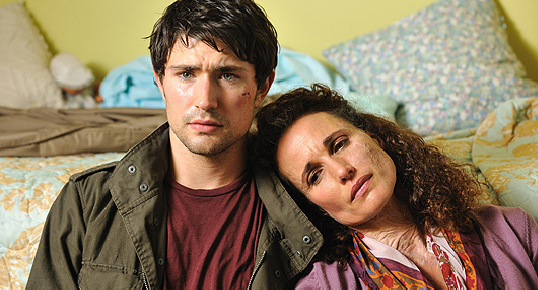
The movie offers several surprising twists, but be warned: It's violent, bloody and grotesque. First-time filmmaker Mossek managed to coral a very good cast here, and each actor delivers appropriately.  After the embarrassment of Happiness Runs, how good it is to see Andie MacDowell (above, right) is a large role and handling it well. Cary Elwes (at right, two photos above) is as commanding as he's been since the original Saw; Matt Dallas (above, left) is seething and sexy; Jess Weixler is, as usual, very fine in the small role as very ill-used neighbor; and Frank Whaley (below) all but walks away with the film as the very nasty "muscle" of the fundamentalist mob.

As Good as Dead is getting a highly limited theatrical release -- one week at NYC's Quad Cinema, starting today, Friday, October 8. Look for it very soon on DVD.

Friday, December 4, 2009

Israel Film Fest opens tomorrow in NYC with 3 fine films -- one of them a "must"

Tomorrow, Saturday, marks the opening night of the 24th Israel Film Festival -- New York venue -- as the festival actually takes place in New York City, Los Angeles, and Miami. New York plays December 5 through the 13, with Miami the following week (December 16 through the 23), with the same program for each. The Los Angeles festival, with a somewhat different program, played the west coast this past June.

Opening night is alight with stars: Elliott Gould, being presented with the 2009 IFF Lifetime Achievement Award; Paul Schrader with the 2009 IFF Achievement in Film Award; and Donald Krim , President of Kino International (a company name to delight any cinephile), with the 2009 IFF Visionary Award. TrustMovies, who is not particularly impressed with awards or celebrity, prefers to stick to the films themselves, and here, the festival looks promising indeed. The opening night feature is the Israeli box-office smash A Matter of Size, which has been nominated for 14 -- count 'em -- Ophirs (Israel's "Oscar") and also on the program is Schrader's very interesting Adam Resurrected, which received a small theatrical release in the U.S. last year and opened in Israel this year. It offers a view of the Holocaust and its aftermath that is, to put it mildly, unlike anything seen elsewhere, and I highly recommend it. (My earlier short review appears here: click and scroll down.)


Due to the simultaneous unveilings of two other festivals -- the FSLC's Spanish Cinema Now and the new In French With English Subtitles, at FIAF -- I was able only to view three films in the Israel Film Fest: one of these was interesting and certainly worth my time and the other two were simply terrific. The interesting one, ZRUVABEL (a still from which is shown above), lets us peek inside a family of Ethiopian Jews that is trying its best to make a life in Israel. Directed by Shmuel Beru -- whom, I believe, acted in another movie about Ethiopian Jews, the fine Live and Become -- the movie is a minimal-budget, hand-held affair with a big heart and a mostly smart mind. We see the casual racism of the Israeli state and how this affects various family members, as well as how fundamentalist tradition cramps their lives and prevents growth -- even as it provides respite and solace from some of the dangers present when youthful rebellion sets in. Due to the genuinely fascinating details of the lives depicted, Zrubavel holds your attention, despite a plot that grows more and more melodramatic. It's not that the characters and situations are unbelievable by any means, but the manner in which these have been assembled is, well, youthful and a bit naive. The film plays at the SVA Theater 1 on Sunday, December 6, at noon; in Theater 1 on Wed., December 9, at 5:15; and in Theater 2 on Sunday, December 13, at 9:30pm.

Better in every way is the splen-
did narrative film FOR MY FATHER (that's its German poster at left; a still from the film is below), which was nominated for seven Israeli "Ophirs, while winning two international festival awards. A movie to which the cliche "a Romeo and Juliet story" most definitely applies, it is manipulative as all get-out, yet once its situation is in place, so deftly and realistically do the director (Dror Zahavi) and writers (Ido and Jonatan Dror) work everything out, and so beautifully performed is the film, that it simply takes off into the stratosphere, leaving you moved and chastened to an almost unbearable degree.


The filmmakers set up a conundrum which both the characters and us viewers try to work out and then escape from. And because the performers, particularly the two leads (shown above), are so beautiful and persuasive, they win us over completely, as do the supporting actors -- each well cast and delivering a fine performances. Though the set-up may manipulate, the follow-through plays absolutely fair from a just, ethical and honest standpoint. That this movie honors its situation and characters so well may be its strongest point. I absolutely recommend it. For My Father screens at the SVA Theater 1 on Sunday, December 6, at 7:30; on Tuesday, December 8, in Theater 2 at 10pm; and on Saturday, December 12, it's back in Theater 1 at 7:30. If you miss all of these, there's still hope -- though, in this case, hope springs about six months from now: Distributor Film Movement will release the movie on DVD sometime in June of 2010. I'll try to cover it in more detail at that time.

Best of the three films I saw, hands down, is a documentary called THE SHAKSHUKA SYSTEM in which investigative reporter Miki Rosenthal and filmmaker Ilan Aboody lay bare an inordinate amount of detail about power, politics, money and corruption in Israel. This is an absolutely model documentary, one that a filmmaker such as Michael Moore could only observe with envy -- so rigorous and smart is it without a trace of the smart-ass and aren't-I-cuteness that Mr. Moore so often provides. Although, going into this film I had little knowledge of Israeli politics (other than that Mr. Netanyahu is back in power), I found I could follow each twist and turn quite easily. And there are plenty of these -- one more shocking and upsetting than the next. The film provoked a scandal and a lawsuit on its home turf and became the talk of the country. If you have an interest in Israel and/or documentary film-making, don't under any circumstance, miss this one. I'll have a lot more to say about it -- plus an interview with the filmmaker and the investigator -- tomorrow. The Shakshuka System (the poster is shown above) screens only twice during the festival: at the SVA Theater 2 Sunday night, December 6, at 10:15pm, and closing night, Sunday, December 13, at 7:15.