Showing posts with label Oren Rudavsky. Show all posts

Saturday, September 24, 2016

Israel/Palestine via a different, personal lens in Daum/Rudavsky's doc, THE RUINS OF LIFTA


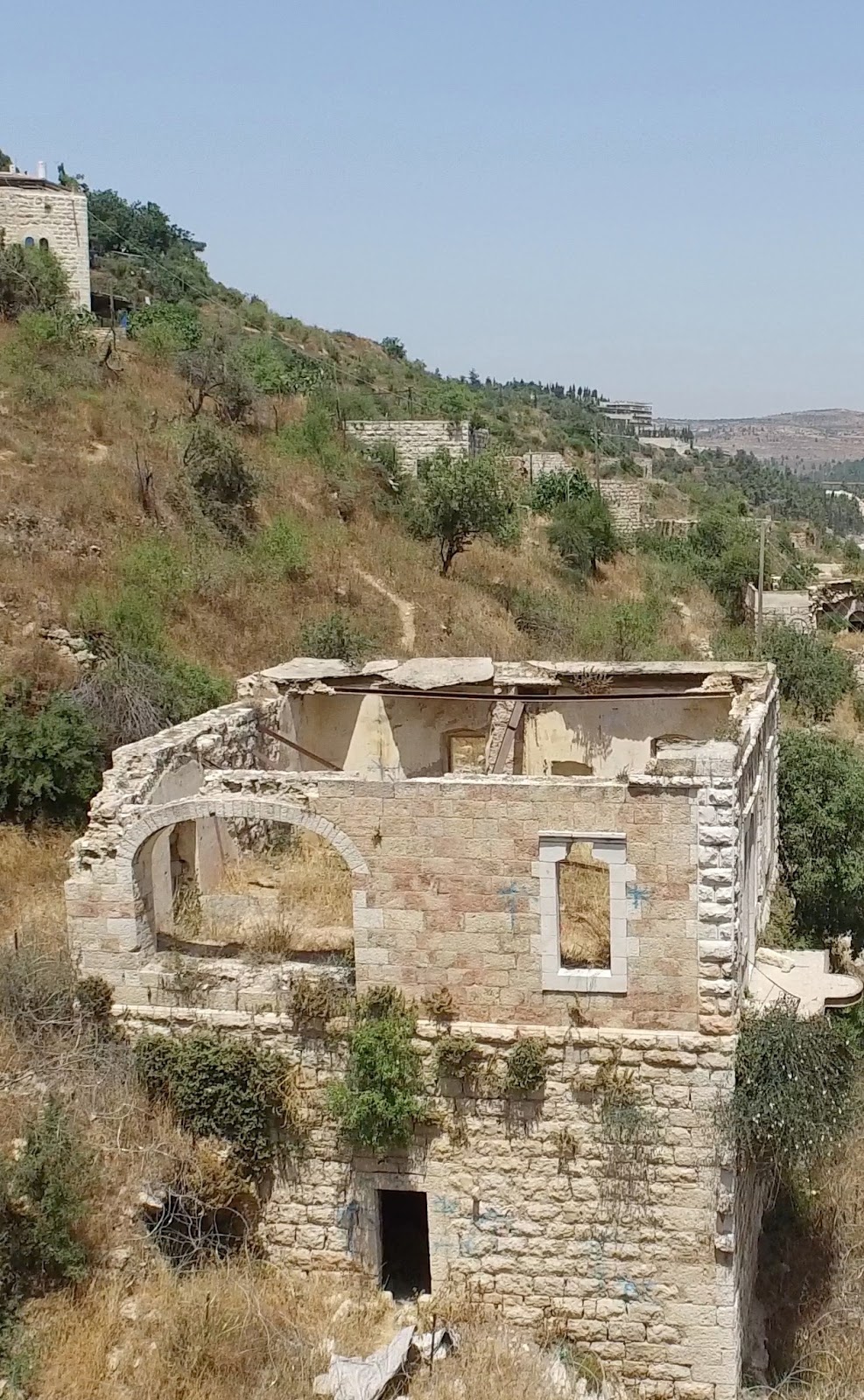
The question of land, ownership, history and all that goes with is always problematic, no matter the location. But when the location is Palestine and Israel, this subject seems very nearly intractable. Over the years there have been a number of fine documentaries and narrative films that have tried to disentangle things -- Colliding Dreams and Rabin: The Last Day are two films that have arrived already this year -- and now we have a very small and very personal little movie that tackles the issue via one single location, Lifta, the only Palestinian village abandoned during the 1948 Arab-Israel war that has not yet been destroyed or repopulated by Jews.

As conceived and directed by Menachem Daum, (shown at left on the poster, top), who appears prominently in the doc, and Oren Rudavsky (shown at right, who co-directed Colliding Dreams and, with Mr. Daum, the excellent post-Holocaust-in-Poland doc, Hiding and Seeking), the movie tracks the obsession of two men with this small abandoned village. Over the years, Mr. Daum has become increasingly concerned about Lifta because its actual story goes against much that he, as a Jew, had been taught by his elders and family about what happened there and why.

The other man, Yacoub (at right on poster, top), was a resident of Lifta who, with his family, was expelled from their home and village during the Nakba (the exodus of more than 700,000 Palestinians who were forced from or fled their homes and villages during the 1948 war).

As Mr. Daum, above, was born in a displaced persons camp in Germany to Jewish parents who had survived the Holocaust, we have a near-perfect combination of people who have suffered enormous displacement and feel powerful attachment to the same homeland. Can there be some kind of rapport and rapprochement to be made here?

Add to the mix an actual Holocaust survivor still remaining alive, an old New York woman named Dasha (shown center, above), one of the few Jewish friends of Menachem who understands his feelings about Lifta. Eventually, Dasha agrees to travel -- at her age! -- to Lifta to meet and speak with Yacoub. The resulting meeting is fraught and difficult, and seeing and hearing these thoughts and feelings pour out is rather extraordinary. Yes, this is but one example involving only two, three people, but this scene -- in fact, this entire movie, gets at the very core of the Israel/Palestine conflict.

The state of Israel is planning to turn Lifta into a real estate development for luxury housing (and not, I think, for Arabs), but protesters (above), both Arab and Israeli, are trying to save the land, with the hope of turning it into a UNESCO World Heritage site. But this would depend on approval by the Israeli government. We watch as meetings toward this goal take place, and we see Mr Daum interview various officials and citizens about the project. -- which is no shoo-in, for sure.

Don't look for resolution. There is none here. But we understand, more deeply and fully, the ideas and feelings on both sides. So we've come a step closer, at least, in this -- one of the smallest and most personal of the many Israeli/Palestinian documentaries to have been released. Also one of the most successful.

Distributed by First Run Features and lasting only 73 minutes -- the movie needs no more time to make its points -- The Ruins of Lifta opened at a single New York screen (the Lincoln Plaza Cinema) yesterday, September 23, and will arrive next month on October 28 in Los Angeles at Laemmle's Town Center 5.

Elsewhere? Nothing yet. But click here to keep up with any further scheduled playdates, cities and theaters.


New York City 
personal appearances! 

On Saturday: 
a Q&A after the 
7:15 & 9:20 pm screenings, 
with the Co-director, Oren Rudavsky, 

and on Sunday: a Q&A 
after the 3:00 pm & 5:05 pm screenings 
with Co-directors Oren Rudavsky & Menachem Daum 


Tuesday, March 1, 2016

The stories of Israel & Palestine converge in Dorman & Rudavsky's exceptional doc, COLLIDING DREAMS


One of the most memorable documentaries TrustMovies has seen during this new century was Joseph Dorman's wonderful Sholem Aleichem: Laughing in the Darkness from 2011, so of course his interest was immediately piqued upon learning Dorman had a new doc arriving soon. It opens this week, in fact, and if it is not the triumphal, spirited blend of history, joy, sorrow and surprise that marked the earlier film, considering the subject matter of Dorman's new work, which he co-directed with Oren Rudavsky, this should come as no surprise.

COLLIDING DREAMS tackles nothing less than one of, if not the thorniest situations in the world today: the state of the State of Israel and the (as yet) non-State of Palestine. Dorman (shown at left) and Rudavsky (below, right) very wisely approach their subject via history rather than mere opinion or some godawful, religious-nut idea that "the Bible says we belong here," and this, more than anything else, I think, is the reason for their surprising success. The filmmakers do not ignore religion, nor its place in Jewish history, but neither do they give it undue credulity. Instead they weave their generally well-
chosen history with interviews (43 of them!) with both Arabs and Jews, including artists, educators, policy-makers and a number of men-(or women)-on-the-street. What this approach accomplishes best is to allow the audience the take in a large number of important ideas along the way, mull them over, and judge for themselves how they fit into Israel and Palestine's history then and now. (This is a film you may very well want and need to see more than once.) Colliding Dreams also places Zionism -- and what it has meant along the way from its creation until today -- front and center, allowing us to learn more about the various incarnations the idea has incorporated.

The play of history, Zionism, culture, religion, land and ownership is expressed better in this film that I have elsewhere seen, and if this sounds like I am calling the movie "fair and balanced," then so be it. Yet it is more than that. Whatever our "feelings" regarding Israel and Palestine, Colliding Dreams forces us to confront ideas that run counter to our own and then deal with them.

I hope that some audiences, at least, will be willing to do this. When one interviewee, a Palestinian, notes that Zionism did indeed unite the Jews, he adds that Zionism also must be judged by its effect on the local community.

Another speaker notes, later in the doc, how most "conquered" people behave after their conquest, and how this has not held true for the Palestinians. We learn of The Balfour Decclaration, the "peaceful violence" that led to more organized Arab resistance to the Jews, Jabotinsky and early nationalism, the rise of Hitler and the consequential increase in the number of Jewish immigrants to Palestine.

By the time we get to the Six-Day War (quite a different look at this subject than we got from the recent Censored Voices), we're tightly wrapped in the usual straight-jacket dilemma: The Jews have got to have a place they can call home. But what if that home already belonged to someone else?

What Dorman and Rudavsky want most, I suspect, is for us to be able to look at things from both sides. So often here people speak of their dreams as meaning their dearest wishes. When, at the end of the film, one of the speakers -- a man who has fought and killed Arabs over the course of his life -- introduces us to his Palestinian son-n-law, he explains that it is the passage of time that is most responsible for this turn of events.

That's why history turns out to be the best guide. Look at America and its black population. Look at the growing legitimacy of the GLBT community throughout much of the western world. Look at Catholic and Protestant Ireland a half century ago and today. Time is the great healer. But will most of us -- not to mention the world itself, what with climate change upon us -- be alive to witness the evolution of Israel and Palestine? Whatever: Dorman and Rudavsky's documentary is a fine and necessary step in this process.

Colliding Dreams -- from International Film Circuit and running a lengthy but invaluable two hours and fifteen minutes -- opens this Friday, March 4, in New York City at the Lincoln Plaza Cinema and in the Los Angeles area at Laemmle's Royal and Town Center and at the Edwards' Westpark 8 in Irvine. The following Friday, March 11, it opens here in South Florida at the AMC Aventura; the Living Room Theaters, and Regal Shadowood in Boca Raton; the Movies of Delray and Movies of Lake Worth;  To view all currently scheduled playdates and theatres/cities, simply click here.