Showing posts with label Israel. Show all posts

Wednesday, September 20, 2017

Another dancer documentary, Elvira Lind's BOBBI JENE, opens in New York City


After Dancer, Restless Creature, A Ballerina's Tale, and a number of other dance-themed documentaries that TrustMovies has seen over the past few years, the newest example -- BOBBI JENE, directed by Elvira Lind -- arrives as an odd but not uninteresting addition to the genre. The movie of which it most reminds me, however, is not a documentary, but the highly detailed, psychologically astute narrative film, Polina. Interestingly, both movies are being released within a few weeks of each other via Oscilloscope Films.

Filmmaker Lind, shown at right, is clearly fascinated by Bobbi Jene Smith, an Iowa-born women who, more than a decade ago, left her home and family in the USA to go study and apprentice with Ohad Naharin, the director of Israel's famous Batsheva Dance Company, where she became one of the principal dancers and eventually a choreographer, too.

The film begins as Bobbi Jene has made the decision to leave Israel, return to the U.S. and pursue her own career as... well, it looked to me like a combination of dancer/ choreographer/ teacher. The movie details her journey toward all this, even as it gives equal time to her romantic life and sexual relationships, which involve a former connection to her teacher/mentor/lover Narahin, her current boyfriend Or Schraiber (also a dancer with Batsheva), and most bizarrely and importantly with a sack of something (flour, cement?) that she uses as a masturbatory device in her main performance piece that we see in great detail here.

Yes, Bobbi Jene, the movie and the woman (shown above, below, and on poster top), wants to be a ground-breaker and barrier-buster. And they are, to some extent, at least. But for all the shock and awe the "dancer" produces (audiences at her live performances we see do seem stunned and moved to see a nude woman reaching orgasm right in front of them), the movie itself consistently glides along the surface of things, telling and showing us what is happening without much probing.

Which raises the oft-asked question regarding certain documentaries: Would this tale have been better told as a narrative film? My answer is "yes." Because, though the characters we see are clearly "acting" for the camera (and doing an excellent job, too), this is hardly "real life." Some scenes, especially those between Bobbi Jene and Or, seem staged or at least re-created. A narrative movie might have allowed us to experience love making between the pair (rather than discretely cutting away as happens here) so we might compare what our heroine is getting from Or with what she gets from that sack she uses in her dance routine. (This may sound silly, but that sack gets the most sexual-partnering screen time of anything we see.)

Calling Bobbi Jene's routine "dance" is also a little iffy, I think. "Performance art" maybe, but I didn't see much dance here. Her act most reminded me of the work of Marina Abramović, with the sexual element even further front-and-center. This is not difficult to take, however, for Bobbi Jene has a wonderful, beautifully-sculpted body, a pretty face and flowing hair, all of which we see plenty of during the course of the doc. Her commitment to her cause certainly comes through, even if that cause seems at times more than a little one-note.

A narrative movie would also have allowed more probing into subjects that, here, are simply brought up and then laid to rest: Bobbi Jene comes from a hugely Christian, maybe even fundamentalist, family. Surely the split, even the reconciliation was filled with more drama than we experience from the documentary. Ditto the relationship with Or (shown above, left).

So far as her sensational dance piece is concerned, maybe you have to witness this in person. For all the praise and tears and accolades we see the audience heaping on her, post-show, what we actually view via the film certainly did not move me to any extreme whatsoever.

And yet Bobbi Jean's story is a fascinating one. Its combination of needs -- sexual, psychological, practical and career-wise -- makes it unusual and compelling. But the film itself, as much as any I've recently viewed (save last week's very personal and oddball family memoir Red Trees), puts me in mind of how "incomplete" even a good documentary can be.

From Oscilloscope Films, in mostly the English language, and running 95 minutes, Bobbi Jene, opens this Friday, September 22, in New York City at the Quad Cinema; on Friday, October 6, in Los Angeles at Laemmle's Royal; and on Friday, October 13, in San Diego at Media Arts Center. To view any further additions to the playdates/cities/theaters list, click here then click on SCREENINGS (or simply scroll down).

Monday, March 20, 2017

Roger Sherman & Michael Solomonov take us on a thoughtful, visually splendid gastronomic tour IN SEARCH OF ISRAELI CUISINE


Unlike some of the modern food-porn documentaries that gush over certain chefs or restaurants, together with their fabulous "presentations," the new documentary, IN SEARCH OF ISRAELI CUISINE, directed by Roger Sherman and featuring Michael Solomonov (along with a number of other fine chefs), seems much less pretentious and a veritable model of intelligent, entertaining filmmaking about food and its delights -- to be found in this case via the little country of Israel. Or perhaps I should identify it as Israel/Palestine.

Mr. Sherman (pictured at left) and Mr. Solomonov's doc never overtly brings up any two-state solution. As one chef reminds us along the way, "Food is not political." Yet, here we see and hear enough chefs with Palestinian and/or Muslim Middle-Eastern roots to quickly realize that Israeli cuisine owes as much to those roots as it does to the Jewish Ashkenazi or Sephardic cultures. All three come into play during the movie and seem to complement each other surprisingly well. Visually, the doc offers some of the most enticing shots of food preparation that TrustMovies has seen.

Solomonov (shown above, left) acts as our guide, leading us around the country of Israel, discovering restaurants and chefs aplenty. That's Mike, above, with Meir Adoni at Mizlala, sampling the chef's Kubbaneh, a Temenite Sabbath bread and below, with Palestinian chef Husam Abbas and his famous Kebab El Babour, for which his restaurant in Umm Al-Fahm is named.

We discover a cheesemaker, below, and learn some interesting tricks of his trade, as well as meeting journalists who've covered the Israeli cuisine scene for some time. We spend a Shabbat evening with a cook and her family, and learn (if we didn't already know this) that most of the citizens of Israel are more secular than religious. Yet the Orthodox sect still exerts huge control over the country, forcing a city such as Jerusalem to close all its shops on the Sabbath.

We learn some history of Mr. Solomonov and his family -- including a brother killed in service of his country shortly before his military term would have ended -- and some history of Israel and its immigrants pertaining to food and culture and why Israeli cuisine was for so many years considered inferior. Explaining how and why this changed is part of the film's mission.

Changed it has, and the many different dishes and meals we see prepared and sampled should make a convert out of you, as it did me. Everything from street food to the selections in some of the famed restaurants look as enticing as food can get. Yet it's all hands-on, no-nonsense cuisine, made with mostly, usually only, local produce.

We learn of the tension between the Ashkenazi and Sephardic sects and how the old-time Ashkenazi cooking -- "cold, boring and guilt-ridden," as one woman puts it, is becoming more vibrant and inclusive.

The movie is also a kind of travelogue, taking us to city after city in all parts of this tiny country. (That's Michael, above, with a seafood maven known as Uri Buri.) From tiny villages to Tel Aviv, we see it all.

We learn how, below, irrigating using salt water makes cherry tomatoes even sweeter (sometimes too sweet), and we discover the Nabatian culture, including its dormant-for-centuries wine industry, and how wine production is flourishing once again. (Our guide explains to us that he is not a drinker, and the reason he gives becomes the documentary's funniest line.)

Full of interesting ideas, scrumptious visuals and a lovely multiculturalism, In Search of Israeli Cuisine should prove a simultaneous treat for foodies, history buffs, and travel lovers. The movie, from Menemsha Films and running 94 minutes, opens this Friday, March 24, in New York City at the Angelika Film Center and the Lincoln Plaza Cinema. The following Friday, March 31, it hits Los Angeles (at Laemmle's Royal and Town Center) and a few other cities. Here in South Florida the film will open on Friday, May 5, in Miami Beach at the O Cinema, in Tamarac at The Last Picture Show, and in Boca Raton at the Living Room Theaters. Elsewhere? Yes, so click here and scroll down to see all currently scheduled playdates, cities and theaters.

Wednesday, March 1, 2017

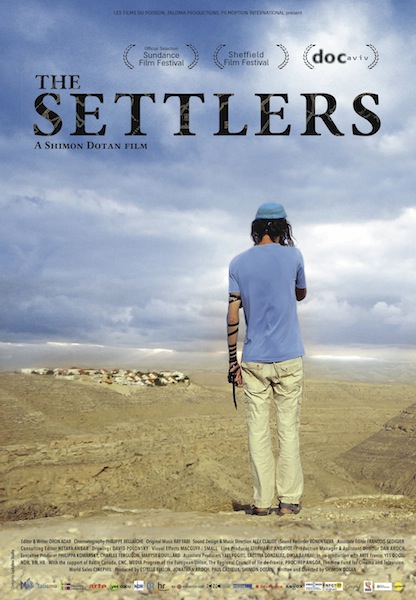
At NYC's Film Forum: the state of Israel now via Shimon Dotan's unsettling THE SETTLERS, and a look at what might have been in Yariv Mozer's must-see BEN-GURION, EPILOGUE


If you haven't yet had your fill of Israeli documentaries (or even if you think you have), the pair that opens this week at Film Forum in New York City are important ones. Both are smart and entertaining but go well beyond that to provide a look at Israel's present state, together with its lost and, it would seem, increasingly irretrievable past. Shimon Dotan's THE SETTLERS, more than any recent documentary or narrative film from Israel that I've seen, makes clear the utter intractability of the current situation, as well as the idea of any kind of peaceful arrangement between Israel and a "state" of Palestine as very nearly impossible.

Mr. Dotan, shown at right, makes it immediately clear that many of the "settlers" -- those Israelis who have built homes in the territories occupied (or "held," as the legal term in Israel would have it) during the period since the Six-Day War of 1967 -- do not approve of this name for themselves. "A settler is someone who lives on land that is not his," one of them explains, and it soon becomes clear that these people believe they have an absolute right -- via prophecy, religion, a divine calling, whatever -- to not just this particular land, but as one young man would have it, any land, "as far as we can see," here in the middle east.

I am guessing that the testimony Dotan draws from the settlers he has interviewed is fairly typical of the feelings of many if not most of them. Only one in the bunch appears not to have a sense of absolute entitlement and expansionist aims. Though in defiance of the Geneva Convention and barely even quasi-legal by Israeli standards, these settlements have grown immensely over time in number and quantity of population within.

According to the film, even the single time that the government cracked down on the settlements and appeared to dismantle certain of them was more of a public relations maneuver to make it appear that the government was offering something up to the Palestinian side. And while no new "settlements" have appeared in some time, there has been plenty of expansion of those already here. In any case, who needs new settlements, when the current and newer name coined for expansion is the "outpost?" We see a number of these outposts in action.

The movie, in its wide-reaching arc, interviews the settlers and gives us some history of the settlements, includes the views of Israeli scholars and legal experts (but only a very few Palestinians), and gives us quite a lot to consider regarding history, Jewish law vs democracy, land and its occupation, and religion and its discontents. Notes one scholar with some irony, "The messianic drive grows stronger when the prophecy fails."

As one interviewee puts it, "The sewage of European nationalism is being piped into the core of Judaism." And it must be said that most of the settlers whom we hear come across as entitled, ugly extremists. The first Jewish baby born in Hebron gives them, in their view, the right to this city. We also learn of the "three mayors" whom the settlers decided were "terrorist leaders." The facts, opinions and history here all build toward a conclusion that to some, like me, will seem horrifying and stupid. Others will no doubt see this as a glorious sign of god's will. Good luck to us all.

To view the companion documentary, BEN-GURION, EPILOGUE, and to listen to the words of its subject, David Ben-Gurion -- the primary founder and first Prime Minister of the state of Israel -- is rather like turning the page from the awful current state of this little country and discovering a time of such hope and possibility that should make you wonder at the prospects that were present, and then despair at what has been lost or destroyed over the decades since then.

At the time of Israel's creation and during the decade or so afterward, TrustMovies was young enough not to have had much of social or political conscience. (He knew slavery was wrong, of course, but that was about the extent of it.) So the character and views of Ben-Gurion were completely new to him as he watched this documentary, culled from a six-hour interview (that was never seen nor heard) with the late Prime Minister (when Ben-Gurion was 82 and retired from politics) by a British journalist/filmmaker Clinton Bailey. shown below, left, during the interview.

Even the sound track to the interview had been lost for decades and was only recently found and put together with the visuals. The six hours were then distilled to around 70 minutes by filmmaker/editor by Yariv Mozer (shown two photos above), who also directed Snails in the Rain), and the result is one of the most thoughtful, surprising, and finally moving and edifying docs concerning Israel that I've yet seen.

What a man this Ben-Gurion was! We learn of his history; his marriage; his wife, Paula and her love for the ideas of Emma Goldman; and his own ideas and his hopes for this then-new country. What he tells us makes such wonderful and obvious sense, and hearing it now, against what we see and hear in The Settlers, adds up to a sad and mournful eulogy to what might have been. I would love to add "and still might be." But I really don't believe this is any longer possible.

In any case, here Ben-Gurion is, standing on his head in competition with Yehudi Menuhin, talking about Moses and a nation of higher virtues, in a TV interview with Ed Murrow and Burma's U Nu, and with Ray Charles, as the latter sings and plays piano. To hear him and his Palestinian counterpart speak of the possibilities for peace will bring salty tears to your tired eyes.  As a certain Dr. Feldenkrais notes along the way, "Will power is what you need when you don't want to do what you need to do. Ben Gurion doesn't work on will power. He likes what he does."  You must experience this remarkable documentary.

The Settlers (released by Bond/360 and running 108 minutes) and Ben-Gurion, Epilogue (released by Go2 Films and running 70 minutes)  will be showing at New York City's Film Forum, beginning Friday, March 3. Unfortunately, each requires separate admission. They're both wonderful, but the Ben-Gurion's a fucking knockout. To view further playdates, cities and theaters for The Settlers click here. I can't find any info on further screenings of the Ben-Gurion doc, but feel free to reach out to the distributor for information.

Tuesday, March 1, 2016

The stories of Israel & Palestine converge in Dorman & Rudavsky's exceptional doc, COLLIDING DREAMS


One of the most memorable documentaries TrustMovies has seen during this new century was Joseph Dorman's wonderful Sholem Aleichem: Laughing in the Darkness from 2011, so of course his interest was immediately piqued upon learning Dorman had a new doc arriving soon. It opens this week, in fact, and if it is not the triumphal, spirited blend of history, joy, sorrow and surprise that marked the earlier film, considering the subject matter of Dorman's new work, which he co-directed with Oren Rudavsky, this should come as no surprise.

COLLIDING DREAMS tackles nothing less than one of, if not the thorniest situations in the world today: the state of the State of Israel and the (as yet) non-State of Palestine. Dorman (shown at left) and Rudavsky (below, right) very wisely approach their subject via history rather than mere opinion or some godawful, religious-nut idea that "the Bible says we belong here," and this, more than anything else, I think, is the reason for their surprising success. The filmmakers do not ignore religion, nor its place in Jewish history, but neither do they give it undue credulity. Instead they weave their generally well-
chosen history with interviews (43 of them!) with both Arabs and Jews, including artists, educators, policy-makers and a number of men-(or women)-on-the-street. What this approach accomplishes best is to allow the audience the take in a large number of important ideas along the way, mull them over, and judge for themselves how they fit into Israel and Palestine's history then and now. (This is a film you may very well want and need to see more than once.) Colliding Dreams also places Zionism -- and what it has meant along the way from its creation until today -- front and center, allowing us to learn more about the various incarnations the idea has incorporated.

The play of history, Zionism, culture, religion, land and ownership is expressed better in this film that I have elsewhere seen, and if this sounds like I am calling the movie "fair and balanced," then so be it. Yet it is more than that. Whatever our "feelings" regarding Israel and Palestine, Colliding Dreams forces us to confront ideas that run counter to our own and then deal with them.

I hope that some audiences, at least, will be willing to do this. When one interviewee, a Palestinian, notes that Zionism did indeed unite the Jews, he adds that Zionism also must be judged by its effect on the local community.

Another speaker notes, later in the doc, how most "conquered" people behave after their conquest, and how this has not held true for the Palestinians. We learn of The Balfour Decclaration, the "peaceful violence" that led to more organized Arab resistance to the Jews, Jabotinsky and early nationalism, the rise of Hitler and the consequential increase in the number of Jewish immigrants to Palestine.

By the time we get to the Six-Day War (quite a different look at this subject than we got from the recent Censored Voices), we're tightly wrapped in the usual straight-jacket dilemma: The Jews have got to have a place they can call home. But what if that home already belonged to someone else?

What Dorman and Rudavsky want most, I suspect, is for us to be able to look at things from both sides. So often here people speak of their dreams as meaning their dearest wishes. When, at the end of the film, one of the speakers -- a man who has fought and killed Arabs over the course of his life -- introduces us to his Palestinian son-n-law, he explains that it is the passage of time that is most responsible for this turn of events.

That's why history turns out to be the best guide. Look at America and its black population. Look at the growing legitimacy of the GLBT community throughout much of the western world. Look at Catholic and Protestant Ireland a half century ago and today. Time is the great healer. But will most of us -- not to mention the world itself, what with climate change upon us -- be alive to witness the evolution of Israel and Palestine? Whatever: Dorman and Rudavsky's documentary is a fine and necessary step in this process.

Colliding Dreams -- from International Film Circuit and running a lengthy but invaluable two hours and fifteen minutes -- opens this Friday, March 4, in New York City at the Lincoln Plaza Cinema and in the Los Angeles area at Laemmle's Royal and Town Center and at the Edwards' Westpark 8 in Irvine. The following Friday, March 11, it opens here in South Florida at the AMC Aventura; the Living Room Theaters, and Regal Shadowood in Boca Raton; the Movies of Delray and Movies of Lake Worth;  To view all currently scheduled playdates and theatres/cities, simply click here.

Friday, March 1, 2013

Kitsch transformed (maybe transcended): Roberta Grossman's docu, HAVA NAGILA

Not being Jewish (although he married a Jew, and hence has a Jewish daughter and Jewish grandkids, and has now also lived with his male Jewish companion for nearly a quarter century), TrustMovies has long considered that old standard (as we used to call 'em) Hava Nagila as one of the things that utterly defines kitsch. Played at every Jewish wedding and Bar or Bat Mitzvah that he's attended over the years, the song immediately calls to mind every Jewish cliché ever seen, spoken or thought. (Fiddler on the Roof, for me, produces the same kitschy feeling. Rags, I believe, is by far the better musical.) Well, some people simply revel in cliché (and call it tradition). Yet it may not only be those people who cotton to the new documentary -- HAVA NAGILA (THE MOVIE) -- which is all about the history and provenance of this fabled song.

The director, Roberta Grossman (shown at right) and writer, Sophie Sartain, have their tongues in cheek from the start. They understand what they're dealing with (they even includes a section involving folk who hate the song, and there plenty of these -- Jews and non-Jews alike). After getting an interesting opinion from one of their talking heads that they feel a need to counter, they explains that "We'll have to ask someone else." The next interviewee is identified simply as Someone Else. (This sort of thing could get kitschy, too, but the filmmakers don't overdo it.)

Our little song, it turns out, began a couple of centuries ago in the Ukraine, and has -- as the writer & director put it -- now made the journey from Ukraine to YouTube. The music preceded the lyrics by quite some time; in fact, exactly who wrote those lyrics is in dispute. (Grossman/Sartain give us both sides of the dispute -- it's fascinating, all right -- and they seem to feel we should maybe allow room for both in our final judgment.)

In a section called Hava Meets Hora, we see how and why dance is inextricably connected to the song. We also learn how and when Hava emigrated from Eastern Europe to Palestine, as well as its important usage during the creation of the state of Israel.

When the celebs start appearing -- Leonard Nimoy, Harry Belafonte, Danny Kaye, Glen Campbell, Connie Francis, the Klezmatics, Regina Spektor -- if you weren't hooked already, you soon will be.  Listening to Belafonte (below), in particular, talk about what the song means to him (then seeing him sing it with Kaye) goes a long way toward kitsch-reduction.

This is a lightweight movie, for sure, but in its scope and reach (albeit on a much less intellectual level), it does for Hava Nagila, something on the order of what Joseph Dorman's recent and wonderful documentary did for Sholem Aleichem. It gives us history served up as genuine entertainment, as well as yet another enjoyable walk down memory lane.

I'll probably never again attend a Jewish event at which the song is played that this little movie -- and what I learned from it -- doesn't immediately pop up in my mind and put a smile on my face. Thank you, Ms Grossman and Ms Sartain.

Hava Nagila (The Movie), running just 73 minutes, opens today, Friday, March 1, in New York City at the Lincoln Plaza Cinema and on March 15, will hit the Los Angeles area at Laemmle's Royal, Noho 7, Town Center 5, Playhouse 7 -- and Orange Country, too.