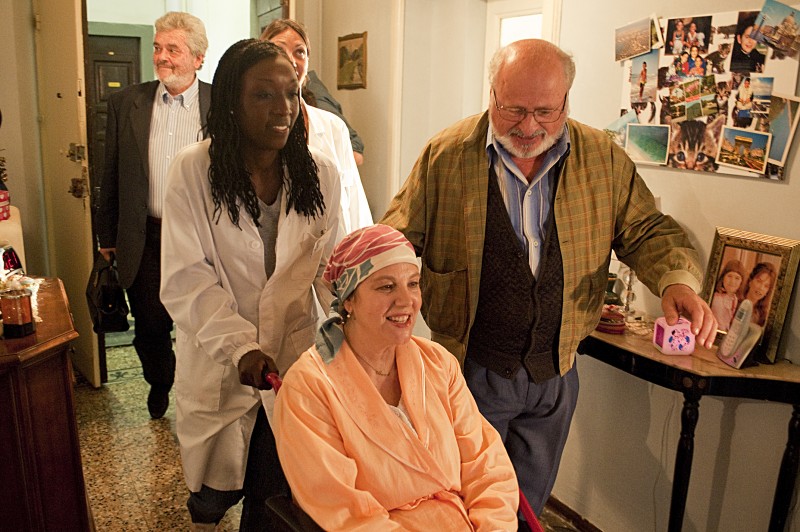
Showing posts with label Paolo Virzi. Show all posts

Monday, May 1, 2017

LIKE CRAZY: Paolo Virzi's latest comedy/ drama is his best ever (that's going some!)


The film of the year, so far, LIKE CRAZY (La pazza gioia, and not to be confused with the Anton Yelchin/Felicity Jones rom-com from 2011) arrives via that grand Italian master of the off-kilter family dram-com, Paolo Virzi, who has already given us a quintet of terrific movies: My Name Is Tonino, Caterina in the Big City, The First Beautiful Thing, Every Blessed Day, and Human Capital. His latest is his best. And that, movie lovers, is saying something.

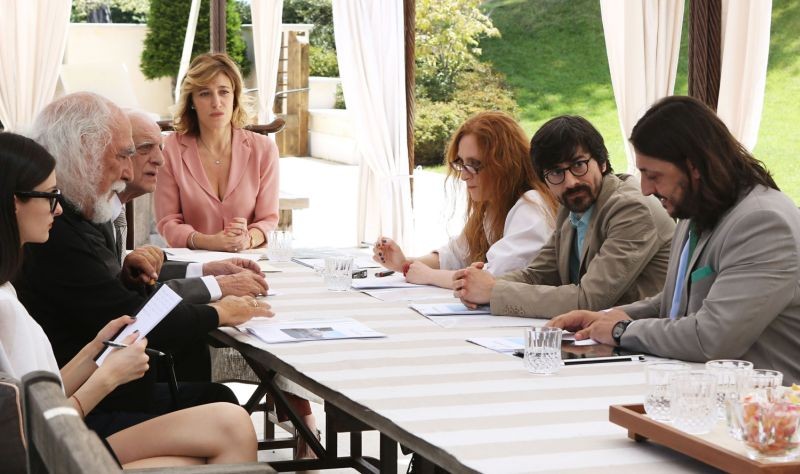
Virzi's film (the director/co-writer is shown at right) follows the adventures of a pair of unusual women, both of whom are inmates of a highly progressive psychiatric clinic in a beautiful mountain region in Italy. How we meet them and how they meet each other and slowly bond make up the initial portion of the film. One day, after their work detail is finished but their bus back to the clinic has not arrived, the two board public transportation and then set off for some off-the-books fun.

The remainder of the movie tracks their movements -- and those of their care-takers -- as the women try to reconnect with their former lives, and we, via the very ingeniously inserted flashbacks, fantasies and delightful dialog, learn more and more about exactly who these two really are.

As played by two of Italy's finest actresses, Valeria Bruni Tedeschi (above, right, and only recently seen in the dreadful Slack Bay) and Micaela Ramazzotti (above, left, of The First Beautiful Thing), these women will eventually become two of the most memorable characters you'll have cared for on screen. Ms Tedeschi is a whirlwind of motor-mouth amazement as the lady who may (or may not) have links to Italy's power crowd, while Ms Ramazzotti plays the poor, sad but resilient mother of a child who has been taken from her, for reasons we eventually discover.

How both stories and characters play out give these wonderful actresses the opportunity to demonstrate just how very good they are, and both come through with terrific, in-the-moment performances that are simply amazing in their depth, breadth and detail.

What Virzi and his co-writer, Francesca Archibugi, bring to the party is a splendid mix of liveliness and incident that never once flags. You'll have a hard time recalling another movie with as high an energy level as this one put to such smart and delicious use.

The amazing thing is, that amidst all this energy and humor and life being lived at the edge, the movie and its two characters keep deepening until, by the finale, we are moved something fierce. And while TrustMovies often pooh-poohs the use of coincidence in films, the very big one Virzi hands us in his penultimate scene at the beach seems so right and so somehow earned that you may shed those tears as copiously as you need without experiencing a trace of guilt.

Like Crazy -- a title that's ironic, just and true -- is one of those crowd-pleasers that will rope in critics and the art house crowd alike. It's a marvel of a movie that has already walked away with five David Di Donatello awards (Italy's Oscars) and, if that country has the good sense to submit it for our Best Foreign Language Film category, it may walk away with that prize, too.

In the recent British delight, Their Finest, one character explains that the big difference between life and movies is that life really has no purpose, while movies are able to take life and then give it that. Like Crazy, just like Their Finest, puts this theory into magical, meaningful practice.

From Strand Releasing, in Italian with English subtitles and running just under two hours, the film opens this Friday, May 5, in New York City (at the IFC Center and Lincoln Plaza Cinemas) and in Los Angeles on Friday, May 12, at Laemmle's Royal and Playhouse 7.

Here in South Florida it will open on Friday, May 19, all over the place: in Miami at the Coral Gables Art Cinema, in Fort Lauderdale at the Savor Cinema, at the Cinema Paradiso in Hollywood and at the Living Room Theater in Boca Raton. In the weeks to come Like Crazy will hit another eight or ten theaters across the country. Click here and then click on Screenings to view all currently scheduled playdates, cities and theaters.

Thursday, January 8, 2015

Italy's submission for the BFLF Oscar: Paolo Virzi's slick and engaging HUMAN CAPITAL


A terrific comic melodrama about the way we live now, Italian style, HUMAN CAPITAL continues the reign of Paolo Virzi as one of, if not the Italian master at capturing his country's life in all its complexities, humor and sadness. This multi award-winning filmmaker has here co-adapted the screenplay (based on the novel by Stephen Amidon) and directed this sleek and highly entertaining tale of Italy's very rich and those who aspire to that class. In the process Virzi looks at the wealthy, the bourgeoisie, and the underclass and the ways in which they connect and bounce off each other -- sometimes comically, at other times violently, and always somehow thoughtlessly, as each strives to "succeed."

Signore Virzi (shown at left) -- whose films, from My Name Is Tanino and Caterina in the Big City to The First Beautiful Thing and Every Blessed Day, have given me immense pleasure over the past decade or so -- comes through again with another good one. If I call Human Capital a melodrama, I mean no disrespect, for a very good melodrama is a rare thing these days, and this proves a fine and comic one, as it dissects class and wealth, attitudes and actions that lead to (and from) the hit-and-run accident that begins this stylish and engaging film. Once we see that initial accident, Virzi circles back to show us -- from several viewpoints -- what has happened and why. Each perspective from which we view things gives us greater scope and understanding, until all the pieces of the mystery at last connect.

The characters here include a wealthy family -- husband (Fabrizio Gifuni, above, right), wife (Valeria Bruni-Tedeschi, above, left) and spoiled son -- and the very middle-class family, the daughter of which happens to be the girlfriend of the rich son.

That bourgeois dad, played with magnificent cluelessness by Fabrizio Bentivoglio (above, left) -- his wife (Valeria Golino, above, right) proves much more stable and intelligent  -- pushes himself into being allowed to invest in one of the wealthy husband's latest schemes (a talent for tennis provides his entryway), and we're off to the races.

The movie's pivotal event is an awards dinner to honor one of the students (the rich man's son is in the running), at which the victim of the accident -- an immigrant waiter (shown in background, above) -- happens to be working. One of the movie's great pleasures comes from the fact that the more we learn, the more things change from what we'd first imagined.

The movie takes some clever and interesting side trips, too, the best being the rich wife's involvement with a soon-to-be-torn-down theater that she decides to "champion," using her husband's money (of course), gathering together a fancy Board of Directors (above, in one of the film's most caustic scenes), and then getting sexually involved with one of the board members (Luigi Lo Cascio, below, right).

The theater surfaces later in a crackpot blackmail scheme, as the finale races toward us and the involvement of the bourgeois daughter (Matilde Gioli, below, right, with Giovanni Anzaldo, who, along with that hit-and-run waiter, represents the lower classes) becomes more central. I do wish the filmmaker had not resorted to the by-now old-hat routine of someone reading someone else's email (this is the modern version of Downton Abbey's surreptitiously overheard conversations). But then, that's one of the things that separates drama from melodrama.

Overall, however, Human Capital proves a feisty, lusty look at Italy under the economic gun, struggling to "achieve," no matter what the cost. (We learn, during the end credits, exactly to what the movie's title refers.)

From Film Movement, in Italian with English subtitles, and running 110 minutes, the movie opens this coming Wednesday, January 14, in New York City at Film Forum and in Los Angeles on Friday, January 16, at the Sundance Sunset Cinema. You can view all currently playdates, with cities and theaters listed, by clicking here and scrolling down.

Saturday, May 25, 2013

Open Roads 2013: Paolo Virzi's up-to-the-minute love story, EVERY BLESSED DAY


Think of the couple -- Antonia and Guido -- that grounds this oddball and very welcome new film in "movie" terms: They are little independents trying somehow to work with and fit into the big, wide main-stream world. That is their challenge and it is also what defines the new film -- EVERY BLESSED DAY (Tutti i santi giorni) -- from the popular Italian filmmaker Paolo Virzi, below, who earlier gave is the wonderful My Name Is ToninioCaterina in the Big City and more recently The First Beautiful Thing.  "Family" is Virzi's thing, in all its wonder and strangeness, hope and disarray, and in his newest movie, though we see a bit of the large, extended family, mostly it is these two main characters (who hope to create their own family) that we come to know best.

Know them we do, in all their quirks and charm, pain and anger, and we root for them something fierce, even while understanding that the road ahead (just as was the road behind) will hardly be an easy one. In his new film, Signore Virzi is dealing with our current economic times, as well as with relationships and family, and this gives his movie an added boost of reality (and difficulty). His two characters are both working well below their level and capacity, and yet are (at least in his case) grateful to have the job at hand.

As his two leading actors, Virzi has chosen (or maybe is simply very lucky to have) a couple of actors who could hardly be better: Luca Marinelli (above, right, of The Solitude of Prime Numbers and this year's Nina) and Federica Victoria Caiozzo (above, left, a composer/musician and now actress who most often goes by the name of Thony).

Marinelli (above) is a riveting presence, all the more so because he never seems to try for this. A rather goofy looking fellow, he is also incredibly "hot" sexually and intellectually -- again, because he never pushes. His Guido is a one-of-a-kind guy who experiences something like love-at-first-sight when he sees Thony's Antonia perform.

For her part, the actress, above, embodies the spirit of upheaval and protest, even if the thing she is perhaps most protesting is herself. Despite all the love given her by her man, the woman can't escape her own demons. Thony wrote the music for the film, and this works just as well as does everything else.

Finally, Virzi has created a wonderful modern-day love story that begins with a ravishingly beautiful view of the eternal city and ends with a scene and a film technique that, though it's been done before, may never have seemed quite as moving and humorous as it does here.

Every Blessed Day (102 minutes) will be shown at Open Roads as the opening night attraction, Thursday, June 6, at 6:30 at the Walter Reade Theater, and once more on Tuesday, June 11 at 9pm at the Elinor Bunin Munroe Film Center.  Click here to seethe entire Open Roads program.

Monday, April 11, 2011

Family film, Italian style: Paolo Virzi's THE FIRST BEAUTIFUL THING opens in NYC; short Q&A with the director/co-writer

The more I see of modern Italian movies (and this is most probably true of the old ones, too), family seems front and center -- the single most important thing in the world.  Now, a case could be made for films from many other countries offering this view, too, but does anyone do "family" with more feeling, humor, and & all-round importance than the Italians?  I ask this, having seen for the second time one of the best of the films from this year's FSLC Open Roads: THE FIRST BEAUTIFUL THING (La prima cosa bella) directed and co-written by Paolo Virzi. In it, family takes a licking but comes on strong: kicking, screaming, screwing, withdrawing, laughing, and loving beyond all measure.

This is a "then and now" movie, as a middle-aged man is drawn back to his dying mother and his sister and so begins to relive "old times."  If a sense of  déjà vu is already descending, trust me -- you won't have seen a movie quite like this. Signore Virzi (shown at right) understands that, in our lives, there are few out-and-out villains. Peo-ple simply try their best -- however dumb, funny, wrong or sad they end up being.  One of the delights of this filmmaker is that he never pushes an agenda; he just lays out character and situation and lets these come up with events that, if singled out, might seem crazy, but as shown here are just part of the "family scene."

He also offers that quintessentially Italian idea that, no matter what happens, there's a way around or through it. The woman at the center of all this, Anna Nigiotti -- played by the Italy's Best Actress-winner Micaela Ramazzotti (above) as her younger incarnation, and by Stefania Sandrelli (seated, center, below) in later years. Together, this succulent combination of Italian womanhood makes up one of those memorable characters that will stick with you forever.

A ball of fire who protects her children come what may (below: a happy little girl and a near-consistently angry little boy--who grows up to be the film's "hero"), mom barrels through life, knocking senseless conventionality, sexuality, religion, medicine, psychiatry, and most of the men around her in the quest for a life for herself and her kids. Why she must do this -- and how -- makes for the one of the most enjoyable, moving movies of the year, the kind you want to share with everyone you love.

That "hero," by the way is played by Italian everyman Valerio Mastandrea (above left), whose performance won him Italy's Best Actor award.

In a year of extraordinarily good Italian films, this one was Italy's choice to represent it in this year's Oscar sweeps for Best Foreign Language Film.  Along with a bunch of other wonderful films from around the world that didn't even make the Academy's shortlist, Virzi's, at least, is getting a U.S. release -- via Palisades Tartan. The film opens this Friday, April 15, in New York City at the Angelika Film Center.  Be there, and scoop up a bowl of extended family, the likes of which you won't have experience in a movie theater in quite some time.
*************

I am sorry that Signore Virzi -- whom I met briefly some years back, when his Caterina in the Big City made its Open Roads debut -- will not be here for his new film's opening. But thanks to his PR rep Susan Senk, I was able to ask him, via email, a few questions about his movie, Italy, family, current times -- and even the Mafia. Here is our conversation, below, with TrustMovies in bold and Paolo Virzi in standard type

Ciao, Paolo—
I have only seen three of your films (My Name in Tannino, Caterina in the Big City, and now The First Beautiful Thing) but these are enough to make you one of my favorite directors -- I think for your ability at invention and for the humanity you allow to fall on all your characters.

Paolo Virzì: Thank you, this is very kind of you. I hope I will not disappoint you with my next films.

I doubt that. When I interviewed Silvio Orlando a couple of years back, the world was in the midst of the big financial crisis (actually, it pretty much still is, right?). Orlando told me that it did not seem to have hit Italy as badly as other countries, and when I asked him why, he told me he felt it was because of how highly Italians value family. That family must always come first. And if so, this would allow Italians to rally more strongly. This has stuck with me ever since then, and I wonder how you feel about Orlando’s statements.

Family in Italy is probably the strongest social shock-absorber and at the same time it is the offspring of many of our cultural weaknesses. Right now we have a very high unemployment rate among young people, but it's impossible here to imagine a social riot of the new generations like the ones we are witnessing in Maghreb. There are families: fathers, mothers, grandparents to protect sons and grandsons. Family seems to be at the same time our big strength and our sickness. A sort of our social pain reliever with the side effect of sedating and frustrating our new generations.

In your films family is very important, but it is often a rather strange or different or extended version of family that we see and come to love. This is so true with your latest film. One of my favorite scenes is the one in which the little boy follows the man who has been making love to his mother out from the basement of the store – only to discover that it is his estranged father. This speak volumes, I think, about the odd twists and turns that love and sex and family can take.

That's an interesting question. I come from a traditional lower-middle-class italian family, but I don't think my films convey an idyllic idea of the Family. For instance both in my last film and in "Caterina" there are troublemaking and immature fathers, and a kind of peace seems to be possible when they die or disappear.

If family loyalty is the most important, pivotal point for Italians, I wonder how something like the Mafia plays into this? I would imagine a connection here: family, loyalty, and the like. I cannot image the Mafia or the Camorra taking hold so firmly in any other country. Do you have any thoughts on this? (Or maybe I am really “barking up the wrong tree,” as we say….)

Tons of thoughts, that would required a whole book. You are probably barking the right tree. Our main sickness as the young nation we are is what sociologists call amoral familism. But there are other serious questions: Who have determined the mafia phenomenon, which in fact exists also in Russia, in China, in South America....

And is there anything else you’d like to talk about that I have not brought up – and which journalists never seem to ask you, but you always wish they would?

No, no. I'm pretty satisfied of your interesting and unusual questions. Thank you very much.

Thank you – and keep ‘em coming -- your films, I mean!

(All photos are from the film itself, with the 
exception of that of the director, above.)

Friday, June 11, 2010

OPEN ROADS winds down, final Italian films debut: THE FIRST BEAUTIFUL THING and ONE LIFE, MAYBE TWO

Italy's Best Actress, Micaela Ramazzotti, in The First Beautiful Thing

Another week of wonderful new Italian films has ended. How are we going to do without them for the next 11-1/2 months? This past Open Roads festival of new Italian films was, overall, the best I've seen in the ten years that the FSLC has been hosting the increas-
ingly popular series. A down economy? You'd never know it from the attendance at the Walter Reade theater during the last eight days.

Best Actor, Valerio Mastandrea, left, and Stefania Sandrelli, as mom, 
in Paolo Virzi's The First Beautiful Thing

This year's films seemed as bright and buoyant (though, with one exception, never flighty nor ridiculous) as last year's were dark. And the final two movies that I saw were among the best of them all: Paolo's Virzi's THE FIRST BEAUTIFUL THING (La prima cosa bella), shown in the two photos above, and Alessandro Aronadio's ONE LIFE, MAYBE TWO (Due vite per caso), shown in the photos below. 

Lorenzo Balducci, above and below, right, plays the lead role -- twice-- 
in Alessandro Aronadio's One Life, Maybe Two

The latter is one of those "What if things had happened differently?" movies and one of the best of its kind I've seen -- not content to simply give us two different scenarios but instead builds these around and into the question of how human character is formed. The former, from the filmmaker who gave us Caterina in the Big City is a superlative example of Italian family drama/comedy/history/romance -- in fact, the best film of this year's lot, eclipsing by a bit even the movie that won this year's Best Picture Dontatello.

Imagine having to choose among films as great -- and varied -- as Baarìa, The First Beautiful Thing, Loose Canons, The Man Who Will Come and Vincere -- all of which I'm lucky enough to have seen, and any one of which is better than the ten films our own Academy nominated this past year (except, I think, A Serious Man). Don't try to tell me that Italy is not once again at -- or very near -- the top of its film-making game.

You can find my final two reviews of the films above at the original Open Roads post here.  Click and scroll down to each (they're arranged alphabetically by English title).