Showing posts with label wealth. Show all posts

Saturday, July 28, 2018

Lauren Greenfield's documentary, GENERATION WEALTH, opens in South Florida


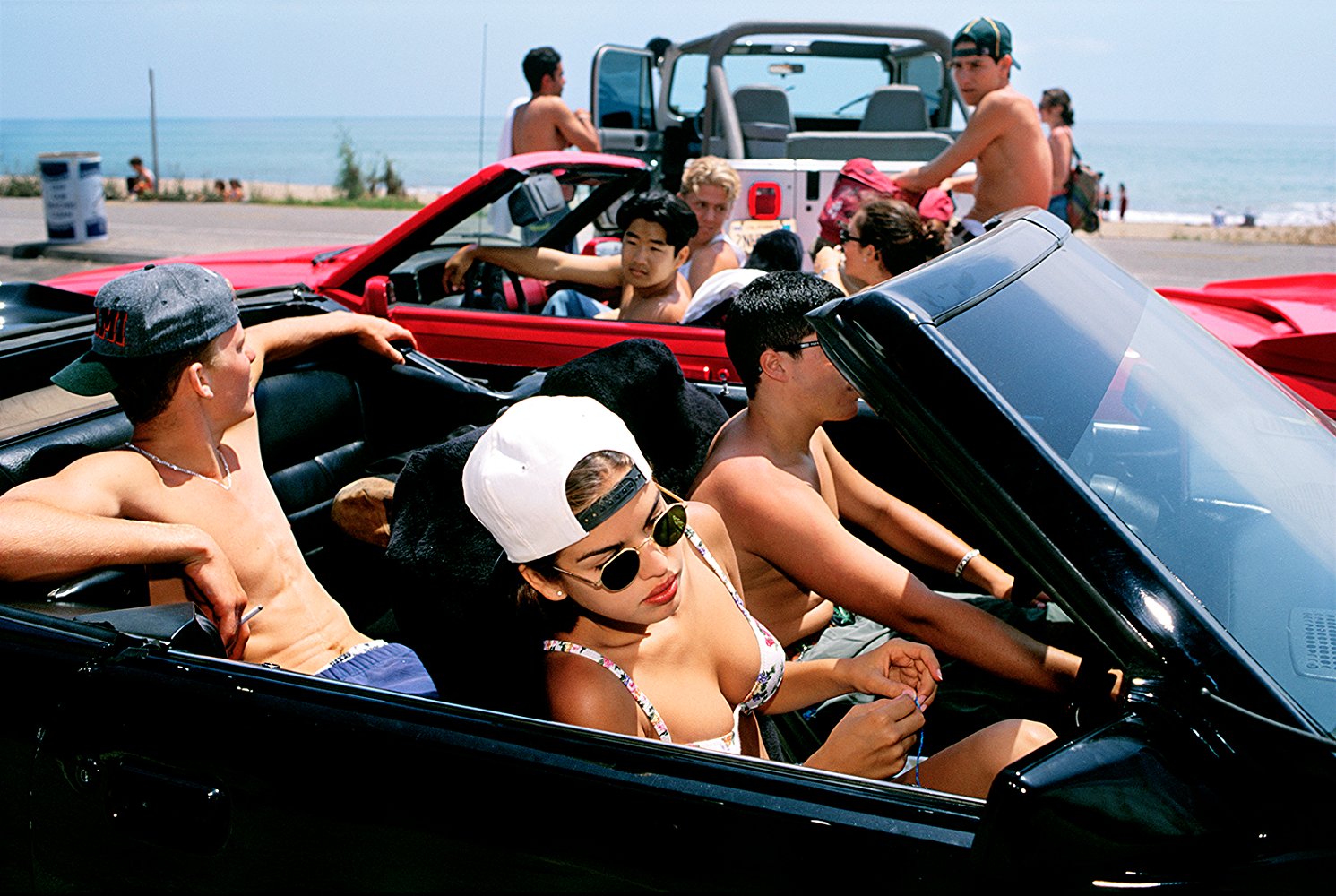
What a bizarre (but still somewhat absorbing) misfire is the new documentary, GENERATION WEALTH, written, directed and produced by Lauren Greenfield, shown below, who back in 2012 gave us another oddball, interesting and not entirely successful doc, The Queen of Versailles. The movie begins as some kind of warning/exploration about how our society is worshiping/pursuing the almighty dollar to the point of no return. Early on, we view an Asian ESL teacher making sure her clients learns the really important words: Louis Vuitton, Lanvin, Hermès and so on.

Then we meet a few of these "pursuers," including a couple of workaholic hedge-fund managers, one of whom eventually goes to prison.

Tossed in with all this is also a school-bus driver who travels to Brazil to get some major plastic surgery, a stage mother and her single-digit daughter intent on finding fame via beauty contests and maybe a reality TV show, and finally Ms Greenfield herself, along with her mother, husband, children and all their stories.

Focus is clearly not Greenfield's strong suit, and before long the viewer may be wondering whether the movie's title ought not have been Generation Workaholic (which would include both Greenfield and her mom), or maybe Generation Addiction (which could include just about everyone covered in this documentary, as each is addicted to something). We even get a small recap of the husband/wife who were the subjects of The Queen of Versailles.

Greenfield's movie is simply all over the place in terms of locale, subject matter, characters, and themes. Had she concentrated more firmly on any one of these, she might have been able to put together a cogent piece of agitprop. Instead the focus keeps shifting and slipping to the point that you may want to grab her script and take a red pencil to about half of it.

The way that Greenfield and her friends and family keep popping into the narrative is almost embarrassing. Had she made a film about this subject only -- her own sense of partial abandonment by her mother and the effect that has had on her life and that of her own family -- she might have had a subject worth tackling. (Her mom, who keeps smiling throughout, clearly would prefer not to think about nor admit to past mistakes.)

And for all Greenfield's would-be concentration on wealth and greed, this is hardly news to anyone who follows cultural/economic trends. Ditto the need for too much body enhancing surgery. And/or the quest for fame. By opting to cover so much by using so many, she weakens her theses and manages to give us both too much and too little at the same time.

Pornography even gets it due via ex-porn star Kacey Jordan, and we view a Bar Mitzvah complete with go-go dancer/strippers but by the end of this overlong documentary, nothing we hear or see registers as either original or even remotely bracing. I would say that Greenfield needed a better editor, but four of them are listed in the credits. I guess it really is the focus here that is most out of whack. I wish Ms Greenfield better luck next time.

An Amazon Studios Release and running 109 minutes, Generation Wealth -- after opening in our major cultural capitals a couple of weeks back -- hits South Florida this coming Friday, August 3. In Miami, it will play the Regal South Beach 18, AMC Aventura, and AMC Sunset Place. In Boca Raton, look for it at the Regal Shadowood.

Thursday, January 8, 2015

Italy's submission for the BFLF Oscar: Paolo Virzi's slick and engaging HUMAN CAPITAL


A terrific comic melodrama about the way we live now, Italian style, HUMAN CAPITAL continues the reign of Paolo Virzi as one of, if not the Italian master at capturing his country's life in all its complexities, humor and sadness. This multi award-winning filmmaker has here co-adapted the screenplay (based on the novel by Stephen Amidon) and directed this sleek and highly entertaining tale of Italy's very rich and those who aspire to that class. In the process Virzi looks at the wealthy, the bourgeoisie, and the underclass and the ways in which they connect and bounce off each other -- sometimes comically, at other times violently, and always somehow thoughtlessly, as each strives to "succeed."

Signore Virzi (shown at left) -- whose films, from My Name Is Tanino and Caterina in the Big City to The First Beautiful Thing and Every Blessed Day, have given me immense pleasure over the past decade or so -- comes through again with another good one. If I call Human Capital a melodrama, I mean no disrespect, for a very good melodrama is a rare thing these days, and this proves a fine and comic one, as it dissects class and wealth, attitudes and actions that lead to (and from) the hit-and-run accident that begins this stylish and engaging film. Once we see that initial accident, Virzi circles back to show us -- from several viewpoints -- what has happened and why. Each perspective from which we view things gives us greater scope and understanding, until all the pieces of the mystery at last connect.

The characters here include a wealthy family -- husband (Fabrizio Gifuni, above, right), wife (Valeria Bruni-Tedeschi, above, left) and spoiled son -- and the very middle-class family, the daughter of which happens to be the girlfriend of the rich son.

That bourgeois dad, played with magnificent cluelessness by Fabrizio Bentivoglio (above, left) -- his wife (Valeria Golino, above, right) proves much more stable and intelligent  -- pushes himself into being allowed to invest in one of the wealthy husband's latest schemes (a talent for tennis provides his entryway), and we're off to the races.

The movie's pivotal event is an awards dinner to honor one of the students (the rich man's son is in the running), at which the victim of the accident -- an immigrant waiter (shown in background, above) -- happens to be working. One of the movie's great pleasures comes from the fact that the more we learn, the more things change from what we'd first imagined.

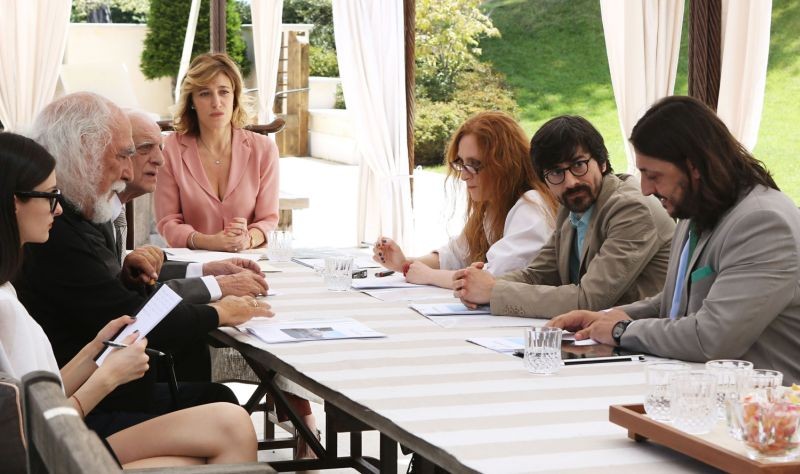
The movie takes some clever and interesting side trips, too, the best being the rich wife's involvement with a soon-to-be-torn-down theater that she decides to "champion," using her husband's money (of course), gathering together a fancy Board of Directors (above, in one of the film's most caustic scenes), and then getting sexually involved with one of the board members (Luigi Lo Cascio, below, right).

The theater surfaces later in a crackpot blackmail scheme, as the finale races toward us and the involvement of the bourgeois daughter (Matilde Gioli, below, right, with Giovanni Anzaldo, who, along with that hit-and-run waiter, represents the lower classes) becomes more central. I do wish the filmmaker had not resorted to the by-now old-hat routine of someone reading someone else's email (this is the modern version of Downton Abbey's surreptitiously overheard conversations). But then, that's one of the things that separates drama from melodrama.

Overall, however, Human Capital proves a feisty, lusty look at Italy under the economic gun, struggling to "achieve," no matter what the cost. (We learn, during the end credits, exactly to what the movie's title refers.)

From Film Movement, in Italian with English subtitles, and running 110 minutes, the movie opens this coming Wednesday, January 14, in New York City at Film Forum and in Los Angeles on Friday, January 16, at the Sundance Sunset Cinema. You can view all currently playdates, with cities and theaters listed, by clicking here and scrolling down.

Wednesday, November 12, 2014

The rich are different in FOXCATCHER, Bennett Miller's look at class, depression & psychosis


How glum is FOXCATCHER, the new movie directed by Bennett Miller (shown below), who earlier gave us Moneyball and Capote? One of the "grayest" movie ever made in color (I don't recall the sun's shining even once, and if you can find a character smiling or happy, do let me know), even when the wrestling champ played by Channing Tatum wins his big match, the sense of dread and doom that hangs over this film is palpable. Granted, the story here -- of the nutcase du Pont heir who took the wrestler under his "wing" and then for good measure took in his older brother as trainer -- is one of the crazier in America's storied history of the damage, personal and societal, that cracked wealth can wreak. No wonder nobody's smiling here.

The screenplay, by E. Max Frye and Dan Futterman, follows pretty closely the news story I recall from the late 1980s, when the events took place. What does not seem to be explored in any depth but is clearly suggested is how the behavior of the rich in our society is pampered, enabled and excused by everyone around them -- from their employees to their peers and even the local police. The results of this are shown here in all their cruddy glory. The rich, in this case, are personified by Jean du Pont (Vanessa Redgrave) and her son John (Steve Carell, shown below), and both actors do what they can by the fairly proscribed roles that allow them mostly a single note: in Ms Redgrave's case, it's rich/restrained, in Mr. Carell's it's rich/nutty.

Much has been made of Carell's hugely changed facial appearance via a prosthetic nose, and if the Academy follows its usual path of honoring prosthetics over performance (Monster and The Hours are two examples), we might see an Award in sight once again. (Carell, a fine and versatile actor, does everything he can with his role, but the screenplay's lack of exploration of his character (beyond a rich momma's boy) leaves him somewhat stymied.

Mr. Tatum, above, adds another feather to his growing cap of fine performances. He's definitely the saddest character on view, with no life to speak of except his sport: he's got a bleak history and probably an even bleaker future. Times were perhaps a bit better back in the 80s than they are now, but in any case depression seems to reign over all.

The most "normal" character in the film would be older brother Dave, played by Mark Ruffalo (above). A family man who loves and honors his brother, and then tries to do the same for du Pont, Ruffalo's Dave captures the innate kindness of the man, as well as his physical abilities and skill in training. (The wrestling scenes here register as pretty authentic.)

Foxcatcher (the title comes from the name of the DuPont farm, later doubles as the name of the Olympic training ground the farm becomes) is a mostly male movie; the only women we see much of are Redgrave's closed-off mother and Dave's wife (played by Sienna Miller, above), who is also shown to be unhappy most of the time. Bleakness even hangs over the few scenes of family fun that Dave, his wife and kids engage in.

I can appreciate Miller's and his screenwriters' aim to give us a kind of peculiarly American tragedy in the making, but I wonder if their constant insistence on the glum does not begin to make the film feel too manipulative. Even into the bleakest of lives a little joy sometimes falls, but you'd never know that from what we see here. Never uninteresting, though a certain sameness does eventually sink in, Foxcatcher is definitely worth seeing. Some of the Hosannas we've been hearing, however, seem a tad out of place.

From Sony Pictures Classics and running a lengthy 134 minutes, Foxcatcher opens this Friday in Los Angeles (at the Arclight Hollywood, AMC Century City 15 and The Landmark) and New York City (at the Regal EWalk 13, AMC Lincoln Square and the Landmark Sunshine), and will open nationwide in the weeks to come. To see all currently scheduled playdates with cities and theaters, click here and scroll down.