Not to worry: the other three directors come through, too. Buying a ticket to
CENTRO HISTÓRICO, which opens tomorrow at New York City's
Anthology Film Archives, will procure a decent evening's entertainment for art aficionados. But it's the third segment --
Vidros Partidos from the great Spanish director
Victor Erice -- that is likely to remain in your brain until memory dies.
Down the history of movies, regarding the omnibus variety -- in which various filmmakers gather under a single movie umbrella to tackle tales related usually by theme -- the occasional success (say,
Dead of Night) offsets most of the failures and so-so examples. The most recent entry into the genre that I recall is the tri-part
Tokyo from 2009. Now, with
Centro Historico, the omnibus is back and chugging along in fine form.
The fact that you could hardly think of four famous art-film directors with less in common stylistically and otherwise probably helps matters, as well. According to the film's press materials, these four --
Aki Kaurismäki, (above)
Pedro Costa,
Víctor Erice, and
Manoel de Oliveira (below) -- were asked to take their inspiration from the Portuguese city of Guimarães, the European Cultural Capital for 2012, and in particular to reflect on “the stories the city has to tell.”
They did, each in his own manner, and so the four films could hardly be more disparate -- in subject, style, agenda and even length. Aki and Manoel, as is usually their wont, give us the short, playful stuff, the former's segment (which leads off the movie) dry and a bit distanced, the latter's (which closes it) a little more obvious than usual, with even a punchline inserted this time around.
In
The Tavern Man (
Guimarães),above, Kaurismäki peers lightly into the life of the sad fellow (played by
Ilkka Koivula) who runs -- and not terribly well -- a local tavern. The filmmaker and his actor show us, in but 14 minutes, the man's work-a-day life and a bit of his desires and dreams.
In the 10-minute
The Conquerer, Conquered (
O Conquistador Conquistado), above, de Oliveira follows a tour bus around the city, as it shows, while the tour guide (the filmmaker's grandson,
Ricardo Trêpa) describes, various places of note, ending up at the statue of that titular conquistador (above), who is supposedly himself conquered by these tourists and their cameras. To call this episode slight is to put it mildly indeed, but the visual are lovely, and the piece offers de Oliveira's usual frayed charm.
Caught between the two "frolics" are the serious stuff, beginning with Costa's 30-minute
Sweet Exoricst, starring -- who else? --
Ventura (above), the man we've come to know from Costa's later work, who begins the film running away from someone or thing and being called out by voices and people. Here is the usual gorgeous, chiaroscuro lighting and camera work we expect from the filmmaker, along with the fabulous faces, and a kind of loose poetry. The lion's share of the film is devoted to Ventura and a solider/corpse stuck together in an elevator that seems to be going nowhere. A political/economic/social agenda is clearly here and just as clearly refuses to be stated. As usual with Costa's work, I had to smack my face occasionally to keep from falling asleep, despite the immense visual, cinematic beauty on display.
But, ah, the Erice! With
Broken Windows (
Vidros Partidos) this Spanish filmmaker, shown above, who is probably best known for his
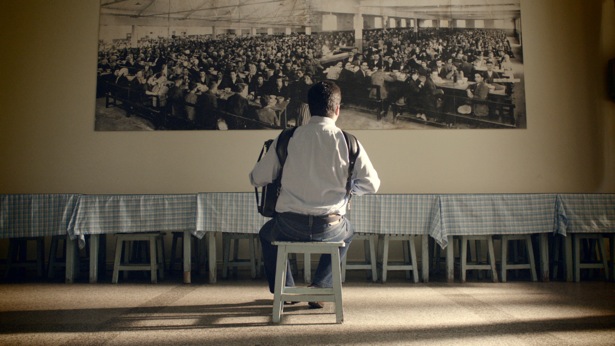
Spirit of the Beehive, takes us into what remains of an old textiles factory where, for 157 years, workers from nearby and far away came to earn their daily bread and a living for their family. Erice talks to a dozen or more of these workers, middle-aged to very senior, and as we hear their stories -- mostly sad but always specific, real and moving -- we begin to get a sense of what this factory meant to the city and the workers and come to understand why it closed its doors. Some of these men and women now know that they, as workers, are a dying breed, and to hear them speak so cogently, clearly and movingly on this subject is something I have not heard or seen elsewhere.

The interviews -- which offer some sly humor, as well as sadness and loss -- take place in front of a huge mural-like photo taken at some point early-to-middle of the last century, showing an enormous spread of workers -- men, women, youngsters -- as they sit at tables to have... their lunch, perhaps? What brings this 34-minute documentary into the realm of high art is how Erice weaves his stories and people together. One of the men talks about his memory. He's an actor, and then he plays a bit of Karl Marx. There's an accordion player, too (below), who seems to be serenading that huge photo of the workers. Then, suddenly Erice lets us come nearer and for the first time we see the faces in this huge photo, one after another after another. I can't quite explain the effect here, but it's a profound one that takes us back to a time few of us knew and that will never be seen again. This is a masterpiece of quiet, deeply-felt, working-class agitprop that will surely take its place in cinema history.

CENTRO HISTÓRICO, distributed by
The Cinema Guild and running 90 minutes, opens tomorrow, July 19 at
Anthology Film Archives for a one-week run, presented in 35mm, in English and Portuguese with English subtitles. Click
here for information on tickets and
here for directions to AFA.