Showing posts with label Portuguese cinema. Show all posts

Tuesday, June 20, 2017

Hot man-on-man sex, loopy Christianity and Amazons-on-horseback converge on João Pedro Rodrigues' juicy THE ORNITHOLOGIST


Portuguese writer/ director João Pedro Rodrigues is not a guy who, moviemaking-wise, repeats himself -- except in the sense that every movie he makes turns out to be something of a what-the-fuck? experience.

From his early O Fantasma through Two Drifters and To Die Like a Man right up to his latest endeavor to reach our shore, THE ORNITHOLOGIST, the viewer (and just as often the main character) may imagine that he is on somewhat stable ground. Oh, honey: You're not.

The filmmaker, shown at left, does love to surprise us and so it is again here. He even (sort of) co-stars in his own film, turning it in the process into a kind of meta-moviemaking, as he portrays the older or maybe wiser or maybe just the alter ego of his protagonist, played by French actor Paul Hamy (shown below).

M. Hamy is blessed with a tall, muscular and rather amazing body, together with a slightly-Neanderthal face that's also sexy as hell. This is quite a combination, and the actor has what is, so far, his most major role. He inhabits every scene in the film and is, well, wonderfully watchable as he negotiates his journey from what begins as a rather typical, if long-distance and picturesque, bird-watching trip into something very much different and hugely bizarre.

The plot is actually a mere series of run-ins with new characters, yet each grows stranger as the movie rolls out. From a rescue by two lost and oddly religious Chinese girls, our "hero" finds himself trussed up and threatened with castration (below), suddenly involved with a very hot and naked young man (Xelo Cagiao, further below, at right) with whom he bird-watches prior to sex (it's always better in that order, don't you think?), is set upon by a group of Amazons on horseback (even further below), and finally encounters the twin of his former hook-up, even as he turns into... what? Wow. A religious figure? Or maybe the filmmaker himself.

Rodrigues' work is nothing if not mystifying. But it's also difficult to pull yourself away from, particularly if you're attracted to same-sex couplings, philosophy-cum-religion, mysticism, and stories so bizarre that they seem more like waking dreams than most movies you'll have witnessed (a second viewing of this guy's films is very nearly a requirement).

When, toward the finale, a character notes,"There are certain things you shouldn't try to understand," you will probably agree, muttering, "Yes. Like this movie." But I suspect you'll want to finish it nonetheless. Visually, it's a non-stop treat -- from the birds at the film's beginning to the gorgeous location photography (who knew Portugal had such lovely, verdant areas?), to the whoppingly watchable Hamy.

Saint Anthony of Padua figures into all this, too, but since I am not a scholar of religion, I can't offer much guidance there, except to say that the movie finally seems like some sort of journey of the soul (and body: thank goodness for M. Hamy!) that culminate in a rather sweet and surprising scene, especially given all that's occurred previously.

Seeing The Ornithologist made me revisit my earlier posts on João Pedro Rodrigues, during which I found my round-up of his earlier films plus an interview I'd done with the filmmaker back in 2010, in which he proved a most delightful explorer of his own work, of Portugal, and lots else. (You can read that interview by clicking here.)

Meanwhile, Rodrigues' latest work -- via Strand Releasing, in English and Portuguese with English subtitles, and running just under two full hours (you'll get your money's worth in mystification) -- arrives in theaters this Friday, June 23, in New York City, where it plays the IFC Center and the Film Society of Lincoln Center. It then hits Los Angeles (at the Landmark NuArt) and Chicago (at the Music Box) the following Friday, June 30. To see all currently scheduled playdates, cities and theaters, click here and then click on Screenings.

Sunday, May 25, 2014

Manoel de Oliveira's GEBO AND THE SHADOW tells a simple story via a starry cast of seniors


He's back. The world's oldest living filmmaker, Manoel de Oliveira, who clocks in at 105, has made yet another full-length feature (of course, he was only 103 when this one was first released), GEBO AND THE SHADOW, which, thanks to Anthology Film Archives here in New York City, is finally getting a week's theatrical release in the USA. Unlike his last couple of full-lengthers -- Eccentricities of a Blond-Haired Girl and The Strange Case of Angelica -- both of which were oddities that didn't easily give up their meaning(s), this new one is as straight-ahead simple as you could wish.

As far back as 2001 and this filmmaker's I'm Going Home, I've off and on been suggesting that maybe it was time that de Oliveira (pictured at right) hung up his camera and typewriter. But then, in 2003, he made A Talking Picture, to my mind one of his best ever, so I determined to keep my mouth and computer shut on the subject. His films are seldom uninteresting, at least in pieces, and his latest is actually one of the more interesting endeavors, if only because it proceeds at such a measured pace, with its theme and story so blatant and repeated that no one could go away from this work wondering what it meant.

This is a dysfunctional family film of major proportions, as it tells the tale of the "missing son," whose absence means that life barely moves and never changes for mother (Claudia Cardinale, above), father (Michael Lonsdale, below), and daughter-in-law (Leonor Silveira). Each seem in thrall to their image of the missing son, with father taking it upon himself to constantly lie to mother to protect her and help keep her spirits "up" (which she never manages to do).

During the first third of the film, everyone complains constantly; in the second third (slight spoiler ahead), missing son shows up but little changes; and then, in the third section, change of a sort does come. The screenplay and its dialog is given to philosophizing a lot: "Were we put into this world to be happy?" (Evidently not.)

Dad keeps busy with his figures and additions (he keep the books for a local company), mom complains and makes coffee for guests (Jeanne Moreau, above, left) and Luís Miguel Cintra (above, second from right).

The philosophizing gets downright crazy, once the son (Ricardo Trêpa, above) takes to doing it: "Deep down, those who kill are those with the biggest hearts." Oh, absolutely! Once the climax occurs and then the denouement, we are left with this moral: The wages of pretense are abysmal in the petty lives of the petite bourgeoisie.

The performers here are only asked to play one note, and being ultra professional -- with great faces that have aged beautifully because they have aged with reality (unlike most of the Hollywood crowd) -- they play that note quite well.

Beautifully shot (by Renato Berta) using a color palette of rich hues of green, brown, and rust, then lighted with a golden glow (the movie is almost exclusively interiors), Gebo and the Shadow is minimalist in every way except the cinematography. The movie -- in French with English subtitles and running 95 minutes -- opens this Wednesday, May 28, and runs through Tuesday, June 3 at Anthology. For directions to AFA, click herefor tickets, click here.   

Thursday, July 18, 2013

The omnibus is back, as Kaurismäki, Costa, Erice and de Oliveira offer the four-part CENTRO HISTÓRICO, with Erice triumphant

Not to worry: the other three directors come through, too. Buying a ticket to CENTRO HISTÓRICO, which opens tomorrow at New York City's Anthology Film Archives, will procure a decent evening's entertainment for art aficionados. But it's the third segment -- Vidros Partidos from the great Spanish director Victor Erice -- that is likely to remain in your brain until memory dies.

Down the history of movies, regarding the omnibus variety -- in which various filmmakers gather under a single movie umbrella to tackle tales related usually by theme -- the occasional success (say, Dead of Night) offsets most of the failures and so-so examples. The most recent entry into the genre that I recall is the tri-part Tokyo from 2009. Now, with Centro Historico, the omnibus is back and chugging along in fine form.

The fact that you could hardly think of four famous art-film directors with less in common stylistically and otherwise probably helps matters, as well. According to the film's press materials, these four -- Aki Kaurismäki, (above) Pedro Costa, Víctor Erice, and Manoel de Oliveira (below) -- were asked to take their inspiration from the Portuguese city of Guimarães, the European Cultural Capital for 2012, and in particular to reflect on “the stories the city has to tell.”

They did, each in his own manner, and so the four films could hardly be more disparate -- in subject, style, agenda and even length. Aki and Manoel, as is usually their wont, give us the short, playful stuff, the former's segment (which leads off the movie) dry and a bit distanced, the latter's (which closes it) a little more obvious than usual, with even a punchline inserted this time around.

In The Tavern Man (Guimarães),above, Kaurismäki peers lightly into the life of the sad fellow (played by Ilkka Koivula) who runs -- and not terribly well -- a local tavern. The filmmaker and his actor show us, in but 14 minutes, the man's work-a-day life and a bit of his desires and dreams.

In the 10-minute The Conquerer, Conquered (O Conquistador Conquistado), above, de Oliveira follows a tour bus around the city, as it shows, while the tour guide (the filmmaker's grandson, Ricardo Trêpa) describes, various places of note, ending up at the statue of that titular conquistador (above), who is supposedly himself conquered by these tourists and their cameras. To call this episode slight is to put it mildly indeed, but the visual are lovely, and the piece offers de Oliveira's usual frayed charm.

Caught between the two "frolics" are the serious stuff, beginning with Costa's 30-minute Sweet Exoricst, starring -- who else? -- Ventura (above), the man we've come to know from Costa's later work, who begins the film running away from someone or thing and being called out by voices and people. Here is the usual gorgeous, chiaroscuro lighting and camera work we expect from the filmmaker, along with the fabulous faces, and a kind of loose poetry. The lion's share of the film is devoted to Ventura and a solider/corpse stuck together in an elevator that seems to be going nowhere. A political/economic/social agenda is clearly here and just as clearly refuses to be stated. As usual with Costa's work, I had to smack my face occasionally to keep from falling asleep, despite the immense visual, cinematic beauty on display.

But, ah, the Erice! With Broken Windows (Vidros Partidos) this Spanish filmmaker, shown above, who is probably best known for his Spirit of the Beehive, takes us into what remains of an old textiles factory where, for 157 years, workers from nearby and far away came to earn their daily bread and a living for their family. Erice talks to a dozen or more of these workers, middle-aged to very senior, and as we hear their stories -- mostly sad but always specific, real and moving  -- we begin to get a sense of what this factory meant to the city and the workers and come to understand why it closed its doors. Some of these men and women now know that they, as workers, are a dying breed, and to hear them speak so cogently, clearly and movingly on this subject is something I have not heard or seen elsewhere.

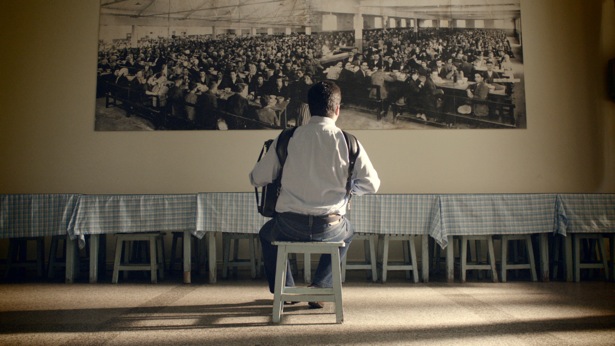
The interviews -- which offer some sly humor, as well as sadness and loss -- take place in front of a huge mural-like photo taken at some point early-to-middle of the last century, showing an enormous spread of workers -- men, women, youngsters -- as they sit at tables to have... their lunch, perhaps? What brings this 34-minute documentary into the realm of high art is how Erice weaves his stories and people together. One of the men talks about his memory. He's an actor, and then he plays a bit of Karl Marx. There's an accordion player, too (below), who seems to be serenading that huge photo of the workers. Then, suddenly Erice lets us come nearer and for the first time we see the faces in this huge photo, one after another after another. I can't quite explain the effect here, but it's a profound one that takes us back to a time few of us knew and that will never be seen again. This is a masterpiece of quiet, deeply-felt, working-class agitprop that will surely take its place in cinema history.

CENTRO HISTÓRICO, distributed by The Cinema Guild and running 90 minutes, opens tomorrow, July 19 at Anthology Film Archives for a one-week run, presented in 35mm, in English and Portuguese with English subtitles. Click here for information on tickets and here for directions to AFA.

Tuesday, December 25, 2012

Miguel Gomes' stodgy, homage-y TABU opens at Film Forum: Of croc and schlock


I am guessing that the work of Portuguese filmmaker Miguel Gomes (previous output: four shorts, the widely heralded Our Beloved Month of August and his earlier The Face You Deserve) is an acquired taste. On the basis of his latest film, TABU, TrustMovies feels that he has not quite yet made that acquisition. Evidently a kind of homage to the work of early movie-maker F. W. Murnau -- even the poster images (the current film's is shown above, the older one's below) have a certain similarity -- Gomes' newest creation provides a not uninteresting combination of colonial critique (Portugal in Africa), forbidden love, the past and the present, and both old-fashioned and somewhat newfangled black-and-white cinematography.

But it all seems finally rather precious and not, I am afraid, that entertaining. At just under two hours, the film does go on. And as it does, the little life, mostly derived from the first half, set in modern day, drains out. The second half tells what ought to be a more interesting story of the love affair between the younger versions of the old woman and man we meet in part one.

But the filmmaker, shown at right, loves to dawdle and diddle, and so getting there, as they say, takes some time. Along the way, we're given story upon story that connect via countries and landscape (the jungle, the African plains and especially crocodiles, see below) that figure into just about every-thing concerning the past and in the dreams our char-acters have in the present.

We also get an early rock band from the period and some accompanying songs that are fun to hear again. While there is a certain "beauty" in much of the goings-on and in the often lovely black-and-white cinematography, the connections that would make for drama are so tenuous that little feeling for anyone or anything is generated. Some critics have called this "brilliantly nuanced," "mind-bending and utterly mysterious," but for me the result produced more than a whiff of... call it kitsch, schlock or camp, that made it impossible to take anything here all that seriously.

I wasn't bored by Tabu (I nodded off for a few seconds only once!) and I found myself taken with some of the characters: the cranky old woman (Laura Soveral, in photo at bottom) whom we see as a younger semi-femme fatale in Part Two; her kindly, ineffective neighbor Pilar (Teresa Madruga), shown below, at the cinema on a semi-date with a fellow who looks a bit like a sleeping Sondheim. If you were so inclined, you could call this one a semi-movie.

Also worth a look is the male lead in Part Two, Carloto Cotta (shown below and on poster, top, with Ana Moreira), as the youn-ger version of the old man we meet at the end of Part One. He is a stunner whose great beauty of face, body and hands ensures that the second section moves, if not quickly, more enjoyably.

So, yes, there are a number of things that make Tabu a forbidden pleasure. If only Mr. Gomes had been able to see that they coalesce more effectively. To my great surprise, the film has popped up on a 10-best list or two, which should at least ensure some kind of audience here in New York City.

To that end, the movie, an Adopt Films release, opens tomorrow, Wednesday, December 26, at New York's Film Forum for a two-week run. So see what you think, New Yorkers. To view all upcoming playdates around the country, click Adopt's web site here, then click on FILMS and then on TABU.

Saturday, December 24, 2011

SCN: Portugal's entry for Best Foreign Film, Miguel Gonçalves Mendes' JOSÉ & PILAR

What, you might ask, is Portugal's submission for the year's Best Foreign Language Film -- JOSÉ & PILAR -- doing as part of the FSLC's Spanish Cinema Now? TrustMovies certainly did. Granted, Portugal is right next to Spain on the map, but last he heard they constituted two different countries. Not only is this a Portuguese film, its director, Miguel Gonçalves Mendes, is Portuguese and so is his subject, José de Sousa Saramago, the Nobel-laureate novelist, poet, playwright and journalist. The movie's other half, Saramago's second wife Pilar del Río, however, is indeed Spanish, and so is one of the most prominent of the film's several producers, Agustín Almodóvar (Pedro's brother). Plus, the titular couple lived in Spain for quite some time. So I guess we'll let this one slip by.

For audience members, like me, uninitiated into the world of Saramago and del Río, the movie cannot help but be interesting, as there is so much to learn. But for those of us who know little of this award-winning writer's work, the film also proves unsatisfying, as we don't get to know all that much about it over the ensuing two hours and five minutes (for a current-times documentary, this is a long one). We get a little history of the pair, together and individually, as the filmmaker, shown at right, concentrates on their life together and how the two manage to help each other in various ways. Pilar is José's social secretary, and in one of the initial scenes, the pair (below) is shown RSVP-ing to various requests -- deciding to turn down one from the Dali Lama!

Saramago is a Communist (my kind of guy!), as well as anti-Church, so for some of us, he's an easy fellow to appreciate. In his 80s when the movie was filmed (the writer died last year at the age of 87), he still maintains a playfulness and fine sense of irony. One of his works for the theater is being given a reading by Gael García Bernal, and the conversation between them, as Bernal complains about the celebrity life, is amusing.

We get to see a bit of that theater piece (which sounds good), and later we hear Pilar's rant on the subject of "Basque is Spain!" Sometimes the filmmaker seems to be trying to give visual images to Saramago's works, but the overall effect is paltry, probably because this is not necessary.

There is plenty of archival footage (as per the above) of the twosome early-on, and even more of them in current times. José goes into hospital after an attack but returns home in time to be honored in his homeland of Portugal. Then Blindness -- Fernando Meirelles' movie version of Saramago's novel -- is shown at Cannes, opening to not terribly good reviews which compare the movie badly to its original source. "It's just as I wrote it," declares the novelist, giving the figurative finger to those critics. (TM thought Blindness was better than many critics gave it the credit of being.)

Toward the end, there is a very nice interview with Pilar, in which we finally get to hear what she thinks about various topics. Regarding the intersection of the streets now named for the pair, one newscaster suggests that all lovers should come there and kiss. Shot during the U.S. Presidential campaign in 2008, the movie makes clear that Saramago was pro-Obama, while del Río was a Clinton supporter. By the finale the poet and raconteur is looking mighty frail, no surprise.

José & Pilar, shown only twice during SCN, has no U.S. distributor so far as I know. (Hold the phone! According to the comment just in, see below, Outsider Pictures -- a company that has brought us some terrific little movies we would not have otherwise seen -- will release the film here this coming April, so my U.S. readers will indeed have the chance to view it.)  And because José & Pilar has been selected as Portugal's entry into the Best Foreign-Language Film "Oscar" sweeps, this release might add to its chances. I wouldn't put my money on the movie's making the final five nominees, but as the Academy has been known to surprise us on that score, we shall see.

Monday, December 27, 2010

THE STRANGE CASE OF ANGELICA: Manoel de Oliveira's mystifying opus opens at IFC


To call this film "slight" is to hugely overstate the case. With enough content to perhaps fill an animated short subject (which the movie may remind you of -- but without the required animation and with a seemingly endless running-time of 97 minutes) -- THE STRANGE CASE OF ANGELICA (O Estranho Caso de Angélica), is yet another odd bauble from the 102-year-old Portuguese filmmaker Manoel de Oliveria. As was his most recent movie (Eccentricities of a Blond-Haired Girl), the new one is also about the nitwit, obsessive love of a man for a woman he does not know. The earlier film's ill-chosen love object turned out to be a shoplifter. We've graduated: This one's a corpse.

Loony as this may sound, Oliveira (pictured at left) makes it even stranger (well, it is titled The Strange Case...). His main character is hired in the middle of the night to take photos of the newly deceased, and as he shoots, he falls. And so, it would seem, does the corpse for him. She opens her eyes during the shoot, gives him a wink and a smile, and then begins appearing to our shut-terbug at odd times, taking him for sky-rides in the air, a la Christopher Reeve and Margot Kidder, but with the sexes and control reversed. It's all story-book and asexual: kids at play.

Obsession being what it is, however, our hero must investigate further, and so he visits the family of his new love (they, shown below, are not amused), then to the graveyard and elsewhere. Growing nuttier over time, he is eventually driven to grab the gates of the cemetery and scream, "Angelica!" at the top of his lungs. Unfortunately, the actor assigned to this role, Ricardo Trêpa (shown above, center, often used by Oliveira and also the lead in his "Eccentricities") is not the sort of performer who commands the screen.  In the recent Spanish Cinema Now film Julia's Eyes, much is made of a character so ordinary looking that he seem to literally blend into the wallpaper. No one in the film can remember what he looks like or anything distinguishing about him. Mr. Trêpa would have made an perfect choice for this role. Here, even screaming at those cemetery gates, he fails to register. But perhaps this is the filmmaker's point: the one-sidedness of obsessive love.

There may be other points here, as well: the pettiness and conven-tionality of the bourgeois mentality, the worth of manual labor, the transitory nature of love and life and their connection to death. Oddly, however, though this film lasts more than a half-hour longer than the earlier Eccentricities, its pleasures are noticeably fewer. Not nearly as beautiful to view as its predecessor (except for that shot of our "heroine" -- the lovely Pilar López de Ayala -- below), it seems as small and cramped as the boarding house in which our hero lives -- despite those trips aloft with the floating corpse.

During the film, a statue in the town's center keeps pointing the way, but no one, most of all the filmmaker, manages to find it.  Still, this is such as "personal" and quirky little movie that I suppose -- whatever it thinks it is about and for -- the filmmaker himself was probably more than satisfied with its outcome.

The Strange Case of Angelica, distributed by Cinema Guild, opens in New York at the IFC Center this Wednesday, December 29. Click here for further playdates around the country, scheduled, at this point in time, for February and March 2011.