Showing posts with label Peter Morgan. Show all posts

Saturday, December 5, 2020

Aaron Sorkin's THE TRIAL OF THE CHICAGO 7 and Steve McQueen's MANGROVE vs Peter Morgan's safely elitist/escapist THE CROWN

Right off the bat I must admit that my attitude toward Britain's Royal Family pretty much mirrors that of moviemaker Terence Davies as described in his rich and moving documentary, Of Time and the City: the sooner our world (and especially Britain) is rid of this nutrient-sapping plague, the better off we'll all be. Goodness knows, we will have much less gossip fodder for the tabloids and soap opera for the TV -- but, hey, them's the breaks. If you're a huge fan of the Netfix series THE CROWN, as so many folk currently are, our Sunday Corner correspondent Lee Liberman has covered the series in depth already, so TrustMovies himself will simply say that when his spouse and he began watching it several years back, we stopped after a few episodes, finding it, as spousie surmised, just more "Royal Family Bullshit" (RFB). 

Coming back to The Crown in the current Season Four (due to all that media hoopla), and again lasting only a few episodes, we were quicky enmired in more RFB, the leading purveyor of which is certainly Peter Morgan, writer/creator of The Crown, as well as of The Queen, who, though he writes wittily and entertainingly, still gives us mostly RFB -- granted with a goodly amount of the Royal Family's pecadilloes in plain view (an alternate titled for the series might have Pecadilloes on Parade!). 


This offers up the chance for audiences to escape into a white, elitist fantasy, while simultaneously feeling superior to the mostly silly twats on view -- really quite an unbeatable combo for mainstream entertainment. The new season is also an opportunity to see some of Britain's and America's finest actors strutting their stuff (quietly and oh, so seriously, of course!), from Olivia Colman (the Queen) to Gillian Anderson (a very fine Margaret Thatcher) and Josh O'Connor (above, as a glum, dumb Prince Charles). 


A very different look at the Britain of the second half of the 20th Century (circa 1970) can be found in MANGROVE, one of the five new films from writer/director Steve McQueen that are part of Amazon Prime Video's new Small Axe series. Mangrove is a hard film to watch because it deals openly and honestly with British racism, especially by the police, during this time. It mirrors our own racism here in the USA, and though it is not overly violent, the entitled, racist -- both casually and nastily --  attitude of  the white, upper-class establishment will be difficult to watch for those of us who grew up in that time either in Britain or here in the USA and tacitly allowed all this to go on. And on. Particularly at this current time, as the Black Lives Matter movement grows and more and more about the racism of then and now comes to light.

Mr. McQueen is a tad heavy on repetition and on some of his messaging about the need to organize and join together to defeat the white elite, but mostly he draws such wonderful performances from his fine cast (that includes Letitia Wright, above, and Shaun Parkes, below) and, along with his co-writer Alastair Siddons, gives us a splendid court trial (of The Mangrove Nine), during which he effectively puts us in a position that comes close to being a member of the jury on this case that his film finally works on every level.


Folk who, when they hear the words Notting Hill, immediately think of Hugh Grant and Julia Roberts, may instead now find themselves remembering instead this little-but-major movie that reminds us of what has been accomplished and how much yet remains to be done.


The tale told in Aaron Sorkin's newest, THE TRIAL OF THE CHICAGO 7 (streaming on Netflix), is much more complex than that of Mangrove, and though both films use a lot of exposition, Mr. Sorkin, not simply clever but also smart, manages to entertain us royally, as well as educate us about a genuinely fascinating trial that captured the world's attention back in 1969. Sorkin's star-studded cast includes everyone from British actors such as Sacha Baron Cohen, Eddie Redmayne and Mark Rylance to Frank Langella (who makes a terrific Judge Hoffman) and Joseph Gordon-Levitt (below), who aces the role of this film's most complex character, a highly traditional and conservative prosecutor who also possesses scruples and morals.


Sorkin's movie is one of this year's best, and while everything about it resonates, for TrustMovies, the most surprising moments came as I watched the film's black defendant Bobby Seale, along with Fred Hampton, and realized how differently I view these men now than I had at the time of the trial -- when Black Panthers seemed to me a frightening bunch and what they were telling us was too overstated to be believed. Watching this really terrific movie in the context of what's going on today made me realize even more strongly how naive I was at that time. 

So go to The Crown for escape if you must, but see Mangrove and The Trial of the Chicago 7 to get reacquainted with British and American history and "justice for all." 

Sunday, December 15, 2019

December Sunday Corner With Lee Liberman: THE CROWN, SEASON 3 -- 1964-1977


There was a young lady from Dallas 
Who used a dynamite stick as a phallus. 
They found her vagina in North Carolina 
and her asshole in Buckingham Palace. 

Imagined not real, the limerick, above, that the screenwriter put in the mouth of Princess Margaret at a White House party in 1965 did the trick: At a lavish dinner party hosted by the Johnson’s for the Snowdon’s, Margaret wooed our president in vernacular they both enjoyed, getting Lyndon to agree to the British government’s plea for a U.S. bailout during an urgent financial crisis. Johnson had been refusing PM Harold Wilson’s calls (the Brit’s weren’t backing his war in Vietnam). But following Margaret and Tony’s visit, the ‘special relationship’ went from cool back to sure-footed. Her thrilling success didn’t widen Margaret’s sphere of influence at home as she was regarded as a bomb-thrower best kept on the down-low. Peter Morgan says he made up what happened at that dinner, but it was so like the principals, one can only wish it did, and pity poor Margaret — the little ‘vice queen’ with an applause deficit.

Morgan’s marvelous Netflix series continues with vignettes that are smaller than the drama of the world war era but absorbing. Here is Britain during the middle years of the Queen (now played by Olivia Colman of The Favourite), the young adulthood of Prince Charles and Princess Anne and the Snowdon scandals. One feels a tad sorry for the Windsors— the ruthless scrutiny and humiliations visited on this ordinary family living under glass.

The royal porn may pay for itself despite the schadenfreude and outright rejection it brings on itself, fed by the soap-opera tales of their private lives. The Windsors function with great success as a soft-touch but powerful PR firm — the outcome of the Crown’s search for meaning as it evolved from ruling monarchy to figurehead. Many royals work full time dutifully promoting civic and social causes. The self-imposed rules they live by assure that duty and kindness are quite, if not perfectly, constant; the Crown ‘firm’ functions as parent archetype, committed to useful work and maintenance of the public image. (Prince Andrew, having embarrassed himself in an unapologetic interview about his ties to Jeffrey Epstein, has just been cut from the firm’s public face upon the intervention of Prince Charles, it is reported, asserting himself as monarch-to-be.) Maybe the US could profit from more do-good, apolitical authority.

The salacious chapters have some nuggets. We learn new about the origins of Charles (Josh O’Connor, Only You) and Camilla (Emerald Fennell, below). Camilla’s relationship with Andrew Parker-Bowles (Andrew Buchan) was more passionate than imagined in which they used others to make each other jealous, involving Charles and an acerbic Princess Anne (well-acted by Erin Doherty) who joined the quadrangle “for a bit of fun”. Lord Mountbatten and the Queen mother then broke up the party, instigating Camilla’s marriage to Parker-Bowles while Charles was on Naval duty. (No wonder he would later defiantly flout his marriage to Diana.) Much more domestic nastiness appears in the chapter about the affairs of Tony Snowdon (he who winsomely charmed the Queen to secure her favor) and Princess Margaret precipitating the deterioration of their marriage — splashy tabloid fodder then, soap-opera now.

It’s not all soap. A KGB spy is discovered living in the Palace and there are labor troubles. Prince Philip, splendidly acted by Tobias Menzies (Game of Thrones, Outlander; click here to read a fine interview with the actor), has a mid-life crisis coinciding with the US moon landing and visit of the astronauts to the palace. The Prince, a pilot himself, unhappily sidelined from adventure, waxes in awe of the young astronauts until he meets them, drippy with colds, having nothing of awe to report beyond the lists they had to tick off as they worked through their mission. Philip doesn’t get that ‘meaning’ is all in the doing — the action of climbing the mountain not getting to the top. Menzies (below, l; Prince Philip, r) conveys Philip’s emotions with such self-restraint, he has made himself the stealth star of this ensemble.

A chapter is devoted to the passing of David, Duke of Windsor (Derek Jacobi) living in exile in France and shunned with his notorious wife Wallis (Geraldine Chaplin), for whom he abdicated the throne. Again, Morgan ignores the elephant in the room — the pair’s unholy infatuation with the Nazi’s that led to their non-grata status, making government quietly grateful that divorced American Wallis kept David from the throne. Perhaps a different screenwriter at a different time will dramatize that juicy story.

Crown - 3’s most memorable episode may be the mining incident at Aberfan in 1966, a tiny Welch town that suffered a tragic coal-debris slide. After days of rain, a tip (little hill) of coal debris sank, sliding downward and across the street, burying the town elementary school. It killed 144 people, most of them kids. PM Harold Wilson, Prince Phillip, and camera-slung Tony Snowdon went to the scene at once but their description of the horror and the PM’s urgings could not convince the Queen to go — it fell to rogue Labour party members to induce her late visit. Labour threatened to blame the Queen and prior Tory governments who had ignored reported dangers at the mine site. Several lines of copy on the screen report that the Queen’s failure to go at once to Aberfan remains a matter of deep regret to Elizabeth, and that she has visited the town often in intervening years.

Another chapter shows us the character of the monarch-in-waiting — that is the story of Charles’s Welsh language and history instruction prior to his investiture as the Prince of Wales. The Welsh, especially his local university tutor, anticipate the chore with derision, only for Charles to win them over with sincere, earnest effort. Charles is well-conveyed by O’Connor, who conjures him quite completely (O'Connor below r, Prince Charles l)


At end, Crown 3 was as entertaining as earlier series, supporting Morgan’s stated goal to use the monarchy as a canvas for this decade or so of the latter 20th century, all the while laying out a good gossip. Full cast replacement helps his case, as you focus less on individuals and more on the unfolding stories of the era.

At left, screenwriter, Peter Morgan and his partner, Gillian Anderson, who will appear in the next edition of The Crown as Margaret Thatcher.


The above post was written by 
our monthly correspondent, Lee Liberman

Sunday, January 14, 2018

Our January Sunday Corner With Lee Liberman: THE CROWN -- Season Two


As intriguing story and stately pageant, Netflix’s streaming series, The Crown, continues to gleam. Peter Morgan, writer (below left, pictured with director, Stephen Daldry), treats the eyes and mind to the beauty and absurdity of the institution that we are at once possessive of, ga-ga over, and feel superior to — the British monarchy being our own origin story, the authoritarian regime that led us to create a democracy for ourselves. 

Right about now that constitutional monarchy is looking benign and not so absurd, compared to U.S. constitution fuzzies that have permitted exactly what we fought against in the 1700’s — authoritarian rule by an erratic, narcissistic, if not mentally ill leader. The British have since created their own democracy, walling off the Crown from Parliament, so that today it functions primarily as a large PR firm headquartered behind palace walls. Imbued with a deep sense of responsibility at home, Crown royalty work hard, some of them nearly 24/7, supporting charities and civic work that helps make Britain well-meaning, if not great.

Queen Elizabeth’s grandmother, Queen Mary (at right), held to the ‘divine right’ view of monarchy. She is said to have told Elizabeth: Monarchy is God’s sacred mission to grace and dignify the earth, to give ordinary people an ideal to strive towards…..

Of course, that was then. Elizabeth (the spectacular and very hard-working actress, Claire Foy) replies that her husband Prince Philip (Matt Smith) believes that church and state should be separate, that if God has servants, they are priests, not kings. Parliament steers its own track now, while the Crown’s adjustment to 21st century mores creeps forward. It offers a tone of caring and civic-mindedness — humanity absent in the U.S. of late.

In fact King George V (above, left), Elizabeth’s grandfather, broke with tradition to affirm that the House of Windsor owed its loyalty to the British people above all, and to establish the precedent of personal outreach and public service that the royals practice now. (A Netflix documentary, The Royal House of Windsor gives a full account of the history of the 100 year old dynasty.) Her parents, George VI and Elizabeth, outdid themselves bucking up the Brits during the blitz, remaining a presence in London (below).

Having been trained dutifully to serve, Elizabeth addressed the nation by radio on her 21st birthday: “my whole life, whether it be long or short, shall be devoted to your service.” Ms Foy portrays the model public servant. Every thought, every worry, every struggle appears on her face and in her eyes; the Queen’s earnestness is palpable.

Crown 2 offers another elegantly, expensively wrought 10 episodes each of which demonstrates, sometimes satirically, the clash between tradition and progress. There is threat to the royal marriage, education trauma for young Prince Charles, parliamentary crisis as England’s colonial domination slips, and for Elizabeth, learning on the job how to “be” with her subjects.

Take the episode, ‘Marionettes,’ in which the Queen delivers a staff-written, unknowingly condescending speech at a Jaguar auto plant that is promptly rebuked by a peer, Lord Altrincham (John Heffernan, above left, a character actor with a talent for satire and irony, shown with the real Altrincham, right). He calls her old-fashioned, priggish, and tone-deaf in the new age of republics replacing monarchies — his words ricocheting across British tabloids. Humble Elizabeth meets him in secret, where he offers suggestions, most involving her being more open and approachable, nearly all implemented in a year. Her first TV holiday greeting was a warm homily delivered in 1958 (below). The palace later conceded that Lord Altrincham did as much as anyone in the 20th century to help the monarchy.

Elizabeth’s flamboyant sister, Princess Margaret (Vanessa Kirby, below, right), gets two tabloid-ready chapters in her love-life following the debacle of her broken relationship with her father’s divorced equerry, Peter Townsend (the church still rigidly denying royal marriage to a divorce with a living spouse). Her next love is avant garde photographer Anthony Armstrong-Jones, later titled Lord Snowden. The versatile Matthew Goode (below, left) plays him as controlling and enormously sexy. Armstrong-Jones ran with a bohemian crowd of artists and intellectuals. He had several lovers while also romancing Margaret, including a married couple both of whom he had sex with, the wife pregnant with Tony’s child at Tony and Margaret’s wedding. The narrative suggests that his desire for her was partly fostered by his own mother’s disregard of him as the lesser of her sons and his need for her approval.

The marriage was happy for some years but eventually broke down, each of them willful and needing the spotlight, though they successfully raised two talented, artistic children and remained friends till Margaret’s death in 2002. Armstrong-Jones was the first commoner to marry into the royal family in 400 years, theirs was the first royal wedding televised (below), and their divorce the first since Henry VIII. (Prince Charles’s marriage to a divorcee has paved the way for Harry’s uncontroversial impending nuptials.)

One episode, Vergangenheit, (means ‘past’ or ‘past history’), was especially provocative and reverberates now—here. Peter Morgan’s narrative bobbed and weaved, so please watch Edward VIII, the Nazi King, also on Netflix, to get the full picture. According to this short documentary, the Brits were lucky to have the “divorcee” excuse to deny Elizabeth’s uncle David, new playboy King Edward VIII (Alex Jennings, below, left), his bride of choice, which led him to abdicate in favor of his brother, Elizabeth’s father, a man of responsible character. Our FBI had been watching David’s paramour, American Wallis Simpson (Lia Williams, below, right) because of her Nazi sympathies. President Roosevelt was fielding American anti-war sentiment on his way to war — he could not afford the glamorous duo rallying that sentiment into a movement.

David too was pro-German, seduced by Hitler’s charisma and power. He wanted to reconnect with his German ancestral roots decisively severed by his father because of anti-German sentiment in England during World War I. George V dropped the German family name in 1917, inventing ‘House of Windsor’ (named after one of their palaces) for the sake of "Englishness."

David’s attraction to power played out in his love for Wallis: she was the dominatrix; he the submissive. His admiration for Hitler was narcissistic and naïve; his public statements argued against Britain’s call for war with Germany in the name of “peace.” Meanwhile, Hitler feted and cultivated the couple for future use (as Putin has done with Trump). Hitler’s ambassador to Britain, Joachim Ribbentrop, had an affair with Wallis while she and David were courting; she remained Ribbentrop’s confidante for years, passing him British secrets. FBI and (literally dug up) German war files reveal that David was being groomed as Hitler’s puppet king, if/when Germany conquered Britain. David believed the continued bombing of London would lead his brother, King George VI, to surrender — a revelation that horrified his family. To David, Nazism was a self-evident good; he was mystified, angered at his family’s rejection (in the face of) his “peaceful” and “noble” ambitions. (In the first season of The Crown, the family disdain of David and Wallis seemed overly cruel; only in Crown 2, do we find out why.)

Because loose-lipped David had already hurt the war effort, especially tipping Germany to choose the least defended route to invade France, Churchill contrived to keep the couple as distant as possible. They were kept out of England and shunned by the royals, even by his mother, Queen Mary. In the end Parliament leadership was grateful that Wallis’s divorces kept David from the throne and the crisis his rule might have provoked. Fortunately he was too passive and shallow to overcome the constraints placed on him — but what if he had been strong and manipulative?

Given that both our nations have verged on authoritarianism in the modern era, one is left to ponder whether either system has more to offer than the other in so far as protecting our inalienable rights.

The above post was written by 
our monthly correspondent, 
Lee Liberman.

Sunday, December 11, 2016

December Sunday Corner with Lee Liberman -- THE CROWN: Smoke and Mirrors


"Oils and oaths, orbs and scepters, 
symbol upon symbol, an unfathomable web 
of arcane mystery and liturgy
no clergyman or historian or 
lawyer could ever untangle.
Who wants transparency 
when you can have magic? 
Who wants prose 
when you can have poetry? 
Pull away the veil and 
what are you left with? 
An ordinary young woman of 
modest ability and little imagination. 
But wrap her up...
anoint her with oil 
and presto... a Goddess!"
....as spoken by Alex Jennings, 
playing The Duke of Windsor, 
former King Edward VIII, 
The Crown, Episode 5, "Smoke and Mirrors"

So be thou anointed, blessed, and consecrated in the name of the Father, the Son, and the Holy Ghost.... Thus began the unexpected reign of Queen Elizabeth II, 'Defender of the Faith', sworn not by a member of the judiciary or the government but rather anointed by Anglican clergy. The visual montage commencing each of The Crown's 10 episodes is of molten metal pouring, sliding, and congealing into filagreed golden regalia (crowns and such) -- images that, along with a sweeping score, plunge you into the royalty thing with timeless grandeur.

Although 'Divine Right of Kings' mostly disappeared itself with Enlighten-ment thinking in the late 18th century, English ceremony would have you attribute god-like qualities to the ruler -- that is how Elizabeth was raised and instructed by her family, her prime ministers, and secretaries. No longer woman, wife, mother she is now answerable to God, submitting her will to monarchy. This had the effect of tying Elizabeth to the past like the Pope, and the Anglicans are almost as slothful as Rome. In this treatment both the Queen and Philip know that church and state must be separate, but always dutiful, she has complied with church authority.

Peter Morgan (shown above), screenwriter of this lavish and complex undertaking (Netflix paying a reputed 100 million for 20 episodes) does not let the royals off lightly. The Queen survives crises at her own and her family's expense; she rules with equal resolve and regret, her composure barely masking discomfort. The excellent Claire Foy (Wolf Hall, Upstairs, Downstairs, Vampire Academy) bears the burden of all this show. We see the young Queen and her dashing naval husband, Philip Mountbatten (the quirky Matt Smith of Dr. Who) struggle mightily to navigate a marriage in which the spousal relationship could not be more upside down from the mores of the 1950's.

Philip, naval commander and great-great grandson of Queen Victoria, has his hopes dashed of continuing his career when father-in-law, George VI, died young. Resentfully putting up with perceived indignities, he knelt before his wife at coronation, paced behind her in public. His children would be named Windsor not Mountbatten. Philip squirms, chafes, and gripes. On a world tour designed to buck up the image of British Dominion, he exclaims that the royal pair are the coat of paint; 'waving like lunatics, a circus trudging from town to town like dancing bears'; or this: 'my work is as a navel officer -- not grinning like a demented ape while you cut ribbons'. He wakes from dreams with his arms in the air -- waving. However, Philip has soldiered on and been a modestly effective populist force for modernization. (Was all that contrariness a desire for progress or pique at the diminution of his own patriarchy?)

A divorce meme percolated through the lives of the Windsors, bookending the first 10 episodes. Edward VIII ( David to his family) became king in January 1936 and abdicated late that year to marry his paramour, twice-divorced American social climber Wallis Simpson, thrusting his shy, stuttering younger brother, Elizabeth's father, on the throne as George VI. Ending the series is the story of her sister, Princess Margaret (Vanessa Kirby), who fell in love with her father's equerry (assistant), Peter Townsend (Ben Miles), also divorced (both, 2 pictures below). Margaret was stopped first by the Cabinet and finally by the Queen, her hand forced by church dictates -- divorced parties with living ex-spouses were not welcome at court until 2002.

The abdicate-king, retitled Duke of Windsor, is a snide observer of the monarchy and his royal relatives (see quote at top). The disgraced pair (above) lived abroad after abdication becoming "society's most notorious parasites...while they thoroughly bored each other". (Wrote Wallis, "You have no idea how hard it is to live out a great romance.") The Duke visited England alone where his mother, Queen Mary, shamed him and he's spurned by his niece the Queen, her mother, and church authorities. All blame him for shirking his duty to rule, causing, they think, the early death of his brother, King George VI (an addicted smoker -- need one say more) and robbing the young Elizabeth of a simpler life out of the spotlight. Morgan reimagines considerable pain spread around as he deploys family resentments.

Gelignite perfectly titles the episode about Princess Margaret's love affair with Peter Townsend that exploded like a bomb in the press, not the least due to Margaret's flamboyance and the vanity of Townsend. Elizabeth, wishing happiness for her sister, makes promise after promise to the couple, but as she wades deeper into the labyrinthine reality of realm, she is forced to go back on her word (below, sisters at odds). If Margaret takes Townsend she will be forced into abdication like their uncle. The repetition of her Uncle David's humiliations was more than Margaret could take.

Some have described Elizabeth as jealous of her sister's popularity and her recall of Margaret from the spotlight as spite; I saw Elizabeth as duty-bound to preserve the proper order of things ("since the crown has landed on my head"), including the sacrosanct image of the royal family. She tells her lively sister: "...the monarchy should shine, not the monarch."

The depth of the emotion aroused in 'The Crown' surprises, since we know the story. One's satisfaction in this mini-series (and two other good ones: Parade's End and Wolf Hall) is not about 'what happens' but the emotional experience and interior lives we come to share with the protagonists --moments of daily life 'pinned to the page' (a phrase of Hilary Mantel, author of the "Wolf Hall" novels) . Here we know fear, pain, and maturing resolve of the Queen, humiliation and acting-out by Philip, hate and loss in the Duke of Windsor, and the despair of Margaret (whose premature death was also smoking-related). "Uneasy lies the head that wears a crown" (Shakespeare).

We share interiority with one other major figure in 'The Crown' -- aging PM Winston Churchill, brilliantly acted by our own John Lithgow who shrinks height but not moral or physical weight as he comes to life. Churchill mentors his Queen, crafts his moments in the limelight (below he's staged a late arrival to Elizabeth and Philip's wedding), manipulates his subordinates, and confronts aging and illness. Ach, the humiliation! Lithgow was genius casting. Churchill also offers example of a relentless visual through the 10 episodes, an enemy of golden regalia, that is tobacco smoke streaming unnoticed, poisoning the mightiest among them.

"The Crown" is in my view a complete triumph of drama; its sumptuous beauty balanced by the dreary tedium, hypocrisy, and vapidity of royal duty -- all that smoke and mirrors. The archaic and mystical connection to the church may reach back to Alfred the Great, for whom the church was the repository of learning, law, and order -- at that time bright hope in dark medieval Europe. But in a modern world of civil order, one wishes that English monarchy could reinvent itself without fake holiness. Would its role vaporize?

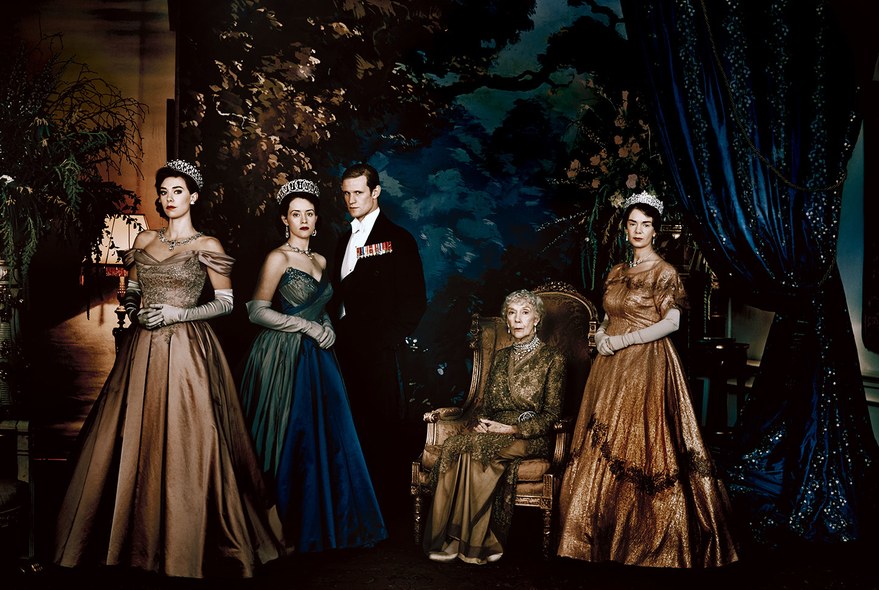
A small note: the casting and acting is close to flawless, with minor exception. Jared Harris (above r), a fine actor, still could not make me suspend disbelief because he looks so unlike King George VI (above, l) no matter how well Harris plays death's door from the opening scene. Greg Wise (Mountbatten) has the Windsor look. The small girls who played young Elizabeth and Margaret were perfect, easy to picture growing up into the adult sisters. At any rate, for anyone into modern royalty, "the Crown" is 5-Star worthy. Below, from l, Princess Margaret (Vanessa Kirby), Queen Elizabeth (Claire Foy), Prince Philip (Matt Smith), Queen Mary (Eileen Atkins), Queen ''Mum" Elizabeth (Victoria Hamilton).

Overheard at Downton Abbey, 
via Violet, Countess of Grantham: 
"You Americans never understand 
the importance of tradition." 
Mrs. Levinson: "Yes we do; 
we just don't give it power over us.
Maybe you should think of letting go of its hand." 
...from Season Three, Episode One 

Life's but a walking shadow, 
A poor player 
 That struts and frets his hour upon the stage
And then is heard no more. 
It is a tale 
 Told by an idiot, full of sound and fury, 
 Signifying nothing.  
...from Macbeth by William Shakespeare 

The above post was written by our 
monthly correspondent, Lee Liberman