The history of Polish army hero
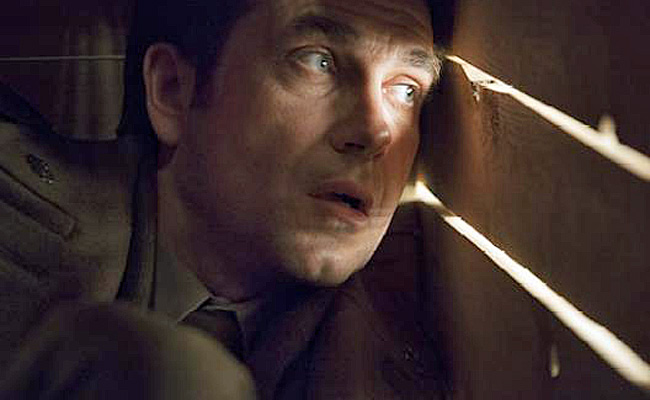
Colonel Ryszard (Richard) Kuklinski is a separate endeavor from the tension-filled thriller
JACK STRONG now streaming on
Netflix and starring
Marcin Dorocinski. Polish writer/director
Wladyslaw Paikowski (
Aftermath) chose to deliver on suspense rather than biography or history.
That's not bad, as the suspense is as entertaining as Hitchcock and there's plenty back story elsewhere to fill in the blanks. While Polish audiences know the history and context of
Jack Strong, for us the film does not impress upon us enough how much this man mattered to American and world stability. However, a vivid thriller may be just the right medium to help along the process of righting Kuklinski's still-abused reputation in his home country by plunging Polish viewers into the drama of what he did for them and the price he paid. (The Kuklinski family, as seen in the film, is shown below.)
Reading subtitles in English while watching a taut plot unfold somewhat degrades comprehension -- hence some background. Post WWII, the Soviets have their thumb on Poland and other members of the Cold War bloc; an arms race is beginning with the West.
Turn up the ominous music. The tale opens with the execution of Polish spy Oleg Penskovsky who fed information to the U.S in the 1960's and met an unceremonious end heaved by thugs into the furnace of a steel mill.
Change scene to a darkened interrogation room where a now older Kuklinski is telling his story, we know not to whom or to what end. From here his life as a spy unfolds in flashbacks. Like his father, Kuklinski was a proud Polish military lifer. His prodigious output led to his swift rise in the ranks, praise from Soviet and Polish superiors, and involvement in top secret military planning. It is safe to assume Kuklinski resented Poland's subjugation by the Soviets. But the escalation of Soviet Cold War activity that could put Poland at the center of a future conflict, began to worry him. One spectacular project he was assigned in 1968 was to develop a set of complex military exercises to be staged in East Germany to distract attention from Soviet skirmishes with China.

His output (above, his presentation to Soviet generals) coincidentally replicated secret Soviet plans already formulated for war against NATO. The Soviets thought he was a genius, but Kuklinski now knew that Poland was the intended battering ram against the West. Poland was to be the Soviet invasion route, and Soviet aggression could turn his nation into a nuclear wasteland when the West hit back.
Kuklinski's tipping point coincided with world-wide student and worker protests against the Vietnam war and in favor of civil and worker rights. In 1970 Gdansk, 3000 Solidarity shipyard workers were fired upon by virtually the entire Polish army. Kuklinski's comrade admitted he cried but he fired -- they all fired on their own Polish workers. "We aren't Poles now, our souls have ugly Soviet faces." Around then, Kuklinski contacted the American Embassy in Bonn, offering to pass Soviet planning documents to the West.
Taking no money, he left messages for a US embassy diplomat hidden in a rock wall and progressed to texting on a CIA prototype of a cell device, reducing the danger of cruder contact methods. Still, from 1972 to 1981 his daily life was furtive and fraught until the KGB finally closed in on him after knowing for years they had a leak in their top ranks.
Many Russian and Polish players in Kuklinski's world are reminiscent of the jowly, Trumpish, table-pounding blowhards from the Soviet era, although for relief, American CIA handler, David Forden, is played by the always competent and attractive
Patrick Wilson (below, left). For those of us who were alive during the Cold War, this film is a sharp memory jolt.
Kulkinski's home life was as stressful as work -- family conflict resulted from his silence and his mental and physical absence. His wife (played by
Maja Ostaszewska (see her in second picture from top and below) suspected him of having an affair and one rebellious son was furious with his father's presumed Communist loyalties.
The years post-1981 are only touched on. For the whole story, a more traditional bio-pic is warranted for this hero. We know from the record that even now some Poles think Kuklinski was a traitor not a patriot. He was sentenced to death in absentia by old regime carry-overs -- understandable -- but even freely-elected labor leader Lech Walesa refused a full pardon. It took President Bill Clinton to make Kuklinski's pardon a condition of Poland's admission to NATO. The bio-pic maker of Kuklinski's life-in-full will have plenty of subject matter on the thankless plight of a moral man who becomes a spy (the ID card of the real Kuklinski, below).
Many accounts of Rhszard Kuklinski's life exist on line. Some describe advocacy for him by several presidents including President Jimmy Carter and his National Security Advisor, Zbignew Brzezinski (shown below, right, together with the man who plays him,
Krzysztof Pieczynski). It was Brzezinski who coined the phrase 'the first Polish officer in NATO' which became a rallying cry for Kuklinski's exoneration at home. We owe Klukinski as much admiration here as any of our own war heroes, yet he's virtually unknown.
Note One: Zbigniew Brzezinski, in his late 80's today, is one figure still active in foreign policy today who factored greatly in the Jack Strong case. He is a professor at John's Hopkins, a scholar at the Center for Strategy and International Studies, on various boards and councils, and a regular commentator on news programs, including 'Morning Joe' on MSNBC anchored by his daughter Mika Brzezinski.
Note Two: Click
here for article from a Wesleyan University magazine about CIA Agent David Forden (Wesleyan '52) and his adventure with Kuklinski. It amplifies the movie plot and answers questions on a number of points.
The above post was written by our
monthly correspondent, Lee Liberman.