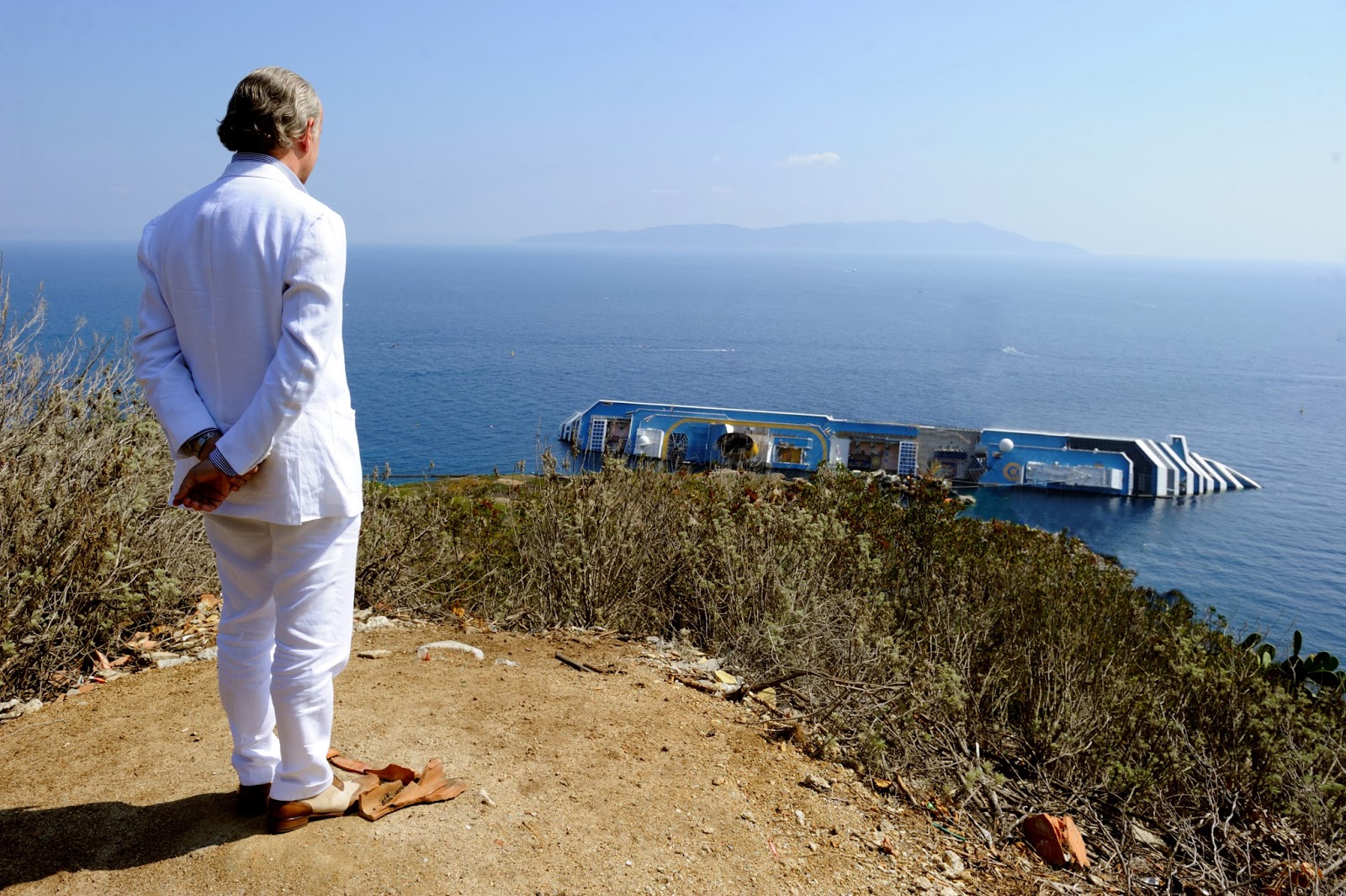
Paolo Sorrentino is back. He of
Il Divo,
The Family Friend,
The Consequences of Love and the woefully under-seen and under-appreciated
This Must Be the Place has a new movie opening this Friday in New York (next Friday in L.A.), and it's Italy's submission as Best Foreign-Language Film.
THE GREAT BEAUTY (
La grande bellezza) is a film of exactly that. What else would anyone who appreciates international cinema expect of Signore Sorrentino (shown at left), who, to my mind, produces frame for frame the most beautiful compositions of anyone working in the medium today and then elides them into something both mysterious and spectacular. (His cinematographer here is the great
Luca Bigazzi --
Kryptonite!, click and scroll down -- while the film editing is by
Cristiano Travaglioli.)
More than any of the five films I've seen of this master (he's now made six full-length narratives, though I don't think his first,
One Man Up, has ever been released in the USA, theatrically or on DVD),
The Great Beauty seems to me to be the film that requires the most full understanding and appreciation of Italy, and specifically, Rome.
In this movie, the images pass by with great poise and sophistication, and the visual pleasure is non-stop. The meaning of those rolling images, however, is not so easily ferreted out. For old-time film buffs, an almost immediate reminder of
Fellini and his
La Dolce Vita and
8-1/2, as though
The Great Beauty were an updating of these a half century later. And in some ways, it is. But Sorrentino is so much subtler a director than was Fellini that any comparison goes only so far.
Sorrentno's Rome, as experienced via that fine and hugely versatile actor he so often uses --
Toni Servillo (above)-- is a place of great beauty and desolation/desiccation, of wonder and horror. Yet the images this writer/director chooses and uses, instead of reducing their subject to the cliched visuals of Hollywood horror or beauty, instead often brings you both in the self-same shot. Intellectually, the movie is constantly pulling you up short, as well as pulling the rug from under your preconceptions.
Everyone is at once grand, foolish, awful and beautiful -- rather like life and that fellow/gal in the mirror we must daily confront. As our guide, Servillo -- playing a 65-year-old journalist/novelist named Jep Gambardella -- brings to the film the sort of quiet ease of a man who has seen and done most everything and now understands the fatuousness of so much that has passed for "life."
As befits his character, Servillo has seldom seemed this secure in himself and his place in the world of the film. He imparts a remarkable grace and stature to the proceedings. Whether he is putting an egotistical career woman in her place (then later dancing with her like a pro) or advising a foolish but wealthy mother what to do about her clearly unbalanced adult son, there is about the man a kind of weary wisdom that is both consoling and upsetting, as though he understands all and knows that there is nothing to be done about anything.
We get a look at journalism and performance art in a quietly hilarious interview with a dolt of a performance artist; then, in an even more hilarious scene (above) in which a child creates "fine art" (this will call to mind
My Kid Could Paint That, and even more so the recent and much fawned-over documentary about artists and relationships,
Cutie and the Boxer), we see what goes into the creation of "modern art"; religion shows its silly faces in both a Mother Teresa-like character and a prominent Catholic high-mukety-muk.
Love? Ah, yes: that, too. And it's a wild and deep and forever-with-us "first love." Except that it proves as specious as all else. Even the old friend who now runs a strip club business (in which his middle-aged daughter does the stripping) proves more interesting and enduring than anything like "love." Boy, this is a dark movie, beautiful as it is. And the more I consider it, the darker it grows -- but so quietly and un-insistently that I can hardly wait to see it again.
The only thing missing (unless I myself managed to miss it) is politics. But then, Sorrentino gave us plenty of this with
Il Divo. The music, as always with Sorrentino, is a blessing over the entire film, providing the kind of religious beauty and peace that religion itself cannot.
If all of the above sounds like a rave review, I must warn you that my spouse gave up on this film after about an hour and a half (the movie runs almost two and one-half hours). And I myself felt a bit flummoxed at the finale. I'd been unable to take my eyes off the screen for fear of missing any of that "great beauty," but what did it all mean? You got me. Since then, however, I've been thinking about the film, piecing it together, and now in writing this reviews, the movie has taken on even more meaning. I will indeed watch it again.
The Great Beauty, one of those rare new releases from
Janus Films, opens this Friday, November 15, at the
Lincoln Plaza Cinema; on the 22, it opens in Los Angeles at
Landmark's NuArt, and over the next few weeks it willl opens at another 15 - 20 cities. Click
here to see all currently scheduled playdates.