Showing posts with label Sally Hawkins. Show all posts

Thursday, July 6, 2017

Aisling Walsh's sweet and moving MAUDIE showcases Sally Hawkins and Ethan Hawke


Golden Globe Best Actress-winner and Oscar Supporting Actress-nominee Sally Hawkins tends to make major waves in small independent movies such as Happy Go Lucky,  Blue Jasmine and All Is Bright (among her more than 50 credits so far). She's doing it again in this year's MAUDIE, a Canadian film in which she gives such an outstanding performance -- different in a number of aspects from all else she's done and consequently sure to be overlooked by the Academy at awards time (just as Rebecca Hall's amazing turn as Christine was last year). Nevertheless, if there is a better performance by an actor or actress this year, TrustMovies will be very surprised.

As written by Sherry White and directed by Aisling Walsh (shown at right), Maudie tracks the adult life of an artist most Americans will not have heard: Maude Lewis. As motion pictures go, this one is a fairly typical biography that breaks no new ground style-wise and yet is consistently fascinating and compelling, thanks to Ms Hawkins, who captures the physicality and personality of the artist in a simply amazing manner. Maud suffered from rheumatoid arthritis as a child and never fully recovered. Consequently her ability to walk and do some other normal movements was impaired but not destroyed.

The manner in which Ms Hawkins (above and below) manages to convey the life -- physical and interior -- of this unusual woman, as well as her understanding and appreciation of art and how it arises from the world around her will more than likely have you thinking you're watching a documentary, so far as this amazing performance is concerned.

The smart way in which White and Walsh give us Maudie's back story -- quietly and in small doses -- allows us to learn about her in similar fashion as does the man she meets, works for and eventually marries: tiny moments that keep enlarging and enriching the character. As played by Ethan Hawke, below, who lately keeps giving one swell (but mostly unheralded) performance after another, this man, Everett Lewis, is by turns slow, angry, caring and strong. Though Hawke looks literally nothing like the tall, thin, and not particularly attractive real Everett Lewis, I  think it's unfair to hold the actor's good looks against him. He adds his talent -- together with some box-office draw -- to a movie that is certainly all the better for it.

Supporting characters are sparse and given not nearly the screen time of our twosome (and the art), but a few of them register strongly, all the same, in particular the more wealthy and sophisticated New York woman who first brings Maude's art to greater attention (Kari Matchett is excellent in this role). Also fine are Zachary Bennett and Gabrielle Rose as, respectively, Maude's money-grubbing brother and angry aunt.

The musical score by Michael Timmins is lovely, as is Guy Godfree's cinematography. The entire movie is handled with a light touch rather than an iron glove (this is particularly telling in the scene involving Maude's daughter), leaving the heavy work to Hawkins and Hawke -- both of whom come through as brilliantly as you could want. As befits a story about a folk artist, Maudie is a "folksy" film -- simple but never dumb; quiet, with a lot on its mind; and curt and staunch when necessary. It's not a great film, but it is a very, very good one. You'd be foolish to miss it.

From Sony Pictures Classics and running 116 minutes, after opening in New York City, Los Angeles and elsewhere in the past couple of weeks, Maudie moves to other major cities this week, opening here in South Florida in Miami at the Tower Theater, Fort Lauderdale at The Gateway, in Boca Raton at the Living Room Theater and Regal Shadowood, and at the Movies of Del Rey and Movies of Lake Worth. To see currently scheduled playdates, cities and theaters, click here and scroll down.

Saturday, November 16, 2013

Blu-ray/DVDebut: Giamatti, Rudd & Hawkins brighten Phil Morrison's ALL IS BRIGHT


The beauty and necessity of indie films stars are put on show in this little independent movie that came and went from theaters in the blink of an eye but can now find its place in film-goers' hearts and minds in a very good Blu-ray transfer that hits the street this coming Tuesday, November 19. ALL IS BRIGHT is about thievery and the criminal as-pect, among other movie constants such as family, love, divorce and coming to terms with what's best for your offspring.

As written by Melissa James Gibson (who penned several episodes of cable TV's The Americans this past season) and directed by Phil Morrison (shown at left, of Junebug), the movie is a parable of how to survive our current bleak economic times.

Those talented Pauls, Rudd and Giamatti, play criminal friends who also share a love for the Giamatti character's wife (Amy Landecker) and child (a talented newcomer named Tatyana Richaud). So Giamatti, just out of prison, on parole and needing immediate employment, talks Rudd into letting him replace another worker selling Canadian Christmas trees in New York City. (The scene in which Rudd tells that worker he's not needed, shot from a distance so that we cannot hear any of the dialog, is one of the film's sweetest, saddest and funniest.)

Down in New York City, Giamatti's first sale is to recent Russian immigrant played in fabulous style by that versatile British actress Sally Hawkins (above, right), who brings the movie a much-needed lift whenever she appears. Otherwise, the Pauls (below, with Rudd on the left) argue and sometime fight, finally managing to sell their trees and earn a nice bit of cash, while trying to convince the other that he's the wrong guy to head the family in question.


All Is Bright's a movie of small pleasures. Ace performances from everyone ensures that anyone who appreciates good acting will stick with the film. The writing too, is full of quirk, charm and a relatively high level of beliveability, given the combination of reality and sentimentality that hovers over the situation. Morrison directs in a simple, offhand manner that lets the actors grab the ball and run with it -- which they do at every opportunity (Morrison and Gibson have given them ample).

And that's pretty much it. There is an interesting viewpoint toward criminality here, what it does to our boys and how it comes back to bite them in the ass. There's also a smart look at immigrants in NYC, and at the haves and the have-nots. Nothing too deep, mind you; there is that air of sentimentality I mentioned earlier that comes home to rest at the finale. And yet. The writer and director and their cast manage to finally circumvent this just enough to let us feel the sadness and pain while exulting in the final decision made -- which seem the right one, considering all that we've come to know.

All Is Bright, from Anchor Bay Entertainment and running 107 minutes, is one of those worthwhile independent films that can easily escape notice. So be aware, particularly if you're a fan of this trio of fine performers.

Wednesday, November 17, 2010

Hawkins, Ivory, Cole and a fine ensemble make MADE IN DAGENHAM arthouse fun


With Saving Grace, Calendar Girls and now MADE IN DAGENHAM, director Nigel Cole proves that, with decent writing and a good cast, he can give us smart, topical, mainstream movies that will fill up American art cinemas -- at least for a week or two -- after which they will find their way to healthy ancillary profits. Cole's work gets better, film after film, and Dagenham is his best yet. This is a movie with a message that could hardly be more timely. It takes us back to pre-Thatcher England, when the Brits -- aw, screw it: the entire western world -- had a firmer grip on the difference between right and wrong, truth and lies, fair and unfair.

Cole, shown at left, and his team -- including William Ivory (writer, mostly television), Sally Hawkins (star) and an exceptionally fine ensemble, each of whom captures his/her character in delightful and very specific fashion -- take an important piece of labor (and Labour Party) history and turn it into rabble-rousing (if sometimes a tad too convenient) life. What happened in Dagenham, the location of the British Ford plant, when its women workers wanted to be recognized as "skilled labor" who should earn something approaching the wages paid to men is the subject of the film, and it could hardly be more timely in many ways. The importance of unions -- when they actually serve the workers who fund them -- is something western nations need to remember just now, and the film offers up this message with surprise and sass.

Screenwriter Ivory does a nice job of blending together several stories of these workers and their union rep (a wonderfully funny and moving Bob Hoskins, shown above, center), and he, together with the ace performers turns each of the characters into specific and very winning individuals.  (Hoskins' speech about his mom is a memorable marvel.)

Ms Hawkins, above, has her best role since Happy Go Lucky, and she makes the most of it: a relatively happy wife in a relatively typical marriage of that time period (the 1960s) who is thrust into the job of union representative and finds herself taking to it with relish and more. Hawkins combines humor, intelligence and vulner-ability with a strength that seems to come from deep within and which she can tap when needed -- but not without some pain.  She has pretty much cornered the market for this brand of pretty, plucky womanhood, and Dagenham gives her another chance to shine.

In the supporting roles are a number wonderful actresses, new and old: Geraldine James (shown center, above, with Hoskins and Hawkins) brings complexity and grace to her role of the older union rep, while Andrea Riseborough (below) is funny and frank as the most "out-there" of the younger women.

Jamie Winstone (below) is sweet and winning as a Ford worker who want to model (and unfortunately gets her chance), while Rosamund Pike (two photos down, with dish) brings her elegance and class to one of the movie's most interesting roles: the wife of one of the Ford factory bosses.

Ivory's script captures various views of the women's strike and what this does to the local town, and to its menfolk, suddenly out of work. He shows the toll taken on the individual women -- James and Hawkins, in particular -- as their own husbands begin to fall away from the "cause,"  one haltingly, the other permanently. And he gives an interesting look at a corrupted union man who consistently sells out his constituency to the factory owners.

It's in the character of one British woman, however, that the film finds much of its fun and satire: the new Secretary of State for Employment and Productivity, one Barbara Castle, played by Miranda Richardson in one of her rare, delightful modes (below, left: seen from back, with big bouffant).  She, among all the politi-cians and government employees shown, is the only one who seems to possess brains and gumption, and in fact might have you thinking of what Margaret Thatcher could have accomplished for Britain and its people had she been in the least humane or progressive.

Made in Dagenham is certainly a feel-good movie -- legitimately so, because of what these women accomplished and how the film gives them their due.  If it cuts a few corners and compresses time, events and characters, it still shows us the black, the white and the gray with humor and smarts.  It should leave you, first, walking on air as you rejoice in the outcome and the progress that was made a few decades back -- and then plummeting to earth when you wonder what the hell happened to it all, as greed, wealth and right-wing power conspire to further erode government, democracy and any decent standard of living.

The movie, from Sony Pictures Classics, opens Friday, November 19, in New York City and Los Angeles -- and elsewhere soon.

Saturday, November 6, 2010

On-Demand: With HAPPY EVER AFTERS Stephen Burke tackles two odd weddings


Sally Hawkins is an unusual actress in that she seems not to mind allowing herself to look pretty awful much of the time. No raving beauty, she can still be quite attractive, though we get only glimpses of this in films such as Happy Go Lucky, in which she created her biggest stir so far. Just recently she's been seen in Never Let Me Go, playing the teacher who gives her strange pupils their first dose of "reality," and she'll soon cause another stir in Made in Dagenham, playing the leader of the protest that eventually gave British women the right to equal pay. Folk who are fans of Ms Hawkins (TM counts himself as one such) can catch her these days on VOD in a middling rom-com featuring the ever-popular wedding theme -- times two.

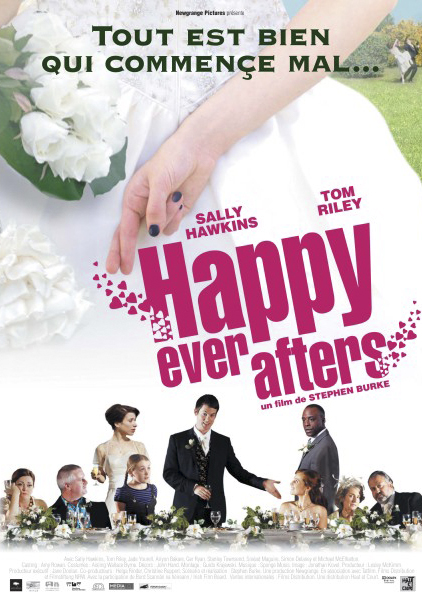
HAPPY EVER AFTERS, the semi-new Irish film from writer/director Stephen Burke, was given its first theatrical release in France in 2009 (hence the poster, above) and has the not-bad idea of conflating two weddings: that of Ms Hawkins character to a strapping and sophisticated black man and her co-star Tom Riley (shown at bottom) to a young woman (played by Jade Yourell ) whom he's already been married to and divorced from. Each couple's post-ceremony reception takes place in the same hotel at the same time -- which makes for all kinds of surprises and misunderstandings, many of these farcical but unfortunately not handled with a particularly sure comedic touch.

Involved in these goings-on are a wealth of characters -- from Hawkin's young and noticeably "fatherless" daughter to various relatives, friends and -- in the case of Riley's bride-to-be-again -- a group of funny ladies she meets in a pub who then tag along for the ride. Much of the humor come from Mr. Riley again and again being placed into what appear to be compromising positions involving the character played by Ms Hawkins.
 
A little of this goes a long way, and, in any case, this kind of thing needs crack comedic timing from the actors and particularly the director, who unfortunately simply keeps his cameras going and leaves the actors on their own. The interesting thing is that they are all, finally, good enough to keep us involved and relatively well-entertained. By the film's finale, after we've spent 24 hours (of movie time) with these characters and dawn has just broken, the cast have become a bit like old friends.  "Seems like we've been with these people for a long time," my companion noted, with some surprise, "and I don't mean that in a bad way."

Early on, the movie may seem a bit rocky, but stick with Happy Ever Afters, and you'll probably be glad you did. Although where can you see it?  That's the question.  The film is apparently available via IFC On Demand -- even though IFC appears to have neglected to mention the film anywhere on its web site or in its marketing. I checked my local reception provider, Time Warner Cable, how-ever, and found that it is indeed available. You might want to check with your local provider to make certain of its existence, as well.