Showing posts with label adventure. Show all posts

Sunday, November 19, 2017

November's Sunday Corner With Lee Liberman: BLACK SAILS


What’s to be done with the unwanted ones, 
the men who do not fit, 
whom civilization must prune from the vine 
to protect it’s sense of itself? 
Every culture since earliest antiquity 
has defined itself by the things it excludes. 
As long as there is progress, 
there will be human debris in its wake…
Sooner or later one must answer the question: 
what becomes of them? 
In London the solution is to call them criminals 
and throw them in a deep dark hole. 
I would argue that justice demands 
we do better than that; 
that a civilization is judged not by whom it excluded 
but how it treats the excluded. 
(...from Season Four, Episode 10) 

An unexpectedly original, ambitious, and close-up look at piracy during its heyday, BLACK SAILS (on demand at STARZ) is a prequel to Robert Louis Stevenson’s famous novel “Treasure Island”. The series is set in early 1700’s Bahamas ahead of Stevenson’s yarn and winds down with the burial and abandonment of a fabulous cache on ‘Treasure Island’s mysterious Skeleton Island. Fictional characters from the novel mix with real pirates of history to make the colorful and mostly entertaining tale spun by co-creator’s Jonathan E. Steinberg and Robert Levine (l and r, below).

I emphasize ‘mostly’ because the show-runners did not get a grip on the story until season two. The project’s attachment to producer Michael Bay’s first TV project (he of Armageddon, Pearl Harbor, and Transformers blockbuster riches) likely enticed STARZ to approve four seasons even though season one was a dud. (New Yorker critic David Denby called Bay “stunningly, almost viciously untalented”, to which Bay is reported to have replied: “I make movies for teenage boys. Oh dear, what a crime.”)

But never mind — Black Sails’ fanbase was rapturous and went beyond teenage boys. After season one, the writers developed a thought-provoking narrative surprising for an action series. Set in a pirate milieu we know most through myth and fable, we find the machinations of the colonial powers, the slave trade, and a community of maroons (slave escapees) who are hidden away from island civic life with lethal ways of staying hid, their own rituals and hierarchy.

There are plenty of invigorating ship battles, land skirmishes, personal conflict, and roiled forces of nature photographed so intimately you can feel the sea boil and the sun parch. But the action derives its thrills not from adventure but because you have become engrossed in the lives of the characters, acted by a terrific cast hailing from at least six countries.

The theme of Black Sails is a tug of war over Nassau between colonial Britain and rebel pirate desires for a haven of their own. The pirates hoped to make their new world not just an extension of the old but autonomous and free — pirate havens were early democracies before the great powers got around to them, organized to provide as much individual liberty and equality as possible. Here, their collective self-government grows into a collaboration between maroons and pirates, the former adding their numbers to throw at British and Spanish military who sought to quell slaves and hang pirates. One rides out this narrative knowing the rebels are doomed — the pirate heyday will last just a few decades, after which international piracy laws and military presence will end their golden era. 

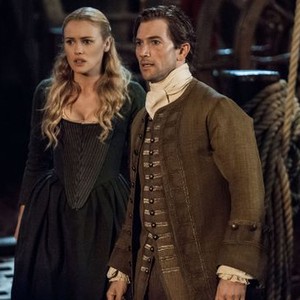
The first season involves pirate pursuit of the Urca, a Spanish galleon carrying a vast treasure, adventure that deserved no more than a couple of episodes. The booty remains at issue among the Spanish, British, and pirates from series start to finish, eventually ending up on Skeleton Island, respectfully teed up to mesh seamlessly with Robert Louis Stevenson’s novel. One character, Eleanor Guthrie (Hannah New), who fenced pirated goods and managed commerce in Nassau’s pirate haven, lurches between wanting Nassau to be self-governed, and coming to embrace new British Governor, Woodes Rogers (Luke Roberts), first as his captive, as a means to this end (Ms New and Roberts are shown below).

Woodes Rogers was a (real) Brit who inherited his family shipping business, became a sea captain and was appointed Governor of the Bahamas twice, eventually establishing order, although (accurately) Black Sails leaves him bankrupt and defeated after his first stint on the job. His assignments as governor grew out of the rise of armies in Europe whose missions included stamping out piracy because it disrupted commerce and the slave trade.

The pirate response to colonial corruption led them to evolve their own self-management. (‘Every man has a vote in affairs of moment…’) Among them were refugees from persecution and sailors experienced in navel warfare seeking employment. According to Pirate Captain Bartholomew Roberts (1682-1722), there are low wages and hard labour in an honest service, while the life of a pirate offers reward and liberty.

Among the pirates in Black Sails’ fictional world are Stevenson creations Long John Silver (Luke Arnold), Billy Bones (Tom Hopper) and Captain Flint (Toby Stephens), shown above, from left.

More major players were pirates who did exist such as Charles Vane (above, far r) created by the unexpectedly magnetic Zack McGowan. Vane was a protégé of Edward Teach — more famously known as Blackbeard (at right) played by Ray Stevenson.

Also real, was the dandyish, erudite Captain Jack Rackham (Toby Schmitz) who produced the famous skull and crossed swords flag and contemplates his legacy: “It’s the art that leaves the mark; it must transcend.” (Writer J. Steinberg comments: his piece of artwork will outlive him and all of us.)

Rackham’s brooding pirate lover, Anne Bonny (the very good Clara Paget) is shown below, with Vane and Rackham.

Flint, however, is the impresario, carrying this saga on his steely frame. Toby Stevens has the same upright bearing of his mother, Maggie Smith, in her portrayal of Violet, Countess of Grantham of Downton Abbey. Their show of determined obstinacy and resemblance is marked.

Flint owns Black Sails, yet is unknowable. Our interest in him, beyond observing his ferocity and genius for leadership, develops in season two when his backstory begins to unspool slowly in flashback culminating in episode 2.5. We see him in early career as affable young Lieutenant James McGraw, assigned in 1705 as naval liaison to the Hamiltons in London —the elder Hamilton an earl and son Thomas a member of Parliament, whose wife Miranda (Louise Barnes) is penetrating, wise, and lovely. Thomas Hamilton (Rupert Penry-Jones) wants to assemble a colony on Nassau, install an honest governor, and most notably, grant full pardons to the pirates — a scheme that is anathema to his father, the earl. (Below, from l, Miranda, Thomas Hamilton, James McGraw.)

McGraw slowly embraces the reform idea and comes to admire Thomas’s idealism. (Miranda says: you can recognize a great man by his relentless pursuit of a better world.) She knowingly seduces McGraw into an affair with both herself and her husband. The elder Hamilton gets wind of it, and uses their ‘disgrace’ to thwart the despised plan. Thomas is confined to an institution or dead; Miranda and McGraw are permitted to vanish. They go to Nassau where he morphs into his Ahab-like Captain Flint and they share a home when he’s not pirating.

We now see that Flint’s rage at being designated a non-person because of his love for a man has driven him headlong into a relentless career getting even with the establishment. McGraw’s naval mentor, Hennessy, when dismissing him from service, intones: “Every man has his flaws but not this, it is too profane.” Later Miranda insists he is ‘fighting to fight’ always in the midst of violence and danger to forget his shame over having loved Thomas.

Flint channels his remaining bits of humanity into a working relationship with John Silver, an ingenious fellow who loses his leg during the series (and gains the ‘Long’) but is more than Flint’s equal in getting his way. Together they become an unparalleled team and defeat Woodes Rogers at sea, ending his first governorship of Nassau. Silver orchestrates an agreement between the pirates and the maroons (he has fallen in love with the queenly Madi). And there’s an improbable series end for Flint, as Silver both drives him out of piracy and devises a heart-rending rescue for him (bottom image).

As the tale progresses, much relationship deepening and fracturing increases the series' addictiveness along with stunning sea action sequences and absorbing visits to Cuba (run by Spain) and several American colonies. We grow with Max, (Jessica Parker Kennedy, below) a beautiful, mixed-race prostitute who loves women and climbs her own ladder of power. Hannah New’s Eleanor Guthrie fares less well. This is New’s second major role, following the Spanish series “The Time In Between” (Netflix) in which, speaking fluent Spanish, she was lovely. Here, she has unconvincing ‘badass’ moments in which too many “f—k” swears make her less not more so. She is too much of a nurturer for this part. However the excellence of the ensemble as a whole and the increasing urgency of the story arc once underway does not leave the viewer wanting.

If adventure is your thing, thoughtful revelations about race, love, and power in the context of chaos and competition among players will be a bonus. If you normally shun the adventure genre, you will find much here to satisfy your need for deeper material once you slog through (or better, skip almost all) season one. The Flint/Silver relationship especially takes you into their power struggle, willingness to kill each other, and well of genuine caring that matures through the seasons. Black Sails was filmed in Cape Town, South Africa (on a set and with ships just repurposed by Outlander for its voyage to/in the Bahamas during the late 1760’s, debuting now on STARZ).

Each episode opens with a smashing musical theme by Bear McCreary (also the music director for Outlander) using the hurdy-gurdy to striking effect; it accompanies a spectacular series of computer-generated alabaster and bronze pirate sculptures inspired by Rodin, Bernini, and anonymous carvings found on ships, crypts, and gravestones in Baroque, Gothic, and Rococo style. Watch this.


The above post was written by our 
monthly correspondent, Lee Liberman.

Wednesday, October 14, 2015

Rick Famuyiwa's DOPE is smart, funny entertainment--with a necessary message


You'll know you're in good hands almost immediately as DOPE begins, sporting a bevy of definitions for the title word: drugs, a dumb person, and something that's good (as opposed to wack -- or maybe it's whack -- which is bad). That last definition may take you back to the parlance of the 1980s, a time period much treasured by the movie's leading young man, Malcolm (played with a fine combination of budding everything -- from sex appeal to intelligence to, yes, even maturity -- by Shameik Moore. Malcolm wasn't around in those "halcyon" 80s days, but he loves the music of that period, which has inspired him and his friends to create some more of it. The movie was written and directed by Rick Famuyiwa (the filmmaker is shown below), who, back in 1999 gave us the overpraised but still worthwhile The Wood. After several movies in between, Dope proves his best so far and by far.

Above all Dope is an entertainment -- not a bad level to which to aspire, particularly when the outcome is as entertaining as it is in this case. Mr. Famuyiwa's screenplay -- his dialog, narration, pacing, events depicted and in particular his understanding of the way the world works in the black ghettos of Los Angeles (the movie is set in Inglewood, California, a city TrustMovies lived in back in the late 1940s and early 50s and recalls rather fondly) -- is smart, often witty and whenever it gets preachy, it does so in a way that should make you smile, if not outright laugh. As a director, Famuyiwa seems to be trying some new stylistic tricks, most of which work pretty well. His speedy cutting between scenes, occasionally going back to show us what was left out, or substituting a bit of fantasy for reality all seem in service to telling his story in the most appropriate, cliche-free way.

The key to the movie's success lies in Famuyiwa's focusing on kids who are geeks and nerds, rather than the usual street kids with problems we most often see in movies about blacks and other "minorities." This allows us to enjoy a kind of "revenge of the nerds, black-style." For most white audiences, this will mean the opportunity to identify with these kids more easily than usual. The movie's keenest insight, however, may be that, to succeed, our hero must be both "street" and not. How he does this -- involving a successful pillar of the black community who acts as adviser and mentor to the kids (played with exquisite nuance by Roger Guenveur Smith) -- proves Dope's ace-in-the-hole, grounding the film in a sad reality, even as it teases and entertains us into such high spirits.

The supporting cast includes the likes of  Kimberly Elise as Malcolm's mom, Tony Revolori (above, right and everyone's favorite bellhop from The Grand Budapest Hotel), Zoë Kravitz (below, right) as the apple of Malcolm's eye, and Kiersey Clemons (above, left) as the lesbian high-schooler and gal pal, Diggy. As strong as the movie is concerning its hero, it is equally weak regarding most of the subsidiary characters, who are, for the most part, one dimensional. This does not destroy the film by any means but it makes it a long way from great. Yet, as I say, it's a smart entertainment, as well as a look at an under-served portion of the black community. And that, these days, is nothing to sneeze at.

From Universal Pictures and running 104 minutes, Dope hit the streets on DVD/Blu-ray/Digital HD yesterday, October 13--for rental or purchase.

Sunday, January 18, 2015

Lee Liberman on Netflix streamer MARCO POLO: Better than you've heard; try it--and stick with it


This post is written by our Sunday Corner 
correspondent, Lee Liberman

Happily, Netflix has renewed John Fusco's gorgeous and thoughtful epic MARCO POLO for a second season. The critics were harsh for good reason but viewers liked this medieval Asian game of thrones, devised by Fusco (shown below), a screenwriter and novelist, as well as the showrunner for this series.

The 90 million dollar first 10 episodes depict Marco Polo's conscrip-tion into the service of Mongol ruler Kublai Khan as the Khan pursues his ambition to rule all China.

For similarity to the Asian Steppe, Kazakhstan is Fusco's vast and beautiful canvas; studios in Malaysia provide the interiors. The costumes are richly handsome, the score engrossing, especially Mongolian throat-singing and instrumentation -- and the falling, bleeding ink drawings that contain the opening credits are magic.

An interesting (if sometimes awkward and stilted) script is textured with believable relationships, rivalries, and provocative discussion among fathers, sons, and ministers on the merits of diplomacy versus war. If you watch -- do listen.

The argument feels particularly modern. On the other hand, love gets short shrift, consisting of gauzily filmed writhing concubines and a few perfunctory love scenes. It's the emotionally-neutered titillation we have come to expect of most cable series. (An exception is genuine affection and respect between Kublai and Empress Chabi.)

The epic starts in Venice (above) and follows the perilous 3-year caravan of Polos (father, son, uncle) to Mongol capital city Cambaluc (now Beijing) -- a journey that wraps in half an episode. Travel and trade are the least of the story -- this tale is about military conquest, empire building, and family.

Arriving in disfavor, Niccolo Polo barters the service of his son to Kublai in exchange for continuing trade in Mongol territory. Thus abandoned by his father, Marco's in-and-out of favor role as servant/advisor begins. The Khan had a craven father (the alcoholic Tolui, fourth son of Genghis, who died young), and he acknowledges Marco's dismay. Kublai tells Marco: "I was about your age when I knew I had to become the man I wished my father were." Marco rises to the challenge and the Khan becomes the father figure whose approval Marco wants to gain.

Kublai's grandfather Genghis (d. 1227) was the first nomad chieftain to expand Mongol territory, his armies fighting galloping battles on their small strong ponies into Central Asia, parts of the Middle East and to the East as far as Korea. Genghis's heir, Ogedai, expanded farther into China, Persia, Russia, and other Asian city states. The geographic holdout was the Song Dynasty in Southern China. There was a gap of years after Ogedai died until Kublai became Khan and resumed Genghis's quest to conquer the Song. Kublai succeeded in 1276, helped in our story by Marco's knowledge of Western war machinery. At that point Kublai became the ruler of the world's largest contiguous land empire reaching from Europe to the ocean; it was to break apart in less than 150 years.

That the flaws in this tale of Marco Polo mar its enjoyment only a little is a tribute to the success of the whole -- an unusually lovely, sweeping, and engrossing portrayal of 13th century Chinese and Mongol politics and culture. The weakness-in-chief is Lorenzo Richelmy (above) as Marco Polo. Richelmy is said to be a rising young Italian star and deserves credit for learning English and Mongol warrior skills in a few months prior to filming -- well done that. But his screen presence is vacuous; there's nothing in the eyes and his hollow affect leaves a hole in the tapestry. (Mr. Fusco, please import James Franco to your set to teach Richelmy how to animate Marco per Franco's Tristan in Tristan and Isolde (2006), or better yet, give Franco the part.)

Never mind Marco, Kublai himself (Benedict Wong, shown above), rises like a lion to occupy the center of this story. (A YouTube of British actor Wong reveals a mild, modest man compared to his outsize screen presence.) Kublai is present even when he's not and his interactions with his family and subordinates offer a striking portrait of leadership, management, ruthlessness, and family love.

Kublai's younger brother Arik played by Mongolian actor, Baljinnjamyn Amarsaikhan, prefers to do business with the Song rather than conquer them. Arik wants to rule the Mongols -- Kublai wants to rule the world. On this they have words, embrace one another, and cross swords in the morning on a killing field, above.

The court of the Chinese Song Dynasty has its own cast of hawks and doves dominated by maniacal Chancellor Jia Sidao (Singaporean actor, Chin Han), the cunning "cricket minister" obsessed with the killing tactics of the Praying Mantis. It has the traits of a warrior king, says Sidao -- patience, speed, adaptability, and ruthlessness, which Sidao employs to deadly effect below.

Many players in this international assembly revolve around Marco and reveal Kublai's insatiable curiosity about other cultures, which Fusco reflects in his casting. Rick Yune (Kaidu), of Korean descent, is the only American-born actor (a Wharton graduate). Joan Chen (American immigrant from Shanghai), Empress Chabi, is entirely devoted to Kublai. She chooses his concubines and manages the harem both to minimize his demands on her for intimacy (he having grown unpleasantly fat) and to maintain her control over his affections.

Prince Jingim (Remy Hii, above, left, an Australian of Chinese/English parentage), the handsome heir, has a Chinese name and been tutored by Chinese scholars in preparation for his eventual rule over a united Chinese Empire. Jinghim's jealousy of his father's interest in Marco waxes and wanes with his own wins and losses as he matures into warrior and diplomat. "I realize now how much pressure one is under turning a son into a man....." Jingim tells Chabi. And the Prince must navigate among competing courtiers -- finance minister Ahmad (Indian Australian, Mahesh Jadu), soft-spoken war hawk, and wise vice-regent, Yusef, a devout Muslim, who counsels diplomacy and cautions against expansion. Yusef explains quietly that egos destroy empires not armies -- Kublai is driven to the (Song) wall by the ghost of Genghis. (Yusef is played by major Egyptian film star, Amr Waked.)

Hundred Eyes, blind Taoist monk (martial arts master, British Tom Wu, shown above, right), schools Marco in warrior skills, his flinty sarcasm turning into loyal support. The martial artist explains to Marco: kung fu is not just how to fight but rather the relentless, exhausting effort it takes to perfect one's art, whatever the medium.

Another weakness of this saga is lackluster romance -- most disappointing between Marco and Blue Princess Kokachin (beautiful Chinese pop princess Zhu Zhu, above, right) but also affecting Byama and Kutalin, two attractive Mongol warriors. The standard for series romance has now been set by Diana Gabaldon's and Ronald D. Moore's collaboration on Outlander (Starz) making surface treatments much less welcome. Opportunity is missed with a Marco/Kokachin story arc that is confusing, stilted, and almost entirely lacking in sexual tension. Romance is not on Fusco's radar despite the pretty picture.

The action that does dominate the screen most affectingly is the domestic and political interplay at both the Mongol and Song courts and the steady escalation of tension and intrigue as war approaches. (The series catches fire too slowly but early episodes are much better after you see the entirety and then revisit early chapters.) Meanwhile wild goose chases, assassination attempts, episodes of torture, battle, and failed diplomacy march forward to the inevitable final confrontation. Watch it unfold on Netflix for many hours of visual pleasure and thought-provoking discussions of war and peace. Click here (or maybe on the photo itself) to enlarge The Khan Empire, shown below. in order to read the captions on this visual map of major characters and their relationships.


Two special notes: 
1. Ju Kun of Beijing, China, a martial arts choreographer on the Marco Polo project, went down on Malaysian Airlines Flight 370, the plane lost mysteriously on March 8, 2014. Australian authorities carry on the deep water search 1000 miles off the coast of Perth, having recently added an underwater drone to their equipment.

2. "Mystery Files: Marco Polo" narrated by Brian Dennehy on the Smithsonian Channel (2011) is a provocative short documentary on Netflix that challenges assumptions about Marco Polo. The contention-in-chief is that there is no documentary evidence of one man involved in the stories described in the Polo books. Polo is known absolutely not to be the author of his stories. Rather he is said to have described his adventures while in jail to Rustichello of Pisa, a historical romance adventure writer who is known as a source of versions of the Arthurian legends. There are more than a hundred differing versions of Rustichello's Polo travels, though no first edition.

Scholars now suppose Rustichello assembled information from various travel accounts and made Marco Polo the hero of them, creating legend not unlike that of King Arthur in which the facts vary with retelling. There was a Polo family of merchants in Venice and one named Marco who might have traveled to China, but there is no proof of such travel. The lifespan of the Marco Polo of fact does not match up with battles and other occurrences annotated in Chinese annals of the time that Polo was said to have participated in, such as the siege and conquest of the Song in 1276.

Scholars continue to look for Rustichello's original book as well as for evidence of Marco in Venice and in highly detailed original Chinese records. For now, in the absence of new information, it's presumed Polo is a hero of myth but myth that does have some historical basis in fact. Similar to the debate as to whether Shakespeare wrote Shakespeare, we can agree that stories of Marco Polo's travels & years at the Mongol court are great adventure, offering a window on the medieval world of the East.

Friday, March 7, 2014

Streaming: Luc Besson is back with something different and delightful: THE EXTRAORDINARY ADVENTURES OF ADÈLE BLANC-SEC


We've been hearing about THE EXTRAORDINARY ADVENTURES OF ADÈLE BLANC-SEC -- the 2010 film directed, written and associate-produced by Luc Besson -- for several years now, always wondering: Will it ever be released over here? I think it was shown at FIAF in New York City some time back, and of course distributed in most of the rest of the countries around the world. But not here -- until it finally hit DVD in the USA last fall and is now available via Netflix streaming. It's an odd bird of a film, especially for someone known so well for his action movies as is Besson. Yet it has been received rather well throughout the world, and now that we have the chance to finally view "Blanc-Sec," it is easy to understand why.

What this famous French movie-maestro, shown at right, has done is to take the very earliest reason that so many of us folk grew up loving film -- the sense of wide-eyed, childlike spectacle and adventure that movies can provide -- and hand it back to us as adults. This works surprisingly well and so we lap it up all over again.

Set in the early 1900s, the film is lavish in its use of sets and costumes that beautifully whisk us back 150 years.

If the basic story is pretty paint-by-numbers -- intelligent adventuress gets involved in Egyptian tomb robbing, romance (rather one-sided) and a pterodactyl (this is the film's pièce de résistance), the execution of that story is done with such sprightliness and charm (not what you would call M. Besson's calling cards up until now) that we are easily carried along.

Truthfully, this movie is such a very odd compilation of story, style, events and special effects that it resembles little else (certainly little in Besson's catalog). The film it most calls to mind is Belpheghor: Phantom of the Louvre, though  Adèle is better than Belpheghor in every way. Its oddness is actually what keeps us amazed and amused. From the outset, as we watch an event of phaux physics taking place that results in the hatching of said pterodactyl, then take a trip to the Folies Bergère (above), go off for some Egyptian mumbo-jumbo that may bring to mind a female Indiana Jones, events are so fast, furious and far afield that we can only watch, open-mouthed and chuckling.

In the lead role, Besson has cast an upcoming actress, Louise Bourgoin (above, from The Girl from Monaco and Black Heaven) and then surrounded her with some current icons of French cinema -- from an unrecognizable Mathieu Amalric (below) to a nearly unrecognizable Gilles Lellouche (center, further below), among others. Everyone gets into the correct spirit of foolish fun and delivers the right kind of performance to keep the movie's tone on track.

The film boasts two expert pieces of special effect cinema played for all they are worth. One is that pterodactyl, a remarkable piece of work that will keep you glued to the screen, breathless and laughing at the same time. This big bird is a marvel that will scare, charm and finally even move you a bit. (I could find not a single photo of him, either, so you'll just have to watch the movie to see him in action!)

The second "wonder" is a unwrapped mummy -- eventually, an entire horde of them -- who come to life and prove quite the intelligent tourists in the Paris of two centuries past. The mummies are played as much for charm and humor as for any fright factor, and this decision was quite the smart one. I think that the late Ray Harryhausen, bless his special-effect soul, would have loved both these wonderful creations.

What Besson has done is to pretty much re-imagine family entertainment, giving the kids plenty to gape at and laugh at, while their parents get spectacles of another sort: costumes, sets, wittier humor and irony. And all this is live-action, remember.

Even if much of the film does resemble a cartoon, the style, tone and movie-making skills on display render it all into this very odd mixture of goofiness, charm, beauty and child-like delight.

The Extraordinary Adventures of Adèle Blanc-Sec is available to view now via Netflix streaming & via Amazon Instant Video or DVD/Blu-ray.