Showing posts with label anti-fundamentalist movies. Show all posts

Thursday, July 23, 2020

Fundamentalist Christianity takes a good kickin' and lickin' in Karen Maine's comedy, YES, GOD, YES


The fundamental hypocrisy embedded in fundamentalist Christianity (yes, in all fundamentalist sects) has been on full display for... what? The past few centuries maybe? So the absolute and often appallingly stupid examples delivered up in the new sex-and-religion comedy YES, GOD, YES ought not come as a surprise to any but the youngest and/or most naive viewers.

This does not mean, however, that these examples do not remain amusing and fun -- even for some of us more aged/jaded audience members.

As written and directed by Karen Maine (shown at left), whose first full-length feature this is, the movie manages to entertain a lot, while provoking just a bit, thanks to the casting of actress Natalia Dyer (shown above and below) in the lead role of a very naive teen named Alice who, thanks to an earlier iteration of the internet (the film takes place maybe 15-20 years ago), is suddenly awakened to sex and its accompanying pleasures -- particularly that of masturbation.

As James Rado informed theater- and movie-goers a few decades back, via his lyrics for the musical Hair, "masturbation can be fun." So can so much else to do with sex (all of which can be problematic, too), yet the restrictive rules placed upon humanity by religion preclude our growth, enjoyment, autonomy and much else where sex is concerned.

Ms Maine and her movie mean to combat this, and they do via a situation which may by now be a bit tired but still engages, and by means of a well-chosen cast which, in addition to the charming, sweet and ill-used character played by Ms Dyer, includes the likes of Donna Lynne Champlin (above, right, of Crazy Ex Girlfriend), Wolfgang Novogratz (below, of The Half of It), and

Timothy Simons (Jonah on Veep), shown at far right below. Though mostly used in one-note fashion, these actors still deliver the necessary goods and keep the ball rolling along in pleasant if standard fashion. The film's best scene, because it veers just a bit from the expected, takes place toward the finale in a local lesbian bar during which our heroine finally gets some advice from an adult that she can actually use and run with.

One might also wish for less obvious coincidence: Would a priest in charge of a school really watch pornography on his office computer with his door wide open for anyone to see? Would the supposedly goody-goody girl go down on her boyfriend on school grounds where they can easily be caught? (TrustMovies could handle only one out of two; you might manage both.)

Still, the sweet, dorky and always believable Ms Dyer quickly becomes the centerpiece that holds it all together, demonstrating once again how, when fundamentalism comes up against inquiring minds and raging hormones, the battle is likely to be funny, silly and a little sad.

From Vertical Entertainment and running just 78 minutes, Yes, God, Yes opens July 24 at Virtual Cinemas and Drive-ins then hits Digital and VOD on Tuesday, July 28.

Monday, July 6, 2020

Sherry Hormann's film, A REGULAR WOMAN, revisits a horrific honor killing in Germany


If you're a foreign-film buff, you will perhaps remember a movie from a decade ago entitled When We Leave, submitted by Germany to qualify in the Oscar category of Best Foreign Language Film. Its subject was the Muslim honor killing of a young woman, and though it was not a very good film, its story has been made into a motion picture once again, this time under the title of A REGULAR WOMAN. The new film is, like its predecessor, German produced but is directed by American-born fillmmaker, Sherry Hormann.

Ms. Hormann, shown at right, has done a remarkable job of telling anew this truly awful tale of fundamentalist religion trumping even the most basic and necessary tenets of family. Her approach is very close to documentary -- using a plethora of "still" shots -- and this not only works surprisingly well, it even adds to the momentum and punch of the wily narrative (the screenplay is by Florian Ă–ller).

Hormann's film begins at very nearly the end of the tale, and her movie is actually narrated by its heroine, Aynur, now deceased, who slyly introduces herself as possibly one of several lively and attractive young women we see on the street.

Then we flashback to Aynur, beautifully portrayed by Almila Bagriacik, first as an eighth-grader about to be sent to her family's homeland, Turkey, to be married to an older cousin who, soon enough, turns out to be an abusive spouse. From the outset, the film steeps us in the "traditions" of fundamentalist Muslim culture -- especially regarding the "ownership" of women.

As the film progresses, we see not only how the current religion, as practiced on the males (especially the young) who attend the mosque, effectively destroys what ought to be a loving family life, but also how this has been going on for so long now that it is accepted as utterly normal by both the men and the women.

Once the pregnant Aynur has returned from Turkey and her abusive spouse to live with her family again, she begins to understand just how awful is the situation for women via these fundamentalist Muslim beliefs. Slowly she begins to respond. Regarding the headscarf: "I start to wonder what Allah finds so bad about my hair."

Rather than simply being a catalog of abuses, the film finds a lot of smart humor and irony in its grievous situations -- without ever losing its momentum or the enormous sense of rage that continues to build up in both Aynur and the viewer. If your blood pressure has not gone into overdrive by the conclusion, I shall be surprised. TrustMovies felt he could use a class in anger management by the time those end credits rolled.

Another worthwhile movie from the newly rejiggered Corinth Films, A Regular Woman hit virtual theaters last month and will eventually find its way to home video, I'm sure. Click here for more information on how you can view it now.

Monday, December 12, 2016

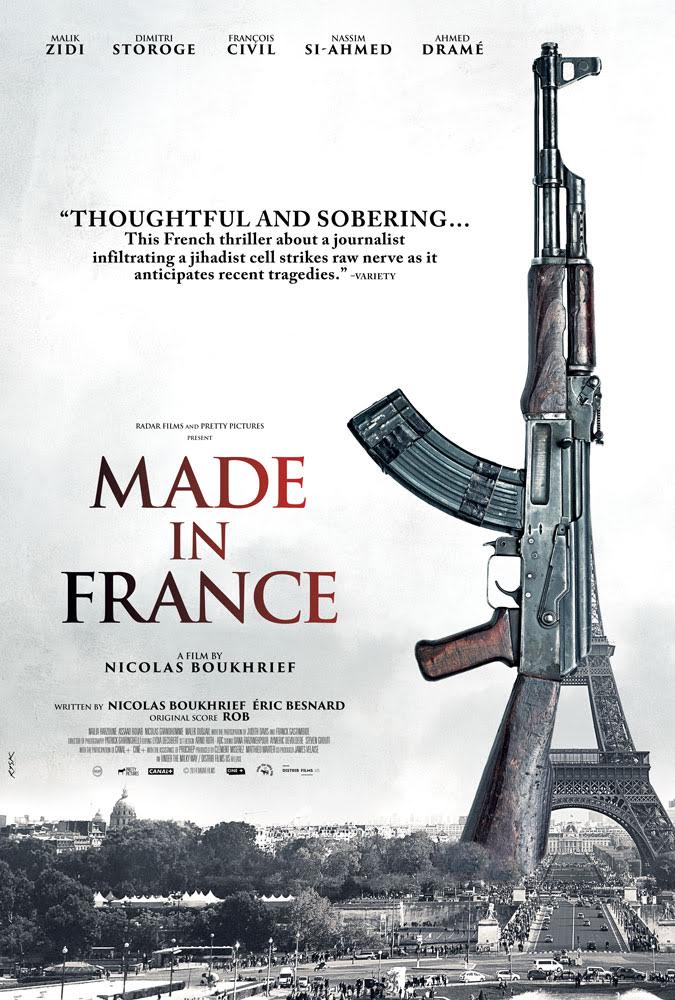
Home-grown terrorism, French-style, in Nicolas Boukhrief's thriller, MADE IN FRANCE


Although made in 2014 and released (in France) in 2015, the new thriller/melodrama MADE IN FRANCE, co-written (with Eric Besnard, of the glorious Ca$h) and directed by Nicolas Boukhrief, appears mostly to be, as they say, "ripped from recent headlines" -- particularly those regarding home-grown terrorism in full swing. The film is an effective look at terrorism from several angles: journalism, anti-terrorist law enforcement, and the terror cell itself, as well as from the POV of all the various characters caught up in this hugely troubling scenario.

M. Boukhrief, shown at left, does an excellent job of compressing time, information and character into a sleek 89 minutes of fast-paced storytelling, in which we meet a journalist named Sam (Malik Zidi, shown below, and recently seen in The Assistant) who has managed to involve himself covertly with a terrorist cell in which, before he can extract himself or alert the authorities, he suddenly becomes a functioning (and violent) part. This unfortunately leaves him open to blackmail by those authorities who need him to remain under-cover to help them prevent further atrocities. The slippery slopes here grow greasier by the moment.

Cast exceptionally well with actors who seem quite right for their roles (and fill them to the brim), the movie functions as exciting entertainment, as well as a heavy-duty and all-too-timely warning about the threat of fundamentalism gone increasingly haywire.

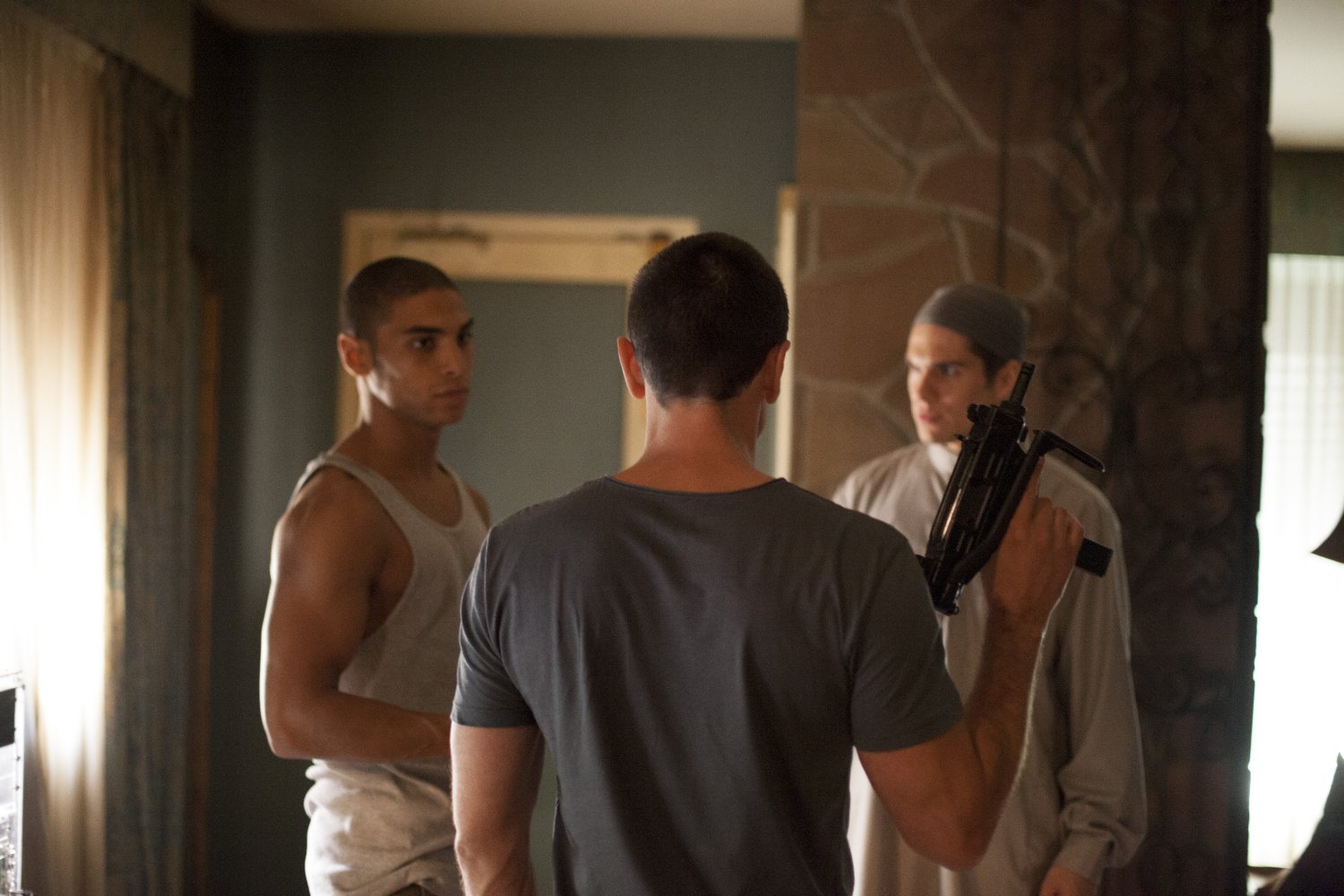
It also allows us to see the varying standpoints of these "brothers" in arms (above), as well as that of their frighteningly insistent leader (played with intense strength and a certain reserve by Dimitri Storoge, center left, above). Their differing beliefs control the thinking and functionality of these men, and as those beliefs are of varying depth, they make the actions of our guys, and therefore the tale being told, full of small surprises that add increasingly to the complications on view.

The distaff side is represented by the beauteous and striking Nailia Harzoune, as the woman belonging to the cell leader, and this character proves pivotal to what finally takes place.

If the movie sorts itself out a little too conveniently, at least it does so with finesse and excitement, leaving us to ponder anew the prospects of both widespread group-terrorists acts in our western nations, as well as those simple-but-deadly, one-off jobs.

From Distrib Films US and Under the Milky Way, Made in France will make its debut, tomorrow, Tuesday, December 13, on all major VOD platforms in the United States, including iTunes, Google Play, Amazon, Comcast, Charter, and Vudu. 

Monday, March 14, 2016

Asghar Farhadi's FIREWORKS WEDNESDAY gets U.S. theatrical premiere at Film Forum


The more movies I see from Iranian filmmaker Asghar Farhadi, the more impressed I am. This is true even though the films I've lately seen were made years before his Oscar-winning A Separation and his following film, The Past. Opening this week is a ten-year-old movie titled FIREWORKS WEDNESDAY, which is almost as fine a film as About Elly, from 2009, which opened here only last year and is, in TrustMovies' estimation, the pinnacle of Farhadi's work so far.

The Iranian filmmaker, shown at right, is the only one I know of who gives us Iran's bourgeoisie in all its troubling, fascinating, gee-they're-kinda-like-us entirety. It is difficult to view the first three of these films, in fact, without being stuck by how little fundamentalist religion appears to rule. The key word here is appears, of course, because, fundamentalist ideals do penetrate and control. And yet -- ah, the endearing/disconcerting predilection of human beings toward denial and hypocrisy -- Iranians do seem to circumvent fundamentalism when they need or want to.

This is why I suspect that Farhadi has mostly circumvented the censors. He manages with almost amazing consistency and honesty to show us Iranians living within their cultural and religious boundaries while at the same time struggling to rise above them.

Yet his characters never give voice to anything negative about their culture/religion. No -- they simply show us their specific situations and how they handle these. So we can watch them struggling to be human, while the censors can see them as moving outside their restricted lives and having to paying the price of unhappiness.

This is quite the tightrope walk, but Mr. Farhadi manages it beautifully, unlike his countryman Jafar Panahi, who is more vocal and open in his criticism -- and has paid for it by, so far as I know, still being under some weird form of house arrest. (Though he did manage to make the great film Taxi while in this "subdued" state, so maybe this sort of "somewhat-censorship" agrees with him by forcing him into the kind of alternating submission, insistence and pretzel twists that lead to humanitarian movie masterpieces.)

In any case, back to Fireworks Wednesday, the plot of which entwines a middle-aged couple's marital troubles (two photos above) with a young bride-to-be cleaning lady (seated, above, and at left, below) and the not-so-young woman (standing above, left) who lives across the hall. The movie takes place within a single day and night, during which we learn everything we need to know about these people to understand what they're going through and why. As usual, Farhadi identifies with all his major characters, and so, eventually, do we.

His film begins with a simply priceless scene (above) that works symbolically and realistically -- involving a chador and a motorcycle -- and manages, without raising its voice (or even suggesting this) to question tradition, fundamentalism, patriarchy, and a whole lot more. From there we bounce from one event to the next, as the movie becomes a surprisingly suspenseful tale of possible adultery, friendship and several instances of help and betrayal.

Before the film is finished, that chador has gotten up to all kinds of odd things, and our sympathies have been tossed back and forth among the various characters and their friends. By the end, the filmmaker has given us yet another amazing, in-depth tale of middle-class life in modern Iran.

A Grasshopper Film release and running 104 minutes, Fireworks Wednesday opens this Wednesday, March 16, at Film Forum in New York City, where it will have a two-week run. As for other playdates and cities, I am not sure, Perhaps the distributor -- a newcomer in the field of foreign, independent and documentary films -- will see fit to tell us soon.

Monday, April 6, 2015

"Rights," wrongs, and a welcome salvage: Asghar Farhadi's early gem, ABOUT ELLY


Those of us who do not travel to film festivals have been waiting to see ABOUT ELLY since 2009, when the film won the Silver Bear at the Berlin Film Festival. Thanks to issues of "rights," this movie has remained in "American limbo" since then. Written and directed by Asghar Farhadi, who went on to give us the Oscar-winning A Separation and then The Past, the film is at last being distributed by The Cinema Guild and hits the U.S. with its theatrical premiere this Wednesday, April 8, here at Film Forum in New York City, before arriving in another 16 cities across the country, beginning in May.

In addition to being, for this viewer at least, the best of Farhadi's three films that I've seen, About Elly also gives us further clues as to why this filmmaker, shown at right, is so able to work seemingly unmolested by censorship, house arrest and the like -- unlike, say, Jafar Panahi. Farhadi is one hell of a lot subtler than Panahi, as well as much more dramatically compelling in his stories.

The filmmaker shows us what look like middle-class (tending toward the upper) characters, who rarely if at all appear to be religious and who would -- except for their language and the headdress of the women -- be nearly indistinguishable from those of many European countries and, hell, even from us here in the USA. No wonder Farhadi's films are so popular with the cinematic elite of the western world.

Further, the concerns of these characters mirror so many of our own -- from the usual man/ women relations to child-rearing and -schooling to setting up one of their good friends with a possible "significant other." More important, where fundamentalism is concerned, whatever problems these people have can easily be attributed to their own faults and misdeeds, particularly those of the women on view -- something that would of course appeal to a fundamentalist/ patriarchal society like Iran (and OK, a few other countries, too.)

And yet I don't believe for a minute that Farhadi truly feels this way himself. Look at what happens in A Separation or About Elly (The Past is set in France and so wiggles out a bit from my theory), and you see people so constricted by their society and its mores that they have no genuine control of their lives -- except by towing the party line.

When something mysterious and possibly fatal happens in About Elly -- the sudden disappearance by the sea of one of the main characters, which will put movie buffs in mind of L'Avventura -- watch what occurs between a husband and his wife, the latter of whom turns out to know much more than he (or we) realized about Elly, and who has kept these facts from the rest of the group. What we get is sudden anger, then verbal and physical abuse. To us this may be shocking, but you just know it will please those religious censors.

About Elly seamlessly weaves its exposition into smart, believable dialog between these friends as they head out and arrive at their seaside week-end away. We learn tons of information about all of them, piecemeal, and over the long haul. What we learn about Elly makes us concerned and uneasy, though we won't understand why for quite some time.

How these people handle themselves, their friends, their children, smacks so thoroughly of the way we all do the same -- with affection and hypocrisy, lies both white and black, trying to balance self-interest with reputation. The big difference here is the society under which the characters must live. And that, to Farhadi's great credit, changes everything -- for everyone, including especially Elly.

Finally it seems, almost everything here is a lie, thanks to a culture based on them -- due of course to that exquisite combination of faith, religion and political power. If the shy school-teacher Elly at first seems to be the outsider, by the finale it is difficult  not to see every character as somehow "outside" the norm -- or would be, if the truth were to come out.

As a filmmaker, Farhadi balances visuals and dialog extremely well. He gives his cast all the room they need, and each comes across with a beautifully specific performance, while blending seamlessly into the ensemble. I am not going to list them all because each is as good as the next. And several cast members -- women and men -- are exquisitely beautiful, to boot. The filmmaker's final image, by the way, is a great one.

About Elly -- running almost exactly two hours, in Persian (with a bit of German) and translated with English subtitles -- opens this Wednesday, April 8th at New York City's Film Forum. You can see all currently scheduled playdates, with cities and theaters listed, by clicking here and scrolling down a bit.

Wednesday, July 9, 2014

Looking for a smart, anti-fundamentalist thriller? Try Shan Khan's juicy melodrama, HONOUR


This is the kind of movie I would refer to (if I used that sort of language) as hot shit. The new melodrama/ thriller about the terribly constricted lives of certain Pakistanis -- female variety, of course -- who dwell in London is not exactly a feminist film (the word is never even used here). Yet by its very nature and the story it tells so well, HONOUR, written and directed by Shan Khan, is hugely feminist. It's no stretch to suggest that, by its conclusion, it will have turned you to a raging, anti-fundamentalist feminist, too.

The film's clever construction gets an A-plus in my book. Beginning with a rancid, racist event on a moving train that shames us, even if we don't quite know why it is there or what it means to the movie as a whole, this first full-length film, written and directed by Mr. Khan (shown at right), turns out to know exactly what it is doing at each moment. If, at the climax, the filmmaker relies a bit too much to the standard and cliched, so good has he given us up to that point that you'll probably go along for the rest of the ride. (The denouement -- which answers an earlier question you'll have asked -- is quietly fraught and absolutely priceless.)

In between all this, because the filmmaker moves back and forth in time, we're not always sure where we are. Yet so cleverly has he managed his plot (and our fears) that we follow along, eventually understanding the entirety of this nasty family saga that -- due to the increasing number of honour killings against Muslim women -- seems all too true and twice as disgusting. (Honour may be one of the most anti-fundamentalist films you'll ever see.)

Our heroine, Mona, played with zest and finally -- considering all that is done to her by her disgusting family -- a finely controlled fury by the beautiful actress Aiysha Hart (two photos above and above, left), is a successful realtor in love with one of her co-workers, Tanvir (played by the handsome, full-lipped Nikesh Patel, above, right). Tanvir, however, has been promised since birth to another. When word gets out in the com-munity about the lovers' plans to run away together, while Tanvir's life is threatened, it is Mona, being a Muslim woman, who pays the dearest price.

When we first meet her stern mother (Harvey Virdi, above) and angry brother Kasim (Faraz Ayub, below, right), we don't much like them. Soon, however, they do something so rotten and shocking that we hold our breath in hopes that what we've seen somehow did not happen. Via his fast-paced use of back-and-forth, past-and-present, the filmmaker keeps us on tenterhooks so that we don't always know in what time frame things are taking place. This can be confusing, but so solidly has Khan hooked us that we stick with him until we learn the answers.

With the introduction of a bounty hunter, hired to find and bring back the missing Mona, the film turns into a kind of chase thriller. Our bounty hunter (played by the fine Paddy Considine, below) has guilt issues of his own with which to deal, and soon Mona has an ally of sorts.

How all this works itself out makes, on one level, for a fast-moving, crackerjack thriller. On another level, it simply adds ammunition to the arsenal of those of us who would like to see this kind of cretinous, fundamentalist thinking wiped off the face of the earth. Good luck. We've got about as much of a chance of turning around Muslim fundamentalist attitudes in Britain, as we have of bringing real and necessary gun control to these United States.

But at least we've got smart movies with a mission like this one to keep us entertained, even as our minds are made to consider what's happening in our culture and the world around us. In fact, this is probably the best feminist melodrama thriller since the amazing French film, Chaos, from 2001. (That's the younger and kinder of Mona's two brothers, played by Shubham Saraf, below.)

From 108 Media and running a tight, just-right 104 minutes (there's hardly a single moment you'd want to see cut), Honour opens this Friday in theaters and via VOD. Here in New York City, it plays the Cinema Village, and it will also hit one of the Laemmle theaters in the L.A. area soon (date and theater are yet to be determined). Don't let this one get lost in the usual, Oh-but-there-are-just-too-many-movies-to-see! shuffle.... If you're so inclined, try it via Vimeo-on-Demand.