Showing posts with label comedies. Show all posts

Saturday, April 3, 2021

Blu-ray debut for Richard Kelly's ever-more-pertinent cult classic, SOUTHLAND TALES

Fifteen years have passed since SOUTHLAND TALES, the follow-up film to Richard Kelly's now cult classic Donnie Darko, made its theatrical debut. 

Back in 2006, TrustMovies found the film alternately bewildering and fun. As I recall, the movie also marked the passing of the name of one of its stars, The Rock, into the more mainstream moniker of Dwayne Johnson (his co-stars were the then-very-hot Sarah Michelle Gellar and Seann William Scott). 

Mr. Kelly, meanwhile, has written and directed only one other movie since then, The Box (from 2009). This seems to me a great waste, as all three of his films may be flawed, but they are also fascinating. Southland Tales, in fact, holds up much better now, I believe, than it seemed to upon release. Times have, unfortunately, caught up with the movie, and it turns out that Kelly (shown at right) was either prescient or remarkably ahead of his time.

His plot, if you can even quite call it that, both sci-fi-ish and political, has to do with travel between dimensions and the fight between right-wing fascists and left-wing neo-Marxists for the power and soul of the USA. Very big deals, right? Yet Kelly seems more amused by it all than overly worked up. And while his sympathies may lie more with the left than the right, he makes fun of both their methodologies, while making the most of his very game cast -- the supporting roles of which are played by some of our crème de la crème of comic actors (then and now).


Kelly also makes the most of the sex appeal (as well as the general appeal) of his three stars. Johnson (above, left) and Scott (at right) shine brightest here, though Gellar (below), in a lesser role, is certainly good enough. 


The filmmaker's tone is remarkably consistent in its goofiness, and this is where those supporting actors prove most important. Crazy as things get -- do they ever -- performers such as Nora Dunn (below), Jon Lovitz, Amy Poehler, John Larroquette and Beth Grant keep things humming and on track throughout. 


Wallace Shawn
and Bai Ling (below, left and right) are used delightfully, too, as is the late Zelda Rubinstein (further below). Even as the "plot" keeps spinning off grid, the enjoyment of watching these actors strut their stuff keeps us happily bouncing along. 


From the outset Southland Tales is apocalyptic (think climate change, even if the movie puts it elsewhere), while the behavior of its generally crazy characters is often violent and close-to-scary. Timely, right?  


Further, the willingness of most of the characters -- politicians, military, police -- to embrace this terrible scenario also proves a little too close for comfort. If Kelly and his script is serious about anything, that would be our back-then-current -- and fuck-it-all, still current -- mid-east wars. 


The film's narrator (and perhaps the actual main character), a wounded vet played by Justin Timberlake (above) gets a kind of musical number for himself and his hot-girl chorus that is both wonderful and downright depressing.


Finally, though, it's the charisma, charm and sheer sex appeal of the three stars that bring the movie home. When one woman places a gun to her head and tells the character played by Johnson that if she can't suck his dick, she's going to pull the trigger, I suspect you'll know exactly how she feels. Then, once satisfied, what the hell, we'll be ready for that apocalypse.


From Arrow Video (distributed here in the USA via MVD Entertainment Group) and running 158 minutes (in the Cannes Festival cut) and 145 minutes (the theatrical cut) -- both are included on this two-disc 2K restoration set, approved by director Kelly and director of photography Stephen Poster, which also includes some nice Bonus features -- Southland Tales hit the street for purchase this past January. My copy, however, did not arrive until last week. Hence the late reporting. Click here for more information on the release.

Thursday, July 23, 2020

Fundamentalist Christianity takes a good kickin' and lickin' in Karen Maine's comedy, YES, GOD, YES


The fundamental hypocrisy embedded in fundamentalist Christianity (yes, in all fundamentalist sects) has been on full display for... what? The past few centuries maybe? So the absolute and often appallingly stupid examples delivered up in the new sex-and-religion comedy YES, GOD, YES ought not come as a surprise to any but the youngest and/or most naive viewers.

This does not mean, however, that these examples do not remain amusing and fun -- even for some of us more aged/jaded audience members.

As written and directed by Karen Maine (shown at left), whose first full-length feature this is, the movie manages to entertain a lot, while provoking just a bit, thanks to the casting of actress Natalia Dyer (shown above and below) in the lead role of a very naive teen named Alice who, thanks to an earlier iteration of the internet (the film takes place maybe 15-20 years ago), is suddenly awakened to sex and its accompanying pleasures -- particularly that of masturbation.

As James Rado informed theater- and movie-goers a few decades back, via his lyrics for the musical Hair, "masturbation can be fun." So can so much else to do with sex (all of which can be problematic, too), yet the restrictive rules placed upon humanity by religion preclude our growth, enjoyment, autonomy and much else where sex is concerned.

Ms Maine and her movie mean to combat this, and they do via a situation which may by now be a bit tired but still engages, and by means of a well-chosen cast which, in addition to the charming, sweet and ill-used character played by Ms Dyer, includes the likes of Donna Lynne Champlin (above, right, of Crazy Ex Girlfriend), Wolfgang Novogratz (below, of The Half of It), and

Timothy Simons (Jonah on Veep), shown at far right below. Though mostly used in one-note fashion, these actors still deliver the necessary goods and keep the ball rolling along in pleasant if standard fashion. The film's best scene, because it veers just a bit from the expected, takes place toward the finale in a local lesbian bar during which our heroine finally gets some advice from an adult that she can actually use and run with.

One might also wish for less obvious coincidence: Would a priest in charge of a school really watch pornography on his office computer with his door wide open for anyone to see? Would the supposedly goody-goody girl go down on her boyfriend on school grounds where they can easily be caught? (TrustMovies could handle only one out of two; you might manage both.)

Still, the sweet, dorky and always believable Ms Dyer quickly becomes the centerpiece that holds it all together, demonstrating once again how, when fundamentalism comes up against inquiring minds and raging hormones, the battle is likely to be funny, silly and a little sad.

From Vertical Entertainment and running just 78 minutes, Yes, God, Yes opens July 24 at Virtual Cinemas and Drive-ins then hits Digital and VOD on Tuesday, July 28.

Monday, August 19, 2019

Israel and Palestine in a whole new light (and genre): Sameh Zoabi's TEL AVIV ON FIRE


What a low-key delight is the new genre-melding movie, TEL AVIV ON FIRE. Taking on the Israel-Palestine conflict -- which we've now seen in just about every manner one would imagine possible, from documentaries such as the questing/philosophic (David Hare's Wall), historical (Colliding Dreams) and the bring-us-together sort (In the Land of Pomegranates) to narrative thrillers (The Little Drummer Girl, either version), family sagas (The Other Son), love stories (Omar) and sex-tryst films (the recent Reports on Sarah and Saleem) -- it provides quite the new perspective.

The genre we have not seen much of regarding this particular subject is comedy. To which you might immediately respond, "And for good reason, dummy!" Until you've viewed the movie under consideration here, that is.

As written and directed by Sameh Zoabi (shown at right), Tel Aviv on Fire might best be described as shambling -- which is not simply deliberate but a huge part of its charm. The film starts slowly and moves even more so. Yet that quiet, unhurried pace builds continually into something near amazing: funny, feisty, satiric, ironic and quite delightful. At film's end TrustMovies was in a state of sheer joy at its underhanded accomplishment of casting the kind of light on this more than 70-year conflict that both upends it and forces you to view it differently.

Even the film's seemingly incendiary title (which doubles as the name of a Palestinian soap opera that is also quite popular with the women of Israel) is part of the fun here. Our hero, a shamblin' man named Salam (Kais Nashif, above), who works as a low-end go-fer at that soap opera which his uncle produces, in order to get back into the affections of his old girl-friend, as well as gain faster thoroughfare at the Palestinian checkpoint, tell a fairly minor fib -- he claims to be a writer on the soap -- which results in his liaison with a Israeli military officer (Yaniv Biton, below) that actually does lead him into that writer's position.

What happens after gets sillier, funnier and much more productive in terms of irony and even depth of perspective, as everyone from the cast, director, original writer, Salam's ex-girlfriend (the lovely Maisa Abd Elhadi, below, left), the lead actress in the soap (a very funny Lubna Azabal), and that military officer's wife all become involved in the goings-on.

One of the small but piquant joys of the film is how this Palestinian soap opera seems different in scale yet all too redolent of soaps around the world. Ditto how love stories resort to such similar schemes to work themselves out. And, yes, how the male ego -- whether Israeli, Palestinian, or any other culture/nation -- proves every bit as tender and typical as you might expect.

The movie may be low-key, but it's an absolute triumph in just about every way -- never more so than when it addresses the Israeli-Palestinian conflict without violence yet head-on, dead-on and with such unalloyed precision and delight.

From the Cohen Media Group, running 97 minutes, in Arabic and Hebrew (with English subtitles for both), Tel Aviv on Fire, after opening on the coasts earlier this month, hits South Florida this Friday, August 23. In Miami, look for it at the Coral Gables Art Cinema, in Hollywood at the  Cinema Paradiso, in Fort Lauderdale at the Savor Cinema, in Boca Raton at the Living Room Theaters; and at the Movies of Delray and Movies of Lake Worth. Wherever you live around the USA, to see if the film is playing anywhere near you, click here.

Saturday, May 11, 2019

Blu-ray debut for John Farrow's delightful genre-mashing original, THE BIG CLOCK


Anyone who's never seen THE BIG CLOCK, the 1948 film that, while successful enough it is own time has since become what one might call a second-tier classic, should avail him/ herself of any opportunity. It's a keeper -- under just about every criteria. And just because you might have seen the so-so would-be remake from 1987 titled No Way Out, don't think you've even begun to  have discovered the genre-jumping/mashing charm of the original.

As directed by the under-rated journeyman filmmaker from Australia, John Farrow (shown right), with a screenplay by Jonathan Latimer (from the novel by Kenneth Fearing), the film begins with what TrustMovies thinks is an unnecessary prolog in which we learn that our hero is a man on the not-quite-run (only because he can't escape his surroundings).

Had the film simply begun at the beginning and moved along as it soon does, the audience might have imagined they were in for -- not the thriller it partially is -- but either a workplace satire or a comedy of manners, morals and art appreciation.

The Big Clock is all three of the above, as well as a lot more, too, mashing and jumping genres in a manner that would spin the heads of many of today's moviemakers. Plus, it offers a plot that has our hero (Ray Milland, above, right) forced by his evil boss to investigate himself for the very murder that boss has commited. (No spoilers here: most of the fun and multi-surprises come as that "investigation" occurs.)

As the hero, Milland proves his usual adept self at garnering our sympathy, even as he holds us back from fully embracing this somewhat flawed and slightly distanced man, while the great actor Charles Laughton (above) makes a magnificent meal out of the villain, a nasty media mogul named Earl Janoth. Watch the subtle (then not so) changes in Laughton's amazing face in the memorable murder scene for a lesson in fine film acting.

The supporting cast is full of familiar faces, with the wonderful Elsa Lanchester (above, left, and Laughton's real-life wife) a hoot-and-a-half as the artist whose work and bizarre personality figure heavily into the plot machinations. If everyone else were not so splendid, Ms Lanchester would have walked away with the movie. The unveiling of her portrait of the murder suspect is one of the film's highlights -- as is her final line.

A nice surprise, too, is the use of famed character actor Harry (Henry) Morgan, above, playing a masseuse/right-hand man you definitely would not want manhandling your vulnerable body. But then everyone here, including an uncredited Noel Neill as a smart and sassy elevator operator, is first-rate.

Director Farrow's handling of the plot and the melding of genres are also classy indeed. Note how swift and shocking is the murder scene, and how deft and fast-paced is the climax. These days, a filmmaker might drag out scenes like these well past their believability or entertainment quotient. Oh, and that titular clock is used well, too.

All in all as old movies go, this one's a don't miss. From Arrow Academy (distributed here in the USA via MVD Visual) and running just 96 minutes, The Big Clock hits Blu-ray (the transfer seems adequate but nothing to shout about) -- along with several worthwhile Bonus Features, including an appreciation of actor Laughton by Simon Callow, and a fine analysis of the film by Adrian Wootton -- this coming Tuesday, May 14, for purchase and I would hope rental, too.

Tuesday, June 7, 2016

Fun with the fanged undead in David Rühm's chuckle-worthy THERAPY FOR A VAMPIRE


Genuine scares and originality are in such short supply these days regarding zombie and vampire movies that we mostly must rely on humorous riffs on these genres to bring us decent entertainment. Zombies don't lend themselves much to humor (though you might want to try the very funny, clever and low-budget Stalled), but vampires, being a lot more versatile than zombies, do occasionally provide some fun (witness last year's New Zealand mockdoc miracle, What We Do in the Shadows).

Now comes the latest bit of very funny nonsense regarding these particular undead, and it's a little ditty from Austria/Switzerland -- in German with English subtitles -- called THERAPY FOR A VAMPIRE. This particular Count (not Dracula, but one, Geza von Közsnöm) has been married now for some 500 years and is growing bored with this lengthy state of matrimony. Writer/director David Rühm, shown at right, has cobbled together a short, swift, full-of-laughs riff on many of the vampire themes and lore that we vamp-lovers have come to appreciate. His "take" on it all proves charming and refreshingly light on its feet.

The very idea of a vampire needing therapy due to marital problems is clever enough, and while Herr Rühm makes some fun out of Sigmund Freud's encounter with our Count (Karl Fisher -- above, left -- does a fine job as our famous "first shrink"), the most sustained laughter in the film comes from the way in which the filmmaker deals with vampire habits like flying, climbing walls, and not being able to reflect in mirrors.

The last of these characteristics is responsible for the appearance of our vampire Count's wife (Jeanette Hain, above, right) at the door of a talented young artist (Dominic Oley, above, left), whom she needs to paint her portrait (since she can't see herself in any of her mansion's many mirrors).

The Count, meanwhile (a lovely and humorous faux-Drac rendition by Tobias Moretti, above), has become smitten with the artist's girlfriend, Lucy (Cornelia Ivancan, below, left), who quite resembles his old girlfriend who, thousands of years ago, turned him into the bloodsucker he remains.

The rondelay in which these four indulge keeps the plot ticking, but it is how certain characters react to their newly acquired -- and then, oh, no! loss of -- vampire skills that makes the movie so much fun. These moments are as oddly "real" as they are enchanting and hilarious, and they'll keep that grin across your face for most of the movie's 87-minute running time.

The requisite blood and gore? Oh, it's there, all right, but it's done with short, sharp and relatively subtle bravura, so that we get the point while also getting the humour/satire implicit. Meanwhile, themes of identity, feminism and vampirism all get their due, too, and we finish the film with that satisfied smile still on our faces.

Therapy for a Vampire, from Music Box Films, opens this Friday, June 10, in Los Angeles at the Landmark NuArt and in New York City at the Landmark Sunshine Cinema, and then, in the weeks following, hits another 15 cities around the country. To see all currently scheduled playdates, click here and then click on THEATERS on the task bar midway down the screen.

Saturday, February 6, 2016

Streaming tip: Riley Stearns' indie, FAULTS, proves a superb surprise in every way


One of those streaming surprises that catch you up between breaths in their twisty, funny, spacey logic, as well as a movie that knows exactly what it's doing while keeping a number of steps ahead of its audience, FAULTS , written and directed by Riley Stearns, opened theatrically in a very limited released almost one year ago, and, as often happens to low-budget independent films, simply disappeared. It's available now via Netflix streaming and Amazon (and probably elsewhere), and it is a don't-miss movie for anyone who enjoys something different that is just about perfectly executed.

Mr. Stearns, shown at left, has come up with something equal parts darkly comic, timely and increasingly bizarre, and he has cast it to perfection, too, -- using his wife, that superb actress Mary Elizabeth Winstead, and an equally fine actor, Leland Orser, in the leading roles.  Ms Winstead (shown below and currently getting her long overdue moment in the sun in the new PBS series, Mercy Street), has given nonstop great performances in everything from the latest remake of The Thing to Smashed. I would say that she has outdone herself with Faults, except she always outdoes herself. That seems to come naturally to the woman.

Her co-star, Mr. Orser (shown below), too, proves a surprise. A fine actor (and one of the reasons Taken 3 was a better movie that most critics wanted to admit), he matches Winstead scene for scene and surprise for surprise. What these characters do and go through in the course of this 89-minute movie is, as we used to say, a humdinger.

The story is a simple and sturdy one: a down-on-his-luck fellow whose career has been all about deprogramming victims of cults, is hired by the parents of a young woman who's been recently "cultivated."  His job is to deprogram her as quickly as possible. That he himself is in big financial trouble proves no small inducement to take this latest case.

The movie is by turns funny, bizarre, dramatic and understated. And the performances from the entire cast are simply terrific. These include Beth Grant and Chris Ellis and the parents, Jon Gries as Orser's boss, and Lance Reddick as the boss' hired hand.

Everything works in Faults, and the beauty of the film is how it works. Part mystery, part comedy, part drama, part "exposé," a movie this good does not appear all that often. Pounce, please -- and do so before you learn much more about this very special film. (I am adding it now to my best-of-last-year list.)

Wednesday, December 30, 2015

"Mainstream" movie of the year: Adam McKay's important and marvelously entertaining THE BIG SHORT


Having seen only a handful of the usual mainstream contenders for Best Picture "Oscar," TrustMovies is in no position to weigh in officially. Of everything he's seen so far, however, THE BIG SHORT -- Adam McKay's adaptation of Michael Lewis' seminal non-fiction account of a few smart "money" guys who saw the financial collapse coming -- is by far the most important film of the year. It is also among the most entertaining.

Yes, Spotlight is equally riveting and is also about something very important. But I would suggest that the subject of McKay's movie (the filmmaker is pictured at left) -- the 2008 worldwide financial collapse -- is even more important than the Catholic Church's long-running parade of sexual-predator priests. Why? Because what caused that financial collapse affects many more of us and is still going on, to the horrific detriment of America's (and most of the world's) poor and middle class -- to everyone, in fact, except the wealthy. It is most responsible for the widening gap between the rich and the rest of us, and the movie points this up like nothing we've so far seen, and does so in a manner to make us laugh, sure, but then grow very, very angry. All over again.

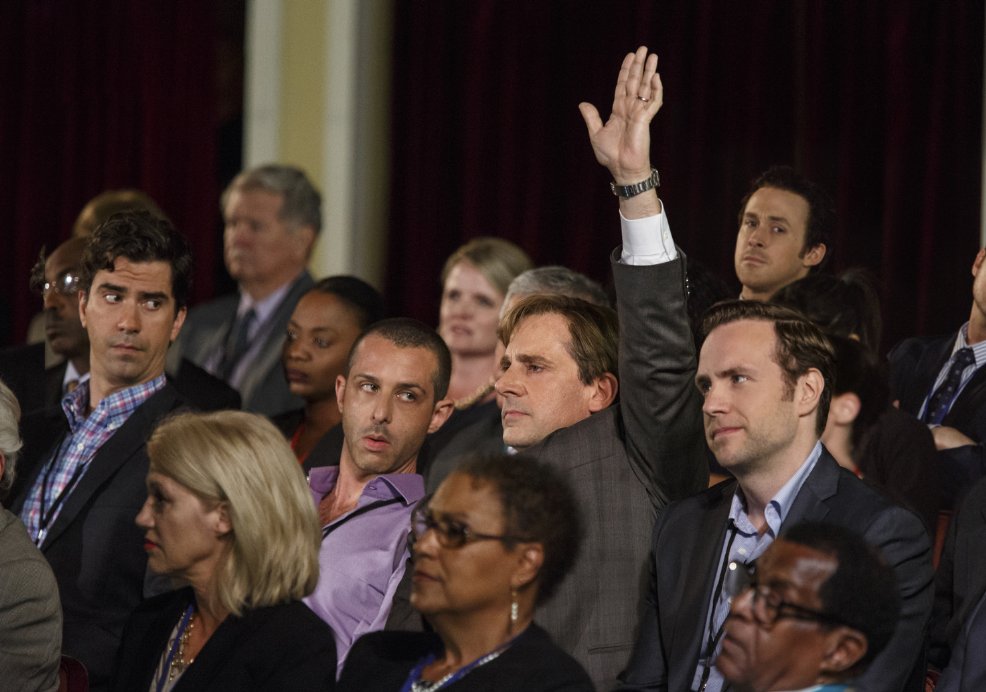
Both films sport crackerjack casts, and each director draws terrific a performance from every actor. But because The Big Short features a number of characters who are not a little bizarre, this makes for some sublimely entertaining performances, especially from Christian Bale, (below), Steve Carell (above, with his hand up, in one of the film's pivotal scenes) and Ryan Gosling (shown two photos below, center right, facing Mr. Carell).

Each actor is superb, though never "showy," at literally every moment in which he appears on screen. And McKay makes the most of them, as well as of his very fine supporting cast.  This is, by the way, a very "male" movie -- as is, of course, the Wall Street/Banking sector of our society.

Women, with very few exceptions, are peripheral to this business, and how Mc Kay uses them here cannot be unintentional. Marisa Tomei is that stand-by-your-man wife; Melissa Leo the blinkered career woman, and, in his most talked-about touch, explanatory guides Margot Robbie (in a bubble bath) and Selena Gomez (at a casino table) are right out of your typical James Bond movie.

The story that McKay and Lewis (along with co-adaptor Charles Randolph) offer up is not the easiest one to follow, unless you've already followed that financial collapse with some acuity. But these guys make it about as easy to access, as possible, considering. And they make it surprisingly fun and funny, as well -- even if the laughs are often at our own expense. The scene with one of the "enablers" (Byron Mann, above, left) toward the film's conclusion is a humdinger indeed.

At 130 minutes, this Short is not short, but there's not a boring moment in the whole shebang. In fact, things seems to grow ever more important, appalling and entertaining as the film builds to its suspenseful (even though of-course-we-know-what-happened) conclusion. (Above are, left and right, Finn Witrock and John Magaro as relative newbies on the big-time financial block.)

The movie is a call to action -- of some sort, at least. Republicans will do all they can to discredit it, but I'm afraid the cat is out of the bag. Wall Street and the Banks are not just corrupt; they are uber-corrupt. And so are our politicians for allowing this greed and stupidity to flourish. (Above: Billy Magnussen and Max Greenfield as two slimey and unrepentant sub-prime mortgage brokers.)

I have to admit that nothing in the past career of Mr. McKay would have given me an idea that he could bring us a movie this important -- and at this level of film smarts. Well, I know now. And I am duly impressed. The manner in which he occasionally breaks the "fourth wall" and how he handles those explanatory moments are sophisticated marvels of making the most of what needs to be done.

TrustMovies is also rather amazed that Paramount -- a Viacom company, hello -- released the film, but I am grateful that it has. Whatever The Big Short does or does not achieve come awards time, this wake-up call will have reached millions in the coming months and millions more when it finally arrives on video and digital.  If you can't wait till then, just know that it is worth the price of a theatrical admission -- and then some.
Click here to learn where you can view it now.