Showing posts with label camp classics. Show all posts

Thursday, September 27, 2018

Blu-ray debut for a cult "classic" from the 1970s: Ted Post/Abe Polsky's THE BABY


Is THE BABY -- the 1973 shocker/horror/ slasher/chiller genre-movie written by Abe Polsky and directed by Ted Post just released on Blu-ray via Arrow Video -- some kind of camp classic? Or is it one of those movies so bad that it's good? Or simply so bad that it's awful? Or maybe just groundbreaking enough to sneak into the "classic" category? Turns out that The Baby proves pretty much all of the above. Just when you decide it is one thing, damned if it doesn't turn into another. And then another.

Overall, TrustMovies would have to say that The Baby is worth the time of viewers who love genre movies, particularly those that rather strain (if not full-out break) the "naughty" barrier. According to what we learn from the interviews in the Special Features section of this full-packed disc, the movie is more the work of writer Polsky than of director Post (shown at left) -- who, according to the Special Features section of this packed disc, had been brought in to class up the proceedings a bit and to add a little humor to the movie's dark mix. (During this same year of 1973, the director would also have two major films released: The Harrad Experiment and one of the "Dirty Harry" oeuvre, Magnum Force.)

The Baby's cast, too, is a cut above the usual for the horror genre: Anjanette Comer (above) and Ruth Roman (below) play, respectively the protagonist and antagonist, and both do a good job in roles the characterization of which rely as much on acting talent and charisma as any depth of writing.

The plot has it that an overly-caring social worker (played by Ms Comer) sets her sights the case of the "baby" of the title, a grown young man who is still in diapers and baby clothes and never seems to have progressed in intelligence or motor skills beyond the infant stage. His mother (Ms Roman) and sisters seems happy, eager maybe, to make sure he remains this way. They get a nice monthly stipend from the state to take care of the boy.

Baby is played by the young actor who used the name of David Manzy (aka David Mooney), and who is indelible enough in the role that you could imagine no casting director would ever take a chance on him in any other kind of role after this film. (Look what happened to the versatile, hugely talented and award-winning Anthony Perkins, once he had made his mark in Psycho.)

The plot, as well as the pacing, goes up and down, back and forth, as the movie moves oddly along and we are treated to some very weird, maybe even taboo delights, the best of which involves a babysitter (Erin O'Reilly, above) and a little unplanned breast-feeding.

We move on to a kidnapping, slashings and murders, and a surprise ending that's a hoot and a half. (That's Marianna Hill, above, who plays one of Baby's two nasty sisters.) By movie's end, you'll probably be satisfied that you watched this very oddball genre piece. Certainly, nothing quite compares to it.

As usual with Arrow Video, the Blu-ray transfer is excellent -- crisp, bright and colorful -- and the disc comes complete with a number of interesting bonus features: new audio commentary from Travis Crawford, archival audio interviews with Ted Post and David Manzy, a recent interview with Marianna Hill (in which she talks about director Post as though he were Ingmar Bergman or Roberto Rossellini), and a very interesting appreciation of The Baby by film professor Rebekah McKendry.

Distributed in the USA via MVD Visual and running 84 minutes, the movie hit the street this past Tuesday, September 25, on Blu-ray only -- for purchase and (I hope, somewhere, somehow) rental.

Friday, September 23, 2016

The Criterion Collection goes classy -- with a Blu-ray/DVD release of a couple of "DOLLS"


In the latest (Vol. XLI, No. 4) issue of that fine, politically savvy movie magazine Cineaste, amongst the letters to the editor on page 3, comes one from Alan Mark Bishop of Vero Beach, Florida, that takes the magazine to task for not giving a great filmmaker like Terrence Malick his due, as well as for covering too much of the output of  The Criterion Collection such as, in Mr. Bishop's own words, "odd bits of junk like Bitter Rice and Gilda."

For any movie-lover who could possibly not know this, Criterion is a company that has given the home video market some of the best films ever, from all over the world, in the best transfers ever. The company also, occasionally, descends a bit to offer "classics" of the cult and camp variety. Well, Mr. Bishop, hold your nose -- and breath -- for here comes the Criterion release of a couple of films that just might raise Bitter Rice and Gilda into the pantheon by comparison:

Yes, I'm writing here of VALLEY OF THE DOLLS, the film manufactured in 1967 out of the uber-famous-in-its-day-and-said-to-be-enjoying-a-current-renaissance novel by Jacqueline Susann, and its 1970 follow-up (though in no way a "sequel"), BEYOND THE VALLEY OF THE DOLLS, directed by the then-king of soft-core, Russ Meyer, and written by none other than our famous (though not as famous back then) film critic Roger Ebert.

Trust Movies had long imagined he'd seen Valley of the Dolls, but as he began watching this new Blu-ray from Criterion, he realized with a shock that he never had. He'd only seen brief moments from it over the years that his spouse of nearly three decades, had called him in to view. Spousie does some really fab imitations of its various actors and songs, and I strongly suspect (but cannot absolutely prove) that the film's popularity comes from and now rests almost completely in the minds of hearts of our gay population, worldwide. The film has become a "classic" of gay camp. Unintentional camp, at that -- which is always the best kind.

Set in the same time frame as its release, the late 1960s, an era when great change was afoot, the movie actually harks back to the repressed 1950s in its feeling and spirit. As flatly and flabbily directed by Mark Robson (who did much better by Peyton Place), it tracks the fortunes of its three protagonists, Anne (the beautiful Barbara Parkins, above), Neely (an atrociously miscast Patty Duke, below), and Jennifer (played by a better actress than we imagined at the time, Sharon Tate, shown two photos below).

As the movie very slowly moves along, it becomes more and more repetitive, tiresome and boring, until one wants to scream, Get the fuck on with it! It's particularly tone-deaf and visually bananas about what a Broadway musical (or maybe a Broadway 'review': it's impossible to tell what the movie-makers had in mind here) might look and sound like.

Nothing in Broadway's past, present or (one hopes) future ever resembled this number in which Susan Hayward (or probably her dubbed voice), below, sings about growing some tree, as a multi-colored 50s-modern chandelier rotates in a manner that appears to be obscuring at times the view of her from the very audience for whom she's supposed to be performing.

But all this, I guess, is part of the "fun" and what makes the movie the camp-fest it remains. There are some wild and funny (unintentionally, of course) scenes along the way, involving everything from drugs and ambition to naughty sex that destroys the sanctity of love and marriage. (No? Yes!) -- the best of which offers a catfight involving a wig (below), during which Hayward and Duke duke it out.

Ms Parkins looks lovely but is required to do little more than bemoan her fate. She does get to appear in the movie's single visually accomplished extended scene, in which her character becomes a nationwide sensation hawking a cosmetics line.

Ms Tate's gets the knee-jerk/tear-jerk character and gives it her best shot, while all the guys on screen seem to be in service to our three (or four, counting Ms Hayward) gals -- which must have pleased the female audiences of the time, while accounting for the film's enduring attraction among us gays.

About the casting of the recently-deceased Ms Duke, it isn't that she was a bad actress. She delivers what is called for in a perfectly adequate manner. But what is called for (her character is said to be based upon Judy Garland) requires at the very least the kind of charisma that this actress simply did not have. She (or her dubbed voice) is no great singer here, either, so her meteoric rise to fame appears simply ridiculous. Ah well, that's part of the fun, too.

I'm glad I finally got to see this "classic" movie (the Blu-ray transfer often looks spectacular, as is Criterion's wont), but I have to say that I'm, well, bemused by its reputation. Even its vaunted gowns (by Travilla) -- unlike those of another, better movie fashion designer Orry Kelly -- have not stood the test of time. Though they, too, add to the camp.

***********************

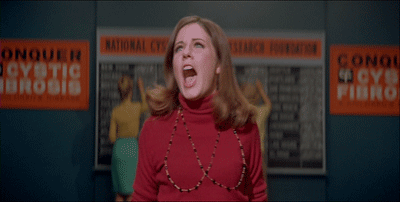
Camp of a very different sort --along with a well-deserved "classic" status -- is provided by Beyond the Valley of The Dolls. Made only three years later, in a bid to cash in on the success of the earlier film (note the not-coincidental arrangement of the threesome two photos up and the one just above), the Meyer/Ebert collaboration resulted in a movie that shocked/delighted audiences bigtime (those who initially ventured out to see it). Though made for a small-enough budget that it was a success originally, the movie has gained in popularity and box-office over the forty-six years since.

Its almost immediate zoom to cult status, where it has remained, is for very good reason. There has never been another movie like it. A supposed satire, the movie veers from banana-level silliness to shock and gore, features a set of songs that are actually quite good -- two of these, In the Long Run and Candy Man, I watch and listen to ever now and again: they're so melodic, bouncy and fun -- and titillates us with all kinds of would-be hot sex (straight, near-gay and muy lesbian). Beyond hits every button imaginable and will keep you alternately giggling and gasping at both its effrontery and its success.

Best of all, after regaling us with all this sex-and-sin-and-come-on-in, at its close the movie offers up a hilarious explanation of what we've just seen that makes it appear as if Meyer and Ebert want us to think we've gone to church. (Or temple.)

The movie begins with an unexplained mini-slaughter, as the credits roll, that ends with a gun placed in a mouth (below). We then go back in time to the story that leads us up to this point, which becomes the film's finale.

The story is full of incident and move quite fast (unlike its sorry predecessor), and the performances are all surprisingly good. One in particular stands out -- and in fact gets better with every viewing. That's the one from John Lazar (below and further below), who plays the character of music promoter/manager Z-Man Barzell, said to be based on the character and career of Phil Spector.

Mr. Lazar is simply brilliant -- as over the top as the movie itself but also so specific, genuine and bizarrely real that he comes to own the movie. You can imagine this actor playing everything and anything from Iago to (as Z-man himself might have it) SuperWoman, with panache and smarts. A very good-looking performer when young, Lazar is said to have credited Beyond with the destruction of his career because he was only offered weird roles from this point on.

I don't buy it, as careers are made from much more than any one role -- from luck and grit and continual trying, among other things -- but Lazar will be remembered so long as movies exist for this amazing performance that, all by itself, makes the movie a must-see.

The ladies who play the rock-and-roll threesome at the center of the film are just fine -- that's hot little Dolly Read, as the central character/singer of the group, above, left, with Michael Blodgett, who takes his place as perhaps the sexiest, sleaziest bad boy of 70s cinema. Below, left, is voluptuous Edy Williams, aka Mrs. Russ Meyer (for a time, at least), along with David Gurian, who seems to have appeared in only a single movie -- this one -- as the sweet/sexy original love interest for Ms Read.

Mr. Gurian (below, right) has a scene in a wheelchair during the finale that is so hilariously crazy that I suspect that the sound of the audience laughing at his character may have soured him on ever making another movie appearance. Too bad: he was a cutie who also could act. But he probably didn't realize just how bizarre was this movie he was acting in.

Having seen the film at least a half dozen times now -- three or four of these via home video -- I can vouch for this new Blu-ray transfer as the best of the lot. From The Criterion Collection, the Dolls pair -- Valley running 123 minutes and Beyond 110 minutes -- hits the street this coming Tuesday, September 27 -- for rental (I hope) or purchase. 

Thursday, December 19, 2013

LAIR OF THE WHITE WORM is back! Now, stream Ken Russell's juiciest, naughtiest, campiest treat


It's been decades since TrustMovies first viewed this little horror treat, brought to the screen by no less than Ken Russell, and starring a very young Hugh Grant, a very sexy Amanda Donohoe, a younger-than-you'll remem-ber-but-funny-as-ever Peter Capaldi and chock full of just about everything Mr. Russell loved to rub in our faces: trans-gressive sex, Christianity trashing and paganism, here joined by a delectably sexy fanged female, a giant snake, and other fun tropes most often found in the horror genre. THE LAIR OF THE WHITE WORM, I believe, is the only one of Russell's films that was a "pure" (or maybe impure) genre piece, though many movie buffs found many Russell movies horrors of another sort.

I've always had a mixed response to this filmmaker's work. (Mr. Russell, who died in 2011 at the age of 84, is shown at left). My favorites are his black-and-white musical biographies made for British television and his very interesting artist bio Savage Messiah. Now that I've seen Lair/Worm again, I must add it to that list of favorites, too. Ken probably ought to have tackled even more genre pieces, because what these film require, along with what Russell clearly had in spades -- the knack for bringing to the horror genre his special kind of transgression -- apparently produced that rare match made in sleazy-movie heaven.

The filmmaker guides his oddly assembled cast (which also includes the likes of Catherine Oxenberg (above, left), that adorable little blond Sammi Davis, (above, right) and everyone's favorite British oddity Paul Brooke (below) to pile on everything from horror to comedy, romance to adult/teen sex (and then teen murder) arriving at a destination that can only be called Camp Wonderful.

Just viewing that old and fondly remembered Vestron Pictures/Vestron Video logo should jolt a number of viewers back to a certain low-end-but-lots-of-fun memory lane. But Lair/Worm is so all-over-the-place that, if you are anything like me, and have not seen the film in decades, then you will also probably have forgotten so much of it that it will seem new and funny and pretty special all over again.

Mr Russell is not particularly good on suspense or surprise, and the villain is rather obvious from the start. But the filmmaker is so good on doing what he loves best -- shocking us with some heavy-duty fantasy elements that combine religion and sex (remember The Devils?) along with pairing Jesus (above) with, well, you'll see -- that the movie almost immediately assumes pride of place in the hearts of the irreligious.

Plus, there's Ms Donohoe, one of whose first major roles this was, and -- boy, oh, boy -- does she impress. So much so, in fact, that I am not sure anything she did subsequently registered quite so strongly. The actress gives her all, whether it's in black boots, panties and negligee (above) or sporting a set of fangs (below) that would have Dracula himself running for the hills.

Mr. Grant (below, left) is almost the straight man in the piece, and so is rather wasted by not being able to show much of his usual charm. Mr. Capaldi (below, right) has more fun with his role and actually registers more strongly here. But we're not coming to a Ken Russell film for charm or romance, are we? So lean back, hold on (yes, it is rather a bumpy ride), and enjoy the utterly bizarre, creepy and funny goings-on.

You can now stream The Lair of the White Worm via Netflix (click here for the link) or via Amazon Instant Video and on DVD.

Wednesday, May 12, 2010

Michael Paul Stephenson's BEST WORST MOVIE: the making of a camp cult classic


"If you're unhappy, watch Troll 2!" That's the advice of one of the many talking heads in Michael Paul Stephenson's funny/sad/rich documentary about a film in which Mr. Stephenson played the youthful hero: number two of the Troll franchise (and this was back in the days before the F word was even in circulation).  Now considered to be among the chosen few of the worst films ever made -- movies so uninten-
tionally bad that they become hilarious camp classics -- Troll 2 does look, from what we see in BEST WORST MOVIE, like it deserves its place in history.

Twenty years after the making of that movie, and even then, only after the film began cultivating a cult fan base, Stephenson (shown, left) decided to explore why and how the movie happened, and what happened to its cast and crew in the two de-
cades since that time.  Our main man, glad-handing Dr. George Hardy (who played the dad in T2), has become a very successful Alabama dentist, and he takes to his new celebrity status like a woodpecker to a tree trunk.

Hardy and Stephenson start looking up other cast members, as well as T2's director and writer (a bizarre Italian husband/wife team). Pretty soon they're making personal appearances at screenings of the film (above) here, there and everywhere (especially in the town in which T2 was filmed), meeting fans (below) and finally going to celebrity/collectible conventions.  It's during this final go-round that our Dr. Hardy begins to learn the difference between being famous and being a joke.

Initially, Best Worst Movie seems like a sweet dream of a documentary: funny, real, silly and sweet.  How can you not love all these crazy people?!  And you can.  But not before you've come up against some very big and damaged egos, as well as one sad lady who just might be certifiably nuts.  It would seem as though Stephenson could not possibly have known what he would find going into this documentary. In fact, one wonders if he knows, even now. (There are a number of times throughout the movie during which the people on screen approach the clueless.)

When we meet that Italian director (above) and his screenwriter wife, reality begins settling in like cement shoes.  These two appear to read the late acclaim for their film as some sort of critical judgment passed on a masterpiece, rather than some easy laughs had at the expense of a unwittingly awful mistake.  We also see the fellow who took the role of Grandpa, admitting that he has pretty much frittered away his life.  And that sweet lady who played mom (below, left)?  She is now the saddest case of all.

Those collectibles conventions pretty much nail it, however.  It is here that our Dr. Hardy learns, where movies are concerned, "the hits make it -- not the flops."   Still, Troll 2 was shown to and appreciated by our boys in Iraq, and it's probably playing this weekend at the midnight movie near you.  And Best Worst Movie -- which opens this Friday, May 14, in New York City at the Village East Cinema (you can find other playdates across the country here) -- catalogs it all: behind the scenes, in front of the camera, and a lot that went on in between.