Given how life-and-time-changing were the rather large number of incidents of home-grown American terrorism back in the 1960 &70s -- as Civil Rights appeared so strongly on the national agenda, the Vietnam War raged, protests mounted, and bombings and other assorted acts occurred (I don't think we referred to them as "terrorism" back then; they were instead "violent protests" or assassinations) -- it seems odd how little our cultural landscape, then or now, reflected this.
Considering how many movies, books and TV shows covered the Manson family and its so-much-more sensational
crimes, this lack is more than a little noticeable. We've seen a few documentaries down the decades, and we had the pretty-good TV movie
Katherine (which has, since then, had its title changed to '
The Radical'), the musical
Hair, of course (but that offered protest than was
non-violent), and a few novels that, mostly quite after-the-fact, addressed the issues that were then at hand and quite vital to the good old USA.
One of these was
Philip Roth's
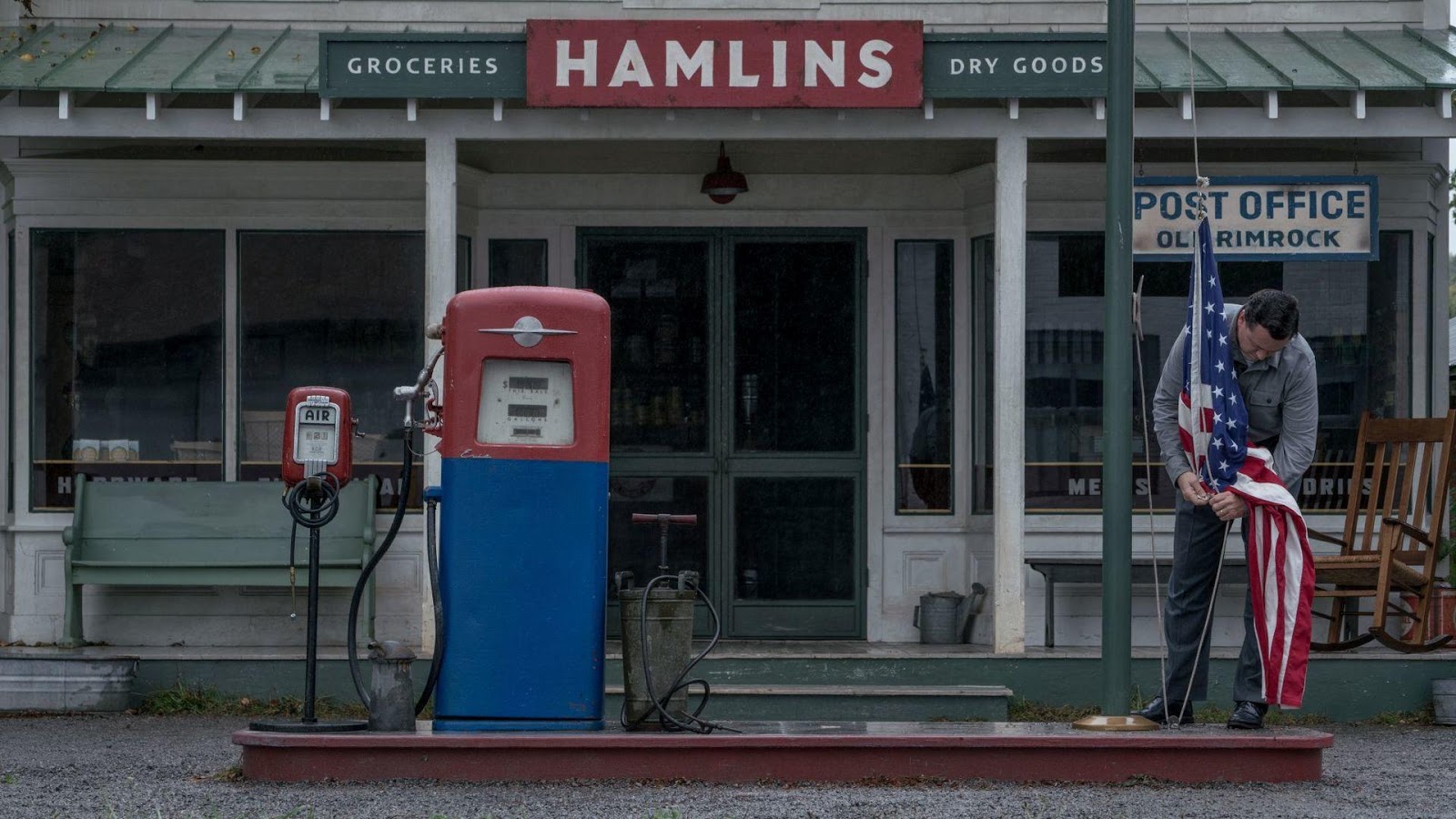
American Pastoral, first published in 1997, of which we now have a movie version, also called
AMERICAN PASTORAL and directed by and starring
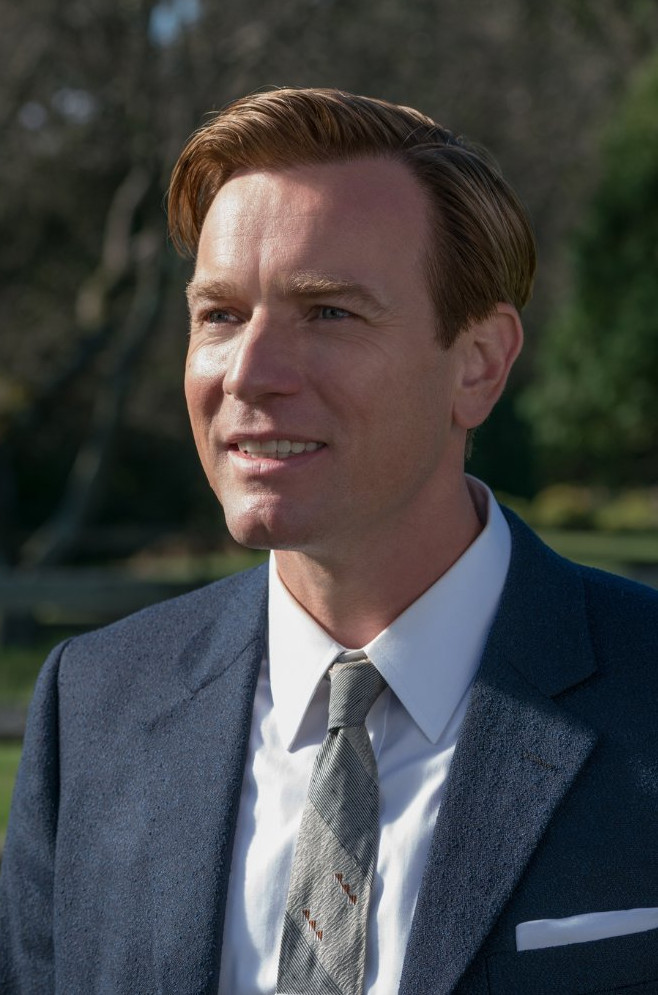
Ewan McGregor (shown at right), with a screenplay adapted by
John Romano. The other currently-streaming-via-
Amazon cultural artifact that tackles this time period and its discontents is -- of all things -- the latest endeavor by one,
Woody Allen, and is titled
CRISIS IN SIX SCENES. The two works, while covering similar territory, could hardly be more different.
This is not unexpected, of course, considering the oeuvre of Mr. Allen and Mr. Roth. But comparison of both these two new "entertainments" -- having seen them in the same week, as did
TrustMovies -- proves rather striking and edifying. While neither work is
entirely successful, both are eminently worth seeing, mulling over and enjoying for their various strong points, which are many.
American Pastoral explores terrorism and its results darkly, while
Crisis in Six Scenes gives us the light and quite funny/satiric side via the usual Woody witticisms/characterizations. Both make you think and ponder nonetheless. Seen together, they add up to a particularly tasty, nourishing and worth-digesting meal.
I have not read the Roth novel, and therefore can only go by what the movie version offers. (I
have read several of Roth's early works and found them sometimes funny and well-written but awfully misogynistic.) The movie, it seems to me, shows that Mr. McGregor has real potential as a filmmaker -- even if the result he has given us here is remarkably flat. But wait: It's often that very flatness that keeps us glued to the enticing and engulfing plot.
Everything is straight up and straight out, from the early exposition/narration to the individual scenes that tell and show us what we need to know. The story, of the "perfect" American family -- Dad's a high school football hero, mom's a beauty queen, and their daughter, ah, there's the catch. She's a lovely little all-American blond named Merry, with a stutter, a keen intelligence and perhaps the kind of real and all-inclusive empathy that (we're being told of late) can prove unhealthy.

In any case, Merry turns into a protester and then into a "terrorist," and the remainder of the movie details the unraveling of this family in a succession of scenes that grows darker and more unsettling, partially because we never completely learn how and why the change (or maybe growth) in Merry happened. We do get a major clue, however, in the scene with the family around the television, as one of those Vietnamese monks of the time self-incinerates himself as the world watches. Merry's reaction here is so strong, so indelible (the fine little actress,
Hannah Nordberg, above, right, nails this moment) that it brings the concept of empathy to searing life. Nothing is quite the same thereafter.
If Nordberg allows us inside her character -- she does so again, in a scene that skirts the Oedipal (or its female counterpart) -- most of the other actors do not. And this seems almost purposeful, as we skate along the surface and the plot details build.
Jennifer Connelly (three photos above) is fine as the beautiful wife who finds her own way of coping (though Roth's misogyny is most apparent here),
David Strathairn (above) impresses, as always, as the narrator, schoolmate, and
Molly Parker (below) does, as well, as Merry's double-duty therapist.
Orange Is the New Black's amazing
Uzo Aduba shows us a whole new side as our hero's assistant at the glove-making factory (is she Roth's idea of the "good negro"?) that he has taken over from his aging father (the very good
Peter Riegert. below). And then there is Mr. McGregor. This actor has been just fine in film after film. Here, he is perfectly OK, but it is in and through him that the flatness of the film most shows up. He's the character we're able least to get inside: Utterly passive; he reacts to everything but rarely acts on his own. While this may have been Roth's and now McGregor's intention, it does leave a kind of hole in the movie.
And yet this very hole forces us to wonder and consider everything anew.
American Pastoral may leave you unsatisfied in certain ways, but I suspect your will mull it over. And maybe over again. Is this the plight of the American father and man? To have all the expectations laid out in one neat, long row? And then to have them, like those famous dominoes, fall flat? What
was America's responsibility in that very unjust Vietnamese war? And how exactly does an act of political violence assuage anything? (
Dakota Fanning (below, right) plays the daughter Merry grown up, and she, too, is flat but still impressive, while leaving us longing for answers, of which there will be none. And rightly so. This character's empathy is far-ranging, eternal and clearly destructive to her and those around her.
From
Lionsgate -- and supposedly running a more than two-hour time frame, which now seems to have now been cut down to around 105 minutes -- the movie opens nationwide this Friday, October 21. Here in South Florida it will play the
AMC Aventura 24 in Miami,
Regal's South Beach 18 in Miami Beach, and the
Cinemark Palace 20, Boca Raton. Click
here and then click on GET TICKETS to find the theater nearest you.
*******************
The game-changing character in Mr. Allen's new series -- quite similar in intentions and even looks (if not at all similar in style and depiction) to
American Pastoral's Merry -- is Lenny Dale, played by, of all people,
Miley Cyrus (above, left), who is actually good -- charming, bright and alluring -- enough to attract another important character, the also bright-but-too-buttoned-down young businessman, Alan, played by the very good
John Magaro (above, right).
It is into the upper-middle-class home of TV and novel writer, S. J. Munsinger (played by Mr. Allen, above, left) and his wife, Kay (the wonderful
Elaine May, above, right), that the gun-toting Lennie breaks one late night, turning the Munsinger household upside down. On the run from the law for a number of "terrorist" acts, Lennie brings up those same themes of justice, retribution, rights and wrongs.
But this, being a Woody Allen creation, uses all these same themes for lighter entertainment. The series begins, however, with a montage of 60s events -- civil rights, Vietnam, etc -- that offers ample evidence of Lennie's claims, and so, even as we chuckle and chortle throughout these six episodes, with each one lasting around 22 minutes and giving us a little over two hours of fun and games, we are still consistently reminded of what -- out there and far away from this comfortable household -- is happening to others, thanks to American policy, both foreign and domestic.
If this sounds like an odd combination, it certainly is. Yet Allen pulls it off with his usual
savoir faire. His S. J. Munsiger (note the syllable similarity to a certain J.D. Salinger -- which is used for a very funny situation late in the series), offers Mr. Allen in his typically nerdy, neurotic schlemiel mode (just older here). He is as funny as ever, and his ability to satirize the 60s/70s in terms of how events effected (usually
not) the comfortable middle class is very much on target.
In his large supporting cast appear everyone from
Joy Behar (above, center), as one of Mrs. Munsinger's book-club attendees, to famous French comic
Gad Elmaleh as one of Kay's marriage- counseling clients. (Some of her advice to these clients is very funny, if not perhaps very typical). The break-in leads to consciousness-raising, romance, and some silly but funny derring-do (below) by Sidney and Kay -- all before the everything's-gonna-be-fine finish, which seems to gather together on screen maybe half of Westchester County.
From the ever more active
Amazon Originals production group,
Crisis in Six Scenes is streaming now and should provide copious laughs and not a little nostalgia for the senior set.
Amazon Prime members can watch it free of charge.


 hiring a young man to do who-knows-what with the very fellow, now old and infirm (Bob Swaffar, at left, below), who molested Alex in his younger days; fellating and/or jacking off a local wealthy Hispanic man in his sauna (João Federici, shown at left, two photos down); and then onwards to actions that are much, much worse.
 The breadth (if not the depth) of the despicable goings-on here is near breathtaking, and yet Mathews gives it to us as though these were merely every-day events. (Perhaps, for those engaging in them, they are.) This makes it seem all the more awful. Intercut with the degradation is the interesting web site of a young and pretty Asian woman with whom Alex seems to want to connect.
 Yet despite this tiny morsel of hope, along with the attempt of Alex's mother to share her son's life in some small way, our boy is dead set on a course of major destruction. Throughout, the filmmaker never strays from his oblique style, dark content and refusal to provide us with one bit of the usual positive spin. The result is one of the more unnerving, queasy-making movies in recent memory. And yet, due to Mathews' subtle, indirect approach, TrustMovies does not remember a single moment of overt violence, blood nor gore to be seen. Yet all of this is present, somehow, via the unspoken "threat."
 Discreet opens this Friday, June 1, in Los Angeles at Laemmle's Music Hall 3 and simultaneously will be available via VOD. The movie is certainly worth a look -- if you're ready for something strange and about as far from feel-good as you can imagine.