Guaranteed -- were it to be seen and believed by many people -- to set Mexican tourism back a few billion dollars,
EL SICARIO, ROOM 164 purports to be an interview with a fellow who was a prime killer for a Mexican drug car-tel.
TrustMovies uses the word
purports not because he necessarily doubts the veracity of the movie (though the film does build up to one whopper of a suspend-your-disbelief moment) but rather because we, the audience, must take an awful lot of what we hear (not to mention
see,
or in this case,
don't-see) on faith, just as did, I suspect, the writer/director,
Gianfranco Rosi (shown just below), and co-writer
Charles Bowden, the journalist who wrote the original
article that appeared in
Harpers Magazine.
According to the documentary's U.S. distributor,
Icarus Films, the definition of "sicario" dates back to Roman-conquered Palestine and to a Jewish terrorist sect, the
Sicarii, who used daggers --
sicae -- in their murders of Romans and Roman supporters. The term, as used here, applies to a
Ciudad Juárez hitman who claims to have killed hundreds of people and to be an expert in torture and kidnapping. On the payroll of the Mexican drug cartels at the same time as he was a commander of the Chihuahua State Police (what he tells us about the connection between these two "powers" is probably the most depressing thing in the movie), the fellow currently has a $250,000 bounty on his head and lives as a fugitive, though he has never been charged with a crime in any country. (Haven't
most of the drug cartel members not been charged with any crimes? True, but they haven't snitched quite like
this.)
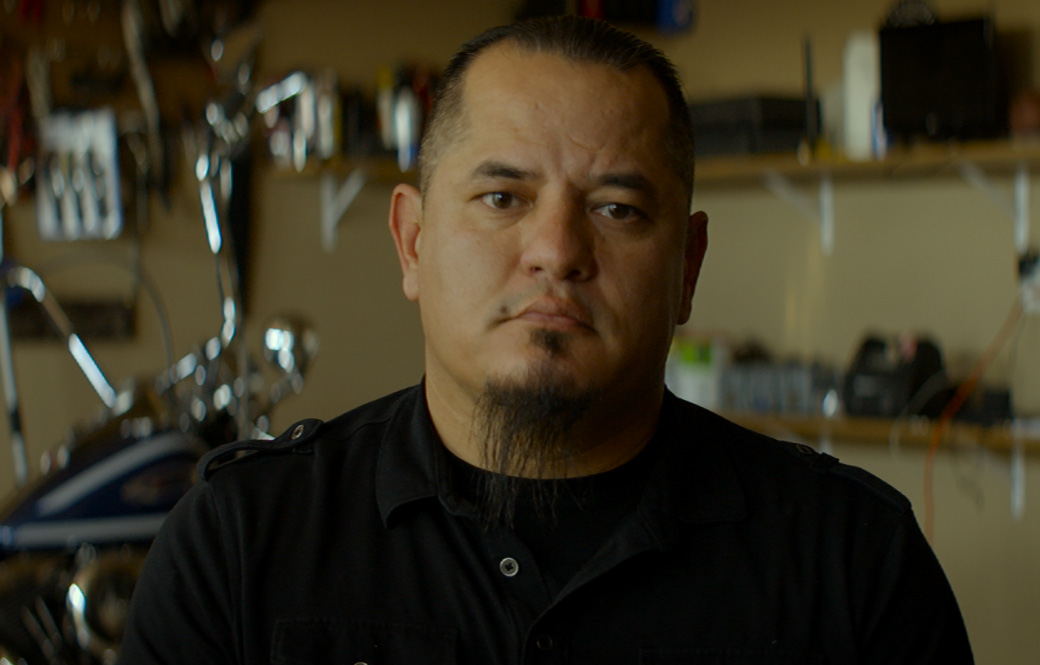
Why did he snitch, you may wonder, as the film progresses? He will probably pay for this with his life, if not those of his family, too. (And when they get him/them, what will happen is most likely the very same horrors we've heard about from this guy over the course of the film.) To protect his identity, Sic (as we'll call him), shown above, wears all black plus a black, breathe-easy rag over his head. Unlike so many documentaries that make use of talking heads, this one offers a talking
covered head. Because all we're really seeing is a black-covered figure, complete with voice and hands, since the voice could have been over-dubbed (and the figure itself might be an actor having memorized lines, in order to prevent ay identification from happening by our guy's former associates), identity is more than a little unclear.

Sic's hands, however, are plainly on view, and I would imagine that his former bosses are combing through any old photos they might possess to match 'em up. Sic generally holds a drawing pad in front of him, too, on which he diagrams some of the things he is explaining -- such as the power structure in Mexico, another tidbit that should depress the hell out of you and even more so out of the hope-free Mexican citizenry. Is there a more populous country on the globe any more corrupt than this one, I wonder? For all the "legit" news stories we read about the Mexican drug cartels, and their accompanying corruption, murders and massacres, probably the most memorable (certainly the darkest and funniest) comes from
The Onion's September 20, 2010 issue (read it
here.)
All there is, then (besides a very occasional -- and useless-- exterior shot, as below) is Sic talking and drawing, but since the talk is about crime and cartels, torture and murder (and the result of same to Sic's psyche), nothing proves uninteresting. And because the movie lasts but 84 minutes, including credits, it's a fast, ugly time. As might be expected, the details are where the true horror is found. Methods of torture, the repetitions, and the time a doctor had to be called to revive a comatose victim (and the irony of what happened afterward): Whether all this is creepier or crazier, I'll leave to your judgment.

It's when we get to the finale and how our man manages to "save" himself that our credibility is most severely tested. Granted Mexico's a Catholic country, and Sic must have come from the lower classes, the fact that Jesus would prove his savoir seems not too far afield. What rankles most is that the man who runs the Church in question appears to be a product of the same cartel and power structure as Sic himself. So how hard would it be for the nasty and powerful to put two and two together and find their canary?
There were moments toward the end when it occurred to me that I might be witnessing the
Banksy of Mexico. If so, more power to the exercise. If not, and all this is gospel, then I hope that (1) Mexico will forgive me for spending my tourist dollars elsewhere and (2) Jesus will save the rest of those
sicario shits before they kill off the remaining population.
El Sicario, Room 164 (which refers to the hotel room where the interview with Sic takes place, and/or maybe the room in which he committed those atrocities?), from
Icarus Films, opens at
Film Forum in New York City (and in time for the holiday season, too!) this Wednesday, December 28 -- for one week only. Check showtimes
here. The film will also be coming to the
Northwest Film Forum in Seattle in January, and to the
Union Theater, Milwaukee, Wisconsin, in February -- and elsewhere perhaps. Check this
link later for possible additional playdates and cities.