Showing posts with label journalism and censorship. Show all posts

Friday, June 23, 2017

Streaming debut: Brian Knappenberger's doc, NOBODY SPEAK: Trials of the Free Press


Brian Knappenberger is the guy who gave us one of 2014's best documentaries, The Internet's Own Boy: The Story of Aaron Swartz. He's back again this year with an equally important and worthwhile doc, NOBODY SPEAK: Trials of the Free Press, which is a warning about how and why one of the (always problematic) pillars of our (less and less) free society continues to crumble beneath us.

The approach of Mr. Knappenberger (shown below) is three-pronged: He shows us

the trial involving Hulk Hogan's sex tape and the news/scandal site, Gawker (and what lay beneath it), the sudden take-over the Nevada's foremost newspaper by billionaire Sheldon Adelson; and finally Donald Trump's ongoing war against the press, truth and facts.

The result of this trio of events points clearly to the increase in danger to a free press in this country, with the filmmaker marshaling his evidence well and presenting it in a focused, meaningful fashion. The result should leave you further aware and frightened.

How you may feel about the late Gawker, its owner Nick Denton (shown below) or Hulk Hogan (shown further below) does not matter here (I was a fan of neither), but the threat to a free society by a billionaire bankrolling a lawsuit he had absolutely nothing to do with (as we learn most definitely happened here) in order to put a news source out of business does indeed matter -- and in fact sets a bad precedent.

Knappenberger lets us meet a number of the fine journalists, as well as the editor, who worked for that Las Vegas newspaper and have now had to depart, due to its utterly compromised position in terms of journalism, and the filmmaker's round-up of Trump's various lies involving the press all add up to a depressing view of these current times and the disappearance of former standards. What's to be done? As we continue to see, in both narrative films and documentaries, no easy answers -- hell, any answers, save the violent overthrow of government, since honest elections are now a thing of the past thanks to gerrymandering, voter restriction, and probable vote tampering -- are forthcoming. Good luck to us all.

Distributed via Netflix and now streaming on that site, as well as opening today in theatrically in New York City (at the IFC Center) and the Los Angeles area at Laemmle's Monica Film Center, the documentary is worth your time, energy and discussion. 

Friday, April 15, 2016

The media, power & justice: Docfactory/Jean-Philippe Tremblay's SHADOWS OF LIBERTY


SHADOWS OF LIBERTY, the 2012 documentary credited to DOCFACTORY and Jean-Philippe Tremblay (shown below), begins with a barrage of statements against our current U.S. media with no identification of any of the speakers. This is off-putting, but hang on: Post the opening-credits sequence, identification begins, and those speakers are an impressive lot. Ditto what they have to say -- all of which centers around the manner in which our mainstream media, whenever the corporate power that owns it is wielded, consistently works against transparency and truth.

We see this via a number of instances in which corporate power trumps the news. Roberta Baskin looks back on how CBS News covered (and then didn't) the NIKE employee abuse story. As an example of one of the "black holes" of journalism, we peruse again, via Kristina Borjesson, the infamous TWA flight 800 plane explosion, along with the cover-up that followed. This remains one of the sleaziest chapters in a history chock full of them.

We get some other good history, too: How, during the 1930s, the idea of for-profit took over the airways, leading to the more than 236 billion dollars per year that the media currently (or at least back in 2012, when this doc was made) brings in via advertising. Which, in turn, is why between 40 and 70 percent of what is considered "news" today comes not from actual reporting but from the work of corporate public relations.

We revisit one of the saddest chapters in American journalism history with Gary Webb and his story of how the CIA and the Contras helped sponsor America's crack cocaine "epidemic." (See Kill the Messenger, if you haven't already.) We hear about the Telecom Act and then the mergers -- one after another after another -- that followed this further encroachment on media accountability and responsibility. And then, of course, there was 9/11 and the lies (hugely bolstered by most of our media) that took us into Iraq and the resulting forever-quagmire.

Whistle-blowing? Oh, yes. Here's the tale of Sibel Edmonds and how she uncovered the Marc Grossman conversations with the Turks involving nuclear secrets, and was then fired for her trouble. And finally we have NBC's wondrous would-be "reality" series, To Catch a Predator -- surely some kind of nadir in the annals of television. (Oh  please: There are now so many that we've quite understandably lost count.)

For those of us who follow media, none of this will be news. But taken together, as it is here, what emerges is enough to maker an intelligent viewer despair at the state of our nation's journalism. (See Spotlight to have a modicum of that faith restored.) One might wish for more current events from this movie, but then again, it was made back in 2012 and researched a good deal prior to then. And almost everything we see and hear in the documentary remains as true and still as "under-reported" today as it was at the time it was"news,"

Two statements from this documentary remain particularly timely and important: "Our country was founded on the idea that if you give citizens the information they need, they can govern themselves." And "If we want the U.S. media to be better, we have to fight for this."  Amen.

From Bullfrog Films and distributed by Icarus Films, Shadows of Liberty comes with two versions on one disc: the theatrical version running 93 minutes and a shorter "classroom" version running just 53 minutes. 

Wednesday, June 18, 2014

Jan Troell's THE LAST SENTENCE: how to deal with the Nazis in "neutral" Sweden during WWII


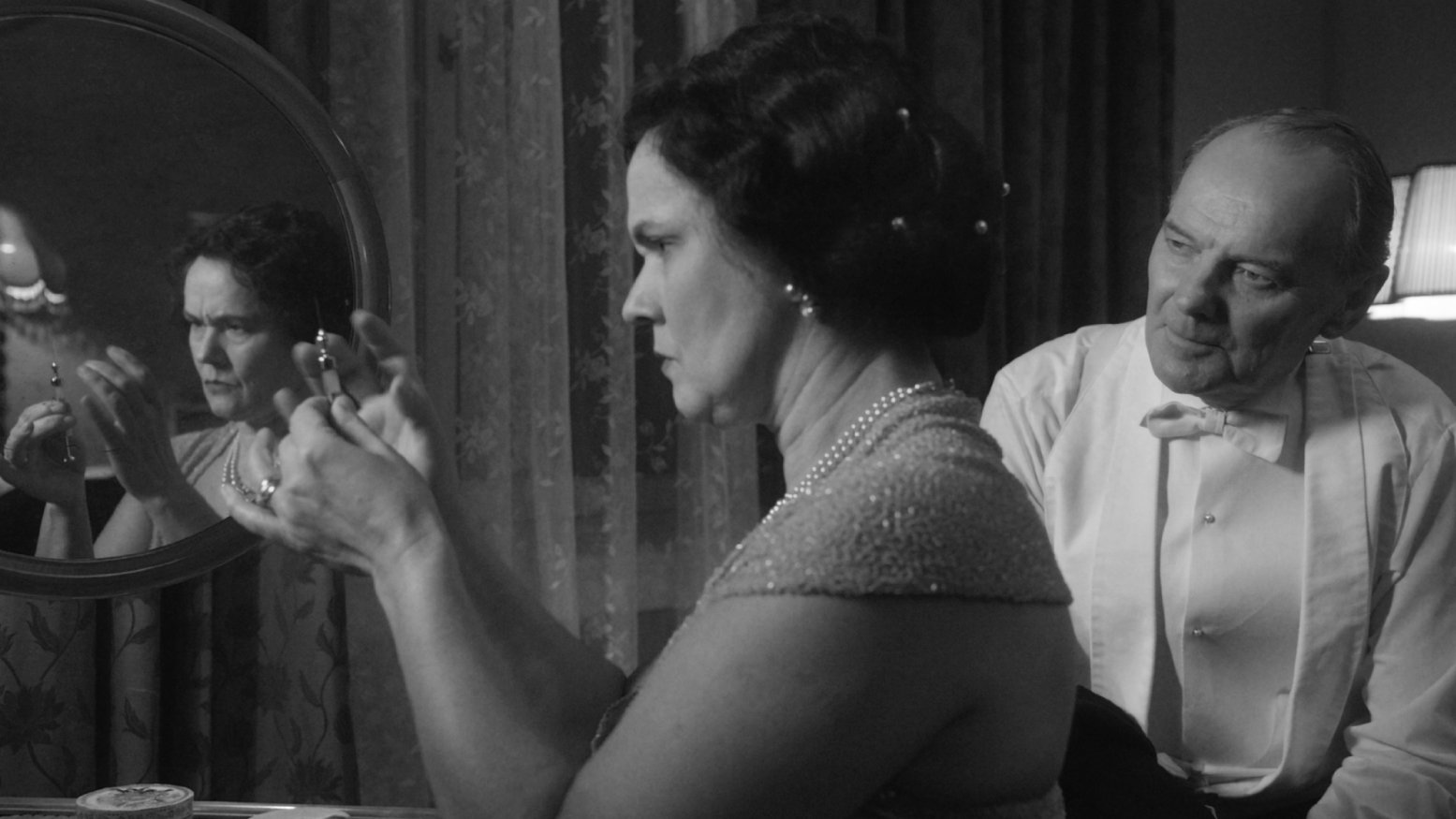
Whew -- this is the third new film (from abroad, of course) to give us succulently good black-and-white cinematography in about as many weeks. First Ida, then A Coffee in Berlin, and now THE LAST SENTENCE (Dom över död man), the new movie from award-winning (and Oscar-nominated) Swedish director Jan Troell (shown below). Those of you who love black-and-white films will want to take a look. And though its visuals may be the main reason to view the film, there are others, as well.

This is another up-close-and-personal look at Sweden during World War II, when that country insisted on its "neutrality" and so escaped, as did Switzerland, the more complete Nazi takeover that the rest of Europe and Scandinavia underwent. In the latter days of our own fake and unnecessary wars -- from Vietnam to our current forays into Iraq, Afghanistan and maybe now Syria (they do no good for us, except to keep the big corporations profiting, and cause unbelievable harm to those we pretend to be helping) -- it may be difficult for the younger generation to understand what the world was like when one crazy dictator in one sheep-like country managed to convince its citizens that Germany joined with Austria (and then Italy and Japan) could take over the whole world. Yes, this does sound like the plot of some SuperHero-fueled blockbuster, but there you are. Or were.

Though it deals with life in pre- and then wartime Sweden, The Last Sentence is really more of a character study. The character here -- and what a character he is! -- is a real-life fellow named Torgny Segerstedt (played by the fine Jesper Christensen, shown above and below), who reigned as editor-in-chief of one of the Swedish newspapers at that time. Torgny, as we see in the film's very first moments, is thoroughly anti-Nazi/anti-Hitler. In most other ways, however, he's one cold, narcissistic son-of-a-bitch.

The movie opens with a quote from Torgny himself: "No human being can withstand close scrutiny," which is pretty much bullshit, though it would certainly apply to Segerstedt. I think a lot of us humans could withstand close scrutiny. Our flaws would be revealed, of course, but if we have half a notion of who we are, this will not cause us to fall apart. Clearly, it would do so for Segerstedt. As the movie progresses, we find out why.

It progresses rather slowly, however, and somewhat repetitively, and that is the main problem with Mr. Troell's work. (This was not true of his most recent narrative movie, Everlasting Moments, which was long but full of life and incident.) Torgny, as seen here, is just not all that interesting a man. Once we learn of his political stance, and then of his treatment of the women in his life (he does love his dogs, however!), there is not much more to keep us watching -- except perhaps the surprise we get from seeing older characters involved in extra-marital affairs, having sex and doing things that Hollywood sets aside only for the young (or sometimes for an older man and younger woman). This is certainly bracing -- for a time, at least.

We also get an interesting sense of what it might have been like, back in the 1930s and 40s to engage in what was called an "open marriage." Torgny is "having it off" with the wealthy Jewish wife of the man who owns the newspaper that he edits, and it is clear that this newspaper owner knows what is going on and accepts it. Torgny's wife also knows what's afoot, but is not nearly so accepting.

We get small forays into the past, as Torgny sees himself as a child, engages in conversation with his long dead mother, and also -- eventually -- with the other women who have "left" him. By the time the movie ends, this fellow has quite an otherworldly harem.

Over all, we get more than a decade of Segerstedt's life, including a couple of incidents that show how bright and conniving he could be vis a vis the Swedish government's obeisance to the Nazis. We also see that he was most probably a good enough writer. He was indeed brave with his pen (which his paramour is fond of calling his "lance," though it was clearly his other lance in which she was most interested).

There are also excellent performances from Pernilla August (above and below) as Torgny's paramour, Ulla Skoog as his put-upon wife, Björn Granath (below, right) as the cuckolded husband, and a very quiet, sad job from Johanna Troell as Torgny's helpful but completely ignored daughter. That fine cinematography, by the way, comes via Mischa Gavrjusjov.

The Last Sentence -- from Music Box Films and running two hours and six minutes -- opens this Friday, June 20, in New York City at the Lincoln Plaza Cinema, and in Los Angeles at Laemmle's Royal in West L.A. In the weeks to come, it will open in another nine cities. Click here and then click on THEATERS, midway down the screen, to see all currently scheduled playdates.