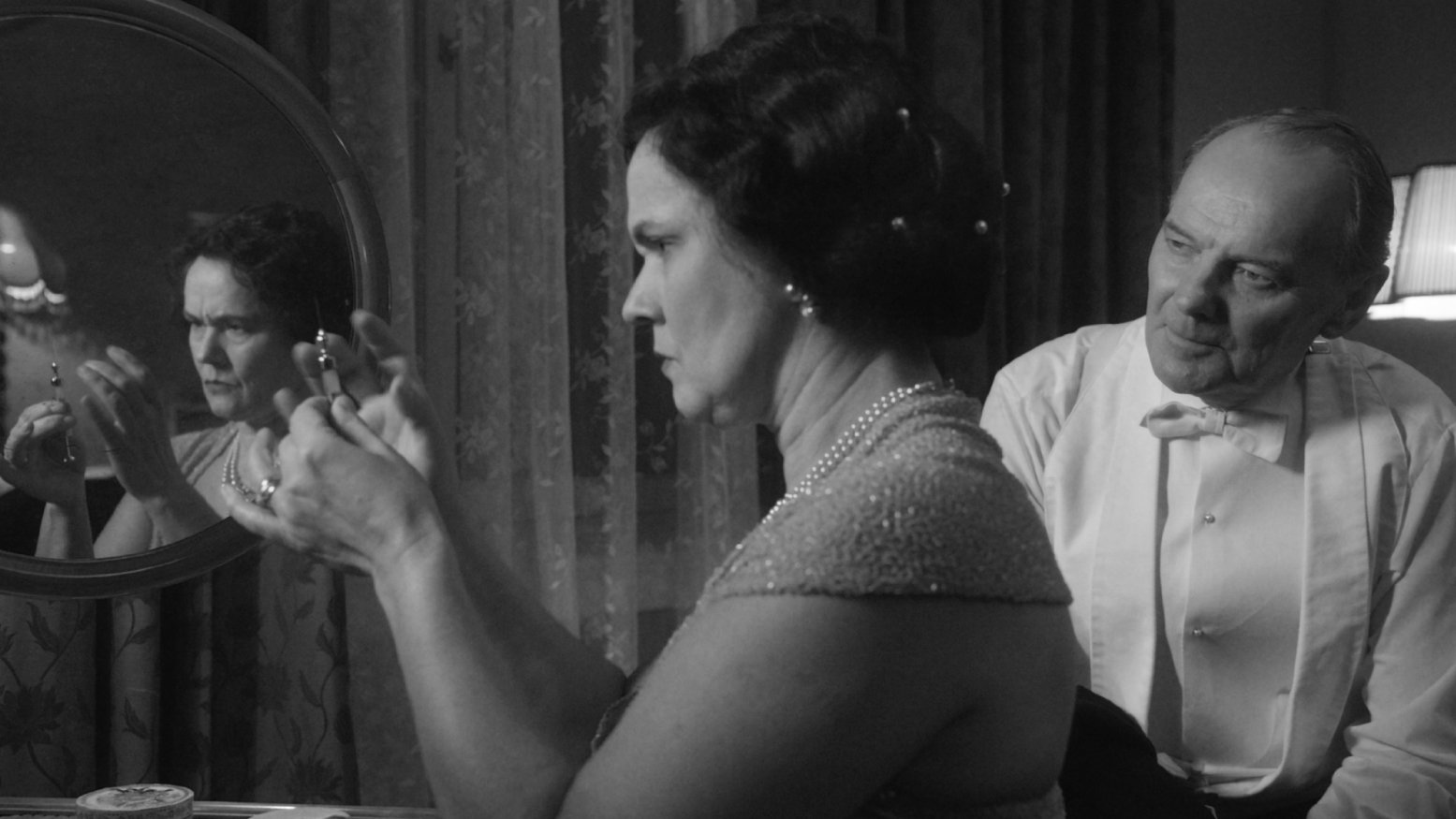
Showing posts with label black-and-white cinematography. Show all posts

Wednesday, February 14, 2018

1945: Ferenc Török's elegant, bleak view of post-WWII Hungary opens in South Florida


We've seen a lot of Holocaust horror, along with post-Holocaust family films and secrets-and-lies investigations about coming to terms with it all. What we've explored least of, perhaps, is tales of Jewish homes and property taken over by non-Jews after the various round-ups and deportations that took place in Nazi-conquered countries throughout Europe. (We got just a taste of this in Sarah's Key and certain other films.) This loss of property, though certainly not as important as the lives lost, is at the heart of the new Hungarian film 1945.

As co-written (with Gábor T. Szántó) and directed by Ferenc Török, shown at right, 1945 takes place in that particular year, after World War II had ended and, for the first time since the deportation,  Jews -- just two of them, actually: an old man and a young one (shown below) -- arrive by train to this sleepy little Hungarian town. Why have they come, and what do they want?

From the outset, it is clear that, however quietly and subtly the townspeople take this all in, they are, to a man and woman, hugely disturbed by the Jews' appearance. Yet it is also clear that they've been aware that, someday down  the road, this would most likely happen.

As the movie progresses, and the two Jews make their way slowly toward the town, the townspeople -- from the powerful town clerk (Péter Rudolf, below, left) down to the town drunk and some lowly housewives -- fret and finger-point, give in to guilt, hide their ill-gotten valuables and/or try to decide their best course of action.

Russia is already controlling Hungary, though the iron hand of its insane Communist dictator has not yet made its power fully felt, yet it is clear that the citizens are already taking sides. And today happens also to mark the wedding of the town clerk's son (Bence Tasnádi, above, right) to a pretty local girl (Dóra Sztarenki, below, right), of whom the groom's mom (Eszter Nagy-Kálózy, below, left) heartily disapproves -- for reasons that will soon (and then later, too) become clear.

The journey toward town of the Jews, together with all the tsuris this causes the townspeople and even their priest, brings out the rather shocking inhumanity of man toward his fellow men, while setting the stage for a showdown of sorts.

And yet, throughout, 1945 is resolutely un-melodramatic. as it unfolds slowly and gracefully, if consistently fraught with fear and anguish. The elegant cinematography (by Elemér Ragályi) is often stunningly beautiful, with its final image as Holocaust-redolent as you could wish. I admit that the film moves slowly at times, and it sometimes scores its points a bit too obviously, as well.

Overall, though, 1945 proves a strong enough indictment of Hungary (and also of nearly all the Nazi-conquered countries) in its treatment of the Jews to warrant a viewing and the accompanying discussion that will surely arise.

From Menemsha Films and running 91 minutes, the movie opens here in South Florida on February 16 -- in Miami at the AMC Aventura 24, in Fort Lauderdale at The Classic Gateway Theatre, in Tamarac at The Last Picture Show, in Boca Raton at the Living Room Theaters and the Regal Shadowood, and at the Movies of Delray and Movies of Lake Worth.

Personal appearance!  
Moviegoers can meet the director of 1945, Ferenc Török, on
Friday, Feb. 16, at Movies of Delray at 12:30pm, 3:00pm, 5:20pm; 
and at The Classic Gateway Theater, 7:20pm and 9:30pm. 
On Saturday, February 17, he will appear at the Movies of Delray 
at 12:30pm, 3:00pm, and 5:20pm, at the Regal Shadowood at 4:50pm 
and at Tamarac's The Last Picture Show at  7:10pm. 
On Sunday, February 18, look for him at the AMC Aventura 24 at 1:45pm 
and at the Living Room Theaters in Boca Raton at 4:30pm and 6:50pm. 
For more information readers can visit www.menemshafilms.com/1945  

Monday, November 13, 2017

Pat Collins' SONG OF GRANITE gives us -- very elliptically -- the story of Joe Heaney and traditional Irish singing


Filmed with the kind of breathtaking black-and-white cinematography that will have aficionados drooling, this year's Irish entry into the Best Foreign Language Film sweepstakes is a movie entitled SONG OF GRANITE, directed and co-written by Pat Collins, a documentary filmmaker who in 2012 gave us his first narrative movie, Silence, and has now come up with this new one, which traces the life, parental history and career of a man named Joe Heaney, of whom TrustMovies had never heard but who was evidently known as a great singer of traditional Irish songs.

Mr. Collins, pictured at right, possesses a highly poetic sensibility, and he and his cinematographer (Richard Kendrick) have contrived a movie so steeped in gorgeous images -- there's one, of a father and son sitting in front of a stone wall and doorway, that I could look at, I think, maybe forever -- that you don't want to look away from the screen for even a moment.

The poetry goes beyond mere images, as Collins also tells his tale by moving back and forth in time and and also by interspersing archival images with those he and Kendrick has more recently created. At film's end he even joins the older Heaney man with his younger self across both time and a lovely outdoor landscape.

If only Song of Granite's aural qualities were anywhere near its visual ones.

Granted, I am not the best person to judge this, since I knew next to nothing about traditional Irish singing going into the movie (if I've ever hear much of it previously, I most likely and immediately tuned it out).

Coming out of this film, I am most definitely not a fan. I find this particular musical genre consistently dour, repetitive and an absolute drudge to hear.

I would estimate that there is at least as much song here as there is dialog (maybe twice as much, unless I am letting my distaste for the genre get the better of me). At times I felt like turning off the sound completely, but then I'd have missed some of the English dialog (much of the film's is spoken in Irish/Gaelic, I am guessing, with accompanying English subtitles).

Eventually I had to content myself with those visuals and with the interesting performances of the cast Collins has assembled, beginning with that of Colm Seoighe, above, as the youngest of the Joes, and especially that of Michael O'Chonfhlaola (three photos up, at microphone) as the adult-to-middle-aged Joe, who has a beautifully sculpted face that seems designed to please the camera.

Because Collins jumps around so much, but does so poetically, while we don't always get the details, we can follow both the story and the emotions it and its characters convey. If you've a taste for traditional Irish singing, by all means see this film. If you're a novice to the genre, Song of Granite is certainly one place to start learning. And if you're not a fan, well then, you know what you're in for.

From Oscilloscope Laboratories and running 104 minutes, the movie opens in New York City at Film Forum this Wednesday, November 15; in Los Angeles on December 8 at Laemmle's Monica Film Center; and in Santa Fe on December 29 at the Jean Cocteau Cinema.

Monday, October 30, 2017

1945: Ferenc Török's elegant, bleak view of post-WWII Hungary opens in So. Florida


We've seen a lot of Holocaust horror, along with post-Holocaust family films and secrets-and-lies investigations about coming to terms with it all. What we've explored least of, perhaps, is tales of Jewish homes and property taken over by non-Jews after the various round-ups and deportations that took place in Nazi-conquered countries throughout Europe. (We got just a taste of this in Sarah's Key and certain other films.) This loss of property, though certainly not as important as the lives lost, is at the heart of the new Hungarian film 1945.

As co-written (with Gábor T. Szántó) and directed by Ferenc Török, shown at right, 1945 takes place in that particular year, after World War II had ended and, for the first time since the deportation,  Jews -- just two of them, actually: an old man and a young one (shown below) -- arrive by train to this sleepy little Hungarian town. Why have they come, and what do they want?

From the outset, it is clear that, however quietly and subtly the townspeople take this all in, they are, to a man and woman, hugely disturbed by the Jews' appearance. Yet it is also clear that they've been aware that, someday down  the road, this would most likely happen.

As the movie progresses, and the two Jews make their way slowly toward the town, the townspeople -- from the powerful town clerk (Péter Rudolf, below, left) down to the town drunk and some lowly housewives -- fret and finger-point, give in to guilt, hide their ill-gotten valuables and/or try to decide their best course of action.

Russia is already controlling Hungary, though the iron hand of its insane Communist dictator has not yet made its power fully felt, yet it is clear that the citizens are already taking sides. And today happens also to mark the wedding of the town clerk's son (Bence Tasnádi, above, right) to a pretty local girl (Dóra Sztarenki, below, right), of whom the groom's mom (Eszter Nagy-Kálózy, below, left) heartily disapproves -- for reasons that will soon (and then later, too) become clear.

The journey toward town of the Jews, together with all the tsuris this causes the townspeople and even their priest, brings out the rather shocking inhumanity of man toward his fellow men, while setting the stage for a showdown of sorts.

And yet, throughout, 1945 is resolutely un-melodramatic. as it unfolds slowly and gracefully, if consistently fraught with fear and anguish. The elegant cinematography (by Elemér Ragályi) is often stunningly beautiful, with its final image as Holocaust-redolent as you could wish. I admit that the film moves slowly at times, and it sometimes scores its points a bit too obviously, as well.

Overall, though, 1945 proves a strong enough indictment of Hungary (and also of nearly all the Nazi-conquered countries) in its treatment of the Jews to warrant a viewing and the accompanying discussion that will surely arise.

From Menemsha Films and running 91 minutes, the movie opens here in South Florida on February 16 -- in Miami at the AMC Aventura 24, in Fort Lauderdale at The Classic Gateway Theatre, in Tamarac at The Last Picture Show, in Boca Raton at the Living Room Theaters and the Regal Shadowood, and at the Movies of Delray and Movies of Lake Worth.

Personal appearance!  
Moviegoers can meet the director of 1945, Ferenc Török, on
Friday, Feb. 16, at Movies of Delray at 12:30pm, 3:00pm, 5:20pm; 
and at The Classic Gateway Theater, 7:20pm and 9:30pm. 
On Saturday, February 17, he will appear at the Movies of Delray 
at 12:30pm, 3:00pm, and 5:20pm, at the Regal Shadowood at 4:50pm 
and at Tamarac's The Last Picture Show at  7:10pm. 
On Sunday, February 18, look for him at the AMC Aventura 24 at 1:45pm 
and at the Living Room Theaters in Boca Raton at 4:30pm and 6:50pm. 
For more information readers can visit www.menemshafilms.com/1945  

Friday, February 13, 2015

Streaming tips: black-and-white 1950s British gems: FAST AND LOOSE and ALWAYS A BRIDE


Netflix provides such a treasure trove of movies -- from foreign films to independents to documentaries -- that some of its least-known gems can easily get lost in this abundance. People stupidly complain that the service doesn't have all the big mainstream hits. True. But so what? If you really care about movies of all types, they're here for the asking. Two such, which we recently watched one right after the other (we almost never do this at a single sitting, but these were so charming, we quickly were hooked), I'll tell you about now.

FAST AND LOOSE, a Brit hit in glorious black-and-white from 1954, and ALWAYS A BRIDE, from 1953, also British and in b/w (and filmed at least partially on the French Riviera!) are two small gems of subtle, subdued humor and full of fine character acting from all concerned. Both are also filmed in the aspect ratio of that time (1.37:1) that may seem a little small by our widescreen standards. But that also helps contribute to their charm -- as do the witty, low-key performances from almost everyone in the two casts, along with the unadorned, straight-ahead direction (Gordon Parry for Fast and Loose,  Ralph Smart for Always a Bride).

F&L takes off as a man and his new bride leave for their honeymoon but he runs into an old flame at the station and chats a bit as the train, with his bride aboard, takes off without him. What to do? The result makes up this silly, funny romp that features the wonderfully droll and glamorous actress Kay Kendall (above) as that old flame and the lesser-known-but-serviceable Brian Reece in the role of the husband. The bride's parents provide a bundle of laughs, as does the harridan landlady of the small hotel in which our cast finally gathers.

Always a Bride takes us into the world of father-daughter con artists, Ronald Squire and Peggy Cummins (above), their very funny accomplices and the fellow who falls in love with the daughter (the handsome Terence Morgan, below).

The grifting is handled with fine aplomb and oodles of charm, the romance is light-footed and sweet, and the Riviera looks lovely, even in black-and-white. Both films are quite short (Fast is only 75 minutes, Bride comes in at 82). And both are available now via Netflix and maybe elsewhere. Click on the links above for easy access.

Sunday, November 9, 2014

Terernce Malick disciple A.J. Edwards makes pretty film debut with THE BETTER ANGELS


Confession time: when I first read the press release for THE BETTER ANGELS, because the release led off with the name Terrence Malick, I assumed this was the newest work from this lately-given-to-undue-rapture filmmaker (I try not to read much of a press release prior to viewing the movie, due to sometimes learning a little more than I would like to know about the film). So, there I sat during the entire screening, thinking to myself, "Well, so he's finally working in black-and-white, and doing a beautiful job of it, too!" "Hmmmm... He's still afraid of too much dialog, so consequently gives us too little." "But at least his lead character isn't dancing around like someone whose next stop is the loony bin!"

I only drifted off to dreamland a few times during the procession of beautiful images that kept passing my view. And when the end credits finally rolled (there were no opening credits, other than the title of the film), I suddenly learned that this was not a Terrence Malick movie at all, but a film by someone named A.J. Edwards, shown at right, who is on the face of what I'd just seen, clearly a Malick disciple (Mr. Malick was one of several of the film's producers, however, so the marketing department clearly knew what famous name to bandy about.)

The movie initially takes us to, as the title card tells us, Indiana 1817, where, in gorgeous, wide-screen, black-and-white images, we look in on Abraham Lincoln as a mere boy (Braydon Denney, shown above and at bottom) somewhere around the age of eight. Gosh, who knew that Abe was such a beautiful child? Or so short?

Before we can say, "Well that's movies for you!" we get those Malickian images of nature in all her glory -- particularly trees. I believe I have seen more trees in this one single film than I may have over the remainder of my entire life. We meet Abe's mom (Brit Marling, below) and dad (Jason Clarke, above), though mom soon makes a major departure. All we really learn about her is that "She knew so much of what she believed was yonder. Always yonder." Or, to put it more bluntly: She had religious faith in what she couldn't know, or see, or understand, and this was more important to her than anything in the here and now.

Still, this event does give Mr. Edwards the opportunity to do some nice visuals as though mom's spirit were present. Soon, young Abe gets a stepmother (Diane Kruger, below) to which he, his dad, and the film seem much more devoted. (One of the movie's better scenes involves Abe and a vision of his two moms.) Given Edwards' love of lingering shots of most everything and everyone (Wes Bentley, two photos below, plays a bearded, taciturn schoolmaster who spots Abe's possibilities and tries to point these out to the kid's dad), a certain stodgy pace begins to set in.

And speaking of taciturn, everyone is this film is about as verbally uncommunicative as possible, which may have fit the time period to some extent (people maybe didn't have that much to say to each other?) but unfortunately makes for a very slow-paced and finally enervating movie. I certainly understand a movie-maker's wanting to show rather than tell, but this does not necessarily mean "no talking."

So, even though The Better Angels runs only 94 minutes, these are awfully slow ones. If lovely b/w photography or anything Lincolnesque are your thing, however, you might just want to view the film, which makes use of some nice Anton Bruckner music along the way, and at the end suddenly jumps ahead to Easter, 1865 -- without ever answering the big question: When did our hero get his growth spurt?

From Amplify Releasing, the film opened this past Friday, November 7, in New York at the Landmark Sunshine Cinema and in Los Angeles at Landmark's NuArt. Overt the coming weeks it will open throughout the country. To view all currently scheduled playdates, cities and theaters, click here and then scroll down.

Wednesday, June 18, 2014

Jan Troell's THE LAST SENTENCE: how to deal with the Nazis in "neutral" Sweden during WWII


Whew -- this is the third new film (from abroad, of course) to give us succulently good black-and-white cinematography in about as many weeks. First Ida, then A Coffee in Berlin, and now THE LAST SENTENCE (Dom över död man), the new movie from award-winning (and Oscar-nominated) Swedish director Jan Troell (shown below). Those of you who love black-and-white films will want to take a look. And though its visuals may be the main reason to view the film, there are others, as well.

This is another up-close-and-personal look at Sweden during World War II, when that country insisted on its "neutrality" and so escaped, as did Switzerland, the more complete Nazi takeover that the rest of Europe and Scandinavia underwent. In the latter days of our own fake and unnecessary wars -- from Vietnam to our current forays into Iraq, Afghanistan and maybe now Syria (they do no good for us, except to keep the big corporations profiting, and cause unbelievable harm to those we pretend to be helping) -- it may be difficult for the younger generation to understand what the world was like when one crazy dictator in one sheep-like country managed to convince its citizens that Germany joined with Austria (and then Italy and Japan) could take over the whole world. Yes, this does sound like the plot of some SuperHero-fueled blockbuster, but there you are. Or were.

Though it deals with life in pre- and then wartime Sweden, The Last Sentence is really more of a character study. The character here -- and what a character he is! -- is a real-life fellow named Torgny Segerstedt (played by the fine Jesper Christensen, shown above and below), who reigned as editor-in-chief of one of the Swedish newspapers at that time. Torgny, as we see in the film's very first moments, is thoroughly anti-Nazi/anti-Hitler. In most other ways, however, he's one cold, narcissistic son-of-a-bitch.

The movie opens with a quote from Torgny himself: "No human being can withstand close scrutiny," which is pretty much bullshit, though it would certainly apply to Segerstedt. I think a lot of us humans could withstand close scrutiny. Our flaws would be revealed, of course, but if we have half a notion of who we are, this will not cause us to fall apart. Clearly, it would do so for Segerstedt. As the movie progresses, we find out why.

It progresses rather slowly, however, and somewhat repetitively, and that is the main problem with Mr. Troell's work. (This was not true of his most recent narrative movie, Everlasting Moments, which was long but full of life and incident.) Torgny, as seen here, is just not all that interesting a man. Once we learn of his political stance, and then of his treatment of the women in his life (he does love his dogs, however!), there is not much more to keep us watching -- except perhaps the surprise we get from seeing older characters involved in extra-marital affairs, having sex and doing things that Hollywood sets aside only for the young (or sometimes for an older man and younger woman). This is certainly bracing -- for a time, at least.

We also get an interesting sense of what it might have been like, back in the 1930s and 40s to engage in what was called an "open marriage." Torgny is "having it off" with the wealthy Jewish wife of the man who owns the newspaper that he edits, and it is clear that this newspaper owner knows what is going on and accepts it. Torgny's wife also knows what's afoot, but is not nearly so accepting.

We get small forays into the past, as Torgny sees himself as a child, engages in conversation with his long dead mother, and also -- eventually -- with the other women who have "left" him. By the time the movie ends, this fellow has quite an otherworldly harem.

Over all, we get more than a decade of Segerstedt's life, including a couple of incidents that show how bright and conniving he could be vis a vis the Swedish government's obeisance to the Nazis. We also see that he was most probably a good enough writer. He was indeed brave with his pen (which his paramour is fond of calling his "lance," though it was clearly his other lance in which she was most interested).

There are also excellent performances from Pernilla August (above and below) as Torgny's paramour, Ulla Skoog as his put-upon wife, Björn Granath (below, right) as the cuckolded husband, and a very quiet, sad job from Johanna Troell as Torgny's helpful but completely ignored daughter. That fine cinematography, by the way, comes via Mischa Gavrjusjov.

The Last Sentence -- from Music Box Films and running two hours and six minutes -- opens this Friday, June 20, in New York City at the Lincoln Plaza Cinema, and in Los Angeles at Laemmle's Royal in West L.A. In the weeks to come, it will open in another nine cities. Click here and then click on THEATERS, midway down the screen, to see all currently scheduled playdates.

Friday, May 17, 2013

A little too much of a good thing: Greta Gerwig in Noah Baumbach's FRANCES HA


As are so many of us independent-film (including mumblecore) movie-watchers, TrustMovies has been a big Greta Gerwig fan, almost from the time he first saw her work seven years ago in LOL and Hannah Takes the Stairs. Since then, it's been nothing but up, with the high point being, in his estimation, Alison Bagnall's The Dish and the Spoon (2011), in which Ms Gerwig does just about everything: makes us laugh, cry, think, feel, the works -- in a story that succeeds on all levels, surprising us, even as it moves and entertains. Do view this one, if you haven't already. (Ms Gerwig also graced Whit Stillman's latest delight, Damsels in Distress, which you undoubtedly did see.)

In 2010 Gerwig worked with writer/director Noah Baumbach, shown at left, in his most commercial movie yet, Greenberg. The two are now a couple and Baumbach is back, directing her again in his latest film, FRANCES HA, on which Gerwig, shown below, also has co-screenplay credit.

His leading lady possesses, as ever, her own distinct personality, which she has proven able to employ in the service of various directors and roles, while maintaining that special Gerwigian spark and style. There are times, in fact, when she may remind you of a less adorable and mainstream but rather more intelligent and independent Goldie Hawn. Consistently quirky, she always manages to keep that quirk within the bounds of reality.

Initially, the new Baumbach/Gerwig endeavor looks a marriage made in heaven. The actress gets to use her fabled moves (half clunky, half charming) and her stop-start vocal pattern at the behest of some bizarre dialog that maybe only she could make work (she does).

Her character, Frances, is a young woman approaching middle age with not much to show for it. She's an almost dancer/almost choreographer, with an almost-best female friend and a bunch of male almost-relationships that go nowhere. The woman doesn't even have her own permanent place to live. And yet she perseveres with a kind of attitude that you might, on a very good day, call hopeful.

As it bubbles and bumbles along, the movie begins to seem like a fairy tale about either a completely deluded young woman with almost no social skills or an equally deluded director gone bonkers over his leading lady. For a time all this works nicely, with the occasional terrific line that makes you grin and chuckle ("You smoke inside?!") and events that continually turn darker and give Gerwig the chance to hunker down and rise up.

The movie will delight Brooklynites (it's so place-specific); it's filmed in that new mode-of-choice, black-and-white; and it gives a couple of other actresses -- Mickey Sumner (above, left) and Grace Gummer (below, right) -- the chance to shine.

When our heroine, with no money to pay for anything, uses a new credit card to take a weekend trip to Paris by herself, with no prior planning, the result is staggeringly stupid. While Baumbach cap-tures the utter loneliness of being in a foreign country all by one-self, he also hammers the biggest nail of all in Frances Ha's coffin.

Eventually, all this becomes too much of a good thing, for Gerwig's pluckiness is no match for Baumbach's punishment. When your main character appears headed irreversibly down the pathway to institutionalization, it's time to reassess. Spoiler ahead: The filmmakers (I'm including Gerwig here, as she co-wrote) do this by plastering on one of the easiest but least believable (given all that's come before) happy endings in movie history. Yes, we all want to see our heroines succeed -- but come on!

There is, however, one final, very dry and delightful visual joke regarding the movie's title that any urban apartment dweller will understand and appreciate. Frances Ha -- from IFC Films and running 86 minutes -- opens today, Friday, May 17, in Manhattan at the IFC Center and Lincoln Plaza Cinema and in Los Angeles at The Landmark, with, I expect, a limited nationwide rollout to follow.