Showing posts with label movies about artists. Show all posts

Wednesday, August 5, 2020

Family, food, art and renovation fuel a sweet/ sad story in James D'Arcy's MADE IN ITALY


One of those feel-good movies that boasts a beautiful location (Tuscany), a big star (Liam Neeson) surrounded by excellent supporting players, and an estranged father/son story (with a deceased mother right out of the Disney cannon).

If you can't quickly figure out where MADE IN ITALY is going, you are probably somewhat new to the notion of the motion picture experience.

On the other, more productive hand, if you'd be interested in something to take you away from the threat of Covid-19, the idiocy of Donald Trump, and wherever the next big hurricane/tropical storm might be headed, this just might be the best medicine currently available.

As written and directed by noted actor James D'Arcy (shown at right, this is his first full-length film), Made in Italy  proves consistently lovely to look at, with dialog that -- if it doesn't exactly sparkle -- has at least enough intelligence and wit to keep your ears open and willing to continue, and it offers enough back story, incident and momentum to bring its tale home with a few mini-surprises that hold boredom at bay.

If all of the above sounds like "damning with faint praise," it is not. The experience of watching Made in Italy is probably as close as one can come these days to taking a gorgeous, enjoyable and safe vacation.

D'Arcy's plot has to do with the fractured relationship between Robert, a blocked-artist father (Neeson, above), and his son Jack (Micheál Richardson, shown below), who runs a London art gallery which is about to be sold out from under his control. The two still own a villa in Italy that, were they to fix it up and then sell it, could help Jack buy that gallery. Complications ensue.

Along the way to fixing up what is indeed a gorgeous villa in dire need of repair, dad and son encounter a couple of local women who prove invaluable to them and to the story. Lindsay Duncan (below, right) plays her usual strong, smart, classy character as the local real estate agent who helps the pair ready the house for sale,

while the beautiful Italian actress Valeria Bilello (below, from Honey and Sense8) takes the plum role of the local chef and restaurateur who provides some good food, romance and design suggestions for our boys.

It's all, if not quite paint-by-numbers, close enough for you to figure out most of it. But as you'll be sitting there enjoying the scenery and fine performances, TrustMovies suspects you won't mind much at all. Neeson is, as ever, very good, and it is particularly nice to see him in something other than an action film again. The whole shebang proves a thoroughly professional job, so I'll look forward to the next movie that Mr. D'Arcy writes and/or directs.

From IFC Films, running 93 minutes and in mostly English (with a few lines of English-subtitled Italian now and again), Made in Italy opens in theaters and via VOD this Friday, August 7 -- for purchase and/or rental.

Saturday, March 25, 2017

TONY CONRAD: COMPLETELY IN THE PRESENT Tyler Hubbard's doc about one of our lesser-known (and happy about it) cultural icons


What to make of Tony Conrad? If you were to judge by TONY CONRAD: COMPLETELY IN THE PRESENT, the new documentary from Tyler Hubby -- opening this coming Friday, March 31, at New York City's Anthology Film Archives -- Mr. Conrad was a nearly undiscovered and unheralded genius and multi-talented artist and musician. And yet the proof Hubby offers is as likely to have you rolling your eyes in annoyance or disbelief as climbing aboard his bandwagon. And yet, by the end of this rambling but occasionally charming and/or surprising doc, you will have to admit that Mr. Conrad was pretty much one-of-a-kind.

Hubby's movie (the filmmaker is shown at left) begins with a Conrad quote: History is like music. It's completely in the present.  Which, of course, history is not. But this does make for an OK subtitle for the documentary, while also reflecting Mr. Conrad, who was, perhaps more than anything else, a big tease. At various times across his career, he was a musician, an artist, a filmmaker, but mostly and always a provocateur. What Hubby allows us to see and hear of Conrad's work will have all but the hardiest of experimental art and music lovers running for the hills.

Still, what an oddly compelling career this guy had! Together, Tyler and Tony give us some early history of Conrad, such as his time with The Primitives, a music group that included the likes of Tony (shown above, left), Lou Reed (center, left), Angus Maclise (center, right) and John Cale (right). And yet the limelight was evidently something that Conrad not only didn't wish to inhabit but actively disparaged. As someone notes about him in the course of the film, "Tony was the smartest guy in the room, but he had other things to do."

Indeed. Along the way, he and a few "minimalist" musicians make a recording of their own experimental music that never, until nearly the end of Conrad's life, saw the light of day, thanks to one of the group -- La Monte Young, who is clearly shown to be the villain of the movie -- refusing to share the only recorded copy with the other participants. Well, who much cares? As Conrad (shown above) notes, "They wanted to be composers. I wanted to end composing." Listening to some of this music, you can fully understand that desire.

Later, Conrad has a serious fling with both experimental filmmaking and another experimental filmmaker, Beverly Grant, which results in a marriage and even a child. But not a lot of memorable work. Watching Conrad in his youth and particularly in middle age and senior years, the impression here is of an immensely likable guy with minimal talent at just about everything he touches.

His gift, it would seem, lay in being against things (New York City's Lincoln Center, above, was one of these). As someone notes along the way: "He reacted, he pushed back." He did -- and most often in a funny, joking manner. Once he gets into the "teaching" trade, his gift is even more apparent. (And why not? Since all of U.S. education, art, politics and the rest has simply led us to the coronation of Donald Trump, why the fuck not be against?)

From teaching, Conrad moves into documentaries and man-on-the-street interviews, and then to a women-in-prison movie in which all the roles were played by men in drag. Conrad ran out of funds midway through this film, and it was never completed. Decades later, he wants to go back to it, using the same actors in their golden years. "That blows my mind," exclaims filmmaker Hubby, though some in the audience may feel less amazed.

Then the director does something odd and interesting -- going back to the 1970s and a group called Faust, and then to a certain record called Outside the Dream Syndicate, an example, I guess, of early minimalism in music (it's almost trance-like), followed by a fling with Pythagoras and some writing Conrad did in which, by god, he does seem awfully smart (from the little snatch we're allowed to read, anyway).

We see Tony diddling with an art project you might call The Incontinent Underwear (above) -- which seems relatively original and something that the New Tate in London might appreciate. And finally, we leave Conrad, in media res, doing some kind of film or sound project on a busy New York street (see photo at bottom) halting/directing traffic, of all things. 


Conrad died one year ago this coming April and probably soon after this film was completed. If Hubby mentioned this in the film or during its end credits, I missed it, but discovered the fact when I went to Wikipedia. 

So then, the film acts as a kind of oddball memorial to an even more oddball fellow who never made it into, nor ever even strove for, that much-ballyhooed limelight.

From Sixty Cycle Hum LLC and running 94 minutes, Tony Conrad: Completely in the Present opens this coming Friday, March 31, for a week's run at Anthology Film Archives in New York City. Click here to see other upcoming screenings.

Wednesday, May 13, 2015

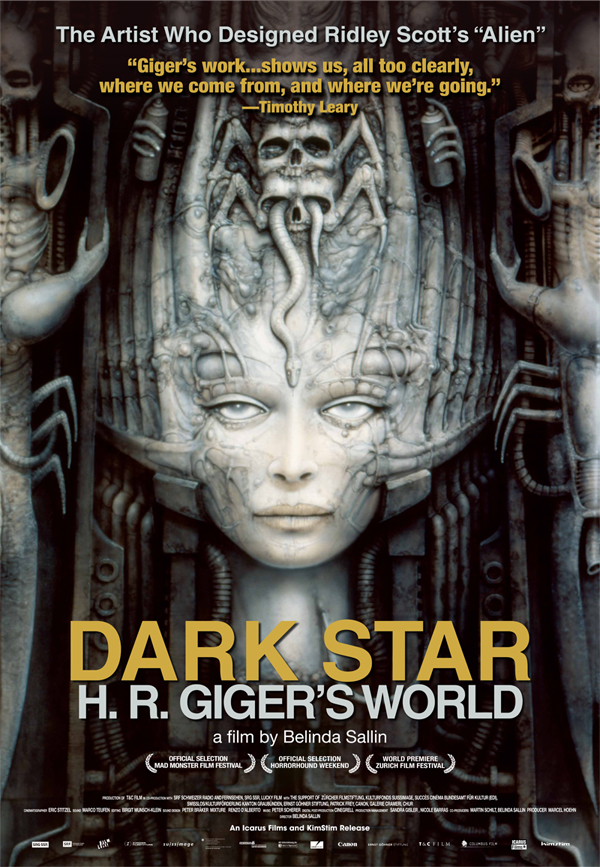
In Belinda Sallin's creepy doc, DARK STAR, we're welcomed into the world of a most bizarre artist


Update: Dark Star will be available on VOD as 
of August 18 and via DVD on September 1.

Nothing moves fast -- not time, not the camera, nor the people that camera captures -- in DARK STAR, the new documentary film by Belinda Sallin -- her first, after making a doc series for German television. This slow pace has a kind of hypnotic effect that can alternately impress you or, if you're not careful, make you a tad sleepy. The result may depend on how much you already know and appreciate about the Swiss artist H.R. Giger. One thing I learned very quickly is that those H R initials stand, affectionately, for HansRuedi.

Ms Sallin, shown at left, was given wonderful access to Herr Giger, his household, his art and ideas, such as they are. Best known as the man who created the "alien" (of the Ridley Scott film and its far-too-many spin-offs, as well as the less famous but quite impressive "Sil" from Species, Giger (the German pronunciation of his name is evidently Geeger) was a guy for whom, as one person in the film succinctly points out, "birth, sex and death were very closely entwi-ned." These three land-marks/hallmarks were also, from what we see here, pretty much all that mattered to the artist.

Giger, shown above and below, during the time of the filming, is also seen at some length as a younger man and artist, during the days in which his career was taking off. We meet a couple of his earlier wives (one of whom he explains he had to marry in order for her to be perceived as something more than a mere "groupie") and spend time with the woman (and her mother) who cared for the artist through the end of his life.

Sallin fills her film with those helpers and caretakers, some of whom double as "shrinks" to our subject. Mostly a two-dimensional artist, Giger also completed a number of sculptures which have similar themes as his paintings. Quiet, slow-paced (often wheelchair-bound when he must travel) and soft-spoken, he had a very close relationship to his mother, in particular, while his father seems simply quiet and mysterious. "If I had shown my pictures to my parents," he admits at one point, "it would have scared them to death."

Though he is not asked about this, it would appears that Giger's influences might have included the likes of Dali, Picasso, Bruegel, Bosch, and maybe even de Chirico. We go with the fellow and his crew to a personal appearance in which he meets some of his many fans, applying his autograph to their books, prints and even their various body parts.

The filmmaker tracks Giger's career from the 1960s onwards, and we see him as a young man and artist, and while the fellow was perhaps always pretty strange, he has clearly become even more so with age. "He probes the dark areas where we don't consciously go," notes one of the interviewees along the way, and this is certainly true enough. But how he probes them seems to me a little facile, single-note and obvious. Perhaps there is more to life -- for some of us, at least -- than birth, sex and death.

The film ends with a dinner at Giger's home, with many of the folk we've seen during this doc in attendance, including the artist's fabulous cat. Mid-meal, the old man suddenly leaves the table and descends the stairs into.... This makes quite the appropriate finale, as Giger, we learn while the end credits roll, died very soon after filming was completed.

Dark Star, from Icarus Films and running 95 minutes, has its theatrical debut this Friday, May 15 at the Landmark's Sunshine Cinema in New York City, Nuart Theater in L.A., Opera Plaza Theater in San Francisco, the Shattuck Cinemas in Berkeley and the Cable Car Cinema in Providence. To see all currently scheduled playdates, cities and theaters, click here and scroll down to the appropriate film.  

Thursday, March 28, 2013

Gilles Bourdos' RENOIR gives us the painter his offspring and -- best of all -- his subject

If Gilles Bourdos, shown below, the director and co-writer of the astoundingly beautiful new French film RENOIR (about, yes, that prodigiously talented family of artists) had decided to name his movie Heuschling, after one of, perhaps the final model (Andrée Heuschling) used by the paterfamilias Pierre-Auguste Renoir as the subject of his popular paintings, the film might not have immediately appealed to the arthouse crowd. But given how important Heuschling is, not only to the Renoir family but to this very good film -- one of the best we've had about artists and the artistic process -- naming it for this woman would not at all have seemed out of line.

It is Andrée, the first thing we see in the film, who brings us into it. We're at her side as she rides her bicycle up and down hills and through the verdant countryside until comes she comes upon a kind of estate. We enter the gate and come to know, slowly, all about the Renoir family and its servants through the eyes and finally the heart and mind of this young woman, who is brought to exceptional life by the talented actress, Christa Theret (below and on poster at top). Ms Theret is not only strikingly beautiful -- with a body that seems to cry, Paint me! -- but she possesses the ability to seem at once of Renoir's time (a century ago) and the very model of a modern major feminist. As a character, she's thoughtful, inquisi-tive, alternately pliant and demanding; as an actress, she's quite a find, so I hope we'll be seeing much more of her in the years ahead.

As for those Renoirs, in addition to dad, we also see a lot of sons Jean (Vincent Rottiers, below, one of the best young actors currently working in France: I'm Glad My Mother Is Alive and In the Beginning) and Claude, nicknamed Coco, played well by Thomas Doret (barely recognizable here as The Kid With the Bike). We see nothing of the the eldest son, Pierre, who went on to become rather a famous actor, but the two we view are enough to make this family come to very interesting life.

As dad and the first of the famous Renoirs, the 87-year-old Michel Bouquet (How I Killed My Father, Toto Le Hero) makes a fine and precise painter, as well as a sad old man, losing by increments to crippling arthritis everything that has made his life worthwhile. What M. Bourdos shows us of a great artist in the sunset of his life -- how he thinks, feels, paints and aches -- is so well realized that I think this will be the standard for some time to come.

What probably will make the movie a keeper in one's memory, however, is the great beauty that has gone into scene after scene after scene. And this is never a "too-showy" thing but rather seems to come naturally from the time and place. The cinematographer is the great Lee Ping Bin (of In the Mood for Love and Norwegian Wood), who shows us how the light plays off everything (see poster, top) and the colors this creates, the manner in which all this beauty feeds the characters and their need to produce, and how it seeps into everything from the house to the grounds to the skin of our (and Renoir's) favorite model.

All the details seem so right, as well, with nothing pushed. The movie is full of quiet critique: of class and behavior, of art, of social mores, of war. It shows us love, too -- differing kinds of this (see below and below) -- and finally it lets us see the place of women at this time. And it is this, as much as anything (except, of course, that great beauty) that is likely to stay with us.

Renoir is memorable indeed -- a wonderful collaboration between writers, director, actors and technicians creating art about art and in the process giving us a splendid slice of humanity in France during (but fortunately far enough away from) World War I.

From Samuel Goldwyn Films and running 111 minutes, the movie opens this Friday, March 29, in New York City (at the Lincoln Plaza Cinema) and in California (in Los Angeles, Encino, Pasadena, Irvine and Santa Barbara). Click here to see all the theaters showing the film this week and also for the many upcoming playdates around the country.

Monday, July 19, 2010

Tamra Davis' radiant movie JEAN-MICHEL BASQUIAT: THE RADIANT CHILD opens


There was indeed something quite radiant about the young street artist Jean-Michel Basquiat -- in his character, appearance and (sometimes) art -- and Tamra Davis' new documentary JEAN-MICHEL BASQUIAT: THE RADIANT CHILD captures this quite beautifully.  As did, I think, the earlier movie starring Jeffrey Wright that was written and directed by artist/filmmaker Julian Schnabel. The two films make a nice set of bookends about this sad and troubled young man who could not handle the seldom-seen but oft remarked-upon cliché of "overnight success."  Basquiat was about as good an example of that rare happening as any I know.

His star rose and rose, thanks to his own artistic talent, his ability to market and manipulate, and his capacity to turn out decent art with almost indecent speed -- and of course to the media's evergreen ability to proclaim and anoint.

Basquiat was also, as you'll have no doubt after seeing either of these movies, a child. He never began to grow up, and once success arrived with its usual whammy, he never would. Ms Davis' movie (the filmmaker is shown at left) came about, the director explains, when she re-discovered some footage she had taken of the young artist (who was a friend of hers) that she had deliberately buried soon after Basquiat died.  This footage provides much of what is best about her film, and it shows Jean-Michel full of creativity, spirit and fun, as well as some confusion, grandiosity and paranoia.

Davis also interviews everyone from the artist's first girlfriend -- who worked in an East Village bar/restaurant, and with whom Basquiat lived and who evidently helped him through the days prior to his success -- to agents, friends, gallery owners and other artists, including Mr. Schnabel.  Through all of this a picture begins to emerge of a personality and his art.  I wish that we had heard a bit more about the negative side of JMB to help balance the whole, and more about the artist's parents, especially his oddly distant father, whose approval Basquiat seemed to want and need.

The artist's affinity for and relationship with Andy Warhol is also explored, with about as much negative outcome as positive to be found.  Their dual show, the poster for which is shown above, was among the last for both men.

The film's 88 minutes pass quickly, with a number of highs along the way. Spending quality time (movie-quality, at least) with Basquiat, as we are able to do here, will probably make us appreciate his art all the more.  Great I do not think he was; that he was good, and sometimes much more, there is little doubt. He was unique in his ablility to communicate a wealth of ideas bracingly, stirringly -- if not richly.  His style, often scratchy and frenetic, rarely achieved beauty.  You can study it and be fascinated, but it is not the sort of thing many of us could live with 'round the clock. He was a "natural" artist, which meant that he could turn out art on a dime -- fast and furiously but not always with the same skill or success.

Ms Davis' film begins its two-week run this Wednesday, July 21, at New York City's Film Forum; click here for screening times and dates. You can find further screenings/playdates in your own area of the country here.  (Note: Ms Davis herself will appear at Film Forum for a Q&A after the 8pm shows on both July 21 & July 22.)