Showing posts with label movies about writers and writing. Show all posts

Sunday, January 27, 2019

THE WILD PEAR TREE: Nuri Bilge Ceylan's latest, lengthy, loving dissection of family, country, religion -- but not quite politics


Nothing overtly political ever crops up in the latest endeavor from Turkish filmmaker, Nuri Bilge Ceylan. Not even a tiny aside such as the bit of "Erdo-gone" graffiti you might have noticed oh-so-briefly in that popular Turkish cat documentary from 2016, Kedi. Yet I defy any viewer who lasts out the 188-minute running time (this should not be difficult, given the quality of filmmaking here) of Ceylan's newest, THE WILD PEAR TREE, not to feel grateful that he or she lives almost anywhere else.

Mr. Ceylan, shown at left, never stints on showing us how beautiful are the Turkish landscapes, full of the kind of flora, fauna and gorgeous scenery you'd want to embrace. It is the people here, thoroughly fucked-up as they seem (which is standard in this filmmaker's work), who will give you pause.

Major family dysfunction is the rule, and while Ceylan is more than adept at spreading responsibility -- no single person, nor even an entire generation, comes off as villain here -- still, the buck must stop somewhere. And so it does. Just off-screen. The restraints that hobble anything close to a democratic society -- while inflicting helplessness and depression on that society, as it forever scrambles and strains to make ends meet by hook (or mostly crook) -- are inescapably shown.

Yet so long as Ceylan points no obvious fingers, he is allowed, thankfully for intelligent film lovers, to keep working and even to have his movies chosen as Turkey's Best Foreign Language Film submissions, as was this one. Mr. Ceylan has so far had five of his films submitted by Turkey in the BFLF category, but none have been actually nominated. TrustMovies suspects they are simply too demanding and lengthy for Academy members to appreciate fully.

The Wild Pear Tree has at its center a young man named Sinan (played by Aydin Doğu Demirkol, above) at last out of college who has written his first book -- that eponymously titled fruit tree --  and has come back to his family and home town to try to find financing for publication. How he does this involves everything from bureaucratic snivelling to family (depending upon how you perceive it) betrayal.

All this allows us to get quite an inclusive and all-angles view of his father (a fine Murat Cemcir, above), an addictive gambler; his angry yet steadfast mother (Bennu Yuldirimlar, below); and Sinan's grandparents;

as well as a look at some of his friends, a would-be lover, and a local politician, a business owner and even a successful author (Serkan Keskin, below) to whom he turns, somewhat angrily, for help.

As in his other lengthy and extremely rich movie, Winter Sleep, The Wild Pear Tree is distinguished by not only by its very strong character studies but also via some equally vital and almost shockingly lengthy conversations/philosophical discussions about writing/accommodating and religion, during which we eagerly hang on to each new turn of phrase and idea expressed. (The gorgeous, beautifully framed cinematography -- by Gökhan Tiryaki -- helps, too.)

We also find ourselves, in a tale told via occasional fantasy and dream, moving from anger and dismay to a sad and quiet understanding of the various characters and their needs and actions. The final father/son scene is as surprising and full-bodied as you could wish, ending the film on a note that is simultaneously hopeful yet might also be a mere continuation of all that has come before, now passed down to a new generation. However you choose to view it, The Wild Pear Tree takes an immediate place as one of this year's best.

A Cinema Guild release, the film opens in its U.S. theatrical premiere this Wednesday, January 30, in New York CIty at Film Forum and on February 8 in Los Angeles at Laemmle's Royal, followed by openings in another dozen cities over the weeks to come. Click here and scroll down to see all currently scheduled playdates, cities and theaters.

Tuesday, February 27, 2018

SUBMISSION: Richard Levine's timely and unsettling adaptation of a Francine Prose novel


Perfectly timed to the current Me2 movement, though not in quite the manner you might expect, the new film by director/adapter Richard Levine -- from the well-regarded novel, Blue Angel, by Francine Prose -- SUBMISSION tackles the idea of sexual harassment from a very different viewpoint. Though TrustMovies has not read this particular novel by Ms Prose, he has always found her writing strong, intelligent, thoughtful and often surprising in its choice of not just her subject but her attitude about that subject.

Here, the sexual harassment comes from both sides and in ways that are not so apparent early on. Motives are unclear, and sex itself seems maybe not nearly as important as things like fame, ego and that always problematic sense of self-worth. As director and adapter, Mr. Levine, shown at left, negotiates all this with remarkable ease and facility so that we are taken in, just as is the movie's protagonist, played with a simply wonderful combination of naivete and smarts by the always-good but here in that rare leading role that allows us to understand just how spectacular this actor can be: Stanley Tucci, below.

Mr. Tucci allows us to identify with and understand his character so thoroughly that, somewhere near the film's conclusion, my spouse murmured aloud, "Oh, this poor guy!" You'll feel the same way, and yet you will also understand exactly how he has managed to put himself in this unenviable position.

You may also feel a very odd combination of anger and admiration for his antagonist, portrayed with exactly the right mix of intelligence, neediness, ambition and a just-slightly-marred allure by Addison Timlin, above. The performances by these two actors could hardly be bettered, and the alternately sweet and naughty little dance they do together grows more complicated and unsettling as the movie progresses.

And, yes, sex is indeed involved, but the harassment portion of the equation is a lot more pliable and provocative than certain viewers might wish. The small liberal arts college that is the setting of the film is brought to satirical and mostly realistic life, while supporting roles  -- from our hero's wife, played by Kyra Sedgwick, below, and one of his faculty friends (Janeane Garafalo, shown at bottom, right) -- are very nicely limned, as well. While the novel was published back in 2000, the filmmaker has updated the content to include (and make some fun of) more current and problematic educational "tools" such as safe spaces and trigger warnings.

What happens to Tucci's character is awful but somehow expected, and the movie (as I imagine was the original novel) is not content to merely leave it there so that we and the characters can stew in our/their own juices. The ending -- which is abrupt yet just about perfect (the last line of dialog is heavenly) -- should put you in mind of something with which I suspect Ms Prose, Mr. Levine, the actors here and most of us writers, too, would all agree: In the end, it's the work that counts.

From Paladin and running 106 minutes, Submission opens theatrically this Friday, March 2, in New York City at the new Landmark 57 West. On Friday, March 9, look for it around the rest of the country in some 45 cities major and minor -- from Los Angeles (at various Laemmle theaters) to elsewhere, at locations including both the Regal and Landmark chains.  

Friday, September 29, 2017

J.D. Salinger again -- this time in Danny Strong's narrative bio-pic, REBEL IN THE RYE


Great American writer (thought by some to be one, anyway) J.D. Salinger is back on screen again. He never seems to be away for all that long, what with a couple of of documentaries (1999's   J D Salinger Doesn't Want to Talk and 2013's critically reviled but actually pretty-damned-good  Salinger) and a number of adaptations of the guy's short stories, one of them unauthorized, and another (the first to reach film: My Foolish Heart) said to be the reason J.D. would never again let Hollywood near any of his writing, in particular any adaptation of his landmark and major novel, The Catcher in the Rye.

The above is by way of introducing the latest in Salinger-iana, a new bio-pic entitled alliteratively but foolishly REBEL IN THE RYE based on the biography of Salinger by Kenneth Slawenski, which has been adapted and directed by Danny Strong (shown at left).

On the plus side of this new film are some fine period detail and cinematography (by Kramer Morgenthau) and yet another commanding performance by Kevin Spacey. Is there nothing this fine actor cannot do? From playing singer Bobby Darin to that fictional/ memorable  President Francis Underwood to this latest gig, essaying Salinger's teacher/mentor, Whit Burnett (shown below), Spacey is consistently terrific.

Performance-wise Mr. Spacey is the main reason to bother with this too-by-the-book bio-pic. The Burnett character is by far the most interesting and full-bodied of anyone in the film. And that includes Salinger himself, played by British actor Nicholas Hoult, below, who can be very good at times but here is made to tow the line of mostly worshipful biography. Oh, the Messieurs Strong, Slawenski and Hoult may imagine that they're giving us the warts-all-all treatment, but most of the details they offer seem second-hand and all too typical of the telescoped storytelling found in movie bios.

So we get numerous scenes of the writer at his typewriter, having love trouble, war-time trouble, and post-war-trauma trouble, and the further along the movie goes, the more of a slough it becomes. In its most embarrassing scene, it even hands us Catcher in the Rye's famous where-do-the-Central-Park-ducks-go-in-the-winter moment, and couples it to Salinger getting mugged. (This may indeed have happened, but as shown here, it seems instead a kind of pandering to the book's many fans.)

The very able cast includes Sarah Paulson (above, left, and just fine as Salinger's agent), Victor Garber as his stern father, and Hope Davis as his loving and supportive mom. They're all as good as they're allowed to be, and along the way we get even more fine actors (Brian d'Arcy JamesEric Bogosian and Jefferson Mays) playing, respectively, famous literary folk such as Robert GirouxHarold Ross and William Maxwell, to not a whole lot of avail.

But then there's Mr. Spacey, who pretty much single-handedly makes the movie worthwhile. His Whit is initially stern, funny, ironic and finally encouraging and equally believable in each state. As his encouragement becomes more forceful, and may be turning into something like a very genuine-if-closeted love, Spacey's performance grows deeper, sadder and finally even desperate.

He's the emotional center and the great strength of the movie, despite its being "about" Salinger.

For his part Hoult touches all the proper bases, but can't bring to much life this man who seemed to prefer "not being there." (Hoult is also far too good-looking for the role. The late Jack Webb -- yes, of Dragnet -- would have made a much better visual Salinger. But of course he predeceased the author by about 30 years.)

From IFC Films and running 109 minutes, Rebel in the Rye opens here in Florida today, Friday, September 29, in Miami at the Regal South Beach 18, in Boca Raton at the Living Room Theaters, at the Movies of Delray and Movies of Lake Worth, and in Orlando at the Regal Winter Park.

Tuesday, June 17, 2014

Paul Haggis' THIRD PERSON probes the creative process as few other Hollywood films ever have


As genuinely ambitious a project as I have seen an independent filmmaker tackle, THIRD PERSON, the new movie from Paul Haggis (shown below, whose work I have warmed up to but slowly), proves a surprise in so many ways. It is also one of the most creative and daring films I've seen in a long while in terms of how it toys with the viewer, at times making you wonder if there was any continuity person involved in the shoot. Don't worry: There was. There was also a very smart writer/director at work here, devoting himself to a subject dear to my own heart: how the creative process works, with particular attention to the link between creativity and the loss of a loved one, especially where writers are concerned.

Third Person tells three not at all obviously inter-connected stories set in three locales: New York, Paris and Rome. In each one, a kind of love story surfaces, though each is fraught with anger, repressed or on the surface, and loss.

Mr. Haggis has concocted some wildly emotional scenes -- sometimes funny, sometimes not -- in each of these stories, and he and the editor with whom he often works (Jo Francis) have done a bang-up job of threading them and the stories together so that we always and quickly know where we are and with whom.

The wrap-around tale takes place in Paris, shown above, where a famous writer, played by Liam Neeson, is involved with a younger writer and muse (Olivia Wilde).

A bi-polar woman (Mila Kunis, above) and her painter husband (James Franco, below) are fighting over custody of their son in New York City.

Rome is home to the tale of a semi-sleazy fashion-design thief (Adrian Brody, below) who finds himself involved in the attempt of an Eastern European immigrant woman (Moran Atias, shown at bottom) to get her young son safely into Italy.

Each story has its pleasures -- particularly via the fine performance Haggis draws from his crack actors -- but each also has its problems. The stories don't always make complete sense: Details are off (and then they're on again), locations are confusing. Yet by the end, all of this is justified. What perhaps is not (quite) justified is the unnecessary repetition which adds to the length (two hours and seventeen minutes) which attenuates the movie's strengths and may put off some viewers. (Also, some stories here are better than others.)

If you last the movie out, however, the finale is so stunning and beautifully rendered (flesh becomes metaphor and more) that you will want to sigh and maybe cry and then applaud. When it is finally clear what is going on, so original and lovely is this paean to writing-by-way-of-filmmaking (or is it the reverse?) that you may, as do I, want to view it all over again, this time from quite a different standpoint.

In the cast are some other notables like Maria Bello (above, rather wasted in too small a role, though her last moment is oddly indelible), Kim Basinger (below, quite wonderful), Loan Chabanol (as Franco's new squeeze) and Italian hottie Ricardo Scarmarcio, as the nastiest bartender in Rome.

As I say, Third Person is one of the most ambitious, big-budget indepen-dent films I've ever seen. If you stick it out to the end, you'll be greatly rewarded. Whatever its flaws -- and Mr. Haggis, damn him, has made them part and parcel of the very core of the film -- it's going to excite and anger, flummox and thrill intelligent audiences all around the world.

The movie, from Sony Pictures Classics, opens this Friday, June 20, in New York City at the Landmark Sunshine Cinema, the AMC Lincoln Square, and City Cinemas 1,2,3, and in the Los Angeles area at The Landmark in West L.A. and the Arclight Hollywood.  In the weeks to come it will receive a large-but-still-limited nationwide release in cities all across the country. Click here and then scroll down to see all currently scheduled playdates.

Thursday, March 27, 2014

Streaming those "Beat" boys again: In BIG SUR Michael Polish takes a different tack to Kerouac


What with Howl, On the Road, Kill Your Darlings and just recently the James Broughton doc Big Joy under our belts, some of us may have had enough of the so-called "beat generation." But it would a shame to miss BIG SUR, the under-seen and quickly disappeared movie by Michael Polish about Jack Kerouac, Neal Cassady, Lawrence Ferlinghetti, Allen Ginsberg and a fellow new to me named Lew Welch that, in a certain fashion, proves the best of the lot. That fashion is not a popular one, however,  so watch this film with the understanding that it is basically a story of words and what writing does to and for Mr. Kerouac.The words are the important thing here -- more so than story, drama, conflict, and most anything else one usually finds in our favorite movies.

With this film Mr. Polish continues his 15-year career of making little-seen but occasionally commented-on small, independent films -- Twin Falls Idaho, Jackpot, Northfork, The Astronaut Farmer, among others -- that go their own (and his own) way, audiences be damned or entertained, as the case may be. Here, it seems that Polish wanted to place the words first and foremost and have all else -- especially visuals and performances -- follow from those words. The effect is alternately bracing and a little crazy-making because what's missing here is drama and conflict, though all else is in place.

Actually, the conflict is here, too, but it is all internalized within the character of Kerouac (very well played, by the way, by German-born international star Jean-Marc Barr, who has worked mostly in France, where he has acted, written, directed, produced, photographed and even edited films). While this internalization pretty much saps Big Sur of conventional "drama," it lets Kerouac's words take pride of place as few other movies have allowed.

Kerouac becomes a kind of narrator here, telling us his own story, and it turns out he's scared to death -- of death. His words become a kind of wall of blather against this fear. (And what words can't manage, liquor does the rest.)  It's all most impressive, moving and ridiculous, rather, I suspect, like the man himself.

Kerouac was sexy and sexual, impressive, intelligent, kind, caring and crazy, and so the other characters act as satellites circling him. Even, Cassady (as played by the always fine Josh Lucas, above, right), usually seen as Kerouac's sun, here takes a back seat to our boy. But by now, Neal's bloom may be beginning to fade a bit. Anthony Edwards is aces as Ferlinghetti, and as Welch, the more versatile than you'd imagine Patrick Fischler surprises -- and then some.

Balthazar Getty, Henry Thomas and John Robinson makes up the rest of the gang, with the women's roles entrusted to Kate Bosworth (above), Radha Mitchell (two photos above, with Lucas) and Stana Katic. Everyone is on their mark, but it M. Barr who nails the movie.

The look of the film is quite fine, too: cars, clothes, hairstyles -- everything brings back the 1950s, whether you liked 'em or not, and the location cinematography is utterly beautiful in high definition. Given the gorgeous Big Sur scenery, this should be a shoo-in, of course.

The movie is also homo-erotic aplenty, without being homosexual. Both Jack and Neal want each other's women, and in the case of Billie (Ms Bosworth), this is arranged.  I would not have missed this film, and I suspect others my age will find themselves held in rapt attention. So we owe Mr. Polish a debt of gratitude for concentrating on Kerouac's words.

Big Sur is available now via Netflix streaming, and on DVD. It is also for sale (though not, it seems, for rental) via Amazon Instant Video.

Thursday, July 4, 2013

Sweet dream of the fractured family made whole again: Josh Boone's STUCK IN LOVE -- plus a short Q&A with the filmmaker

If you come, as maybe more than half of us now do, from a family broken by divorce or separation, you may leave the new film STUCK IN LOVE as moved as was TrustMovies. He sat there in his screening room seat waiting for the tears to subside and his face and composure to return to something like normal before he felt comfortable enough to stand up go out and face the world. Why hadn't he brought a pair of sunglasses with him?!

He didn't feel particularly manipulated, either, as most movies of this kind manage to do. Yes, certain information is withheld from us until a point at which it registers more strongly. But because that information is also withheld from another key character in the film, the withholding makes sense on both a dramatic and a realistic level. This is just one of the smart moves that first-time filmmaker Josh Boone, shown at right, makes with his movie. There are plenty more. Stuck in Love is quite the auspicious debut. And gheesh, what fun it is! Though I was crying at the finale, I had laughed myself silly on a number of occasions throughout the film, which is wonderfully entertaining, superbly cast and acted, and written extremely well -- it's that rare film about writers (a whole family of 'em) in which you believe that the folks you're watching might actually have put intelligent and entertaining thoughts to paper (or computer).

It must have been a pleasure for the ensemble of actors to tackle roles this rich and bring them to such full life. The story concerns a mom (Jennifer Connelly, above, right) who has left dad (Greg Kinnear, above, left) and is now living with a younger hunk.

The character played Mr. Kinnear (who remains plenty hunky himself), though still deeply in love with his ex-wife, is now canoodling with a younger married woman (Kristin Bell), his rather short trysts with whom interrupt her jogging sessions. (The movie is quite realistic about sex used as a stopgap for pain and/or a substitute for other things we're not getting -- as well as simply something that's necessary and enjoyable.)

On the younger front, the family's daughter (Lily Collins, above, left), still raging mad at mom, refuses to get close to any boy and instead makes certain her partners understand that this is only a "sex" thing. When a persistent young man (Logan Lerman, above, right), puts his quietly intelligent moves on her, she is typically angry but also flummoxed.

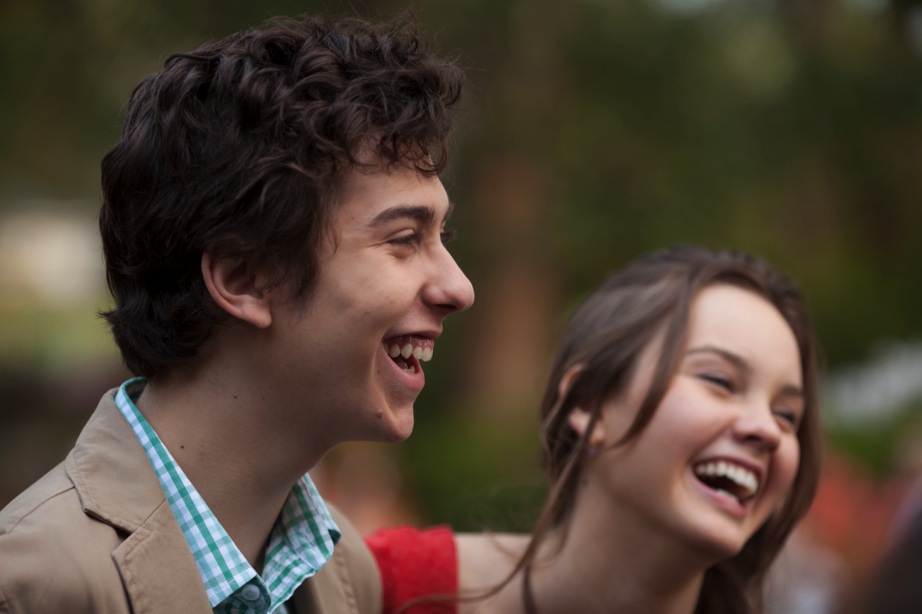
Sis' younger brother (Nat Wolff, above, left) who has wisely not taken sides in the family dispute and is just coming into his own sexuality, is attracted to the girlfriend (Liana Liberato, above, right) of the school druggie/bully (Patrick Schwarzenegger), shown below and about to punch.

How all this plays out is full of intelligence, energy, charm and wit. Dad, sis and bro -- writers all -- are at various levels of their career, and it is fun to see how each one handles this. The movie is a rom-com, all right, but it proves much deeper and more expansive on a number of levels -- one of which includes, yes, Stephen King -- than most of its ilk.

I don't expect that you'll have as strong an emotional reaction to the film as did I. We each come to a movie carrying our own bag-gage, which reacts to and with the film in its own way. But if you are at all interested in things like love & trust, writers & writing, and the uses of sex, I'll be surprised if you do not find Stuck in Love very much worth your time, not to mention your laughter and tears.

The movie -- from Millennium Entertainment and running 96 minutes, opens its exclusive NYC run tomorrow, Friday, July 5, at Landmark's Sunshine Cinema. Oddly enough, it seems to be getting a wide release in both the Kansas City and the Orlando/
Daytona Beach/Melbourne, Florida, areas. Los Angeles? Maybe later. Anyway, catch it if you can -- or wait for the DVD/Blu-ray.

*****************

TrustMovies met with filmmaker Josh Boone (shown below and further below) a week or so back but managed to leave his tape recorder next to his desktop at home. Much scribbling on note paper ensued as we spoke with this really "up," smart (but not smart-alecky) and charming young man.

Film school for Boone, he told us, meant growing up with a Super 8 and watching all the old movies he could manage to see, first on first VHS and then DVD. He's especially fond of The Criterion Collection (and who can blame him?).

Boone has always been attracted to writing and writers -- as his terrific use in the film of Stephen King and his work proves, along with the interesting way in which he has managed to endow each writer in his "movie family" with their own special subject and style.

Perhaps one of the biggest things in his young life occurred when his parents became born-again Christians during his adolescence, and he was forced to start hiding the books he was voraciously reading behind the covers ripped from "Christian" books then placed over Boone's preferred content.

All this was a strange but interesting part of the young man's life, and he says he would some day like to do a movie about religion. We can't wait.

TrustMovies remarked to Boone how amazing it seemed that he not only got this script filmed but that he himself, with no experience behind the camera, was allowed to direct it. He agreed, with a shrug and a chuckle. But the result more than bears out the trust placed in him by producer Judy Cairo (who earlier gave us the award-winning film Crazy Heart, Hysteria and the recent Erased).

When Boone's own parents later divorced (yes, this movie, as you might expect, comes from someplace personal), he explains that, like the brother in the film, he held no great anger toward either parent.

The filmmaker, now 34, tells us that while he may appear an overnight success, he has spent 10 years living in Los Angeles and "rolling that snowball up the hill," trying to get a film script produced.  "The key," he says, "is to write from your own personal experience." While we've heard that one before, we must admit results rarely come together this well.

As a small, independent film -- though cast just about perfectly with top professionals -- Stuck in Love will still have its work cut out for it, trying to reach the audience that, if it just can be tapped properly, surely exists for a movie this appealing and well-executed. We thank Mr Boone for his time and wish him -- and his film -- the very best.