Showing posts with label soccer. Show all posts

Wednesday, December 5, 2018

Catching up with Nick Park's claymation soccer-themed delight, EARLY MAN


TrustMovies spent the past few days with his daughter, son-in-law and grandkids in the Atlanta area (specifically the uber-charming little town of Decatur, Georgia), during which grandsons Ronin and Walker suggested watching EARLY MAN, the animated movie directed by the claymation maven, Nick Park (of Wallace & Gromit fame, Chicken Run, and a bunch more).

The movie, as expected given Park's oeuvre, was great fun-- and probably as much for adults as for the kids. I suspect, however, that it proved more successful in Europe and elsewhere internationally than here in the USA because its subject is soccer (or futbol, as it is known around the globe), while the manner in which this game was originally invented and played is brought to goofy and delightful life by Park (shown below) and his writers, Mark Burton and James Higginson.

Early Man posits a properly dumb but very diverse caveman tribe, pushed by their youngest but most forward-thinking member (shown at  bottom, with his pet cave-pig) to hunt for something "meatier" than mere rabbit, when rather suddenly their quiet life (for cavemen, anyway) is upended by marauders from a more "civilized" (read empire-driven) society.

Somehow, this turns into an all-or-nothing soccer match, which, against great odds, our little tribe must win.

Don't expect much in the way of originality in how the plot progresses, but so much of what we see and hear is so much fun that I doubt this will matter.

The film is so full of lunatic moments (my favorite occurs at the left-hand bottom of the screen, as a roach dons a pair of sunglasses while a nuclear moment erupts) that you will probably find yourself alternately chuckling and laughing aloud.

The voices assembled for this little lark includes a bevy of talented and well-known actors (check out the full cast here), and no one disappoints in the least. That voice-master Rob Brydon may be the most fun, playing several roles, including the messenger bird, above.

And, yes, there's a love story of sorts, as well as a major nod to feminism, a good 'n greedy villain, a nifty gladiatorial Colosseum set, an exciting chase or two, and tons of humor in a wide variety.

Available now on DVD and streaming (we viewed it via Comcast/Xfinity's Free Movies for Kids category), Early Man is well worth a watch for children and adults -- especially, of course, fans of futbol/soccer.

Thursday, February 8, 2018

Transgender time again in Rebekah Fortune's excellent (for awhile) example, JUST CHARLIE


What's to become of a young boy who's very good at soccer and who secretly and with all his/her heart wants to be a girl. You'll find out when you view the new British indie film, JUST CHARLIE, written by Peter Machen and directed by Rebekah Fortune, which, for quite awhile and quite well, explores the difficulties -- family/school/ friends/sports-related -- of someone going through this kind of heavy-duty trauma in which the recipient of one sex knows with every breath that it ought to have been the other.

Ms Fortune (shown at left) and Mr. Machen have done their research but know enough to bury all that within a screenplay that very specifically and cleverly creates a believable world around its main character, the titular Charlie, played with a lovely generosity and sweetness that never curdles by Harry Gilby, shown below.

So believable, in fact, are young Mr. Gilby and all the characters who surround him that the movie, for most of its length, is an easy one to appreciate and admire.

Gilby is pretty enough of face but also a whiz on the soccer field, so much so that he has been chosen to audition for training in the big league. But this gender identity thing grows ever more important and imminent. (That's he in his male attire above, with dad -- played by Scot Williams -- and his soon-to-be female version, below.)

Once the cat is out of the bag for his family, sides are taken, which occurs in school as well. Friends are lost , not just for Charlie but for his family members, too, and all this is handled with surprising truthfulness and precision. So much so, in fact, that we feel the pain, not just of Charlie herself, but that of her family and even some of the friends who are no longer so friendly.

This is all the the movie's credit, and it makes the film seem more real that many of its ilk in which coincidence and the need for a happy ending trump all else.  But then maybe a quarter hour or so from its ending, Just Charlie suddenly changes course, as an angry family member returns too easily to the fold, a florid melodramatic beating takes place (that ought to have put our heroine into a coma) followed by a (sort of) surprise bit of feel-good nonsense.

This is all too bad, for had the film been willing to continue on its small-steps course, it might have been a game changer of sorts. So if you do decide to view Just Charlie, make certain you also see A Fantastic Woman, if only for some ballast.

From Wolfe Video and running 99 minutes, the movie hit the street on DVD and streaming earlier this week -- for purchase and/or rental.

Friday, July 1, 2016

Alix Delaporte's THE LAST HAMMER BLOW -- another winner screens at FIAF's CinéSalon


With a single exception so far, Burning Bright -- the new series from FIAF's CinéSalon that introduces the next generation of French auteurs -- is proving to be every bit as good as is that popular yearly series from the FSLC, Rendez-vous With French Cinema. This week's film is another little gem: THE LAST HAMMER BLOW from a filmmaker, Alix Delaporte (shown below), with whom TrustMovies is only now getting acquainted.

Ms Delaporte has written for French television and co-written and directed two movies, the latest of which is this 2014 film, which tackles the tale of an adolescent boy named Victor (played by a simply terrific newcomer, Romain Paul, above and below) in the French provinces finally coming into contact with his birth father, whom he has never met.

Dad  (played by Grégory Gadebois) is a fairly famous orchestra conductor, who may not even know he has a son. Victor's mom (the always fine Clotilde Hesme), who wants nothing to do with his dad, is recovering (well, we hope she is) from what looks like a bout with cancer of some sort, and when Victor learns that his father is guest conducting the local symphony in a performance of Mahler's Sixth, he determines to meet the man, come hell or high water.

That's the set-up, which sounds interesting enough but perhaps nothing we haven't seen previously. But how Ms Delaporte chooses to tell her story -- in swift, sharply observed scenes in which the exposition is mostly buried within the actions and behavior of the characters -- is something else.

This means we have to stay quite alert for fear of missing any telling moments, of which there are plenty. But the filmmaker makes this easy to do, via her casting of the three leads, each of whom shines, and all the subsidiary characters, as well. (That's Spanish actress Candela Peña, above, left, with Ms. Hesme; also in the cast is noted Spanish actor Tristán Ulloa.)

The lead performances -- that's M.Gadebois, above, and Ms Hesme, below -- are so immediate and real, without ever being "showy," that the film often appears to be something close to a documentary. (Gadebois rather resembles a French answer to our own Peter Sarsgaard, if a little heavier, and he gives a most interesting performance here.)

While her film unfurls in logical, first-this/then-that order -- no back-and-forth flashbacks or anything super-stylish here -- Ms Delaporte instead chooses to give us scenes that may seem almost random but are actually very well chosen to further her story and build her characters, while avoiding the typical and sentimental.

Characters grow and perhaps change, but only in small increments. All this makes what happens in the course of the film seem both believable and "earned." Consequently the joy we experience at the finale comes from a place much deeper and more genuine than often happens in stories like this one.

Young Monsieur Paul is quite a find. He has one of those wonderful faces that seem to want to hide feelings yet can't. They keep seeping through, as much as he tries for disguise. The IMDB does not show any further acting work for him post this film, but I do hope we'll see more of this young man as he grows up.

Gadebois and Hesme give performances of wonderful specificity and emotion. Though we never learn specifics about what happened between their characters, this seems yet another smart choice on the filmmaker's part. And the actors bring such depth to their roles -- they make their quite different situations seem understandable -- that we don't miss, even one tiny bit, the more standard exposition many moviemakers would offer. (The scene, above, in which Dad has his son come up and watch the orchestra from the conductor's standpoint is fascinating and rich. I've never seen anything quite like it in a film before.)

The way the movie handles music -- the love of it and the making of it -- seems to me exemplary. Combining Mahler, soccer, cancer and parenting, The Last Hammer Blow weaves all this together with such spirit and grace that we can only sit back and marvel. And care. And enjoy.

This film really ought to have been picked up for U.S. distribution, so FIAF's bringing it to us now can only be seen as a gift. It plays this coming Tuesday, July 5, at Florence Gould Hall in Manhattan, twice only at 4 and 7:30 PM. Click here to learn more and/or purchase tickets. And remember: FIAF members attend free of charge.

Thursday, December 6, 2012

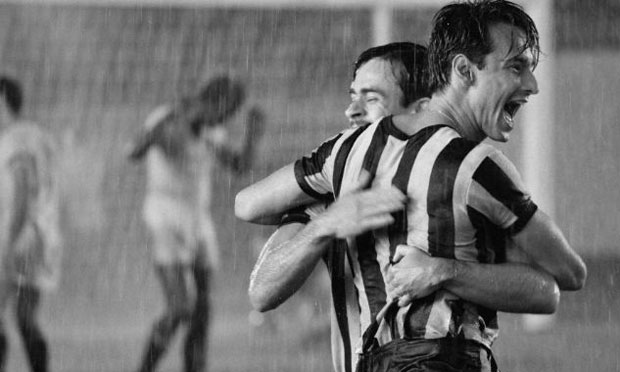
HELENO: José Henrique Fonseca's bio-pic about Brazil's mid-20th-century soccer star

Who was HELENO (full name: Heleno de Freitas)? This famous syphilitic soccer star from Brazil was perhaps the first bad-boy media-darling of the sport. He predates even Pelé, let alone a late-comer like Britain's Beckham, and his warts-and-nothing-but story -- or as much of it as director and co-screenwriter (with four other collaborators) José Henrique Fonseca chooses to show us -- is a relatively interesting one.

If Fonseca, shown at right, indulges in most of the standard clichés of the genre, he does it using performers who are talented, committed and plenty gorgeous to view. He also made the smart decision to shoot the film in black-and-white, which helps enormously to capture the ambience of the mid-20th-Century world of South America (the crack cinematographer is Walter Carvalho (Central Station, Carandiru and To the Left of the Father). For a time, the filmmaker's use of impressionistic "takes" on the various events in Heleno's life -- Fonseco dashes back and forth in time and place -- helps keep us nicely off-balance, imagining that we'll be getting something more from this particular bio-pic. In a way, we finally do -- because, although those clichés keep building up, so does the strange character of our non-hero.

Heleno de Freitas came from money, studied law and could easily have led a cushy, entitled, no-sweat, upper-class life. His passion -- for women, sports, sex -- was so great (as was his temper) that he could not abide anything less than perfection or near. As Heleno, Rodrigo Santoro (above and below, from Lions Den, Che and I Love You Philip Morris) captures this crazy passion so well that you spend your viewing time alternately loving this guy and wanting to deck him.

The two main women (at least as shown here) in his life are played by Aline Moraes (above) and Angie Cepeda (below) -- who bear enough resemblance to each other to make us imagine that Heleno had quite specific tastes in the physical appearance of his women. We never see his mother in the film (though he talks to her often on the phone) but I would bet that she looked a lot like these two.

As the syphilis continues to eat away at him (the doctors knew and he knew, but he refused to do anything about it: "I don't want to be soft," he says, meaning, we guess, below the belt), his mind and body deteriorate.  The make-up artists and Santoro's willingness to lose weight combine to give us, as seen below, a surprisingly real pre-cadaver. In the sanitarium where he spends the final time, we witness some psychologically creepy stuff, as Heleno eats his press clippings off the wall. But even there, as ever, everyone continues to serve him, while he serves no one but himself.

As angry as we get with Heleno's own anger and near-constant harangues, even so, the final scene -- which flashes between this fellow's heyday and his end --  is very well done. It should bring a tear to the dryest eye of even those, like me, who care not a fig about sports of any kind. Here, the the filmmaker and his star find a visual means to address that gap between who we are and who we want to be, what we reach for as opposed to what we are able to grasp.

Heleno, from Screen Media and running just under two hours, opens tomorrow, Friday, December 7 in New York City, Los Angeles and Miami. Click here and then click on THEATERS on the top line to see all specifics.