First a note:
TrustMovies' review of the original
Burzynski film, together with a long interview with the filmmaker
Eric Merola (you can find both
here), is the single most read post on this blog, by a wide margin -- with literally thousands more hits, page-views and readers than any other posting in the blog's nearly five-year history. In a normal to good week, my postings might get 2,500 hits;
Burynski's best week reached 10,000. I'm happy about this because the film is not only a very good one, as it details the triumphs and struggles of this Texas-based doctor to cure cancer using his own Antineoplastons method (which, by the way, after 27 years of independent testing, notes Dr. Hideaki Tsuda of
Kurume University Hospital in Japan, have been found successful), it also shows up the behavior of our government, the Cancer industry and Big Pharma for the power/money-hungry, hypocritical scum that they all too often are.
Mr. Merola, shown at left, has done his homework -- and a lot more. His first film is so tightly focused, documented and well argued that if it were used in court as a defense of Dr. Burzynski (or better, the prosecution of that government/pharma/cancer coalition) there would be no contest. In the time since I saw the original film, Merola tells me that it has been reedited to include certain testimony that was not originally available, and now makes an even
stronger case. The injustice quotient here is so staggering that one cannot blame many Americans for wanting to look the other way. As more and more truth about the lies we are being fed keeps surfacing, thanks to everything from Google Search to WikiLeaks, looking away grows more difficult in these days of "banks too big to fail," Wall Street crime unchecked and unpunished, constantly growing corporate power, and the increasingly lurid and sick control of Monsanto over our diet. This is just as well, for we seem to be approaching a time when either martial law or armed insurrection will at last be America's real form of
democracy.
Meanwhile, what to make of
BURZYNSKI: CANCER IS SERIOUS BUSINESS (PART II)? First off, in my estimation, you should make certain you've seen the original film
first, for it offers such terrific history and background on the whole story. For anyone who's already seen Part I, Part II will be be a must. The latter film gives updates on much of what we saw in Part I -- further explaining the doctor's use of personalized gene-targeted cancer therapy along with the Antineoplasteons method.

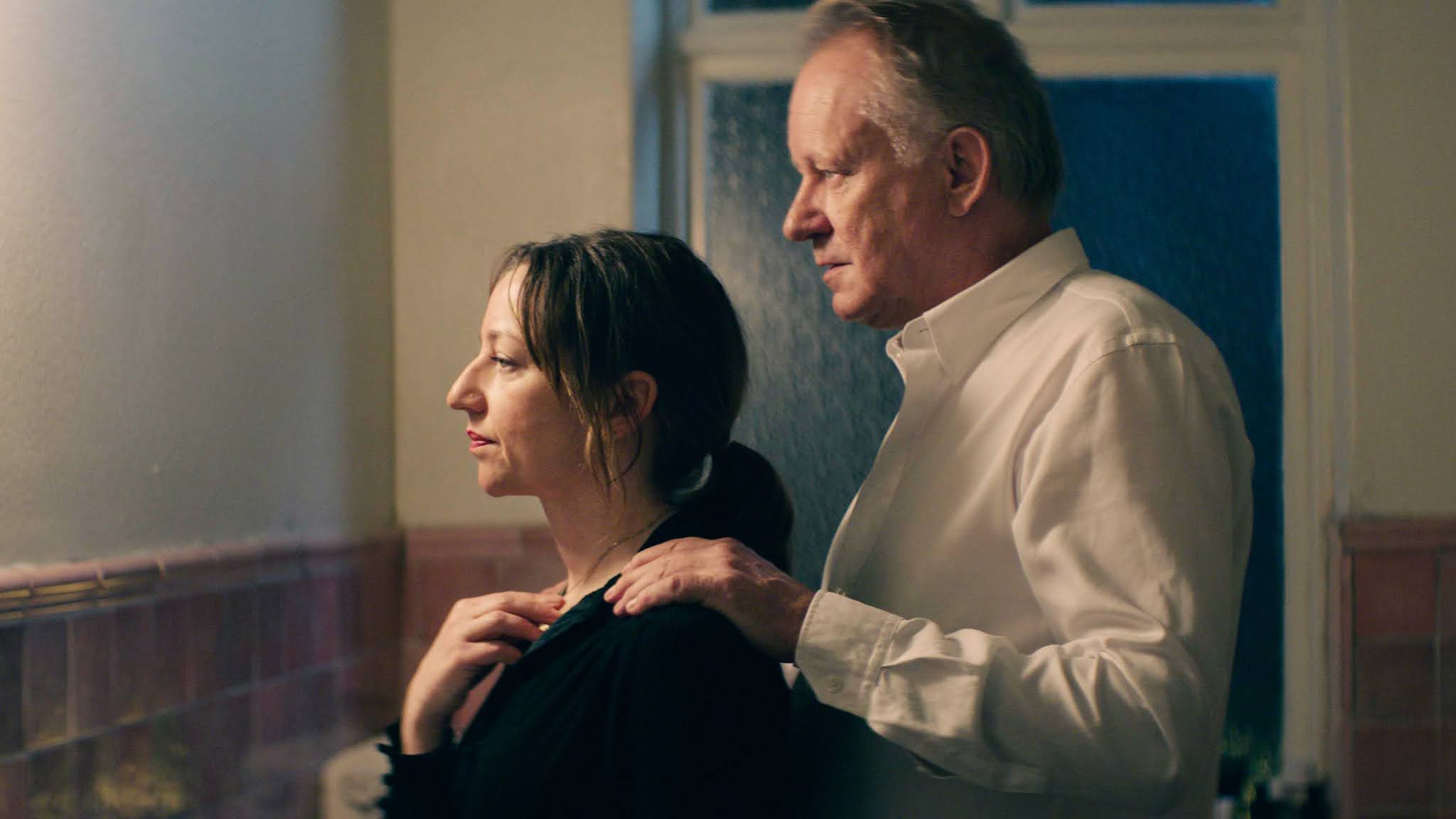
There is also an almost entirely new cast of patients, some of whom "make it," some of whom do not. (Neither the doctor nor the filmmaker ever implies that this method is foolproof.) We follow one particular family in Britain, that of Laura and Ben Hymas (above) and how the British medical establishment tries to prevent the Hymases from going with Burzynski (there is a audio-taped interview here, a still from which is shown below, that is simply staggering); how the paid-off leading "skeptics" and their follow-along acolytes try to first scare and then drub the Hymases into submission, and finally how Laura comes through and what she has to say to these "supposed" skeptics, post-remission.

The FDA as an arm of the drug companies is explored once more, along with a lot else. What isn't in the documentary (from folk who are no doubt too frightened to go on record) is probably as important as what is, but you can read about some of this in the Q&A below. Our government, our Cancer industry and our drug companies all know the Burzynski's method works better than anything they have come up with. (That's the good doctor himself, shown below.) Why this method has not been accepted and allowed to be used to treat the general public (not to mention be covered by insurance) will prove one of the great and enduring scandals of our time. (To get the filmmaker's "take" on this question, read the interview below.) As George Bernard Shaw's
Saint Joan so famously asked: "How long, oh lord, how long?"
BURZYNSKI: CANCER IS SERIOUS BUSINESS (PART II) is available beginning today, June 1, via VOD on over 100 cable/satellite provi-ders and will hit the streets as a DVD on July 1. You can also
rent or stream its predecessor from Netflix. Or order both films from the link
here. Go to it -- and learn about something worth fighting for.
*******************
Eric Merola is the fastest talker (literally, not symbolically) I have ever interviewed, and so my already inadequate typing skills were simply not enough. Once I'd readied the transcript, I sent it off to Merola for additions and/or corrections, so what you read below has both his and my imprimatur. In the following, TM appears in boldface and Merola in standard type....
Boy, you have been spending a lot of time on this film -- in addition to all you put in on Part I.
Yes—the Burzynski saga has been going on for nearly 40 years now. I started cold calling the Burzynski Clinic back in 2007, and they had zero interest in speaking to me. They had no idea who I was, and frankly I don't blame them. I had never directed my own documentary before, my only credits included some work on some PBS documentaries and Michael Moore's films. After about a year of persistence, Burzynski finally allowed me into his world.
After the release of the first documentary in 2010, I immediately began working on "Part II".
The first documentary was more of a historical and biographical story of the struggles and battles that allowed Dr. Burzynski to freely allow his "Antineoplastons (ANP)" invention to enter America's Food & Drug Administration (FDA) drug approval process. This film also included the plight of many of the cancer patients throughout this time period—many of whom were instrumental in winning numerous monumental legal battles with the FDA. For "Part 1", aside from curing incurable cancers, I was fascinated by the fact that a single scientist stood up to the FDA and defeated them in not one, but two federal juried trials. The most stunning thing about those court battles was—the prosecution refused to allow whether the therapy worked or not into the trials! (Click to see
Source.
) The trials were merely about "interstate commerce", accusing Burzynski of shipping his medications across Texas state lines, breaking Federal Law. Two sets of juries reached a "not guilty" verdict related to these charges.
For me the the highlight/low-light of your first film was seeing the collusion involved -- when they are unable to discredit his work, they try to steal it!
For me, too. Perhaps the most stunning aspect of "Part 1," is where I was able to prove how the very same agencies trying to imprison Burzynski for the rest of his life for "interstate commerce", were also colluding with one of Burzynski's own research scientists as well as The Department Of Health and Human Services to file duplicate patents of already existing patents of one of his Antineoplastons' medications, "AS2-1"!
Part I can be seen on Netflix, DVD, and other distribution outlets, and the entire film is backed up and sourced for transparent fact-checking by anyone—including the patent situation. Every document used in the film are available—in context—for anyone to scrutinize and fact-check for themselves. I knew I had to back up everything in this documentary since most people would find corruption of this magnitude simply too hard to believe at face value. (Click for
Source.)
For "Part II", I not only wanted to make a modern story of the current status of clinical testing of Antineoplastons—but also roll the dice and follow patients from diagnosis, and throughout their journey using Antineoplastons. Some of them came out cancer-free, and some died. This therapy is not a "miracle cure" nor is it in any way a "magic bullet". It works for some, and not for others.
Do you think this film can stand alone? It seems to me that you really should see Part One first.
Since this saga has been going on for nearly 4 decades, it's impossible to cover everything in one film, and especially in a sequel. I feel "Part II" stands on its own, but anyone who is interested in this story will really want to see "Part I", to understand the background. Again, I wanted to document a "modern story", and not harp on the past—I wanted to make a documentary where once it was released, all its contents occurred within the last 24-36 months. The last scene in the film occurred in January of 2013, for instance.
Another big difference between this new film and the first one is—the first film focused on Burzynski's history—"Part II" focuses on the patients. For Part II, I also managed to get oncologists, surgeons, neurosurgeons and other medical professionals who witnessed their patients leave their care, headed to Hospice, only to return cancer-free.
Another aspect that will take many viewers who are familiar with this story by surprise—is Burzynski's work on what he calls "Personalized Gene-Targeted Therapy". In a nutshell, how this works is: the patient is diagnosed via biopsy by a third party cancer center—(Dr. Burzynski has never diagnosed anyone, all cancer patients that seek the therapy of the Burzynski Clinic come to the clinic already diagnosed by usually more than 2 outside cancer institutions like MD Anderson or Sloan-Kettering)—a sample of that biopsy is sent to one of the cutting-edge gene-testing labs that are emerging around the country more and more today, coupled with a blood sample that is sent to another lab. These genetic labs are able to scan the biopsy sample and the blood sample to recognize what genes relate to that individual person's cancer. From there, Burzynski and his medical team design a "personalized gene-targeted" regimen using any number of the 40+ gene targeted cancer drugs on the market today. Burzynski also includes a substance called "Phenylbutyrate (PB)" which is a "pre-metabolite" of one of his initial Antineoplastons' invention, AS2-1. When the patient takes PB orally, it metabolizes in the liver into AS2-1. The oral form (PB) isn't as powerful as just giving AS2-1 intravenously, but under FDA sanctions Burzynski isn't allowed to give anyone the genuine infusions of AS2-1 without FDA's permission. (The FDA holds full dictatorial rights over what Burzynski can and can't do with ANP).

While this "personalized gene targeted therapy" doesn't hold the power that his original ANP invention holds—it's a cutting edge new direction that has been considered by some of the top oncologists in the world as "the future of cancer therapy". Burzynski has been practicing this method since the late 1990's—MD Anderson is finally catching up, finishing their new "personalized gene-targeted cancer center" in 2014. Most importantly, it's a new direction away from the cookie-cutter, conveyor belt of blindly giving everyone with a particular cancer diagnosis standard chemotherapy and radiation, without an ounce of an idea if it will be efficacious for that patient. This new "personalized" direction has more of a "targeted" purpose. They weed out the drugs that most likely will not benefit the patient, and include the drugs that most likely will. (Ideally, since Antineoplastons are shown to target as many as 90+ genes related to certain cancers, it would be ideal to combine Antineoplastons as well as the "personalized gene-targeted therapy" to give the patient the most optimum chance at winning their battle against their cancer—but we are worlds away from getting to that point given the strict sanctions the FDA currently holds over Antineoplastons alone).
Most amazing of all in "Part II"—for me—was my travels to Japan interviewing and meeting a team of pathologists, oncologists, radiologists, surgeons, neurosurgeons, PhD biochemists, and anesthesiologists at the Kurume Medical Center in Fukuoka, Japan. This team did something that no other medical research team has had the courage to do, at least not at this scale. They underwent 27 years of independent studies of Antineoplastons, starting from mice studies in the 1980's, then Phase 1 human trials (testing toxicity), Phase 2 human trials (testing efficacy), and finally the first ever randomized human clinical trials—for colon cancer with metastasis to the liver, lungs and brain.
The "randomized trial" was created by the world's scientific community to eliminate "bias" and "anecdotal data". As Dr. Hideaki Tsuda from my film says, "Anecdotal data gives birth to the scientific mind. But recording anecdotal data again and again, isn't convincing. You have to create the randomized study where the patients are arranged randomly and no one knows who is getting just chemotherapy and who is also getting the experimental medications (in this case, Antineoplastons). We did exactly this, and after 27 years of independently testing Antineoplastons, it's clear to us that Antineoplastons are now considered a proven therapy, and its results can no longer be considered anecdotal."
Oh, but that doesn't count, 'cause we beat out Japan in World War II, right?
(Merola chuckles) What is interesting about these Japanese studies is: They were truly independent, and were not done under Burzynski's supervision or advice whatsoever. Speaking to Burzynski about these monumental independent randomized trials conducted by the Japanese, Burzynski said "They didn't use the 24 hour infusions as I have done since the 1980's, they only gave the patients one week of arm injections of ANP, and then one year of oral pills of ANP. If they used the infusions as I have designed, their results would have been far better."

While this is true that the Japanese ignored all of Burzynski's recommended protocols for their human studies—and chose to design their own, the fact that they had double the survival rate in the Antineoplaston group vs. the chemotherapy alone group—that is pretty darn incredible. I can only imagine how the patients would have fared under the infusions. What is also remarkable about these Japanese studies is the fact that this medical team are not "alternative" scientists, they are orthodox medical doctors and scientists. And as such, they insisted on combining chemotherapy with both the control and Antineoplaston groups. The Japanese insist that Antineoplastons work very well in connection with chemotherapy—as chemotherapy is "reactive" and "kills", while Antineoplastons are "non-reactive" and "occupy the space and reprograms the cells". They feel that the easiest way to ease Antineoplastons into the mainstream medical profession is to start there—combine it with chemotherapy. In some ways I agree from a "paradigm-shift" stand point. Telling an oncologist to throw his chemotherapy into the garbage and start using only Antineoplastons overnight—from a bureaucratic standpoint—is next to impossible. This Japanese oncology medical research team firmly feel that Antineoplastons are a perfect complement to standard chemotherapy.
England features more prominently in this edition than in the first one.
All four patients I followed the closest happened to be from the United Kingdom. Some of these patients were cancer-free at the end of our journeys together, and some died. This therapy is not a magic bullet, but when you are told by your oncologist "you are going to die, we can't save you", and then they opt as a last resort for the Burzynski Clinic, and that patient comes out cancer-free, that is remarkable. Especially since all four of these particular patients were diagnosed with incurable brain tumors.
Focusing heavily on the United Kingdom patients wasn’t planned, but it’s just the way the story went. So I made best use of my time over there. I actually found the British to be more resourceful than most of the American patients. Many American patients in general put a lot of blind faith in Burzynski (they also put a lot of blind faith in their regular oncologists too), while the English really did their homework. The English were far more skeptical and came to their treatment choice only after weeks of research and scrutiny of Burzynski and his therapy methods. Maybe it's because Americans are living under the delusion that they have a "choice" in their cancer therapies—due to all the indoctrination that Americans live in a free country—and the British just know they have no choice in their cancer therapy—given the socialized system there. I am not knocking socialized medicine—all I am saying is, if any country has socialized medicine, the "cook book, conveyor belt, blind administration of chemotherapy and radiation" protocols given to everyone will be the only option for that population—unless they go private, which most people can't afford. Any medical system where the government dictates its scientific protocols pretty much automatically excludes anything "out of the box" or "innovative."

One thing I was particularly impressed with is how much of a fighter Laura Hymas really is!
Yes, she is. Another aspect of this new documentary I am most proud of, is how much documentation I was able to obtain related to Laura Hymas' story. After Laura was deemed incurable by her oncologists, and decided to raise money to travel to Houston to get Antineoplastons at the Burzynski Clinic, I have National UK TV news clips essentially telling its audience Laura is going to die, two-page national magazine spreads saying "How am I going to tell my son I am going to die", the list goes on. The British media had a frenzy over Laura when she was first diagnosed—and ever more so when it was realized that she wanted to go to some Polish doctor in Houston Texas . Her story was a super tragic story—she was diagnosed with an incurable Glioblastoma Multiforme Grade IV brain tumor on Christmas Eve, she had an 18 month old son, was having 40 seizures a day due to her tumor's location—the media loved it, as they always love to report on tragedies. (Of course, once her tumor began to shrink using Antineoplastons, and her tumor is now completely gone—the British media wants nothing to do with her!)
There is another aspect to Laura's story included in this new documentary that I will not tell your readers about—I'll let it be a surprise—but I will say that never before in documentary history has any documentary obtained and included such a profound piece of material. Everyone that sees the film is floored by this piece of material. I am still pinching myself that I was able to obtain it—much less include it.
Can we talk about these “Astroturf campaigners,” which you spend some time on in Part Two?
Yes. They ironically call themselves "The Skeptics". (I have found that we should be wary of any organized group that labels itself after a pre-existing attribute of the human condition). They pretend to be patient advocates protecting people. In reality, they are there to stop people from seeking Burzynski's therapy. However, Burzynski isn't alone. Any therapy that is not invented, approved, packaged, marketed, and sold by the pharmaceutical industry—is automatically a "quack therapy" by default in their eyes. They have even attacked the world-famous Sloan-Kettering Cancer Center in New York City for giving their terminal cancer patients the option of choosing yoga, meditation, and acupuncture—over traditional highly addictive narcotic pain medications. These so-called Skeptics have roundly accused Sloan-Kettering of quackery for daring to give their patients a choice in pain management. In the Skeptics point of view "all cancer patients are prisoners, and they must receive the cook book pharmaceuticals and if they or anyone even thinks of altering that cookie-cutter plan—off with their heads!" These people have zero tolerance of any sort of freedom—when it comes to medical choices—or one's freedom of speech. But then again, that is their job. Burzynski is merely in the blender with the rest of those innovators who dare deter from the norm—since Burzynski's therapy also isn't packaged and produced by one of the top pharma companies.
The whole goal of the Astroturf campaign is to manipulate other unsuspecting and naive members of the public—and then recruit and build their army that way. Not all of the so-called skeptics are on a discreet payroll, perhaps only a handful of them at the top. But this really isn't the most important thing—as using fake advocacy groups to push an agenda is the pharmaceutical company's oldest trick in its toolbox. Former editor in Chief of the New England Journal of Medicine—Marcia Angell—has written extensively how the pharmaceutical industry has created dozens upon dozens of fake advocacy groups to fight their battles and defend their own interests (Read Dr. Angell's "The Truth About the Drug Companies: How They Deceive Us and What to Do About It").

It would only make sense that such a force would exist, I mean after all—imagine if Antineoplastons were released onto the market—being a proven gentle and effective therapy—and you as a cancer patient had that choice over the ancient toxic carcinogenic chemotherapies and radiation… which one would you choose? The industry knows this, and they will do whatever it takes to stop it—and polluting the internet with noise to confuse everyone is a very effective strategy.
But they don't stop at just polluting the internet, for instance, when PBS in Colorado aired the first documentary during a fund-raiser earlier this year, all these Astroturf/Skeptics got together and hounded PBS: calling and telling them, "You can’t air this!" Of course PBS isn't going to listen to a bunch of random angry ranting yahoos, so they aired it anyway. But then, after airing, this group continued calling, emailing, and harassing the PBS staff to the point where they convinced the PBS Ombudsman to apologize for airing it, which he did! I guess if you harass someone long enough, they will eventually give in, just to silent the relentless badgering. These "Skeptics" have even called my film's distributors, harassing them! Any time my film airs anywhere these guys get together and launch a campaign of hate and lies toward the distributor providing the service. Free speech is certainly not something the "skeptics" hold sacred.
Have these "skeptics" taken some of the wind out of your sails.
Frankly, I couldn't care less about them, and I had no intention of covering them in my film. I really wanted to tell the patients’ side of this story here—but the patients kept complaining about "The Skeptics", so I felt I
had to include them. First they kept telling Laura that she would die if she used Burzynski. Once she was cured, of course, they shut up. And now it’s like she never even existed. While other "Skeptics" say Laura was just pretending to have cancer, and she is just a money launderer for Burzynski. (I wonder what Laura's neurosurgeon who performed her biopsy confirming her Glioblastoma Multiforme Grade IV diagnosis—who I interviewed and included in my new documentary—would have to say about that?!)
The Skeptics only care and get excited about patients who die under Burzynski's therapy, think about trying Burzynski's therapy and die before they can get there, or people that "choose the smart path" and die under the hands of chemotherapy and radiation. That would make sense, since that is what fits their agenda. Anyone who is cured by Burzynski's therapy—those people don't exist to them.
To give you an example, if you decide to cover this film, and your online review allows comments on its webpage, and you publish them, your page will be filled with the same Astroturf/Skeptics, saying the same stuff, calling Burzynski a quack, scam, con artist whose works have never been published, etc etc . They will say I was paid to make these films, the films are infomercials, etc etc. You will notice that one thing none of them will do—is address the films themselves. They always resort to character assassinations, and try their best to distract from the actual subject matter—which is understandable, and fits their agenda. You can't win a battle of misinformation by addressing truth, you can only do it by distracting from it. And as soon as anyone bothers to counter their "arguments" and prove them wrong on anything, they stop with that particular "argument" and move on to their next invented "argument". They just keep moving the goal posts. Again and again.
You can't win; the biggest mistake anyone can make is to engage them. They want you to engage them—like the bullies in the school yard trying to make you flinch. At the end of the day, they will always end up metaphorically stealing your lunch money—by wasting as much of your precious time as they can.
Do you think there will be a Part Three to this story and to your filmmaking?
If something big happens, there might be a 3rd Burzynski film from me. Not until then. Until something really changes, at least, I’ve reported on the situation as much as I can. Frankly, until everyone knows who Burzynski and what Antineoplastons are, until the population rises up and takes charge of the situation, until something really changes, I don’t see the point of doing another documentary on this subject just now. I am very passionate about this subject matter, and it's occupied all of my time over the last 6 years, but I don't want to just report on Burzynski and his patients the rest of my life. There are many other stories to tell, and I also want to write and direct my own original scripted narrative films, too.
If this is it for you (and the Burzynski subject) for a while, where does it leave you in regards to the subject itself?

I will say, this whole experience has been a huge life-changing catharsis for me. We’re all so used to corruption these days. People shrug their shoulders and say "well, that’s the way it is!" People cannot imagine that this same corruption that we get in politics and business every day is occurring in relation to a life-threatening disease like cancer. Back in the day, there was no awareness campaign to get penicillin or insulin on the market. Today, anyone who even thinks about advancing the therapies of anything—given the stranglehold the market has on everything related to science—especially in cancer, is immediately marginalized because advancing the therapies isn't the name of the game—keeping things the same is the name of the game. They don't call it an establishment for nothing—these therapies are established and they are here to stay. Protecting the establishment and the status quo is the job of today's governments and industries—their job is not to change it—things are working just perfect for the status quo—and changing it by doing something drastic like adding Antineoplastons onto the free market—within an existing failing, yet highly profitable system—really screws up what has been already established.
For example, David Axelrod – a top political adviser to both Bill Clinton and Barack Obama – he saw the first film, and said, "yes, it is very, very important, but it is just “too big” for our government to get involved in right now. Maybe in 10 years we can face it, but not right now."
Lastly on this subject, anyone that says "what! no one would ever block a cure for cancer!"—needs to remember one thing, that their response is an emotional one, not a scientific one. Saying "I can't believe the FDA would do this—or do that" - is just that, your "belief". It is an emotional response and isn't based in fact. If one actually practices the scientific method in researching this subject, and ignores their emotion while researching it—they will find this reality to be as apparent as the sky is blue on a sunny day.
Quick example: Congresswoman Kathy Dahlkemper introduced into law HR 3472 in 2009. This newly proposed law said basically that if you can prove through your family doctor that you lead a healthy lifestyle, you are then entitled to discounts on your health insurance premiums. This law never made it to the Congressional floor—why? Because The American Cancer Society and The American Heart Association teamed up and blocked it! That's right, the two largest advocacy groups for heart health and cancer therapy and prevention blocked a bill that would likely reduce heart disease and new cancer diagnoses. What does that single little event tell you? (Think logically about your answer to that—not emotionally). Even more telling is the fact that not a single mainstream TV news outlet touched this story, the only entity to cover it was The Daily Show with Jon Stewart. (Click for
Source.) Oh, and Ms. Dahlkemper was never reelected for her seat after that…
Yes, like those banks that are too big (and too criminal) to fail, but our government refuses to go after them. And, speaking of: That government is clearly already involved here via the FDA not allowing certain things to happen, and by Texas law enforcement constantly try to shut the doctor down.
Right. But maybe in 10 years, Axelrod says, maybe then we can face it. If this therapy is unleashed now, it would destroy the current cancer drug market.

As dark and horrible as this sounds, through my journey of following this story and watching the pure hell these patients had to go through just to get the therapy, not to mention fighting their cancer itself—what I now believe is that something as innovative as Burzynski’s therapy is not meant to go to market now—not yet. Right now, it’s only for the very affluent—those who can afford such luxuries—the ones that are smarter than the rest—and the ones who simply "know better." I used to think that this fight could be won—and maybe it can—but the American public is just far too complacent to actually put up any sort of fight, and the regulatory agencies and industry are far too corrupted and in bed together to allow this therapy into their so-called "free market." I came to that conclusion by listening to the logical and scientific side of my brain—not the emotional side.
Burzynski's invention isn't alone—there are a handful of other extremely effective and highly advanced cancer therapies left under the radar that we can all gain access to, if we know where to look and want them bad enough. What is happening to Burzynski is far from a one-time anomaly.
This is simply the world in which we live.
Well, we know how despicable our own government can be in so many other ways. Now we can add this to the mix. Thanks so much for you time, Eric. And especially, thank you for your yeoman work on these two films—which brings to the public information that it desperately needs to know.
My pleasure. All I can say to everyone reading this: Think for yourself. Question everything, including me and my films. Feel free to fact check anything within the films—and don't take anything at face value, especially from "The Skeptics." Research, make up your own mind—and that doesn't mean stopping at a Wikipedia page and saying "Well, that's that! Wikipedia said it so it must be true! I'm done with my research!"
Burzynski: Cancer Is Serious Business, Part II
releases throughout North America, United Kingdom,
Australia, Ireland, New Zealand and more via TV and online
"On Demand/Pay Per View" on June 1, 2013.
The DVD is also for sale shipping July 1, 2013.
For more info, click here.