Showing posts with label family secrets. Show all posts

Sunday, February 5, 2017

Piotr J. Lewandowski's JONATHAN proves a not-so-hot "family secrets" melodrama


If you enjoy melodramatic movies in which long buried family secrets come to the fore, then JONATHAN -- the new (and first-full-length) German film from Polish-born director Piotr J. Lewandowski -- may be just your cup of tsuris. Most adult filmgoers who've been around the block once or twice will be far ahead of both the title character and the film he occupies in terms of figuring out exactly what's going on here. Heavy-handed does not begin to describe the movie's style.

Cancer, chemo-therapy, and "I can't go on!" are all present and accounted for, as is a budding "first love," and Lewandowski, shown at left, packs them all in with a vengeance. Unfortunately, the title character is something of a major twat, although the actor who plays him (Jannis Niewöhner, shown above and below) is hunky enough to keep us watching and would probably seem a perfectly good actor when seen in less turgid material.

Jonathan behaves so poorly throughout that his redemption at the finale seems both stupid and unearned. Granted, the filmmaker enjoys piling it on, and if you happen to be a sucker for that sort of thing, Jonathan is definitely made for you.

Early there's a shot of a spider and fly, and we see spiders again off and on throughout, along with moths attracted to (if not the flame) the bright light. Lest you imagine some symbolism here, as did I, after a time it seems that the filmmaker is instead merely giving us a closer look at "the natural world." The movie, set in the lush countryside of a farming community where Jonathan, his father and aunt all labor, is certainly easy on the eyes, foliage-wise.

Dad (André Hennicke, above, left) has terminal cancer, however, and though his son takes care of him, communication does not seem to have been one of their more valued endeavors. "Tell me about mama," Jon queries his dad at one point, following this with, "I don't know anything about her." Hello: You're asking this now?

The less said about the film's utterly schlocky finale -- with light pouring from the heavens yet! --  the better. Enough to know that every scene goes on perhaps twice as long as it needs to make its point. Still, Thomas Sarbacher, below, makes a very impressive old friend of dad, while Julia Koschitz, above, proves a pretty, sprightly caretaker-cum-lady love. The rest of the cast is as fine as the material allows.

Running a seemingly forever 99 minutes, the movie -- in German with English subtitles -- will be released this Tuesday, February 7th, in the U.S. and Canada on DVD and VOD via Wolfe Video -- for purchase/rental.  

Wednesday, June 22, 2016

An Israeli gem worth treasuring: Shemi Zarhin's family road trip, THE KIND WORDS


A trio of grown children get a surprise jolt about their parentage in one of this year's most joyous and enjoyable movies, the new film from Israeli writer/director Shemi Zarhin, who, a decade or so back, gave us the lovely Bonjour, Monsieur Sholmi. His latest work -- THE KIND WORDS -- is even better: one of the most beautifully acted family comedy-dramas I can recall in a long while, and one that always maintains its grip on reality, no matter how bizarre the situation appears to grow.

This is due to absolutely spot-on and first-rate dialog, and characterizations of the four family members -- two brothers, a sister and a brother-in-law -- that are so precisely attuned to the way siblings (along with that one slightly outsider) act and think and feel that the movie, at times, is often so specific and real that it will make you shiver. I can only assume that Mr. Zarhin, shown at right, is himself a sibling and perhaps from this kind of large family. If not, he is just about the most astute observer of this special sort of sibling behavior that one could possibly imagine.

He gets enormous help, it must be said, from his fine cast, who bounce off each other with the kind of grace and ease that seem to have come from decades of sibling competition, interaction and love. How this little group speaks, touches, watches and understands each other is so full of specificity, history and especially humor that near-constant delight is served up.

The cast includes as the three siblings (above, clockwise from top) the hunky/funny Roy Assaf (seen just last week as the weakling hero of Wedding Doll), Assaf Ben-Shimon (playing, and very well, the bisexual brother with a child living in Bulgaria), and the standout Rotem Zissman-Cohen as their angry, witty, frustrated sister. The smart and stable brother-in-law Ricky, played with infinite patience and caring by Tsahi Halevi, is shown at left, two photos above, while that sort-of father, whom we warm up to more and more as the film frolics along, is played by Sasson Gabai, below.

The story? Via a sudden revelation by their "father" followed by some astute investigation (all three of these kids are bright), the siblings discover that their paternity may lie elsewhere, perhaps in France. The movie takes us from Israel to Paris to Marseilles, from posh hotel to hospital, dance club, sauna, the home of a famous actress and a very unusual restaurant.

All along the way, our delightful quartet of kids -- plus their tag-along dad -- keeps us chuckling, smarting and hoping for some kind of closure for them all. How that closure finally comes is, I suspect, nothing like what you will expect -- or even imagine that you want. But filmmaker Zarhin is determined to make us consider and wonder and finally appreciate what our inner and most secret lives -- and those of our parents -- might actually be about.

Some secrets need to stay secret, in fact, and that "identity" we seek can as often be based on things outside our own body and mind (and control), so it is salutary to occasionally be reminded of this. Which is something that The Kind Words -- damned few of which are uttered throughout the movie, which is perhaps another of the filmmakers' points and is all to the good, so far as expert entertainment is concerned -- manages in spades.

The movie -- a delicious road trip that takes in themes of Jewish and Arab identity, GLBT concerns, history, religion, orthodoxy and so much more -- refuses to indulge us in any expected happy ending (it does not offer up an unhappy one, either), and it is all the better, smarter and special for this refusal.

From Strand Releasing, in Hebrew and French and English subtitles, and running a long but consistently enjoyable two hours, The Kind Words opens this Friday, June 24, in New York City at the Lincoln Plaza Cinema and in Los Angeles on July 1 at Laemmle's Royal and Town Center theaters. Here in South Florida the film opens on July 22 at Miami's Bill Cosford Cinema and at the Cinema Paradiso in Hollywood. Elsewhere? Absolutely. Click here and then scroll down to the task bar midway and click on Screenings.

Friday, November 21, 2014

Werewolves, anyone? Genre clunker Adrián García Bogliano's LATE PHASES hits theaters


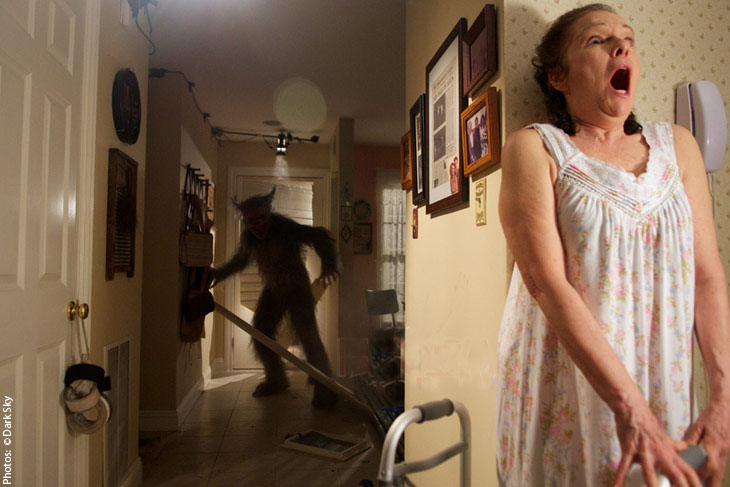
"A masterpiece of the werewolf genre," as its poster proclaims? Only if you're totally unfamiliar with the werewolf genre and have never seen The Howling, Dog Soldiers, An American Werewolf in London (or even its silly-fun follow-up, in Paris) and any number of other fine werewolf films, could you possibly be taken in by this trivial pursuit that seems about as arbitrary and as clunkily put together as a genre movie can be. Despite a fine lead performance from Nick Damici (two photos below), as a blind Viet Nam vet stuck into a retirement community on the edge of town by his uncaring son (Ethan Embry), LATE PHASES mostly sucks, playing fast and loose with the usual werewolf tropes and making too little sense on too many levels.

As directed by Spaniard Adrián García Bogliano (pictured at left), quite far afield from his more subtle and disturbing Here Comes  the Devil, this later movie has the director out of his element in more ways than mere locale. Forget that the carnage begins the very night that Damici's character moves into the community, and that he finds a very large wolf's nail embedded in a huge, scratched-out claw print in his wall (What? The people-in-charge of this community don't clean up the houses prior to renting them?), and that the town's police don't pay a lick of attention to all the deaths occurring here. Well, maybe they're involved? If only the movie had something more complex than gore and special effects on its tiny brain.

Actually, it does. And that thing is a father/son fallout that goes way back, and is even more clunkily handled than the rest of this sorry movie. As you might guess, I am a big werewolf fan, so I sat there during the screening, trying to make excuses for what was passing before my eyes until there were no more remaining.

Much is made of our blind man's sense of smell -- until it suddenly doesn't seem to matter any more. And although we see our werewolf almost from the second or third scene of the film, the movie appears to be mostly a mystery as to who, exactly, this werewolf is. We learn the answer too soon, which drains the little suspense that has built up.

Subsidiary characters exist only to move the movie along, though they are played by some enticing pros like Tom Noonan (below, right), Larry Fessenden and Tina Louise. And when we finally get the big-deal, human-to-werewolf transformation (in photo, bottom), it's far too little too late. The filmmaker and special effect maven -- Robert Kurtzman and crew -- do get points, however, for trying to make the wolf look something like the human it represents.

Finally, the film seems a super-clunky melding of worthless family-secrets drama and sub-par monster-horror. Barely releasable crap is my verdict.

Late Phases, from Dark Sky Films and running a too-long 95 minutes, opens today, Friday, November 21, in New York City at the IFC Center (once daily at 9:45pm) and maybe elsewhere, too.

Thursday, May 1, 2014

Pawel Pawlikowski's IDA explores Poland, family, identity, secrets, Holocaust, religion and more


IDA, the new film from expatriate Pole, Pawel Pawlikowski, is one of the most beautiful movies, visually, that I have seen a long while. Its black-and-white cinematography (by Ryszard Lenczewski and Lukasz Zal) is scrumptious, with compositions -- one after another after another -- that are so stunning and attention-catching that you can only marvel at their alternating power and loveliness. TrustMovies dearly loves good black-and-white cine-matography, and so, for this alone he would not have missed the movie. Its story, too, is a humdinger of sorts:

A young novitiate in a convent is suddenly thrust (forced, really) into a visit with what's left of the family that she has not seen since early childhood. Under duress, she does this, and secrets are soon revealed. Co-writer (with Rebecca Lenkiewicz) and director Pawlikowski (shown at right) has taken these secrets -- there is but a single important one, but this leads to the discovery of others -- involving heritage, family, religion, the Holocaust and the meaning of identity itself, and from them built a sturdy but suprisingly swift, 80-minute movie.

Ida is but Pawlikowski's fifth film in fifteen years, While Last Resort is said to be his best by far (till now), I have not been able to see it, though it has remained, unfulfilled, in my Netflix queue for over a decade. The films I have seen -- My Summer of Love, The Woman in the Fifth and Ida -- have been interesting and often beautifully filmed, but they seem nowhere near the level of praise accorded "Summer" and now Ida.

While one can cetainly give the filmmaker points for managing to pack so much so quickly into this new film, there is to Ida an awfully schematic, almost heavy-handed sense of story-telling. The performances are quite good, so the actors cannot be faulted, and, because giving you specifics would ruin the suprise in store, I'll just use a single example:

The good-looking young hitchhiker (above) the two woman pick up en route to their destination turns out to be a game-changer (below). Surprise? Hardly. Just about everything that happens in this movie is a game-changer. Ida does not even last the length of the standard 90-minute film, yet the simplicity of the story -- in which enormous events unfold rather quickly (the present time frame takes place in but a few days, maybe a couple of weeks, although the history of these people goes back a couple of decades) -- borders on the simplistic.

And as good as the actors are, we get the kind of standard characterization in the screenplay that quite fully explains motivation and action yet does not allow for the kind of specifics that reveal in-depth characterization. This is particularly true of the character of Ida/Anna (the lovely Agata Trzebuchowska, who may just have the darkest pairs of non-special-effects-induced eyes in the history of cinema). Raised in a convent, Anna/Ida would not, it is true, be one for much small talk or explanation. But still, for us in the audience, inquiring minds want to know.

Her aunt Wanda is another matter. We get everything we need to know of her, distilled just about to its essence. As played by the beautiful, and beautifully sour actress Agata Kulesza (below). Wanda is the picture-perfect renditon of a woman who placed social/political duty/revenge above family, repressed it, and now finds it suddenly taking over her life. How this character/situation works itself out is a case study full of facts, excellent performances, and a screenplay offering pre-arranged resolution rather than messy life.

If I sound a bit down on Ida, this is more a reaction to some of the overly effusive praise lumped on the movie than anything else. The film is beautiful to observe and worth seeing. But a classic of any great depth? I don't think so. Compare it, for instance, to one of the late Claude Miller's fine films on some similar themes -- A Secret (which you can now stream via Netflix) -- chock full of that messy life, which Miller and his cast and co-screewriter Natalie Carter (from Philippe Grimbert's novel) turn into to moving art. In the concise, contained Ida, the secrets, resolutions and -- hell -- everything else, too, come just a little too easily.

The movie, another worthwhile piece from Music Box Films, opens this Friday May 2, in New York City at the Lincoln Plaza Cienma and Film Forum on Friday, May 2, and in Los Angeles at Laemmle's Royal. In the weeks to come the film will open all over the country. Click here to see currently scheduled playdates, with cities and theaters.

Wednesday, February 17, 2010

Cindy Kleine's PHYLLIS AND HAROLD shocks, stuns, moves and amuses; filmmaker Q&A


Joining the ranks of top-notch docs about family -- Must Read After My Death, Life Support Music and Capturing the Friedmans -- is this week's opener PHYLLIS AND HAROLD, in which filmmaker Cindy Kleine tells the story of her family, especially that of the title characters -- her mom and dad. Neither as dark/
dysfunctional as "Must Read" nor as functional/
positive as Life Support Music, Phyllis and Harold nonetheless occupies a place all its own in the overcrowded documentary field. As it quietly unfolds, it shocks, moves, educates and entertains in about equal measure.

Beginning with some cute but appropriate stop-motion photography/animation, Ms Kleine (shown at left) sets us up for her role as our grown-up-child guide who's trying to figure out the relationship between her parents. Haven't we all done that at some point in our own lives -- though without, I suspect, either the interest, resources or the skill for unearthing and connecting that this woman possesses?

The less you know going in to this documentary, the more surprises will be in store.  No less a famed documentarian than Ken Burns is on record noting that, while he was viewing the film, various people who happened into the screening room were so caught up with this film that they simply stayed there and watched the entire thing. Yes, it's that addictive.  Part of its attraction stems from its very homemade quality. Not that it isn't professionally mounted in most ways, but it is also so "chatty," warm and real-seeming that, as you might do with a film a friend had made, you first watch out of ease or maybe duty.  Within a few minutes, you're hooked.

A combination of straightforward talking-head interviews, animation, old photos (what a treasure trove here!), home movies, and old songs, the movie's 84 minutes fly.  Seeing her parents both young (above) and old (below) is a revelation -- as much to them as much as to us: "This is like a stranger to me!" marvels her father upon reading one of his old love letters to this young wife.  Just when we're thinking how very salutary this is -- and would be for most oldsters -- Kleine drops the bomb.  From here on, surprise topples surprise, as we discover secrets, war, the family's black nanny and more.  My goodness: how complicated people are, and mysterious, problematic, impossible and sad.

If Phyllis and Harold has at least one ending too many, I think you'll easily forgive Kleine her need for "closure" and sentiment.  She and her family deserve it. And maybe we do, too.  The movie opens Friday, February 19, at NYC's Cinema Village.  For further screening dates, click here.

*******

Once you see the film, you'll have you own set of questions for Ms. Kleine.  Below are ours, with TrustMovies in boldface, Cindy in standard type.  There are spoilers ahead, so perhaps see the film first  and then come back to this.

When and why did you decide to tell your parents’ story?

In a specific way, I decided to tell their story about ten years before I shot the first interviews with them, and I spent years writing a script for what I thought would be a fiction film. In a more abstract way, though, even my earliest work was preparing me to tell their story. My earliest videos and films were all about love relationships, both familial and romantic (Dinosaur, 1979, Secrets of Cindy, 1983, Doug and Mike, Mike and Doug, 1984, Nana, 1987, Passage, 1991, etc...)

Did you always plan to hold it back until both of them were gone? (I would guess so.)


Once I decided the film would be a documentary, I knew I could not tell the whole story until my father was gone. (My mother, on the other hand, would have LOVED it, but that's another story!) So I conceived it as a film that would be made in sections, and got excited about the idea of making a feature length film of three or four sections that could also be shown as shorts, without the other parts. "Til Death Do Us Part" (1998, 20 minutes) was the first section. It premiered at the Telluride Film Festival, and showed in a handful of other choice festivals (Seattle, Vancouver, Rocky Mountain International Women's Film Festival, etc), though I had to hold it back from distribution because my father was alive at the time. The section of my parents reading their love letters was "Part 2", and "Part 3" was supposed to be my parents getting old together. But my father died suddenly while I was shooting that section, and then, inevitably, the direction of the film changed.

Did you and your mom ever talk about her “neglect” of you and your sister when you were kids? If so, how did she respond?

Late in her life, she admitted to some degree her emotional neglect of my sister with great shame and sadness. She couldn't really hear my own feelings, but then, she was a much better mother to me than she was to my sister, I would say.

Your use of old photos was sublime and fascinating. Did you always have access to these or did you spend months trying to find them? 

Thanks. I inherited the trove of 40,000 slides my Dad shot from 1939 until 1990 when he died. The home movies my grandfather shot were given to me in a box by my grandmother after he died.

What was the most difficult part of the filmmaking process for you?

Besides spending so much time with my parents? Well, the most difficult part was after my father died, trying to pick up the pieces of myself, my family, and my film; to find the energy again to resume shooting, and to shoot with my mother through those long months of her shock, her falls and illnesses and her mental decline. It was poignant and painful.

When did the idea to use animation hit you?  The animation, by the way, is delightful and very well thought-out and applied. 

 Thanks. I knew I wanted to use animation pretty early on in the editing process of the full length film, which began to approach it's final form sometime around 2005 or 2006. I asked Lisa Crafts to do an animation of the "Mom meeting the lover for the first time" story very early on, so that was in the cut from way back. The rest of the animation didn't find it's place until very late in the game, in the last nine months of editing with Jonathan Oppenheim.

Do you think your mom realized that you were finally going to make her “famous’? If so, how did she feel about this?

She could never have known or guessed that the film would be as widely seen as it has been and is about to be, but she LOVED being a movie star, and I hope is somewhere up there looking down on opening night at Cinema Village in her designer gown and borrowed Harry Winston jewels, with a gorgeous young man on her lap! It is truly heartbreaking to me that she did not live to see the film, and to be at that opening. My husband, Andre, says she deserves, and he hopes she will win the Posthumous Oscar for Best Performance in a Documentary.

Your dad reminded me of my dad (and myself -- and so many men who tend to hold back). Did it occur to you that he might have had affairs of his own? Did you ever question him about this? (Probably not, because he was not to know about your mom’s)

Sure I did!! Are you kidding? How could I have resisted? Though he never admitted to anything outright, I know he did have affairs, but I don't think he ever was in love with anyone else the way my Mom was. His were purely sexual flings, I'm sure. He was a hot guy, and he wasn't getting steak at home.

How did Andre Gregory come into the picture? 

Very short version: I was introduced to Andre* by an old friend who had been working with him. Four days later we kissed and the rest is history.

I realize that you did one shorter film earlier (Inside Out) that was about half the length of Phyllis and Harold. How was, other than dealing so closely with your own family, this film different for you as a filmmaker: twice the work because of its being twice the length? Or maybe ten times the work? (Is it like the difference, as I have been told, between having one child and two: not twice the work but four times the work.)

I did many short films earlier than P and H. (see my website).   Having two cats and no kids, I can't relate to the child analogy, but suffice to say, this film was 12 plus years in the making, all my others were 2 to 5 years in the making, approximately. I would guess it is like the difference between writing a short story and writng a novel.

Anything else you want to talk about that I did not cover?

No...thank you, but please encourage everyone to come out to see the film during its run at Cinema Village, beginning February 19th.
(All photos. courtesy of Ms Kleine)
* Cindy Kleine is married to playwright/producer/actor Andre Gregory (pictured above a couple of times).