Showing posts with label the South on film. Show all posts

Sunday, May 13, 2018

Sunday Corner With Lee Liberman: 1971/2017 -- The Beguiled times two for Mother’s Day


Today, for Mother’s Day 2018, we have two different takes of the same story about girls and women. HBO has on tap for easy comparison the 1971 and the 2017 versions of “The Beguiled”, a sexually charged psychodrama based on a Southern gothic novel written by Thomas P. Cullinan (1966). Both plots tell the story of a group of young-to-middle-age women cloistered on a Southern plantation toward the end of

the Civil War, and their encounter with a wounded Yankee soldier who winds up in their charge.

The early film, a poster for which is shown above, was a vehicle for a quite handsome Clint Eastwood, with Geraldine Page and Elizabeth Hartman (both now deceased) as the female protagonists.

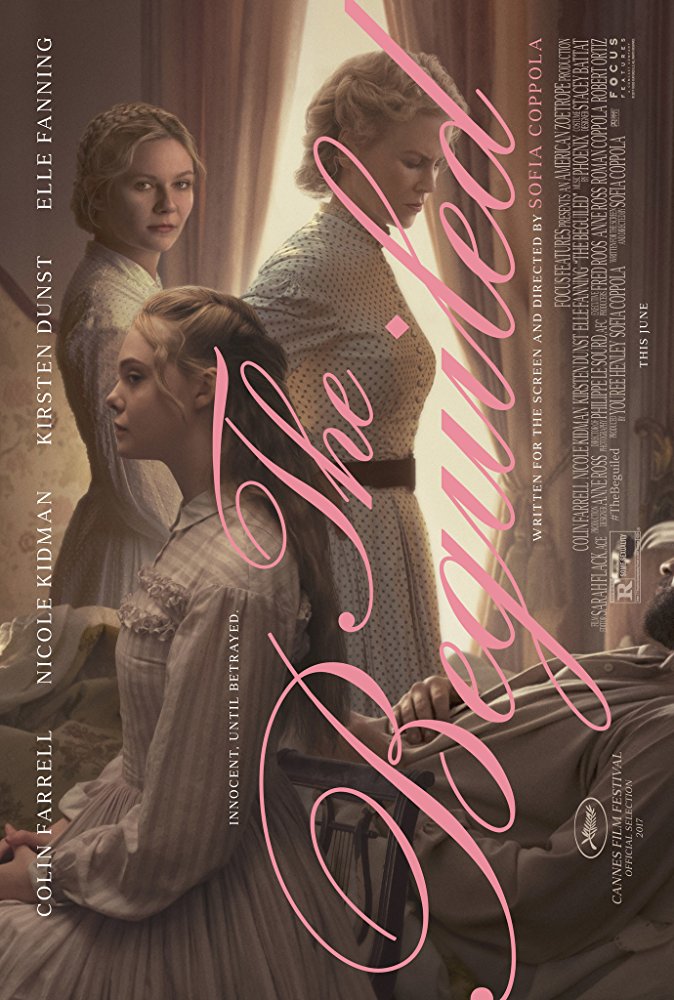
In the 2017 version (at left), Director Sofia Coppola’s cast headlined Colin Farrell, Nicole Kidman, Kirsten Dunst, and Elle Fanning.

The near-identical plots are hot-house steamy, although one generates much more steam than the other: 12-year-old Amy (Pamelyn Ferdin, above, 1971) is picking mushrooms in the woods when she comes across wounded Yankee Colonel John McBurney and helps him back to the columned plantation manse, (Miss Martha Farnsworth’s Seminary for Young Ladies), where the students, their teacher, Miss Edwina, and Headmistress Martha nurse the soldier. Fear of the enemy is displaced by sexual yearnings that simmer to a boil — and big trouble. McBurney proposes to Miss Edwina, but the school hussy has lured him into bed where Edwina discovers them. In her rage a scuffle ensues and McBurney tumbles down stairs, shattering his leg. Miss Martha cuts it off, (her own erotic stirrings for their guest had felt betrayed). Much more rage ensues, and Amy is dispatched to the forest to find the not-good kind of mushrooms for their now unwelcome visitor. He will be longed for but not mourned. The shock to their system removed, peace and harmony is restored to the sisterhood in the small seminary at the large plantation house. Below is the 2017 cast, including Miss Edwina, (Ms Dunst, at left) and Miss Martha (Ms Kidman at right); center is Ms Fanning, who plays the hussy. 

Despite its being the same tale, the two films feel quite different and are worth viewing to see what the two directors do with the same material. The 1971 version was like a steam kettle fired up by the commotion of the sex, drugs, rock-roll 1960-70’s; anti-Vietnam war sentiment; and women’s lib and civil rights protests. The slave South and the Civil War made vivid backdrops for rising civil rights and anti-Vietnam consciousness, but the fear by men of emasculating women plus female rage at male patriarchy were the film’s driving emotions during the heyday of Betty Friedan and bra-burning. The riled-up anxieties of the era — Freudian fear coupled with budding political enlightenment — ruled the brains of the male movers of the ’71 “Beguiled’.

With Eastwood as the Yankee and directed by his oft-time collaborator, Don Siegel (Dirty Harry, Escape from Alcatraz), the atmosphere reflects Siegel’s blatant tell that ‘Beguiled’ is about “the basic desire of women to castrate men”. Eastwood’s McBurney, however, was no innocent; he deserved what he got. Siegel uses McBurney’s caddishness to show that the Corporal’s brand of patriarchy deserved its comeuppance. From the first encounter with little Amy, pronouncing her ‘old enough for it’ with a long adult kiss, to his relentless romancing and manipulation of the other women, McBurney was one leonine fox to avoid in the woods or henhouse.

The slave Hallie (Mae Mercer) who labors for the school speaks to early civil rights political correctness. She is the only woman who is not at all deceived by his blandishments. When McBurney threatens rape she taunts back: “You’d better like it with a dead black woman because that’s the only way you’d get it from this one”. One critic said that there is not enough cinema that is as unabashedly horny as this old film. It is not just horny, but full of female hysteria, fear, and fantasy. (Miss Martha is revealed to have had an incestuous relationship with her dear departed brother; she dreams of three-way sex with him and Miss Edwina.) All the skeevy heat makes for an entirely campy romp seasoned with a dash of True Blood, only slightly diminished by the dated filmmaking tropes of the seventies.

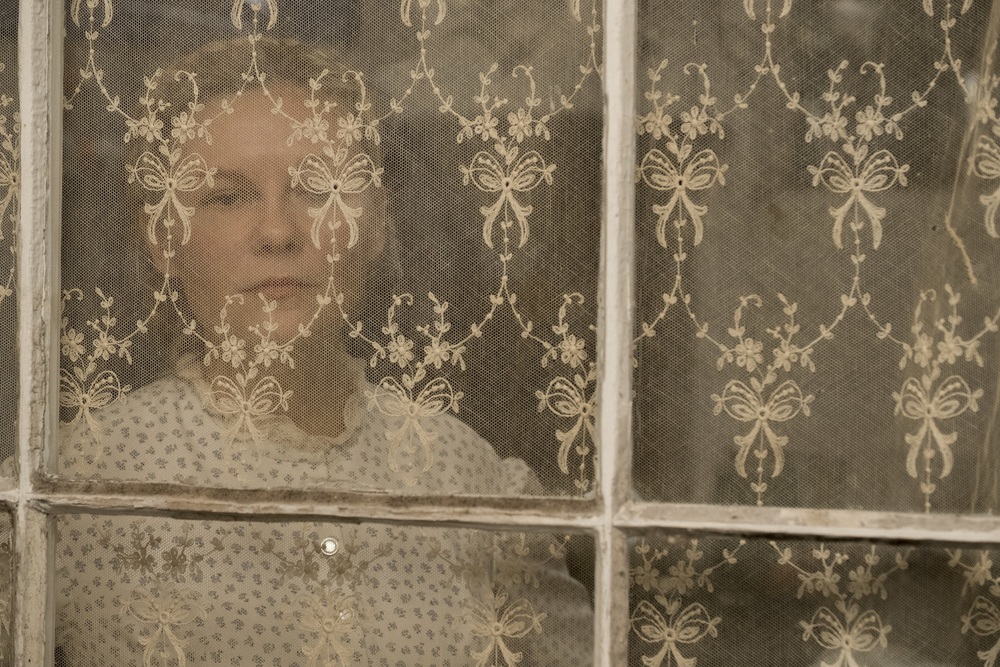
At the time it was a box office flop; the Trumpian Eastwood suggested that his fans didn’t support his he-man persona being cast as the women’s victim. But the film has since found its audience, scoring 92+% approval on Rotten Tomatoes and considered one of Eastwood’s finest, especially by the French. Meanwhile at Cannes the ‘Beguiled’ remake won Sofia Coppola a best director prize exactly a year ago, only the second time a woman has won for direction at the festival. The accolade may have been a hasty swoon over the Coppola image and Spanish hanging moss (see the very last image). I doubt her version will become a classic like Siegel and Eastwood’s, despite the loveliness of the imagery by Philippe Le Sourd, a stunning sound score, and a cast led by A-listers. Scenes shot through giant arching trees dripping with moss and ladies framed in lace are very beguiling (that's Dunst as Miss Edwina below). Coppola has been reported saying that she wanted to tell the story from the point of view of the “female gaze”, which is to say, the opposite of the male castration fear fantasy. She succeeded in trodding gently on Freud compared to the old film, but the implementation of her own strategy was not a winning formula.

In Coppola’s version the handsome injured soldier is not devious scum but a handsome average bloke (Mr. Farrell, below) destined by accident to outlive his battle wounds only a bit longer than he otherwise might have expected.

Coppola’s gracious Southern mansion is stripped bare of politics, race, and war (despite a boom here and there of distant cannons). It’s essence is the intimate world of the young and middle-age women — interdependent flowers of the South, noble in the heroism of their lost cause, mythically ‘gone with the wind’. Here is no Freudian fantasy but a portrait of women as social beings in survival mode rather than passive sex objects. Their men are dead or fighting and they are isolated in a world of frustrated desires. Coppola switches up the perspectives of the women not to diminish men but rather to acknowledge each other as women.

Coppola is at home in the rarified setting; here it takes the form of a gauzy feminine world of pinks, creams, and lavender, patterned social rituals, and decorous manners— whether being held tight to the graces of the antebellum South or as in an earlier Coppola movie, at the palace of Marie Antoinette. According to NYTimes reviewer, A.O. Scott, her worlds are “designed to quarantine [their] privileged residents from the disorder and misery of life.” A particular objection to her version is said to be the whitewashing of slavery by leaving it out (Hallie is much missed). Coppola’s reason, she said, was that to have touched on the subject without doing it justice was simply not the story she wanted to explore.

This filmmaker is surely mistress of her own subject matter, but her choice to use the pulpy plot of the original “Beguiled” did her no favor given its current reputation as a classic. Her refined ‘female gaze’ embedded in the raunchy plot points does not compete with the salacious hotbed that Eastwood and Siegel exploited with such relish (above).

The essence for Coppola is the mutual feeling expressed in glances and looks — the understanding conveyed by implication rather than direct expression. Siegel offers frenzy and lust; Coppola seeks luminous beauty and mystery of desire (above). An experienced Don Siegel worked his point-of-view better than Coppola worked hers.

A female-centric story of women isolated during the Civil War perhaps should not be hung on a tale of such lurid facts as “The Beguiled”. (The James Ivory film of Henry JamesThe Golden Bowl in 2000 comes to mind as powerful treatment of a story in which quiet violence is embedded into domestic ritual and manners.) Coppola’s ‘Beguiled’ lacks suspense or sexual tension. The extreme events that happen here drown out the feminine affect that Coppola sought. She fell into the trap of failing to compete with the entertainment value of the original or of enabling the female gaze to mount in intensity. I nevertheless liked the exercise of watching both versions to see the differences in mind-set and production values — and it is a provocative story.

The above post is written 
by our monthly correspondent, 
Lee Liberman.

Thursday, March 8, 2018

Blu-ray debut for John Grissmer's 1977 southern-gothic oddity, SCALPEL


Leave it to Arrow Video to unearth (and then so beautifully reproduce/remaster) some really oddball entries into the movie canon. One such is the recently-released on Blu-ray, 1977 psychological thriller/southern-gothic melodrama, SCALPEL, that features, among other delectations, a very heavy dose of would-be father-daughter incest. Golly, the south! Not enough that it was the cradle of American slavery, it seems, as ever, to get up to the most transgressive stuff.

This little zircon-in-the-rough, directed and adapted (from a story by Joseph Weintraub) by John Grissmer, shown at right, tells of a semi-famous and quite popular plastic surgeon whose daughter suddenly disappears following the suspicious death of her current boyfriend. Dad is so bereft that, when a young stripper gets her face beaten to that proverbial pulp, he takes the poor child under his wing and, yes, gives her the face of that missing daughter. As you might imagine, complications ensue.

Are you already put in mind of that classic of all plastic surgery movies, Eyes Without a Face? Worry not. Grissmer's little spin on the Franju film offers enough fun and games, smart and reasonably witty dialog, ambience and characters that fairly drip of our besotted south, and even a few surprises to keep you pleasantly engrossed.

The surgeon is played by that yeoman professional Robert Lansing (at left, above and below), who does a bang-up job of first impressing us (as well as his students) with how smart and resourceful he seems, before allowing us to see what an absolute turd this guy really is.

As the subject of his little experiment, The Young and the Restless actress Judith Chapman (above)-- who barely looks much older today than she did back in '77: she's a shining example of the art of plastic surgery -- also does nifty turns playing the dual roles required here.

Fine support is given by a game cast, including an especially good, Arlen Dean Snyder, as one of this seedy family's seedier members. If you've seen more than a dozen-or-so mysteries you will probably figure out much of the plot machinations prior to their taking place. Still, Grissmer does a nice job with enough of his twists and turns that you'll probably stick with Scalpel to its amusing and quite "just" finale.

About the Blu-ray transfer: It is up to Arrow's usual excellent standards. Especially worth noting is that the movie appears in two formats on the disc. One is evidently what the original release pretty much looked like in theaters. The other, however, has been given a kind of semi-golden overlay more fitting of the southern gothic look that both Grissmer and his cameraman, the now highly noted Edward Lachman, originally wanted. I watched a bit of the former but would recommend the latter, which not only looks wonderful but seems more correct for both the time period and location (Scalpel was filmed in the state of Georgia).

Bonus extras on the disc include very good present-day interviews with the director, the cinematographer, and the lead actress -- plus a new audio commentary by film historian Richard Harland Smith.

From Arrow Video, running 95 minutes and distributed here in the USA via MVD Visual, the movie hit the street last month and is available now for purchase -- and I would hope somewhere for rental, as well.

Wednesday, January 17, 2018

Religion as the "closet" in Jennifer Gerber's interesting gay melodrama, THE REVIVIAL


The gay closet, as it turns out, can take a number of forms with which we might not immediately associate it. One of these is religion, particularly when the gay in question happens to be a preacher of it. Such a fellow is our non-hero, Eli, who has taken over his little town's church (Baptist, I think) from his late father, who was -- from all we hear -- much more popular, offering up the fire-and-brimstone kind of sermon our country's Southern folk love to hear. Eli, who is married to a wife who is soon to be a mother, prefers a more thoughtful and, well, "progressive" kind of preaching. You can imagine how well that goes down with his congregation.

As adapted (from his own stage play) by Samuel Brett Williams, shown below, and directed with intelligent, straight-ahead force by Jennifer Gerber (shown at left: This is her first full-length work), THE REVIVAL proves to be one of the better gay-themed melodramas we've seen of late. Mr. Williams, with his intelligently withholding writing that does not allow us to understand or fully know most of these characters until the finals scenes (the execution of which Ms Gerber's restraint and skill helps mightily), has concocted a very interesting melodrama
that explores the lengths to which a man will go in using his religion to better hide his sexuality.

Most organized religions, particularly in the Southern USA, do not accept homosexuality as something natural and good, but there are all kinds of ways around this -- as so many of our Southern "preachers" and their past scandals have shown us -- from out-and-out lying and hypocrisy to burying this "sin" so deeply within that even the sinner can sometimes ignore it.

Nothing works forever, of course, and truth, as they say, will out.

When a good-looking young drifter (Zachary Booth, above) appears at church one day -- not for the sermon but for the pot-luck lunch held afterward -- our "kindly" minister (David Rysdahl, below) of course wants to help. First offering that meal and then later a temporary roof over the fellow's head, before you can say, "But I'm not gay," this new twosome is locking lips and then other parts of the anatomy.

Now, if this part of the tale were all that's on offer, we could yawn and say been there/done that. We also meet and spend time with some interesting subsidiary characters, too, such as Trevor (nice job by Raymond McAnally, below), the good-'ol-boy pal who consistently tries to get Eli to preach what the congregation wants. Trevor is , in fact, raising money for a big "revival" style meeting at the church -- which Eli is dead set against.

Eli's put-upon wife -- a low-key but very smart performance from Lucy Faust, below -- comes into her own during the course of the film, as well. It is her character of whom we learn perhaps the most about by film's end.

There is even one member of the congregation -- played with off-key charm by Stephen Ellis, below -- who is desperately in love with his first cousin. While this situation might initially seem merely a bit of comic relief, it serves a deeper purpose in showing us how poor (uncaring, really) a minister our anti-hero actually is.

By the time the "gay love" situation has worked itself out -- and not probably in either of the ways you will expect -- several other situations and characters have come heavily and surprisingly into play. The Revival is a much stronger and more forceful piece of gay-themed film-making than TrustMovies expected. Take a chance on it.

From Breaking Glass Pictures and running just 85 minutes, the movie opens this Friday, January 19, in Los Angeles at Laemmle's Music Hall 3. The DVD will be released the following week on Tuesday, January 23.

Sunday, December 17, 2017

December Sunday Corner With Lee Liberman: Dee Rees' MUDBOUND


“The arc of the moral universe is long, 
but it bends toward justice.”
 ....Martin Luther King, Jr.

Writer/director Dee Rees (below) and screenwriter Virgil Williams adapted this quietly painful yet transcendent saga from a novel by Hillary Jordan — a tale of the daily rigors of two families who work the same unforgiving land in the Mississippi delta of 80 years ago. The ensemble drama, MUDBOUND, gives voice to the point of view of each of the main characters, bound as they are to each other and the mud, furrows, and trials of eking a living off the land. It is also as pure a study of bigotry as you’ve ever seen — the everyday condescension that blacks and other minorities still endure. The movie captures the relentless dailiness of this as if it were today, not the 1940s.

In that way it is also the story of our original sin — the polar opposite of the flag we fly: “all men are created equal and are endowed with inalienable rights…..”. The current iteration of American racism smacks of repressed rage at not being so white and Christian anymore; the sounds of America have gotten meaner as our non-white population increases. The President sings the same tune as everybody’s racist uncle and Mudbound’s foul-mouthed Pappy. Trumpism is racism, says Adam Serwer, an Atlantic editor.

Trump’s appeal doesn’t originate in economic suffering; his followers are driven by the desire to suppress non-white America’s civil and voting rights. The film plunges us into the murk of racial memory, the metaphorical mud of the delta; it stars everyday meanness in its Jim Crow rules and poverty. The Washington Post film critic Ann Hornaday’s review of Mudbound compares it to great literature of Faulkner and Steinbeck and the sweeping film sagas of William Wyler and John Ford. The difference in Mudbound is that it is the daily earth-bound struggle itself that is epic — the warp and weave of farm life under segregation in rural Mississippi during the 1940’s, writ large.

The landowner is laconic Henry McAllan, his cheerless wife Laura (Jason Clarke and Carey Mulligan, below), their daughters, and sadistic, racist Pappy (Jonathan Banks). Henry’s younger brother Jamie (Garrett Hedlund, early in his years of leading-man heart-crushing) goes off to war and then returns home.

Their tenant-farmer neighbors, shown below, are the Jacksons: Hap (Rob Morgan), his wife Florence (a poignantly heroic Mary J. Blige), and their children including oldest son Ronsel (Jason Mitchell) who also makes the round trip to war and back home to the delta.

Hap Jackson grieves his ancestral ties to this earth: “What good is a deed? My grandfathers and great uncles, grandmothers and great aunts, father and mother… worked this land all their lives, this land that will never be theirs… They sweated until they bled; they bled until they died… Died with the dirt of this same 200 acres under their fingernails… all their deeds undone. Yet this man, this place, this law say you need a Deed--not deeds.”

Laura McAllan dreams in brown, knees and hair encrusted in mud (constantly refreshed by downpours), boot-shaped brown patches marching across the floor. Violence is part and parcel of country life, she says. “You’re forever being assailed by dead things. Dead mice, dead rabbits, dead possums. You find them in the yard, you smell them rotting under the house. And then there are the creatures you kill for food. Chickens, hogs, deer, frogs, squirrels. Pluck, skin, disembowel, debone, fry, eat. Start again…..” There is miscarriage, incest, adultery, murder, and Klan violence quietly woven into the fabric. But the central relationship is that of the returning warriors: Jamie a bomber pilot and Ronsel a tank sergeant in the black battalion that General Patton used to spearhead his army (archival photo below).

The story occurs at a turning point referred to as the ‘forgotten years of the black revolution’ — World War II and it’s aftermath.

Ronsel (above, right) says: “Home again, home again jiggity jig; coon, spade, darky, nigger. Went off to fight for my country and found it hasn’t changed a bit. Over there we were the liberator, they were lined up waiting for us, throwing flowers and cheering. Here I’m just another nigger pushing a plow…..

“The army gave us separate barracks, separate blood supply, separate latrines... But them European girls they didn’t have any problem with us at all… But that was then… and right now I guess I’m right where I should be — throwing my life away.”

The two depressed men get drunk together, flouting the ingrained habits of segregation and leading Pappy (below, left) to scold Ronsel: “I don’t know what they let you do over there, but you in Mississippi now — you leave by the back door”. It doesn’t take long for both former soldier-heroes to feel like aliens in a South they have grown out of.

In fact, the end of legal segregation in America and the British de-colonialization of Asia and Africa were the unplanned outcomes of war fought against German and Japanese racism. Although, as Ronsel says, they were segregated as soldiers, they got jobs, pulled their weight, and black and white fought as one against the enemy. Dee Rees makes the point with a U.S. flyer shooting down Germans who were pummeling Jamie’s plane, after which the rescuer, a black pilot, hi-fives Jamie on a fly-by (archival photo of black airmen below).

In the 1920’s the socialist speaker/writer, A Philip Randolph, organized the Brotherhood of Sleeping Car Porters; during the 1941 war build-up he organized a march on Washington demanding that blacks be hired for factory jobs. When Randolph assured the president that 100,000 would show up and demonstrate, Roosevelt signed the order, the march was pre-empted, and blacks entered the workforce.

After the war, Truman ordered the integration of U.S. armed forces. Black voters then turned out to help Truman defeat Dewey in the 1948 presidential election. The next leap forward for civil rights wasn’t until 1963, taking us into the modern era of integration.

No -- Mississippi held no post-war hope for Jamie or Ronsel, and Rees crafts off-ramps for them, leaving the delta to marinate in Jim Crow. The viewer comes away feeling waked up again to the fact that ever since slaves were brought to America we have been mired in racism. Still, this movie with its mostly note-perfect story-telling is uplifting rather than depressing. Last week Mississippi opened its civil rights museum and a Democrat, civil rights lawyer Doug Jones, just won an Alabama Senate seat ("turning back the dead hand of George Wallace," said Howell Raines, retired editor of The New York Times and an Alabama native). We are on a journey and must move forward.

Mudbound got raves on the festival circuit but was not picked up for distribution until content chief at Netflix, Ted Sarandos, stepped up. Yet this might be one of the more absorbing and meaningful films of the year in its quiet revelation of America’s original sin. It came to theaters and has been streaming on Netflix since late November and has received some nominations for awards, including Mary J Blige’s ‘Mighty River’, a spiritual she co-wrote and sang for the film (press here to have a listen).

The above post was written by our 
 monthly correspondent, Lee Liberman.

Wednesday, July 23, 2014

Blu-ray/DVDebut: Jeremy Saulnier's smart, thought-provoking vengeance tale, BLUE RUIN


One of the most oddball, funny and smart/sleazily enjoyable slasher comedies TrustMovies has seen -- the 2007 Murder Party -- suddenly popped up when I clicked to see the IMDB profile for Jeremy Saulnier (shown below), director, writer and cinematog-rapher of the generally well-received BLUE RUIN. Murder Party was an original -- a comic tale of "art," life and the mayhem that ensues when a fellow is invited to said party as the "guest of honor." It's been seven years since that film made its debut, and we've still seen nothing quite like it. Now we have Mr. Saulnier's latest endeavor to consider and content us. Again, it's an original.

This time, however, Saulnier is every bit as serious about his characters and events as he was lighthearted about those in his earlier piece. And though his movie is indeed original, its genre -- the vengeance thriller -- is anything but. Yet how this talented filmmaker approaches his story, how he parcels out information so that both we and the characters we're watching learn more about what is really going on and why makes for a much more thoughtful and problematic tale than we initially expect.

Who actually initiated the killings that began the tale and will continue, as well as who in the two families involved decides to keep the revenge going: These are things we learn along the way that stop us short and make us re-consider.

Saulnier tosses us into the middle of things immediately, in the person of Dwight (Macon Blair, in an unforgettable performance), initially hirsute, wide-eyed and looking like a crazy man (two photos above) then later, clearn shaven and more more "together" (just above) That he is not as crazy as might have imagined is quickly brought home by the kindly woman cop who alerts Dwight to some unsettling news.

I don't want to give much more away regarding plot twists and turns. I'll just say that every last one of these is believable and adds to the complexities on view. Along the way, we meet Dwight's sister (Amy Hargreaves, above), his old high school friend (Devin Ratray, below), and finally members of the, well, "opposing" family.

How it all is resolved should leave you satisfied, but not in the usual, vengeance-is-mine manner. When Blue Ruin made its theatrical debut a few months back, some critics remarked that, really, it was just another revenge tale. But it is not. It's a lot deeper and problematic that that. On the basis of Saulnier's two full-length films, I'd call him a very accomplished young filmmaker, one whom I will follow wherever he chooses to go.

Meanwhile, Blue Ruin -- from Anchor Bay Entertainment and Radius-TWC and running just 90 minutes -- appeared on DVD and Blu-ray yesterday, July 22 (the Blu-ray transfer, by the way, is smashing), for purchase or rental.