Showing posts with label transgressive violence. Show all posts

Friday, January 17, 2014

Woooo-eeee! Let's hear it for Israel -- as the Keshales/Papushado BIG BAD WOLVES opens...


Hey, Quentin Tarantino thinks it's the Best Film of the Year. (That'll send some cinephiles, particularly those who love uber-violence, to the theater.) But I wonder what the Israeli powers-that-be, cultural and otherwise, have to say about the new movie BIG BAD WOLVES, which, of all the films to come out of Israel that I have so far seen, including Rabies (Kalevet), paints by far the nastiest picture of the place. Granted, this is a genre movie, of the type which, if we are to believe the very good article by John Anderson that appeared in the The New York Times of January 10, those cultural/political powers-that-be would prefer not be made by talented Israeli filmmakers.

As much as I found Big Bad Wolves to be mostly a crock of ugly and very smelly faux shit, the men who made it are without doubt quite talented. The film-making team here is comprised of Aharon Keshales and Navot Papushado (shown above, with Mr. Papushado on the right), who also gave us the crazily enjoyable, if awfully bloody, 2009 Rabies. Their new one is so much more accomplished in most ways that I am guessing their budget may have doubled (or better).

The film's opening, which offers in gorgeous slo-mo three kids playing hide-and-seek, in which the camera covers so much so beautifully that when, soon after, we see a pair of shoes emptied of their owner, our heart skips a beat. What happens to the little girl who was wearing these we see only sidelong, in bits and pieces, but it's horrible enough. Soon after we're treated to a point-by-point, blow by blow description of her torture, mutilation and demise. This isn't simply strong stuff: Because Big Bad Wolves is, first and foremost, an entertainment, it is also disgusting stuff. You'll want to stop the film to bathe or maybe wash the filmmakers' mouths out with soap, or their eyes with acid.

Well, hey, this sort of torture/mutilation/murder of children does go on. Even, I expect, in Israel. Further, Big Bad Wolves, turns out to be a (very) black comedy of sorts. Really. Occasionally, you'll imagine it's the blackest you've seen. And, yes, I did guffaw a few times. The give-and-take between the fellow with the shovel, above, and his mother is choice indeed, as is what happens to and with a certain birthday cake.

After this beginning, the movie is mostly then devoted to the capture and torture of a young man (Rotem Keinan, above) whom someone sort of suspects of doing this horrible deed, without -- from what I could tell -- having more than the very slightest circumstantial evidence with which to convict him. Involved in all this is a policeman (the fine Lior Ashkenazi, below, right) and his underlings; his boss (Menashe Noy, below, left); the father of the child victim (himself a former military man) played by Tzahi Grad, two photos above and in the penultimate one; and finally the father's own father. All the men in the movie turn out to be thugs of one sort or another (hence the title) -- except perhaps for our poor, put-upon victim, who teaches in a religious school (oh, yes: and an Arab who rides by on a horse from time to time).

Though it makes more sense on the surface than did Rabies, the movie has some rather gaping holes. Israeli cities have always struck me as rather heavily inhabited places, yet Big Bad Wolves exists in the kind of movie la-la-land in which a man can be chased in broad daylight down a perfectly respectable middle-to-upper-class street, then tasered and dragged back a block or two to a car and then kidnapped -- with absolute-ly nobody around to notice any of this. Yet, earlier, when the police are illegally interrogating their suspect in what is supposedly a totally deserted and abandoned building (below), all this is conveniently videotaped by a school-kid and then streamed out to YouTube-style to Israel and the world. (I can understand and sympathize with budgetary restrictions, but surely someone could have sprung for a few extras now and then, not to mention a little more logic?!)

If you can buy into crap like the above, then I am guessing that you'll buy most anything in order to get your rocks off via some super violence. Along the way the movie says a mouthful, if is to be believed, about the grossly incompetent Israeli police force and the mindset of the military. And while it is difficult not to see these scarily macho males and what they do as mirroring what Israel is doing to its in-state, Arab neighbors (and has been ever since the new state was first created), we'd best not go there. (After all, those god-damned Arabs have plenty to answer for, too!) In any case, this film can be viewed from all sorts of aspects -- social, political, or Dada-esque.

While I will not give even a hint as to what happens in the end, I will say this: Because the filmmakers clearly want to make this the darkest of dark comedy/horror/torture films (it really does achieve the level of torture porn, by the way), I simply suggest that, before it's all over, you try to imagine the very darkest outcome that you can. Depending on your own capacity for ugliness, you'll either be near correct or right-on.

Big Bad Wolves, from Magnet Releasing and running a too-long 110 minutes, opens today in New York City at the Cinema Village and the Elinor Bunin Munroe Film Center. Simultanesouly it will open in Chicago at the Music Box, and across Canada in Ottawa, Toronto and Victoria. In the weeks to come, look for it to open in another 20 cities (click here to see all playdates) across the USA, though oddly enough I don't see Los Angeles or Hollywood listed among them. I wonder why?

The photos of the two filmmakers, second from top, 
is by Rina Castelnuovo and comes courtesy 

Wednesday, January 8, 2014

Holy hotpants --- it's women killing women!!! Line up, perverts, for Josh Waller's RAZE

Hey -- it's The Most Dangerous Game all over again! Only this time, in RAZE, it's being played by the gals -- with the guys actually in control of the ladies, of course. Imagine this: An organization of the very wealthy kidnaps a bunch of women, imprisons them and forces them to fight each other to the death until only one survives. Why would the women agree to this? Because, if they don't, those nasty bad-guys will not only kill them but their daughters/mothers/ husbands/or some other much-loved-target. These "death matches" are of course viewed by an audience of the very wealthy (you can bet they're all Republicans) for their delectation and entertainment. Oh, yes -- and we viewers might just possibly be entertained by all this, too, right?
God, no -- perish the thought!

I feel I must quote here from the press kit for Josh Waller's new film -- the filmmaker is pictured at left -- in which Mr. Waller tells us that, although his movie "could have easily gone the way of exploitation," (I'll give you a moment to pick yourself up off the floor and stop laughing) "we decided to take a much more elevated approach to it." Right. Sometimes the camera looks at all the violence from up above.

Further thoughts: "...some of my influences aren't necessarily references to horror or action films, but more the films of Stanley Kubrick, Kinji Fukasaku, and more recently, Quentin Tarantino."

What, no Ozu? By the way, Mr. Waller: Both Kukasaku (who did Battle Royale) and Tarantino could easily be described as horror or action filmmakers, too, with nary a nose, I suspect, being put out of joint.

Well, then: We now know that watching Raze -- in which match after match after match has one women brutally killing another -- is not exploitative. I am so relieved. What is it, then? A kind of confined-space movie, a variation on the women-in-prison film, a martial arts extravaganza, a thriller of sorts, and -- if you were being particularly obtuse, you might even call it feminist.

My daughter, who attended the press screening with me and knows a thing or two about martial arts, says that the movie definitely gets its moves right. So this, along with some fancy and fast editing, makes the fight scenes look real (though in the still, shown at right, the muscles look a little limp to be actually engaged in struggle). A nod is given early on to how these women ended up where they are, and we get a cursory look at their captors, the man and woman (Doug Jones and Sherilyn Fenn, below) who head this creepy and uber-entitled group, as well as at the male guards who keep our ladies in line.

As to the characterization of these poor women themselves, we're mostly given the standard cliff notes versions: They come in varieties of hard, sweet, nasty, nice and naive -- and all, eventually, dead. Except maybe that final contestant. But since we're dealing here with people in charge who haven't the foggiest notion of morality, justice, right, wrong, good, bad, or any fashion sense (they must be Republicans), we pretty much realize that this is not going to end well.

The cast is led by New Zealand gymnast/martial artist/stuntwoman Zoë Bell, shown above and below, who has yet to add actress to her credentials. She's not bad (and she certainly executes her moves with consummate skill) but she mostly keep a single expression going throughout the film.

Also in the cast are Rachel Nichols (shown below), Tracie Thoms and Rebecca Marshall (shown at bottom), along with Bruce Thomas as the guard you love to hate the most. Everyone does the expected, and if there are no surprises, neither are there any screw-ups. We thought we noticed Rosario Dawson in the movie, too (always a good reason to see any film), but her part is so small that if you blink twice in quick succession, you'll miss it.

Raze is such an ugly movie in just about every way that recommending it proves difficult. It's not badly
done so much as revoltingly imagined. This is the Roman Colosseum in microcosm, with the spectacle reduced to simple killing: no lions, gladiators or weapons on view. And since it's all women killing women for the delectation of the "one percent," you can add an extra layer of sleaze and perversion.

The movie's also mostly humor-free, but there is one whoppingly (and intentionally) hilarious

joke toward the finale. Each fight is introduced with a label:  "Jamie vs Teresa" and so forth, until the final one, which should make you laugh out loud.

Raze, from IFC Midnight and lasting 87 relatively lengthy minutes, opens in theaters this Friday, January 10, and will simultaneously be available via VOD. In NYC, look for it at the IFC Center; in L.A. it will play the Sundance Sunset Cinemas. To see all currently scheduled playdates, click here.

Friday, January 3, 2014

Rob Kuhns' BIRTH OF THE LIVING DEAD: Everything you wanted to know about the original flesh-eating-zombie movie

Imitations and homages may come and go but there is still only one true and great "modern" zombie movie: Night of the Living Dead, the transgressive -- politically and moviewise -- 1968 chiller/thriller/
horror/gore-fest from George A. Romero. A young filmmaker named Rob Kuhns (shown below) had the fine idea to interview Mr. Romero (about how the movie came to be) along with others (about what the movie means), and the result is a first-rate documentary -- BIRTH OF THE LIVING DEAD -- that should please zombie fans, cult movie lovers and literally anyone who feels, as does TrustMovies, that Romero's film remains, in its own special way, something seminal and important to the history of motion pictures (and I do not mean only horror movies).

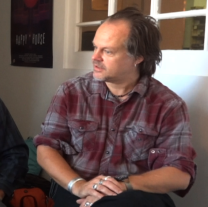
As captured by Kuhns' direction and editing, Mr. Romero, shown below and now 73, turns out to be a charming raconteur: intelligent, relatively humble (as filmmakers go), funny but never glib, with a good memory and a real delight in recalling the old days and how they went down. Mr. Kuhns has rounded up a fine array of talking heads, too -- from horror filmmaker Larry Fessenden (shown further below) to producer Gale Anne Hurd, critics Elvis Mitchell and Jason Zinoman, and film historian Mark Harris, along with some of the actors like Bill Hinzman who doubled and tripled in other jobs on the film set and who are still alive. (Mr. Hinzman gets a lovely post-credit sequences at a mall event celebrating--what else?--zombies.)

Mostly though, it's Romero who guides us through the thicket of the past, how the initial idea came about and grew, how money was raised, first to film that idea and then do the technical work necessary to ready the film for release. In order to find enough funds to finish the sound track (as I recall, it was the sound track), one of the actors/workers bet a fellow who owned a sound studio that he could beat him in a chess match. He did.

Some of the anecdotes we hear along the way are wonderfully funny and surprising. (Who knew that Mr. Rogers had any connection to the world's most famous zombie movie?) And some are simply sad. (Want to make a guess as to how rich everyone connected to this groundbreaking movie became -- along with the reason why not?)

The 76-minute length of the documentary simply flies by, and I can hardly think of anything I'd want to have seen left on the cutting room floor. From this film we get -- as the original movie itself has always given us -- politics, race, taboos and other cultural touchstones.

Via scenes from the film, as well as from some nifty illustrations (shown above), we can relive our initial shock and fear all over again, this time with a smile always flickering around our faces. (That's Mr. Hinzman -- above in illustration and below on film -- as the initial zombie encountered in the graveyard.)

One of the most flat-out enjoyable documentaries of the year, Birth of the Living Dead, from First Run Features, had a short theatrical release a few months back, and will make its DVDebut this coming Tuesday, January 7. As with many FRF releases, I think we can expect it to appear on streaming sources eventually.

Wednesday, May 9, 2012

Bobcat Goldthwait's GOD BLESS AMERICA proves the cultural vigilante's wet-dream

If you thought Bobcat Goldthwait's earlier films -- Sleeping Dogs Lie and The World's Greatest Dad -- were transgressive, wait till you get a load of GOD BLESS AMERICA, his latest combination of smackdown and provocation. Up yours, America, would seem to be the message here, and there are going to be a lot of Americans who welcome and agree with it. It is not, I think, the problematic America of decades past at which Bobcat is directing his middle finger, not the America that simultaneously held such promise and despair, but today's USA, which promises only more despair -- no matter which crappy politicians the wealthy and corporate manage to grease into office. Ah, but Mr. Goldthwait, pictured below, has just the remedy we need.

A very good friend of mine with whom I attended the press screening -- he's an intelligent, cranky, 70-year-old with relatively high standards -- announced to me as the end credits finished rolling, "I have never seen a movie that was more about me."  That my friend is also a mild-mannered picture of civility, while the me of the movie is a rampaging, murderous vigilante is, well, something that should give us all pause. The movie itself will give us shocking, gut-busting laughs, as its "hero," fed up with the increasing stupidity and incivility of the modern world takes it upon himself (with a little unasked-for help from a local high-school girl) to, as the movie's priceless tag line puts it, "take out the trash, one jerk at a time."

The thing I like best about Bobcat as a filmmaker is that he lets the chips fall where they may. If he tackles a problem, he really wrestles with it. With each new film, he's grown more disciplined until, in this one, he's decided to take no prisoners. His filmmaking skill may still remain below his talent as a provocateur, and that's just fine. We already have plenty of skilled movie-makers. We don't have nearly as many hypocrisy-puncturers and balls-to-the-wall social critics like Mr. Goldthwait. 

My cranky but civil friend remarked on the filmmaker's occasional lack of continuity (something my longtime companion is also skilled at noting, while I am not), but let's talk about what's really good about this film -- in addition to its premise and execution. That would start with its well-chosen leading man: Joel Murray (above, and bro of Bill), who proves an inspired choice for the role of Frank. He gets exactly right the sense of "otherness" that eventually engulfs and then appears to becalm those of us who will identify with Frank. Really, though, this calm only masks our anger at the world around us, where black is now white, good evil, corporations humans and so much else touted as true that is patently false. And all of it as uncivil as can be -- from our schools to the workplace to television entertainment (below).

Murray goes from very believable, quiet sadness to depression, into fantasy and from there into action -- without missing a step along the way, And we're with him too, and much further along in his crazy, violent endeavor than we might expect.

As his partner in crime, Roxy, an "outsider" high-school student who has her own reasons for going on the rampage with Frank, Tara Lynne Barr is a good foil for Murray's gravity and odd grace. Her character is nowhere near as strong as his, however, but the act-ress is charged with enough energy and charm to carry us along.

Other than our two vigilantes, most of the rest of the cast are the victims (save the notably uninterested medical professional, above) -- and a scurvier, clueless, more entitled bunch of scumbags would be hard to find. Which of course makes us not care for them while they're with us and mourn them not at all when they're gone. As the film moves along, it becomes clearer what Frank's rationale really is. I'll use only one scene -- in the movie theater -- for emphasis so as not to spoil anything else.

It is not the political view of the other guy (or gal) that the filmmaker and his hero disdain unto death. No, it's the lack of civility these people bring to the table (and everywhere else they go). In that movie theater, a group of rowdy, thoughtless teens won't shut up during the movie. One young woman in their party desists and suggests that her companions tone it down. She is spared, and they are "offed." Another patron in the theater, although he made no noise and was not rude, decides to use his cell phone camera to record the carnage: bye-bye. Priorities, people!

There's a weird morality at work here. Or course, we root for the vigilantes, even though we know they've gone too far. But there is also a great release, a catharsis of sorts, to be found in what's going on.  This is most profoundly true during the American Idol-like satire in which a fat, talent-free contestant (below) is unmercifully mocked by all. What happens to him -- and why and with whose help -- may be Bobcat's most vicious, yet saddest, comment on the depths to which we can sink.

God Bless America is funny, all right, but it succeeds best as a nasty, no-holds-barred satire, the edge of which cuts us all. The film opens this Friday, May 11, in a dozen major cities across the country, with many more to come in the weeks that follow. (In New York City, it's playing at the Landmark Sunshine Cinema.)   Click here to see all currently scheduled playdates, with cities and theaters.

Wednesday, May 11, 2011

HESHER: Gordon-Levitt's a grungy mentor in Spencer Susser's naughty/funny film


One of the first things we see in HESHER -- the relatively new movie that has been on-tap since last year's Sundance festival -- is a boy on his bike (below) following a tow truck as it travels around town and into a garage. The kid then climbs into the wrecked car that the truck has been towing and goes to sleep. This is just odd enough to peak our interest. Who's the kid and what's the significance of that car? We find this out, over time, along with a lot of other stuff that also proves interesting.

Whether all of it hangs together and achieves the right tone, however, is something that TrustMovies suspects will divide audiences. He enjoyed the film for the most part -- enough, in fact, to forgive its very odd combination of aberrant grunge, transgressive behavior and unforced-but-still-present sentimentality that rears up throughout and then, all stops out, closes the movie.

Taking off from a story credited to Brian Charles Frank, the film has been directed and co-writen (with Animal Kingdom's David Michôd!) by Spencer Susser, shown at left -- who himself looks a bit like a hunky Hesher-in-training (or maybe a post-rehab version). Hesher combines the coming-of-age genre (child and adult versions) and a dealing-with-grief scenario. Into this mix is tossed the title character, played by the versatile and talented actor Joseph Gordon-Levitt, below: a homeless young man who is by turns aggressive and helpful but always pretty frightening.  Dirty, dope-smoking, emblazoned with tattoos that look homemade and given to violence and fire-starting at a moment's notice, this guy's some treat.

That boy on the bike (Devin Brochu), it turns out, is part of a grieving family that includes his depressed dad (Rainn Wilson, below, left) and smart, feisty grandmother (no, not Betty White). Instead it's a very well-used Piper Laurie, who adds immeasurably to the film's reality and gravity. The how and why Hesher moves in with this family might strain credibility (more that it already does) were not the performances all first-rate and the writing and direction interesting enough to keep us with the movie.

Oh, yes -- and there's also another important character here, the supermarket clerk who comes to double as surrogate mom for the boy and love interest for Hesher. As played -- very well -- by Natalie Portman, below (does a week go by without another Portman performance upon us? Last Friday: Thor!), this character (Nicole) helps give the film its timeliness regarding our ailing-unto-death economy.

As the film rolls along, dual threats of accelerating violence and sentimentality crop up, and the movie does a pretty good job of handling this tension -- making it more pleasurable than not. Whether you'll buy the finale, which offers a combination of feel-good with necessary loss, I don't know. It worked for me because it leaves our fractured family at a point at which they can move on. But Hesher himself? I wonder...

From Newmarket Films, the movie opens Friday, May 13, in a fairly wide limited run. Go to the film's web site and then click on Where can I see Hesher? to view a list of theaters and cities.

Friday, May 6, 2011

HOBO WITH A SHOTGUN is this year's "Human Centipede"--transgressive trash

The comparison, by the way, is not a compli-ment.  Although slightly better than Tom Six's "Centipede" (I suspect that the director/editor Jason Eisener has a good deal more film sense than Mr. Six), HOBO WITH A SHOTGUN, written by John Davies, is one of the ugliest movies ever made. (It pains me to realize that, upon reading that last phrase, some of my followers will rush headlong to see this film. Good luck.) From its gaudy, hellish color palette to its near-non-stop grizzly gore and violence to the really ridiculous behavior of the movie's denizens -- good 'n bad guys 'n gals included -- the movie goes almost  immediately over the top. And then just goes on and on until it soon seems unending.

Why, you might ask, did TrustMovies even bother with a film like this? Well, he was told that it was so over-the-top as to be hilarious. Over the top it certainly is, but humor, as we should know by now, is a highly personal thing, and the main problem with "Hobo" -- as conceived by Eisener (pictured at right) -- is that there practically isn't any. Unless, for you, laughs automatically arrive when that top has been "overed." For TM, real humor and/or satire involves a good deal more than that.

Other than his use of noticeably garish colors, Eisner comes up with some interesting widescreen compositions. But again, they're so-fucking-ugly that they become increasingly difficult to watch. A latter-day Brueghel this guy ain't.

Rutger Hauer (above), an actor I've loved since the days of Turkish Delight, gives a fully committed performance as the Hobo, and this may be one of the film's problems. He's the only thing under-the-top in this entire fiasco. A wink or a tongue in cheek from him (or from somebody) might have helped the humor factor. But god damn: Every last cast member around Mr. Hauer is acting up a storm not seen since the most recent, really bad production of Macbeth.

There is also not a lot of logic to the plot events. When our heroine (Molly Dunsworth, struggling at left), gets hacksawed half to death and is barely saved at what passes for a hospital, then within moments is back on the street raring for revenge, well I give up. And so should she. And the rest of the contributors to this mess. But perhaps this is what the movie-makers hope will pass for humor. Again, it's such a matter of taste. Or its lack. Oh, yes: I suppose I should mention that the idea for and title of this movie first appeared, along with the recent Machete, as a trailer in the Tarrantino/Rodriguez Grindhouse. Big deal.

Hobo With A Shitgun -- oops, Shotgun  --  opens today at the Alamo Ritz in Austin and the Village East Cinema in New York City.  It'll be all around the country soon -- Alaska to Atlanta, Denver to Detroit. Click here for cities, dates and theaters.