Showing posts with label weighty themes. Show all posts

Saturday, June 23, 2018

Paul Schrader's FIRST REFORMED: an unintentional remake of Beatriz at Dinner


Style- and character-wise, FIRST REFORMED, the new film written and directed by Paul Schrader, has almost nothing in common with last year's movie, Beatriz at Dinner, written by Mike White and directed by Miguel Arteta. Theme- and content-wise, however, the two films are close enough to seem like two sides of the same coin.

Consider: both films present a "religious" protagonist who, in suffering through a spiritual crisis, comes upon a person of wealth and power who is doing indelible harm to the environment, both locally and globally. Our protagonist sees the opportunity to rid the world of this man, and then must decide if and how to act on this.

Granted, Mr. Schrader (the writer/director is shown at right) has a sensibility and style that could hardly be more different from those of the Arteta/White combo. The latters' film is as entertaining and full of life as the former's is bleak and dour: think Bresson by way of Bergman.

Further, though in Schrader's film, his leading character -- a priest in the titular Protestant First Reformed Church (played as well as possible under the circumstances, by Ethan Hawke, shown above and below) --  is an alcoholic in danger of losing the sparse congregation he barely has, the Beatriz character is equally religious, a masseuse and healer who has no "church," yet from all we see and hear about her and her history, has enabled patient after patient to embrace a better life.

Do you find it as odd-yet-telling as do I that so many of our critics so easily embrace the "angsty" and by-now thoroughly done-to-death spiritual crisis of a male priest in a brick-and-mortar church, while pretty much ignoring something just as vital and important experienced by a woman who is simply what you might call "spiritual" but who has no edifice/congregation? (Salma Hayek in the role of Beatriz gives an even deeper and infinitely more varied performance than does the highly constrained Mr. Hawke.)

Both films leave their protagonist, as well as their audience, up in the air, yet Beatriz does this in a manner that is absolutely understandable and acceptable because the question of commiting a murder in order to stop something hugely evil shakes its heroine's individual morality to its core. In both films, the increasingly timely and vital question is asked, What action can we/must we take to help stop the destruction of our world? The answer is right in front of us in both films, but can that road be taken by a supposedly moral person?

Arteta and White cannot answer because they know that there is no answer in terms of a single person being able to change what must come from an entire country/government. Schrader's answer is almost shockingly melodramatic and predictable. Without, I hope, giving away spoilers, what we have here goes something like this: I must do this -- sacrifice myself along with many others, some of them innocent -- in order for good to triumph over evil. And then: Oh, my god, I can't do this because everything has suddenly changed.

How it changes and why makes the damning difference to this pristine-yet-overwrought and very over-rated film. Unfortunately for intelligent audiences who've seen a few movies over their lifetime, the film's climax and denouement are handled so predictably and obviously that viewers will figure out just about every step before it happens. And then be frustrated by the simple-minded silliness of it all. But because this is such serious stuff, folk, we ask that you try not to laugh.

That First Reformed has received near-unanimously good reviews boggles my mind because the movie spells literally everything out and leaves so little room for wiggle. It is also relentlessly dour and slow-paced. On the plus side is the excellent performance from Cedric the Entertainer (as Cedric Kyles), shown above, in the role of the minister of the town's mega-church. Just as he did in the little seen but terrific Grassroots, Cedric brings his keen intelligence and his especially engaging quality to a role that could easily descend into cliche.

In the distaff lead, Amanda Seyfried (above) can do little more than fill out what is a standard female role. Victoria Hill does better playing the church-woman with the hots for Hawke who simply cannot take 'no' for an answer.

TrustMovies rushed out to see First Reformed once it opened down here in South Florida because he is a long-time fan of Schrader's work as both writer and director. As other critics have pointed out, this movie would seem to encapsulate so many of the themes and idea that have been important to the filmmaker throughout his life and career. So true. But, gosh, I wish these ideas had come to better fruition.

From A24 and running 113 minutes, the movie may still be playing in a few theaters. To find one near you, click here.

Sunday, May 31, 2015

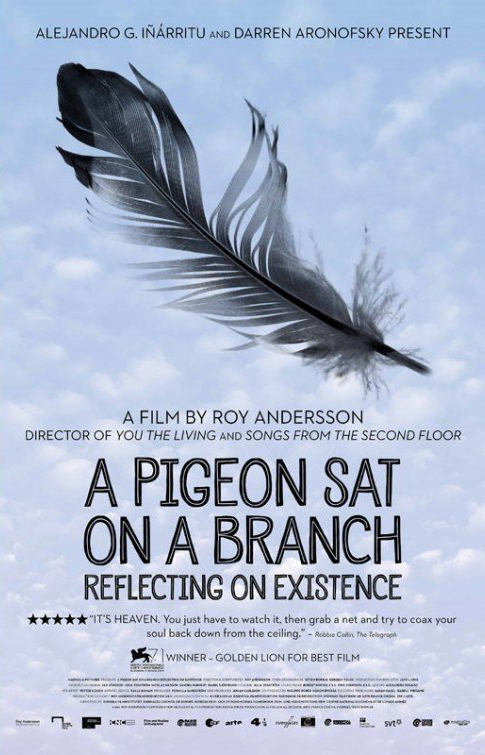
Roy Andersson completes The Living Trilogy with another profound, deadpan winner: A PIGEON SAT ON A BRANCH REFLECTING ON EXISTENCE


Whether or not you already know the work of Swedish filmmaker Roy Andersson, his latest very dark and often very funny foray into humanity and our foibles, A PIGEON SAT ON A BRANCH REFLECTING ON EXISTENCE, will be a must-see. There is literally no moviemaker anything like our Mr. Andersson (shown below) whose work is singular --
and then some.

His compositions are painterly -- they may remind you of Edward Hopper (with much brighter lighting) -- while his theme is about as weighty as they get: humanity in all its sad, silly, horrible glory. His style is deadpan in the extreme and runs the risk of eventually allowing a certain sameness to set in. And yet the combination of all this remains provocative, funny, moving and quietly horrifying throughout.

What is missing, perhaps, once you have seen the first or second film in this trilogy -- respectively Songs from the Second Floor and You, the Living -- is any element of surprise. You'll pretty much know what you are getting, and it will be mostly more of the same. And yet, when "the same" is as good as what Andersson dishes out, you'll probably line up for seconds. (And thirds: This is a trilogy, after all).

As weighty as are his themes and ideas, they are brought to life in the most quiet, nearly routine fashion.  This film begins with three encounters with death (one of which is shown above) -- as though we're getting the beginnings of several Six Feet Under episodes all at once, but in Andersson's inimitable style.

From there we go to a dance class in Flamenco, in which the teacher clearly has a untoward (and unreturned) attraction to one of her students. We meet a few of these characters again, along with many others with their special problems, especially two middle aged men (below) whose job it is to sell novelty products to their peers. (Yes, those vampire fangs are supposedly very big sellers!) This will no doubt bring to mind the fellow from Songs from the Second Floor who hawks crucifixes.

We come to know these two fellows pretty well, and take sorrow, as well as some laughs, from their economic predicament (and especially from their pretty awful living quarters, run by a particularly unfeeling bureaucrat). The film also moves back in time to the days of WWII, below, to give us a memorable scene in a bar, which we also visit in more modern days.

Barrooms and drinking play an important part in all Andersson's movies, offering characters a respite from their troubles but not, unfortunately any real connection to each other. Among the movie's several  pièces de résistance are one scene in which dark-skinned people are force marched into a very odd looking object (below) and then.... This manages to combine slavery with The Holocaust in such a way that we watch open-mouthed and spellbound in horror -- and yet not a drop of blood is shed, within our purview, at least.

Another fine few moments occurs while a lab technician chats on the phone even as her subject -- a petrified, imprisoned monkey -- is given grueling electric shocks. At many points along the way, the rather standard phrase, "I'm happy to hear you're dong fine!" is repeated by one person to another. It is especially shocking during that monkey moment, in which it is used to to underscore our habit of animal abuse, just as, elsewhere, it offers up the abuse of humans by other humans.

It is a dark and ugly world Mr. Andersson inhabits and films -- in often brightly lit scenes of great depth (in terms of both what the camera takes in and its message to our soul). In what may be the most bizarre and hypnotically fervid section, a local bar is invaded by soldiers (shown below) who are clearly from another era. They sweep all the women from the bar and then bully the remaining men.

Who they are and why they are here matters less than what they do and want. A later scene offers up the results of their visit, showing us war's defeat, along with the utter uselessness of "royalty." If arthouse audiences can be coaxed out of their too-mainstream shell to take a look at Andersson's work, I suspect many of them will be converted. What they will see is simply too strange and amazing to be easily shrugged off.

A Pigeon Sat on a Branch Reflecting on Existence is probably as good a place to begin as any in this trilogy. My favorite by far is Songs from the Second Floor, but that may be because it was the first I encountered. Andersson's themes do not change, only the individual scenes by which he brings them to life (or death). That is plenty.

The movie, from Magnolia Pictures and running 100 minutes (the longest of Andersson's three, but the other two are only 98 and 95), opens this Wednesday in New York City at Film Forum and Lincoln Plaza Cinema, and will hit another 23 cities/theaters in the weeks to come. (Click here to see all currently scheduled playdates.) I noted with surprise and dismay that none of these theaters is in the Los Angeles area (Angelenos will have to travel to Santa Barbara to see this one). Surely there might be one single theater in all of L.A. willing to offer its clientele an edifying challenge like this? 

Tuesday, July 23, 2013

In BLUE JASMINE, Allen and Blanchett channel Blanche DuBois via Mrs. Madoff


Woody Allen just keeps rolling 'em out. And while he doesn't really repeat himself (I don't think any alert viewer would mistake one of his films for another), it may be that he cranks these out a little too quickly, relying as ever on happenstance and coincidence to make the connections that real life can seldom provide. This works best in the comedy and rom-com genres, where we expect -- hell, we want -- our happy endings. When too-easy coincidence occurs in drama (whether it tilts toward the happy or unhappy makes little difference), the whole thing begins to look too much like a set-up.

So it is with BLUE JASMINE, which is saved, as Allen's films often are, by first-class casting and acting. As a writer, the guy seems to grow sloppier, while directing-wise he's even less fussy than in the old days and so more on-the-mark. Notice how he handles the repeated back-and-forth of time frames to present and past. These are sharp, clear and focused so that we quickly know where we are and whether it's now or then. It's as though he's telling us, "Look I don't have time to erect all the signposts; just follow along!" And we do.

What we follow here is the tale of an entitled, sleazy and basically nasty woman named "Jasmine" (she's changed to that name from something more prosaic), played by Cate Blanchett, above, whose marriage and fancy, moneyed life have recently collapsed. She's left New York City and the Hamptons for the much simpler and more affordable(!) world of San Francisco. This location shows how out-of-touch Mr Allen is with where working people can afford to live, but I guess the midwest would not have been as much fun for him to film. San Francisco is the home of her lower-class sister, Ginger (Sally Hawkins, below, left, with Andrew Dice Clay, who plays -- and very well -- her former husband).

Fully one-third to one-half of the film is set in the past, so we really get to see who Jasmine was, as well as who she remains -- even though her circumstances have turned upside down. Allen is crafting here a morality tale for our time -- the financial crisis and the economic downturn -- in which the great wealth of Jasmine's husband (Alec Baldwin, below, center, and fine, as usual) was evidently derived from fakery (think Bernie Madoff).

Yet the filmmaker's grasp of how the hoi polloi live is awfully limited. Even the manner in which Jasmine earns her living as a "worker" -- a short spell with an odd dentist (the amusing Michael Stuhlbarg) and then, nothing -- indicates that Allen has little understanding of or interest in how most of us pay our bills.

Ditto his creation of "working men" like Ginger's new boyfriend (the wonderful Bobby Cannavale, above, left) and his best friend (Max Casella, above, right) who remain walking, talking clichés. That Cannavale and Casella walk and talk damn well, goes some distance toward camouflaging this. But there are times when, watching Cannavale act, you think, God, he must have been dying for a bit of decent dialog! But none of the characters here, save Jasmine, are given any depth by their author.

Around the time Peter Sarsgaard (above) appears (then rather quickly disappears), the coincidences really hit home. Through it all, Ms Blanchett delivers a spot-on performance, with every moment real (and often grating). Cate's too smart an actress to try to sugar-coat her character, who is, let's face it, a horror who just keep growing more horrible. That the actress has played -- and quite well, I am told -- Blanche DuBois could only have helped her performance -- which is some kind of wonderfully strange concoction of Blanche and a character somewhat like Mr. Madoff's wife (but younger), who could not have helped but know what her husband was up to on some level but ignored it all to bask in the wealth. At this point in our film year, Blanchett would seem a shoo-in for an Oscar nomination.

Blue Jasmine is a lot of fun, though it is not particularly funny, as in ha-ha. (That's Louis C.K. with Ms Hawkins, above.) It is light on its feet, as shallow movies with weighty themes sometimes are. I think Allen may not have intentionally gone after a character study, but that's what, thanks mostly to Blanchett, he has achieved. It's a good one, too -- even memorable -- though everything else here pales beside it.

The movie, from Sony Pictures Classics and running 98 minutes, opens this Friday, July 26, in New York City (at the Angelika Film Center, City Cinemas 123, Lincoln Plaza Cinema), in Brooklyn (at the BAM Harvey Theater) and in Los Angeles (at The Landmark and perhaps elsewhere). From there, a national rollout will follows in cities across the U.S.