Showing posts with label character studies. Show all posts

Sunday, September 22, 2019

Friendship, interrupted & rekindled, beautifully explored in Simone Catania's DRIVE ME HOME


Essentially a full-length road-trip movie buoyed by two marvelous male performances, DRIVE ME HOME -- a lovely, meaningful-yet-never-spoken title -- is one of those special films from Italy that give us an exploration of "family" in a manner no other country seem to manage quite as well. Bonus treat: This one is often visually stunning, too.

Simone Catania (shown at right), the film's director and co-writer (with Fabio Natale), has created a little movie with big themes -- the testing of friendship, the meaning of goals unachieved, the relationship of past to present -- all of which are explored honestly, even deeply, without a lick of pushing or overdoing anything. This is quite an accomplishment, but it is one so gracefully, subtly managed that, in our current era of overlong overkill, it is likely to be near-completely overlooked.

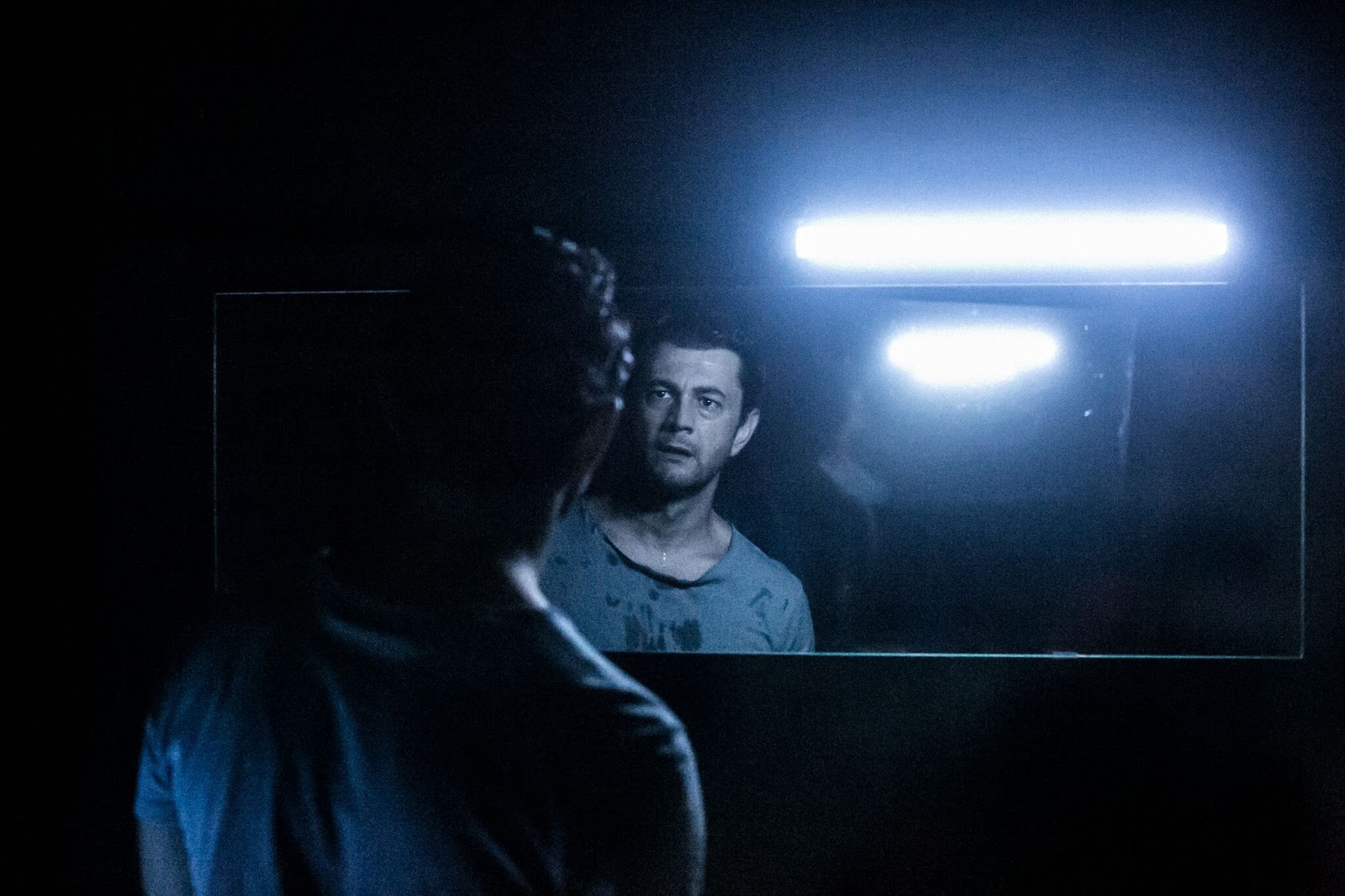
The two leading roles could not have been cast better nor, I think, could the resulting performances been improved. Both Marco D'Amore (above, left), best know for his role in the Italian television series Gomorra (available here via Netflix), and his co-star Vinicio Marchioni (shown below, and last seen by me in the also lovely and poetic Italian crime film, Tainted Souls, now available via Amazon Prime Video) inhabit their very different roles completely. The result is a movie that resonates and builds to a conclusion that -- in any other film might seem like foolish feel-good. Here, thanks to the complete credibility of the actors, instead it seems as though these two men, along with us viewers, have indeed reached some version of "home."

With boyhood scenes from the two men's past in Sicily intercut with their present-day road trip through Belgium, The Netherlands, Germany and finally back to Italy, we slowly learn both who they were and who they are. They are learning this, too -- which is one of the things that makes the film so quietly moving.

Along the way, due to an accident and the need for truck repair, they encounter the kind of commune that could make socialists of us all, as well as a visit to a no-holds-barred sex club where anything goes and some important information is revealed. How this information is processed by one of the men is handled by the actor and filmmaker in exemplary fashion.

There are some sweet and spiky supporting characters --  especially those played by the lovely Jennifer Ulrich and the fine-and-still-kicking Lou Castel in that very special commune -- but the film belongs to D'Amore and Marchioni. And to that amazing truck that the character played by D'Amore drives. It (shown above and below) -- along with these two guys and the movie they inhabit -- is an absolute keeper.

From Breaking Glass Pictures and running just 99 minutes, the movie makes its American debut on home video tomorrow, Tuesday, September 24 -- for purchase and/or rental.

Tuesday, June 11, 2019

Solitude in company: Thomas Stuber's original, bittersweet and beautiful IN THE AISLES


It may not be the first film to adapt a Strauss waltz to an unusual visual, but for the most part IN THE AISLES, the new film from Thomas Stuber (he directed and co-wrote it with Clemens Meyer), is an original work of humanist art.

Beginning with its locale -- a kind of German version of Costco during, mostly, the graveyard shift -- the movie introduces a set of characters who slowly grow on you until you come to love them and want to care for them as though they were your very own.

Mr. Stuber, shown at right, takes his sweet time with all of this, so if you demand action and car chases, do please move along. Yet as quiet as all this is, it is also never for a moment boring.

This is due to a screenplay that doles out its information haltingly and pretty much in the manner that these characters themselves would offer it. They don't like to intrude -- on each other or even, it seems, on themselves.

The actors chosen for these roles are very good indeed, and even if you've seen them previously, the characters they play here will seem ideally matched with the performers.

The young man who acts as a kind of guide for us -- because, as the film begins, he is being trained for his first day on the job -- is Christian, played by Franz Rogowski (above, of Transit and Happy End). The object, soon, of Franz's affection is a pert and pretty co-worker named Marion (Sandra Hüller, below, of Toni Erdmann) .

Our "newbie" (Marion's pet name for Christian) is under the tutelage of long-time employee Bruno, whose initial gruff manner belies a sad heart of gold. As played by Peter Kurth, below, left -- the lead villain (one of them, anyway) from Babylon Berlin -- Bruno is a wonderful character, rich, deep and quiet, and one who grows and grows on us, until....

All of the night shift employees, no matter how small the role, are brought to fine and specific life here. Eventually this small group and its place of work becomes a world in itself, one that we are only too happy to abide in for the 125 minutes we're allowed to. In the Aisles proves a small, alternately bright and dark, wonder.

From Music Box Films, in German with English subtitles, the movie opens this Friday, June 14, in New York City at the Village East Cinema, and in Los Angeles on Friday, June 21, at Laemmle's Royal and on June 21 and over the weeks to come expanding to another 15 cities and theaters, including the Bill Cosford Cinema here in the Miami area on July 5. Click here, then scroll down to click on Theatrical Engagements to view all currently scheduled playdates, cities and theaters.

Sunday, April 7, 2019

The life of a hot, young, gay French sex worker in Camille Vidal-Naquet's SAUVAGE/WILD


Here's a movie that should give you just about everything you could want and expect from a story about a young French sex worker who is hugely attractive -- and gay. From the graphic opening scene, set in a doctor's office, that turns surprising, funny and even oddly moving, the film explores the life, labor and love of this sweet, sad young man. As written and directed by Camille Vidal-Naquet (shown below), SAUVAGE/WILD certainly lives up to its title, never more so than by the finale, when we learn most fully what this means.

Embodied -- physically, emotionally, intellectually -- to near perfection by Félix Maritaud (shown below, seen most recently in Knife + Heart and earlier in BPM), the character of Léo is complicated indeed. M. Maritaud's performance is initially ingratiating and finally problematic but so compelling that I suspect you will remember this particular sex worker for a long time to come.

The filmmaker offers little exposition, and because Léo  generally prefers not to talk much about himself or his life, we must pick up clues as we move along. Thanks to a screenplay full of subtlety and well-chosen detail, together with Maritaud's rich and splendid performance, we have everything we need to finally understand our hero.

We're with Léo at work, with men both kindly and not so (the two, apparently Muslim, fellows, below, who invite him for a threesome and then abuse him mightily will have you ready for blood), and these scenes give you quite a sense of the breadth of the young man's varied work and clientele.

Léo's roommate Ahd, we soon learn, is also love of his life (played very well by Eric Bernard, below), but Ahd, being much more of a pragmatist than Léo, can't or won't return this love. And because Léo cannot properly control or maybe even understand his feelings, he slowly forges his way toward disaster.

Sauvage/Wild is no downer, however, there's far too much incident, emotion, even humor generated here for that. We're with Léo in scene after scene after scene, and eventually we understand him and his situation so well that nothing he does seems at all unbelievable.

Though this is filmmaker Vidal-Naquet's first full-length feature, he has managed to capture a character and milieu so well and near completely that it's an impressive feat indeed. Erotic, moving, dynamic, amusing and melancholic, Léo's tale should leave you with, among other things, a few nagging questions about the meaning and price of freedom.

From Strand Releasing and running a just-right 99 minutes, Sauvage/Wild has its U.S. theatrical premiere this Wednesday, April 10, in New York City for a two-week run at Film Forum. It hits L.A. (at the Landmark NuArt) on Friday, April 26, and will then reach another dozen or more cities over the weeks to come. Here in South Florida, look for it to play Miami at the Silverspot Cinema and Fort Lauderdale at the Classic Gateway, at both theaters opening on Friday, May 3.

Monday, January 14, 2019

From Paraguay, THE HEIRESSES: Marcelo Martinessi's first full-length film is a rich and moving character/situation study


It is unusual enough to view a movie from Paraguay, but when that movie is also a first full-length film from an unknown director that turns out to be not only thoroughly involving but first-class in every respect, this is grounds for rejoicing. So it is with THE HEIRESSES (Las herederas), written and directed by Marcelo Martinessi.

Señor Martinessi (shown at right) has managed to combine themes involving class, change, entitlement, old money vs new, relationships, power, control and prison (of various sorts), all the while providing a study of character and situation that is really quite close to perfection. It has been a long while since I've seen a first film this well done in all areas -- on both sides of the camera.

The tale told is of two women -- Chela and Chiquita -- each from a wealthy (formerly, at least) family who have been lovers/partners for decades but have come upon hard times, due to which they are now forced to sell many of their most precious belongings.

As essayed by Margarita Irun (shown above, who plays Chiquita) and especially Ana Brun (below, left, as Chela), who has the more important role, these women resonate hugely. Ms Brun, in what is apparently her debut role, could hardly be better, as she slowly and quietly wraps us in her at first stand-offish but finally almost warm and completely understandable near embrace.

We get to know the two women, as well as their circle of friends and neighbors, especially once Chiquita has been "removed" to some extent from Chela's immediate life. How and why provides one of the film's many interesting plot devices, leading to some very quietly surprising changes along the way.

We get a look a Paraguay's prison system (women's variety, above), as well as a number of glimpses at the elderly, card-playing old-money wealthy (below) and their gossipy, judgmental habits,

and in particular one younger woman, Angy (very well-played by Ana Ivanova, below,  right), to whom Chela has clearly taken a shine. What happens between these two provides a good deal of the small but irrevocable changes that occur throughout the film, many of which involve those that Chela must make in order to grow and survive.

The manner in which Martinessi has laid out this growth and change is calibrated in such a way -- never too obvious but with enough information provided to keep up interested and on our toes -- that his movie proves consistently compelling and finally moving and even, yes, uplifting. Yet in a very minor key.

What we first perceive as a kind of love is eventually understood to be control. How Chela learns to circumvent some of this makes for one of the great, low-key pleasures of this just-beginning movie-going year.

From Distrib Films US and running 97 minutes, The Heiresses opens in its U.S. theatrical premiere this Wednesday, January 16, in New York City at Film Forum. Elsewhere? Well, it's scheduled to play Los Angeles at Laemmle's Royal in early March, but I can't find any other currently scheduled playdates. But it is difficult to imagine that a foreign film this good won't eventually hit major cities around the USA. Keep watch.

Monday, December 31, 2018

Matan Yair's SCAFFOLDING: from Israel, a beautiful, believable, nuanced look at a troubled boy on the cusp of manhood


Yet another fine Israeli film reaches U.S. distribution, as SCAFFOLDING -- an unusual character study of a troubled-but-hugely-worth-caring-about Israeli high school student -- written and directed by Matan Yair, hits VOD and DVD via Breaking Glass films.

As a filmmaker, Mr. Yair, shown below, often begins his scenes in the middle of something and/or ends them abruptly, also in the midst of things. This works pretty well, too, as it forces us to observe and contend with a life -- that of the main character, Asher, beautifully played by newcomer Asher Lax -- that seems as fractured as does the ongoing narrative.

Slowly we ascertain that Asher is the only son of a problemed single father -- given to telling jokes, each of which seems more misogynistic than the last -- who owns a construction company specializing in scaffolding and expects his son to take over dad's business rather than pursuing the arts/academic career that apparently beckons him.

Young Mr. Lax, shown above and below, proves a natural -- an enormously attractive and charismatic performer who never needs to push, yet thanks to his talent and beauty, holds the audience securely in his alternately warm and angry grip.

In contrast to his single-minded and physically declining father, Asher's favorite teacher, Rami (played by Ami Smolartchik, shown at left, above and below) seems as physically and intellectually different as could be. We get snippets of how Rami teaches and how effective he is at reaching the difficult Asher. At one point Rami suggests to his student, "Try to be less prickly" -- a quiet and lovely manner in which to make the young man consider his words and actions.

When something totally unforeseen (but not at all difficult to accept) occurs, Asher must find ways to deal with this, as well as with his father and future. (Dad is played by Yaacov Cohen with just the right combo of incivility and caring that he never quite loses us. Nor his son.) On the feminine side are a good friend of Asher (not exactly a girlfriend, however; the young man's sexuality seems at this point maybe indeterminate), various educators, and the wife of the teacher, Rami.

Coming to terms with all this is not at all easy for Asher, but as orchestrated by Yair and Lax, the ongoing movie continues to hold us -- and afterward to haunt us -- via its marvelous combination of observation, compassion, detail and suggestion. The finale takes us just so far, making its quiet point in a moving and compelling fashion that doubles as a kind of memorial to that exceptional teacher.

Running a just-about-perfect length of 94 minutes, Scaffolding, from Breaking Glass Pictures, comes available on DVD and VOD tomorrow, Tuesday, January 1 (for purchase or rental) via iTunes, Amazon Prime Video, Google Play Vudu, FandangoNOW, iNDEMAND, Direct TV and elsewhere, too. For folk who appreciate foreign films, particularly well-done character studies, I can't think of a better way to begin the New Year.

Tuesday, October 30, 2018

The Flori-duh movie screening strikes again -- this time to Marielle Heller's quietly delightful CAN YOU EVER FORGIVE ME?


TrustMovies dearly hopes that, elsewhere around the country, movie theaters are doing a better job of screening their films than happens down here in South Florida with alarming frequency. I would estimate that every four to five times that I go out to a theater, something untoward occurs that must be remedied before the screening can continue. And this happens as often at critics' screenings as it does when I simply pay to attend a film like most other audiences. Either the film is out of focus, or we get visuals and no sound (or sound without visuals) or, as last night, about two-thirds or three-quarters of the way through CAN YOU EVER FORGIVE ME?, the movie simply stopped dead in its tracks, due to some problems with its "projection". After a few minutes, it started up again, only to stop a second and (soon after that) a third time -- after which it never finished at all (from what I'm told, at least; my spouse and I beat a retreat after waiting nearly an extra half hour to no result).

Hint to theater owners: If you are worried about further losing your ever decreasing audiences, this is not the way to remedy that.

As written by Nicole Holofcener (Enough Said) and Jeff Whitty (Shortbus) and directed by Marielle Heller (The Diary of a Teenage Girl), shown at right, Can You ever Forgive Me? moves along at just about a perfect pace, as it tells the based-on-life tale of an ex-successful writer, Lee Israel, and how she became an even-better-known "literary forger."

While TrustMovies does not normally cover a film he hasn't finished viewing, since he does not know at this point if and when he'll get the opportunity to finish this one, and because that first and major portion has saw was so very good, it is hard for him to imagine the rest of the film will not follow suit.

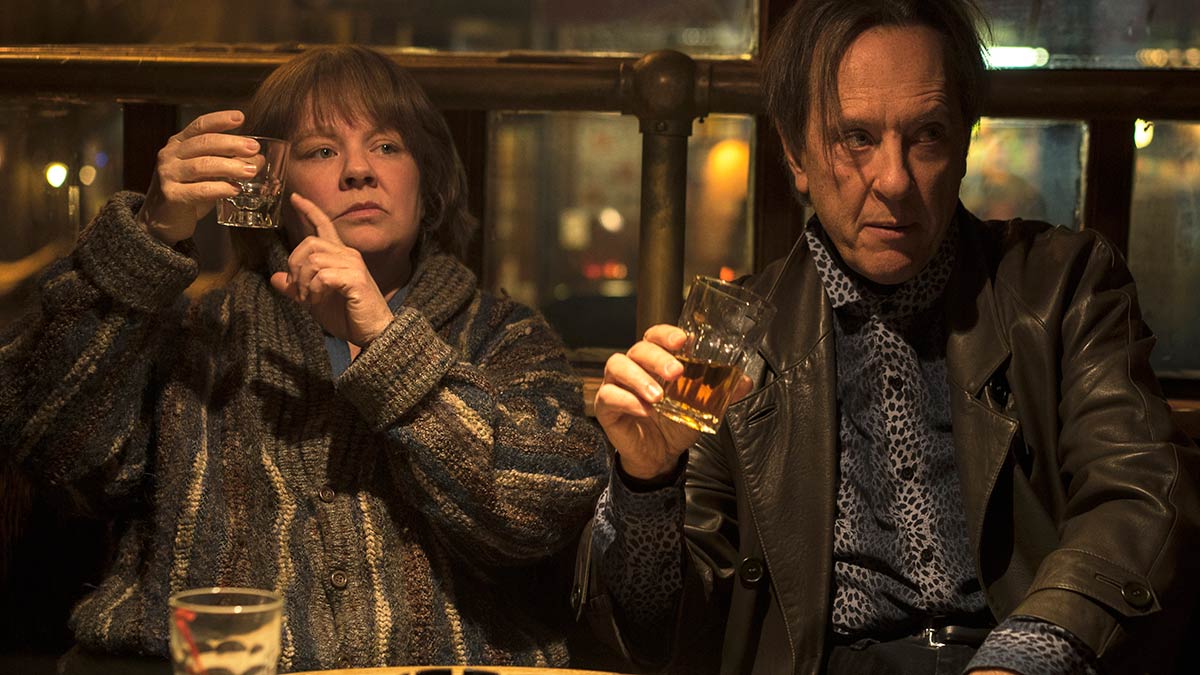
Also, if you're a fan of actress Melissa McCarthy (above and below, and there are a lot of these), know that this may be her very best performance ever. She makes Ms Israel a bitch who -- thanks to the abilities of the actress and the filmmakers to instill such humanity into the woman -- wins us over completely.

Ditto Richard E. Grant (below, right), who plays her best (and nearly only) friend, confidant and eventual henchman, an aging gay con-man who is forever down on his luck.

Heller, Holofcener and Whitty do such a remarkable job of both storytelling and character-building that their tale seems to practically tell itself, balancing comedy and drama, with nary a seam ever showing. We so grow to understand the kind of self-imposed prison that Israel's life has become that it is difficult not to root for her, despite her deception.

Because the movie is so "literary" and 20th-Century-based, some knowledge of the likes of Noel Coward, Dorothy Parker, Marlene Dietrich, Fanny Brice and others will certainly increase one's enjoyment. Action lovers had best remain at home. I could certainly watch the whole thing again, simply to savor the wonderful performances -- Dolly Wells' (below, left) among these -- and the witty, dry dialog.

When you see the film, I hope you have better luck at the theater than did we. From Fox Searchlight and running 106 minutes -- 20 or so of which  I still hope to see -- the movie opened on the coasts two weeks ago, and has expanded nationwide with each new week. Here in South Florida it opens this Friday, November 2, in the Miami, Fort Lauderdale, Boca Raton and West Palm Beach areas.

Thursday, May 3, 2018

Natalia Almada's EVERYTHING ELSE: the cost of solitude and loneliness in Mexico City


What a quiet but engulfing little gem of a film is EVERYTHING ELSE, the new movie from Mexico by writer/director Natalia Almada (shown below). It is not, however, for action aficionados. Not only is there practically no action at all -- our poor heroine cannot even gather the courage to jump into a swimming pool along with the rest of her peers -- even the camera here does not move. From scene to scene, whatever new view it must take in, the camera eye remains utterly stationary throughout.

The cinematographer, Lorenzo Hagerman, keeps his shots clean and pristine, even when the subject matter is often dark and dreary. And when a film boasts a leading actress whose face possesses such character -- longing, suspicion, fear, hope and all the rest -- as does that of Adriana Barraza (shown below and further below), what you have to look at will never, it seems,  tire you in the least. Ms Barraza has been utterly terrific in supporting roles in movie after movie -- from Amores Perros and Babel to Henry Poole Is Here, Rage, Drag Me to Hell and especially Cake -- but what a pleasure it is to see her in a leading role, using that marvelous face with such command & subtlety.

Ms Barraza is on screen for most of the movie, with only occasional reaction shots and a bit of dialog given to subsidiary characters. The actress plays a 60-something-year-old government worker, Doña Flor, whose job -- at least it would seem so -- is to prevent citizens (such as the woman shown below) who need some kind of government authorization from actually getting that authorization. (In its own way, the film is quite an indictment of bureaucracy.) Such a stickler Flor is for by-the-letter rules, she uses anything from the color of the ink to the fact that a man's signature is not exactly the same two times in a row (of course: no signature ever is, but she's in charge, so we'll have to let that pass).

The fellow with the incorrect signatures also happens to look and act like an uber-entitled wealthy man, so perhaps something else is going on here, too. Our heroine also keeps a kind of record of violent incidents against women, which we hear reported with regularity via radio and TV over the course of the film.

Doña Flor also lives alone with her cat, and so may also qualify as one of those lonely cat ladies we often hear about. She also swims daily and showers with the other women, though without ever really connecting in any way with anyone. Every scene, every thing in the film is given -- intentionally, I believe -- the same weight, which is certainly one interesting way to define and show us an empty life.

As the movie goes along, after the loss of her only companion, small breaks in Doña Flor's facade begin to appear. And then, slowly, while at work she seems to perhaps listen more closely to the people who appear in front of her for help. She even -- shock! -- begins to bend those rules just a little.

Her journey is a slow and very small one, and yet, thanks to the minute detail that the filmmaker, her star and the supporting cast provide, this journey should prove a vital and important one for viewers looking for character and depth in place of action and special effects. The effects here are of the human and humane variety.

The movie this one most reminded me of is that great but little-seen-over-here Spanish film Le Soledad (Solitary Fragments is its English-language title) by Jaime Rosales, which won Spain's Goya award for Best Film back in 2007. It's been more than a decade since I've seen another Spanish language movie as quiet, austere, elegant and character-driven as that one. So if you want to enter the world of a sad and lonely woman who may still have some possibilities to explore, Everything Else is that opportunity. Snatch it.

From Cinema Tropical, in Spanish with English subtitles and running 98 minutes, the movie opens tomorrow, Friday, May 4, in New York City at the Cinema Village. Elsewhere? I certainly hope so, and if and when I find out where and when, I'll post it here.