Guaranteed -- were it to be seen and believed by many people -- to set Mexican tourism back a few billion dollars, EL SICARIO, ROOM 164 purports to be an interview with a fellow who was a prime killer for a Mexican drug car-tel. TrustMovies uses the word purports not because he necessarily doubts the veracity of the movie (though the film does build up to one whopper of a suspend-your-disbelief moment) but rather because we, the audience, must take an awful lot of what we hear (not to mention see, or in this case, don't-see) on faith, just as did, I suspect, the writer/director, Gianfranco Rosi (shown just below), and co-writer Charles Bowden, the journalist who wrote the original article that appeared in Harpers Magazine.
According to the documentary's U.S. distributor, Icarus Films, the definition of "sicario" dates back to Roman-conquered Palestine and to a Jewish terrorist sect, the Sicarii, who used daggers -- sicae -- in their murders of Romans and Roman supporters. The term, as used here, applies to a Ciudad Juárez hitman who claims to have killed hundreds of people and to be an expert in torture and kidnapping. On the payroll of the Mexican drug cartels at the same time as he was a commander of the Chihuahua State Police (what he tells us about the connection between these two "powers" is probably the most depressing thing in the movie), the fellow currently has a $250,000 bounty on his head and lives as a fugitive, though he has never been charged with a crime in any country. (Haven't most of the drug cartel members not been charged with any crimes? True, but they haven't snitched quite like this.)
Why did he snitch, you may wonder, as the film progresses? He will probably pay for this with his life, if not those of his family, too. (And when they get him/them, what will happen is most likely the very same horrors we've heard about from this guy over the course of the film.) To protect his identity, Sic (as we'll call him), shown above, wears all black plus a black, breathe-easy rag over his head. Unlike so many documentaries that make use of talking heads, this one offers a talking covered head. Because all we're really seeing is a black-covered figure, complete with voice and hands, since the voice could have been over-dubbed (and the figure itself might be an actor having memorized lines, in order to prevent ay identification from happening by our guy's former associates), identity is more than a little unclear.
Sic's hands, however, are plainly on view, and I would imagine that his former bosses are combing through any old photos they might possess to match 'em up. Sic generally holds a drawing pad in front of him, too, on which he diagrams some of the things he is explaining -- such as the power structure in Mexico, another tidbit that should depress the hell out of you and even more so out of the hope-free Mexican citizenry. Is there a more populous country on the globe any more corrupt than this one, I wonder? For all the "legit" news stories we read about the Mexican drug cartels, and their accompanying corruption, murders and massacres, probably the most memorable (certainly the darkest and funniest) comes from The Onion's September 20, 2010 issue (read it here.)
All there is, then (besides a very occasional -- and useless-- exterior shot, as below) is Sic talking and drawing, but since the talk is about crime and cartels, torture and murder (and the result of same to Sic's psyche), nothing proves uninteresting. And because the movie lasts but 84 minutes, including credits, it's a fast, ugly time. As might be expected, the details are where the true horror is found. Methods of torture, the repetitions, and the time a doctor had to be called to revive a comatose victim (and the irony of what happened afterward): Whether all this is creepier or crazier, I'll leave to your judgment.
It's when we get to the finale and how our man manages to "save" himself that our credibility is most severely tested. Granted Mexico's a Catholic country, and Sic must have come from the lower classes, the fact that Jesus would prove his savoir seems not too far afield. What rankles most is that the man who runs the Church in question appears to be a product of the same cartel and power structure as Sic himself. So how hard would it be for the nasty and powerful to put two and two together and find their canary?
There were moments toward the end when it occurred to me that I might be witnessing the Banksy of Mexico. If so, more power to the exercise. If not, and all this is gospel, then I hope that (1) Mexico will forgive me for spending my tourist dollars elsewhere and (2) Jesus will save the rest of those sicario shits before they kill off the remaining population.
El Sicario, Room 164 (which refers to the hotel room where the interview with Sic takes place, and/or maybe the room in which he committed those atrocities?), from Icarus Films, opens at Film Forum in New York City (and in time for the holiday season, too!) this Wednesday, December 28 -- for one week only. Check showtimes here. The film will also be coming to the Northwest Film Forum in Seattle in January, and to the Union Theater, Milwaukee, Wisconsin, in February -- and elsewhere perhaps. Check this link later for possible additional playdates and cities.
Monday, December 26, 2011
Sunday, December 25, 2011
Spielberg's WAR HORSE--90 minutes, at least--proves a genuine holiday blockbuster
Ah, WAR HORSE! Well, 90 minutes of it, anyway. Because of being given the wrong starting time for the advance screening, and a prior commitment to interview French filmmaker Cedric Klapisch, TrustMovies simply had to leave with nearly a full hour left to view. Now that the film has officially opened -- today, in theaters everywhere, as they say -- he will certainly go back and catch that last hour (he did: see final paragraph below). So, consider the following not exactly a review but a recommendation -- because that first hour-and-a-half is supremely entertaining, beautiful to view and full of strong performances (from animals and humans) that pull you in and keep you there. (Post-screening, TM's daughter and ex-wife both claimed the last portion of the film to be even more powerful than the first.)
Steven Spielberg (shown at left), the film's director, is no stranger to blockbusters nor to family films. This one, rated PG-13, is not for the younger children (or any older ones or adults) who may grow upset seeing beautiful animals put in harm's way. For the rest of us, the movie works, as much because of this director's love of cliché and how to use it as anything else. Few filmmakers are so able to give us the tried-and-true as though it were new -- and then succeed in making it so. Much of the time, anyway.
In this tale of the love of a boy for his horse (adapted, from Michael Morpurgo's novel by Lee Hall and Richard Curtis), though we know just about everything that's going to happen from our consumption of so many earlier movies, this does not make most of what occurs any less engaging or lively.
Only the section involving a Frenchmen and his granddaughter (played by the ever-reliable Niels Arestrup, above, right, and newcomer Celine Buckens, at left) seems particularly heavy-handed and unbelievable. Fortunately, this ends rather abruptly, and we can get on with the show.
Once we finish with the necessary initial family scenes -- that's father (Peter Mullan), above right; son (Jeremy Irvine), center; mother (Emily Watson, center left) and their landlord (David Thewlis, seated left) and the procurement of the horse and its training, we then go to war, along with that horse and, eventually, the son.
As this is World War I, death is everywhere, but Spielberg manages to gloss it whenever possible. There's an initial strange, gung-ho attack (above) that begins in tall grass and ends with riderless horses as the main indication that the men are dead. Later, a pair of young deserters are executed, with the blades of a huge windmill obscuring their actual moment of death.
Other directors would do all this differently and might please a smaller section of the public, but Spielberg knows how to do it in a manner that will rake in the largest audience, giving it both what it wants and what he wants. My personal favorites among his films are the two least successful at the box-office: Empire of the Sun and A.I., but when I see something as accomplished as War Horse, I am able to appreciate what this director can do, even if the film may not be among my favorites of the year.
I'll have to see that final hour to know for sure. And I will. Meanwhile, consider this "sort-of" review a genuine recommendation. War Horse, a co-production of Touchstone Pictures and Dreamworks, opens today, Christmas 2011. Click here to find a theater near you.
*********
Saturday, December 24, 2011
SCN: Portugal's entry for Best Foreign Film, Miguel Gonçalves Mendes' JOSÉ & PILAR
What, you might ask, is Portugal's submission for the year's Best Foreign Language Film -- JOSÉ & PILAR -- doing as part of the FSLC's Spanish Cinema Now? TrustMovies certainly did. Granted, Portugal is right next to Spain on the map, but last he heard they constituted two different countries. Not only is this a Portuguese film, its director, Miguel Gonçalves Mendes, is Portuguese and so is his subject, José de Sousa Saramago, the Nobel-laureate novelist, poet, playwright and journalist. The movie's other half, Saramago's second wife Pilar del Río, however, is indeed Spanish, and so is one of the most prominent of the film's several producers, Agustín Almodóvar (Pedro's brother). Plus, the titular couple lived in Spain for quite some time. So I guess we'll let this one slip by.
For audience members, like me, uninitiated into the world of Saramago and del Río, the movie cannot help but be interesting, as there is so much to learn. But for those of us who know little of this award-winning writer's work, the film also proves unsatisfying, as we don't get to know all that much about it over the ensuing two hours and five minutes (for a current-times documentary, this is a long one). We get a little history of the pair, together and individually, as the filmmaker, shown at right, concentrates on their life together and how the two manage to help each other in various ways. Pilar is José's social secretary, and in one of the initial scenes, the pair (below) is shown RSVP-ing to various requests -- deciding to turn down one from the Dali Lama!
Saramago is a Communist (my kind of guy!), as well as anti-Church, so for some of us, he's an easy fellow to appreciate. In his 80s when the movie was filmed (the writer died last year at the age of 87), he still maintains a playfulness and fine sense of irony. One of his works for the theater is being given a reading by Gael García Bernal, and the conversation between them, as Bernal complains about the celebrity life, is amusing.
We get to see a bit of that theater piece (which sounds good), and later we hear Pilar's rant on the subject of "Basque is Spain!" Sometimes the filmmaker seems to be trying to give visual images to Saramago's works, but the overall effect is paltry, probably because this is not necessary.
There is plenty of archival footage (as per the above) of the twosome early-on, and even more of them in current times. José goes into hospital after an attack but returns home in time to be honored in his homeland of Portugal. Then Blindness -- Fernando Meirelles' movie version of Saramago's novel -- is shown at Cannes, opening to not terribly good reviews which compare the movie badly to its original source. "It's just as I wrote it," declares the novelist, giving the figurative finger to those critics. (TM thought Blindness was better than many critics gave it the credit of being.)
Toward the end, there is a very nice interview with Pilar, in which we finally get to hear what she thinks about various topics. Regarding the intersection of the streets now named for the pair, one newscaster suggests that all lovers should come there and kiss. Shot during the U.S. Presidential campaign in 2008, the movie makes clear that Saramago was pro-Obama, while del Río was a Clinton supporter. By the finale the poet and raconteur is looking mighty frail, no surprise.
José & Pilar, shown only twice during SCN, has no U.S. distributor so far as I know. (Hold the phone! According to the comment just in, see below, Outsider Pictures -- a company that has brought us some terrific little movies we would not have otherwise seen -- will release the film here this coming April, so my U.S. readers will indeed have the chance to view it.) And because José & Pilar has been selected as Portugal's entry into the Best Foreign-Language Film "Oscar" sweeps, this release might add to its chances. I wouldn't put my money on the movie's making the final five nominees, but as the Academy has been known to surprise us on that score, we shall see.
For audience members, like me, uninitiated into the world of Saramago and del Río, the movie cannot help but be interesting, as there is so much to learn. But for those of us who know little of this award-winning writer's work, the film also proves unsatisfying, as we don't get to know all that much about it over the ensuing two hours and five minutes (for a current-times documentary, this is a long one). We get a little history of the pair, together and individually, as the filmmaker, shown at right, concentrates on their life together and how the two manage to help each other in various ways. Pilar is José's social secretary, and in one of the initial scenes, the pair (below) is shown RSVP-ing to various requests -- deciding to turn down one from the Dali Lama!
Saramago is a Communist (my kind of guy!), as well as anti-Church, so for some of us, he's an easy fellow to appreciate. In his 80s when the movie was filmed (the writer died last year at the age of 87), he still maintains a playfulness and fine sense of irony. One of his works for the theater is being given a reading by Gael García Bernal, and the conversation between them, as Bernal complains about the celebrity life, is amusing.
We get to see a bit of that theater piece (which sounds good), and later we hear Pilar's rant on the subject of "Basque is Spain!" Sometimes the filmmaker seems to be trying to give visual images to Saramago's works, but the overall effect is paltry, probably because this is not necessary.
There is plenty of archival footage (as per the above) of the twosome early-on, and even more of them in current times. José goes into hospital after an attack but returns home in time to be honored in his homeland of Portugal. Then Blindness -- Fernando Meirelles' movie version of Saramago's novel -- is shown at Cannes, opening to not terribly good reviews which compare the movie badly to its original source. "It's just as I wrote it," declares the novelist, giving the figurative finger to those critics. (TM thought Blindness was better than many critics gave it the credit of being.)
Toward the end, there is a very nice interview with Pilar, in which we finally get to hear what she thinks about various topics. Regarding the intersection of the streets now named for the pair, one newscaster suggests that all lovers should come there and kiss. Shot during the U.S. Presidential campaign in 2008, the movie makes clear that Saramago was pro-Obama, while del Río was a Clinton supporter. By the finale the poet and raconteur is looking mighty frail, no surprise.
José & Pilar, shown only twice during SCN, has no U.S. distributor so far as I know. (Hold the phone! According to the comment just in, see below, Outsider Pictures -- a company that has brought us some terrific little movies we would not have otherwise seen -- will release the film here this coming April, so my U.S. readers will indeed have the chance to view it.) And because José & Pilar has been selected as Portugal's entry into the Best Foreign-Language Film "Oscar" sweeps, this release might add to its chances. I wouldn't put my money on the movie's making the final five nominees, but as the Academy has been known to surprise us on that score, we shall see.
Friday, December 23, 2011
SCN: Enrique Otero's CREBINSKY combines silent-film clowning with cows, icons & war
Galicia, one of Spain's most beautiful areas, adds the scenery, notable actors Sergio Zearreta and Miguel De Lira offer the clowning, Patricia de Lorenzo (as a character called Loli Marlén) does a nifty, low-end and brunette version of Marlene Dietrich, while nasty Germans and asinine Americans frolic around the outskirts, and a cow -- the real and enduring love interest in the movie -- disappears. All of this (taking place during WWII, 'natch) is whipped into fairly acceptable shape by filmmaker Enrique Otero, who co-wrote the film with his co-star De Lira.
CREBINSKY, the name of the film and (I think) of the family that inhabits it (which is currently down to two brothers, mom and dad having been eliminated via tree), is a vehicle for, most particularly, whimsy -- a state of being that many movies aspire to put their audiences into but few effectively manage. Señor Otero, shown at left, comes close enough periodically for his film to qualify as a contender, though at times it seems like whimsy run rampant, complete with tinkly, silent-film music to cue us into obeisance. This is especially true when the Germans or Americans come into play, with the latter's commanding officer played by that great Spanish actor Luis Tosar (below), here sporting a not-so-hot American accent that probably wowed Spaniards but will leave most Americans scratching their head.
The treatment of WWII as pictured in Crebinsky may not be as lowly as, say, Hogan's Heroes, but it comes off as just this side of silly, nonetheless. But because the film is set in WWII Spain, a country that went Fascist but managed to keep itself, supposedly, above the fray, the picture is not as much black-and-white as it is all shades of gray, many of them pretty dark.
The plot, such as it is, manages to give us the history of these two brothers and their late family, while showing us what's happening right now -- which is the loss and then the finding of their precious cow, with side trips for the traveling musicale performed by Loli Marlén and her manager, and the search by the Germans for one of their lost flyers and the Americans, personified by submarine Captain played by Tosar.
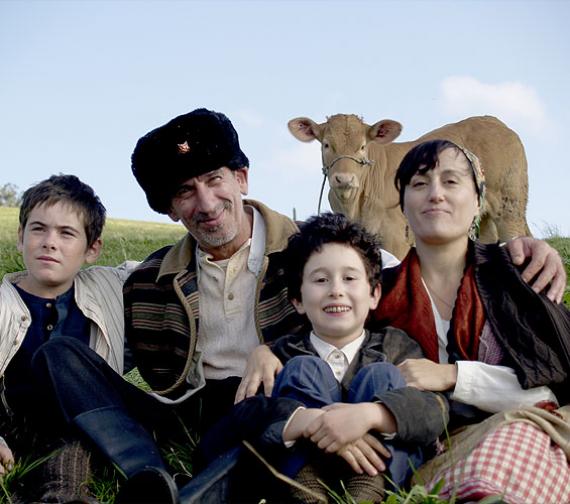
Too heavy-handed by half, the film still manages to entertain and occasionally surprise, thanks for the performances of its two leads, De Lira (above, right) and Zearreta (above, left), that very special cow (below), Tosar, the actors playing Germans, and all the rest. I should imagine that filming this movie was lots of fun. And about half of that fun is passed along to the audience. Whether it will be enough will be up to each individual member.

Thursday, December 22, 2011
Vincent Bal's fine feline, MISS MINOES, arrives for the holidays -- one decade late
The backstory of MISS MINOES is very nearly as interesting as the the film itself: a sweet, slight family treat about the title character, a cat who is transformed into a young woman (Carice van Houten, of Black Book and Black Death) who befriends Tibbe (Theo Maassen, shown in photo at bottom of post), a not-very-bright cub reporter for the local news-paper, and, with the help of the local felines, enables Tibbe to land some "scoops" and keep his job. Based on the 1970 novel by Annie M. G. Schmidt (one of Holland's most popular writers of children's tales) and brought to the screen by adapter/director Vincent Bal (shown below) and his co-adapters Tamara Bos and Burny Bos, the movie alternates sweet and saucy and even has it leading child character utter a four-letter word and get slapped rather nastily by the chief villain. (Certain parents will take umbrage at this, but kids'll love it.)
Surprisingly enough, the film was actually made in 2001 and released in Holland that December, after which it became the most popular Dutch film of the year and went on in 2002 to win the Best Feature Film award at the Netherlands Film Festival -- known in Holland as Golden Calf, a statuette/idol that Moses would have undoubtedly smashed. (Ms van Houten, below, also grabbed a deserved "Calf" for Best Actress.) Here in the US, Miss Minoes won Best Film at the Chicago Children's Film Festival -- an award and a venue that seems a bit more in keeping with the level of this movie. Despite a DVD release in the U.S. (carrying the new title of Undercover Kitty) from a now defunct video company, the film has gone largely unseen here in the states.
Cue Music Box Films, purveyor of quality foreign-language movies to the USA over the past few years, which felt the film was worthy of a theatrical release, despite a decade's delay. I would agree. Miss Minoes is good, silly, fantasy fun, done with style and pace and just different enough to provide receptive American kids (and their parents) an oddball treat.
And Ms van Houten could hardly be better. Those of us familiar with her work already know how beautiful she is. Here, in one of her early roles, with cat-like bearing and reticence, she's simply stunning as the newly human woman, sweet, sexy, funny and utterly adroit -- first moment to last.
Miss Minoes loves hanging out on rooftops (above) but takes to a tree, below, whenever a dog comes upon the scene, and is happy sleeping in a cardboard box and eating fresh, uncooked fish, right down to the bone. She also befriends the plucky little sub-heroine, nicely played in her film debut by Sarah Bannier, above, right.
The remainder of the cast fulfill their roles adequately in this, one of Music Box's rare forays unto dubbing. (The company simply could not have left the language intact, as young children would not be able to read the subtitles.) The dubbing is not bad, but it's not very good either. In my experience viewing dubbing, the results seem to fall into two camps: one that insists on translating the dialog correctly, even if the lip-syncing does not quite match; and the second that matches lip movement to sound almost perfectly but sacrifices meaning and content in the process. Using the first "style" of dubbing, sounds sometime appears when lips don't move (and vice versa); with the second style, a line like "Yes, I killed him, and I'm glad he's dead!" can be transposed to "Oh, my god, that purple car is now red!" But, boy, the lip movement is exact. Miss Minoes, thank goodness, errs on the side of the first dubbing style. The content and meaning come through just fine, but you will see a lot of odd lip movement, so maybe set your gaze elsewhere on the screen.
Miss Minoes (92 minutes, dubbed in English and rated PG) opens tomorrow, Friday, December 23, in New York City at the Cinema Village and the Elinor Bunin Munroe Film Center and in Chicago at the Music Box Theatre. More cities and venues are in the works. Click here to view them, eventually.
Surprisingly enough, the film was actually made in 2001 and released in Holland that December, after which it became the most popular Dutch film of the year and went on in 2002 to win the Best Feature Film award at the Netherlands Film Festival -- known in Holland as Golden Calf, a statuette/idol that Moses would have undoubtedly smashed. (Ms van Houten, below, also grabbed a deserved "Calf" for Best Actress.) Here in the US, Miss Minoes won Best Film at the Chicago Children's Film Festival -- an award and a venue that seems a bit more in keeping with the level of this movie. Despite a DVD release in the U.S. (carrying the new title of Undercover Kitty) from a now defunct video company, the film has gone largely unseen here in the states.
Cue Music Box Films, purveyor of quality foreign-language movies to the USA over the past few years, which felt the film was worthy of a theatrical release, despite a decade's delay. I would agree. Miss Minoes is good, silly, fantasy fun, done with style and pace and just different enough to provide receptive American kids (and their parents) an oddball treat.
And Ms van Houten could hardly be better. Those of us familiar with her work already know how beautiful she is. Here, in one of her early roles, with cat-like bearing and reticence, she's simply stunning as the newly human woman, sweet, sexy, funny and utterly adroit -- first moment to last.
Miss Minoes loves hanging out on rooftops (above) but takes to a tree, below, whenever a dog comes upon the scene, and is happy sleeping in a cardboard box and eating fresh, uncooked fish, right down to the bone. She also befriends the plucky little sub-heroine, nicely played in her film debut by Sarah Bannier, above, right.
The remainder of the cast fulfill their roles adequately in this, one of Music Box's rare forays unto dubbing. (The company simply could not have left the language intact, as young children would not be able to read the subtitles.) The dubbing is not bad, but it's not very good either. In my experience viewing dubbing, the results seem to fall into two camps: one that insists on translating the dialog correctly, even if the lip-syncing does not quite match; and the second that matches lip movement to sound almost perfectly but sacrifices meaning and content in the process. Using the first "style" of dubbing, sounds sometime appears when lips don't move (and vice versa); with the second style, a line like "Yes, I killed him, and I'm glad he's dead!" can be transposed to "Oh, my god, that purple car is now red!" But, boy, the lip movement is exact. Miss Minoes, thank goodness, errs on the side of the first dubbing style. The content and meaning come through just fine, but you will see a lot of odd lip movement, so maybe set your gaze elsewhere on the screen.
Miss Minoes (92 minutes, dubbed in English and rated PG) opens tomorrow, Friday, December 23, in New York City at the Cinema Village and the Elinor Bunin Munroe Film Center and in Chicago at the Music Box Theatre. More cities and venues are in the works. Click here to view them, eventually.
Wednesday, December 21, 2011
Wim Wenders' PINA proves (1) a must for dance lovers and (2) that 3D is here to stay
If you love dance -- particularly modern dance, and even more so the work of the dancer/
choreographer Pina Bausch -- I don't see how you can miss Wim Wenders' new film PINA. If you know her work, I suspect you won't mind seeing it fragmented (in the way that Wenders necessarily must in order to make a film like this) because you'll get the bonus of experiencing her troupe, their thoughts and the extreme love they clearly feel for their late leader. If, like me, you are not that familiar with Bausch's oeuvre (that's she in red, below) and have only seen it in snippets (in films such as Talk to Her), this movie will be an eye/mind/heart-opening experience.
As a very young man TrustMovies came to New York City to go to drama school. There, part of the curriculum was dance training under the tutelage of the Martha Graham dancers (Ms Graham herself made an appearance or two at the school during those years). While TM was not much of a dancer, he did love seeing those people do their thing. And that training -- those moves! -- has evidently stuck with him, for seeing Pina and its many excellent dancers brought his long buried love of modern dance to the fore once again.
What Herr Wenders, pictured at right, has accomplished with this film is at least twofold. In addtiion to allowing us to see, in parts, the work of this marvelous choreographer and her troupe, the director has given us a 3D movie in which the depth is so integral to the whole that after viewing this film, you really can't imagine not having that extra depth as part of your experience. (Do try to see this one in the 3D, rather than in the 2D format.) Space -- whether occupied or empty and by whom and how -- is a vital part of dance. The three dimension process allows you to experience space in a way that no other dance film before has managed. Very soon, as you watch this movie, any sense of trick effect falls away and you simply become part of the space itself, and more fully than you could, even at a live dance concert, because the camera, after all, can and does go places that the audience would never be allowed.
The Bausch troupe, too -- full of talent and beauty -- is something to behold. The various dances, the moves, the individual members of such varying age and type bring each dance to life in memorable ways.
The film is by turns emotional and primal (the opening dance, shown in the photo below the poster at top), aggressive, funny (below), thoughtful, surprising, and always beautiful, due to the movement, faces and bodies on display.
The use of the natural elements, particularly earth and water, are dynamic, too, and Wenders' decision to offer site-specific performances, wonderfully varied and on-target, makes the movie all the more visually interesting. (Some of his dissolves are wonders in their own right.)
What are these dances saying? Each viewer is likely to take away his/her own message, but certain of the scenes may make make you a tad uncomfortable. One of these, in which a group of men literally paw at one fragile woman, is utterly squirm-inducing.
The beauty of the film lies in how it shows us what dance can finally be: giving us ourselves and the world in ways we've never seen. That's what all good art does, and Pina Bausch's dance would appear to be among the best of it.
Pina (from Sundance Selects, 103 minutes) -- which is Germany's submission for this year's Best Foreign Language Film (even though most of its "language" is dance, it is certainly one of the best films of the year) opens Friday, December 23, in New York City at the IFC Center, the Elinor Bunin Munroe Film Center and in Brooklyn at the BAM Rose Cinema. A nationwide, limited roll-out is planned, beginning in January.
choreographer Pina Bausch -- I don't see how you can miss Wim Wenders' new film PINA. If you know her work, I suspect you won't mind seeing it fragmented (in the way that Wenders necessarily must in order to make a film like this) because you'll get the bonus of experiencing her troupe, their thoughts and the extreme love they clearly feel for their late leader. If, like me, you are not that familiar with Bausch's oeuvre (that's she in red, below) and have only seen it in snippets (in films such as Talk to Her), this movie will be an eye/mind/heart-opening experience.
As a very young man TrustMovies came to New York City to go to drama school. There, part of the curriculum was dance training under the tutelage of the Martha Graham dancers (Ms Graham herself made an appearance or two at the school during those years). While TM was not much of a dancer, he did love seeing those people do their thing. And that training -- those moves! -- has evidently stuck with him, for seeing Pina and its many excellent dancers brought his long buried love of modern dance to the fore once again.
What Herr Wenders, pictured at right, has accomplished with this film is at least twofold. In addtiion to allowing us to see, in parts, the work of this marvelous choreographer and her troupe, the director has given us a 3D movie in which the depth is so integral to the whole that after viewing this film, you really can't imagine not having that extra depth as part of your experience. (Do try to see this one in the 3D, rather than in the 2D format.) Space -- whether occupied or empty and by whom and how -- is a vital part of dance. The three dimension process allows you to experience space in a way that no other dance film before has managed. Very soon, as you watch this movie, any sense of trick effect falls away and you simply become part of the space itself, and more fully than you could, even at a live dance concert, because the camera, after all, can and does go places that the audience would never be allowed.
The Bausch troupe, too -- full of talent and beauty -- is something to behold. The various dances, the moves, the individual members of such varying age and type bring each dance to life in memorable ways.
The film is by turns emotional and primal (the opening dance, shown in the photo below the poster at top), aggressive, funny (below), thoughtful, surprising, and always beautiful, due to the movement, faces and bodies on display.
The use of the natural elements, particularly earth and water, are dynamic, too, and Wenders' decision to offer site-specific performances, wonderfully varied and on-target, makes the movie all the more visually interesting. (Some of his dissolves are wonders in their own right.)
What are these dances saying? Each viewer is likely to take away his/her own message, but certain of the scenes may make make you a tad uncomfortable. One of these, in which a group of men literally paw at one fragile woman, is utterly squirm-inducing.
The beauty of the film lies in how it shows us what dance can finally be: giving us ourselves and the world in ways we've never seen. That's what all good art does, and Pina Bausch's dance would appear to be among the best of it.
Pina (from Sundance Selects, 103 minutes) -- which is Germany's submission for this year's Best Foreign Language Film (even though most of its "language" is dance, it is certainly one of the best films of the year) opens Friday, December 23, in New York City at the IFC Center, the Elinor Bunin Munroe Film Center and in Brooklyn at the BAM Rose Cinema. A nationwide, limited roll-out is planned, beginning in January.
Subscribe to:
Comments (Atom)