Tuesday, September 24, 2013

The 51st Annual NEW YORK FILM FESTIVAL is upon us: Guiraudie's STRANGER BY THE LAKE & Lanzmann's LAST OF THE UNJUST in U.S. debut

It begins this Friday, September 27, and runs through Sunday, October 13. In addition to all the films from top-flight fests around the world, here making their U.S. premiere, there will also be several world premieres. As usual there will also be the interesting, experimental Views from the Avant Garde (with some of the screenings free this year!); the Gala Tributes (to Blanchett & Fiennes); the NYFF Convergence initiative; films by two Emerging Artists (Joanna Hogg and Fernando Eimbcke); the Retrospective (Does the name Godard ring a bell? And do you, as I, wish that, in this case, it belonged to Agnès or Thierry?); a series of Revivals and another that encompasses new Shorts; and all this only covers about half of it.

Yes, friends: The New York Film Festival is about to be in full swing, with so much going on, that the only possible way you could see it all would be to clone yourself at least thrice. Events will be happening often simultaneously at seven different venues (click and scroll down to see 'em all.) TrustMovies has managed to attend only two of the press screenings, and both films were more than worthwhile. Since both are receiving a theatrical release in the months to come, I'll cover them but briefly now, with more later if and when when they finally reach the Netflix streaming facility -- concerning the content of which this blog is now dedicated to giving you a heads-up.

(Le Dernier des injustes)
a documentary by Claude Lanzmann
In French and German with English subtitles,
218 minutes (yes, that's 3 hours and 38 minutes)
M. Lanzmann will appear in person for Q&A on Sunday, September 29!

Long, but less than half the length of his monumental (and finally monumentally boring: the trains, the trains!) Holocaust documentary, Shoah, this "new" film from Claude Lanzmann (shown at right, and below and above) was actually shot almost 40 years ago, and an additional 30 years after the events recalled by its subject, Benjamin Murmelstein (shown at right in the photo, top), the last Jewish Elder of the Theresienstadt concentration camp. Lanzmann, above by the railroad track, is still into trains, but nothing as all-consuming as in the earlier doc. Here he interviews Murmelstein, who was brought to trial post-WWII for his supposed crimes and collaboration with the Nazis, but he was let go unscathed. The man explains some things, while completely leaving out any mention of others. He's full of spunk, clearly loves to talk and had what appears to be a remarkable memory, though whether he was a completely "reliable witness," I rather doubt.

I’m not sure that I trust Murmelstein's remembrances, even though, in this film, he’s all we have. Lanzman offers a few pertinent questions and occasionally tries to draw the man further out, but to not much avail. Mumelstein has such energy and drive, however, that for quite awhile he pulled me in. But as the movie wore on, by the end I was tired of his nattering voice and found myself questioning much that he said. (His comments on how laughable is Arendt's "banality-of-evil" theory regarding Adolf Eichman completely bypasses, of course, her more important comments about how the Jews might better have survived had they not been so organizedly in thrall to leaders like Murmelstein.)

Further, I would have liked to have known what went on at his trial, what happened to his family, and other things we don’t learn. But the film certainly deserves a place of important in permanent Holocaust history by virtue of its subject, and the fact that this is the only such interview that exists. Even considering all the Holocaust movies I’ve already seen, I still learned a lot from this one. And I only nodded off a couple of times during the nearly 4-hour film -- both of them when that cantor was singing (and singing and singing!). M. Lanzmann seems intent on memorializing the victims via religion. And my regular readers will know by now that I have little taste for organized religion of any kind.

For those who cannot attend the film's single festival screening at 1pm on Sunday, September 29, in Alice Tully Hall, not to worry: The Last of the Unjust is being distributed here in the USA by Cohen Media Group.


(L’Inconnu du lac)
written and directed by Alain Guiraudie.
In French with English subtitles, 97 minutes
M. Guiraudie will appear in person for a Q&A on Monday, September 30!

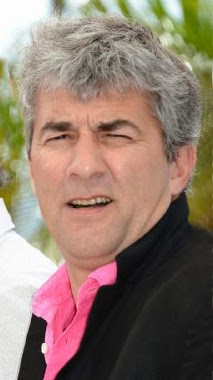
This remarkable follow-up by Alain Guiraudie (shown at left) to his also remarkable The King of Escape (click and scroll down) -- is one hot movie. It's also very cool. Might as well tell you upfront that this habits-of-homosexuals film offers a few short hardcore moments. So if you object to gay-themed movies or full-frontal passion on either moral grounds or (for you fellows) any unseemly comparison with your own limited cock size, by all means avoid this film. (According to one of the Findings pages in Harper's magazine, the French are said to possess Europe's largest penises.)

In any case, the movie takes place in and around a gay cruising area by a lake (below) in a relatively remote section of French countryside where men meet for some sunbathing, sex and conversation. Then, on an early evening in which light is still visible -- suddenly, surreptitiously -- one man kills another.

Why? What does this mean, other than murder? And why does not the fellow who has seen all this from afar, hidden from both victim and killer, alert the inspector who's investigating the crime? Well, he's got a lech for the perp and perhaps something more. A death wish? Hard to say, exactly. But something's going on.... That perp (the mysterious and handsome Christophe Paou, at left, below) is a hunk of major proportions and, as it turns out, a very versatile, talented and willing sexual partner, too.

As hot as the sex is here, the friendship that grows between our "hero" (acted with an almost perfect blend of decency, horniness and self-effacement by Pierre Deladonchamps, shown at right, above and below, and four photos up, in the water), and a heavy-set fellow (beautifully played by Patrick d'Assumçao, below, left) with whom he has increasingly interesting conversations, is every bit as riveting as that sex and twice as endearing.

Slow-moving yet without a wasted frame, Stranger by the Lake accrues near-monumental suspense and discomfort as it plays out. The final moments at nightfall -- as the barely visible skin over the beautiful collarbones of one of our characters fades into black -- are among film history's most memorably fraught and ambivalent.

This exquisite movie (a major winner at Cannes) is made all the more so by its transgressive visuals and theme. It should at the very least see success on the art film circuit, and gain interest and a possible release for Guiraudie's earlier odd charmer, that King of Escape.

If you don't catch either of the festival's two screenings (Monday, September 30, at 9:15pm in Alice Tully Hall or Wednesday, October 2, at 1pm in the Francesca Beale Theater), the film has been picked up for U.S. theatrical distribution by Strand Releasing.

Monday, September 23, 2013

The Jean-Jacques Annaud and Menno Meyjes DAY OF THE FALCON proves flight-worthy

The original title -- Black Gold -- of the film under consideration here has been used at least eight times already, even as recently as 2011. So, given the cliché factor and the addition of over-use, the change to something else was a smart move, even if the resulting DAY OF THE FALCON doesn't exactly set one's heart to racing. "Black gold," of course, refers to oil, as is the case in a half-dozen of these films, though in one of them it means coffee, while another creatively combines oil with a horse.

First seen in 2011, the film made its VOD debut in the USA this past February and had a slight theatrical release the following month. Now, here it is on Netflix streaming and worth seeing for a number of reasons, beginning with its director, Jean-Jacques Annaud (shown at right), a man who has given us over the past 37 years not that many but mostly good movies, and who knows his way around intelligent, exotic (to those of us in the west) spectacles like the Oscar-winning Black and White in Color, Quest for Fire, The Name of the Rose and Enemy at the Gates, to name but four of his dozen films.

This new one -- set in Arabia at the beginning of the 20th Century and adapted by Annaud and his oft-time collaborator Alain Godard (from the novel Arab by Hans Ruesch) with a decent screenplay in English by Menno Meyjes -- tells the tale of two Arab tribal heads who, rather than fighting over a large plot of desert land, agree to keep it between them as a kind of unused no-man's-land, with the additional obligation that the Sultan (played by Mark Strong, above) will turn over his two sons to the Emir (Antonio Banderas, below) to be raised along with the Emir's own son and daughter.

How this is exactly "fair" (what does the Emir give in return?) escaped me, but if you can accept this beginning, the rest of the film unfurls pretty seamlessly, with -- once oil is discovered (below) in this no man's land -- plenty of spectacle, battles, thrills, suspense, surprises (my favorite is how one finds fresh drinking water in the ocean!), along with enough intelligence to make the themes and events shown from a century ago quite timely and thought-provoking for today's world.

First off, who is the villain and who the hero? Both "kings" are shown to be bright but hypocritical in a number of ways. In the movie's depiction of Islam and tradition, we see conventional wisdom and forward thinking both come a-cropper at various times.

The most important plot thread is the growth and change of the Sultan's younger son (another fine performance by A Prophet's Tahar Rahim, at left), who goes from a bookish, eye-glassed librarian to a powerful warrior chief in such a way that you thoroughly believe the entire process. Along the way, he must marry the Emir's daughter (the lovely Freida Pinto, below), whom he indeed loves, and find a way to live with and show decency and honor to those who have betray-ed him and his family. How and why this hap-pens makes for a more intelligent spectacle that you might expect.

We also get interesting views of Islam as a thing that both holds humanity back and offers it a code for living. "God hates what we do to each other in his name," a character notes along the way. And there's a particular death scene mid-movie that uses the religion's tenants in a manner that nearly brought tears to the eyes of this particular atheist.

Above all this, even, what I found most interesting in the movie is its use of oil as the agent for change, and how it affects all concerned. There's a lot of truth here, and most of it is unfortunate. Notes the Sultan, toward the close of events, "When the foreigners (yes, you can read America in this) finally leave, we will not recognize ourselves."

In the supporting cast are good turns from the talented Riz Ahmed and a gorgeous, charismatic actress named Liya Kebede. All in all, the movie proves that there is still a good deal of life, not to mention intelligence, left in some of those Arabian desert spectacles. Regarding that oil, you may leave the movie, wishing as I did, If only... 


A co-production of France, Italy, Qatar and Tunisia, Day of the Falcon is available now via Netflix streaming, on DVD, and elsewhere, as well.

Sunday, September 22, 2013

An original--and an odd one--Bob Byington's family saga SOMEBODY UP THERE LIKES ME

Bob Byington is a name (and a movie-maker) new to me, but I'm awfully glad I stumbled onto his SOMEBODY UP THERE LIKES ME, for it is as odd a film as I've watched in some time. I missed its theatrical opening earlier this year, but its sudden appearance on Netflix's streaming facility this week led me to give it an immediate shot. It took awhile to get with the program, considering that most of the characters (especially the lead, Max, played by Keith Poulson) are not very likable. Stick with it, however, because it gets a whole lot better as it goes along. Even if you can't quite put your finger on the filmmaker's point, by the end of the film, I think you'll feel that your time was well spent.

The very confusion you're likely to feel here -- Why do some characters age, while others do not? Why does everyone seem to take life so cavalierly, almost non-seriously? -- adds to the movie's bizarre-but-impactful quality. Mr. Byington, shown at left, has given us a four-generation family saga, all packed into a mere 76 minutes. Love, death, career, betrayal and more happen over five-year intervals, and things that would normally shake us to our bones, occur so fast and in such a routine manner that our reactions here would seem to call into question the reactions we experience in more "normal" movies.

It's our hero, Max, who is anything but heroic (that's Mr. Poulson, above), whose failure to age takes on immense proportions. Is this because he also does not in the least mature? Perhaps. His son, does, however, going from infant to toddler to youngster to teen to adult, even as others grow and die. (The movie spans some 35 years.) That's the son, as an adult (played quite interestingly by Jonathan Togo), below, right, shown with Max's grandson.

The film begins as Max catches his wife (Kate Lyn Sheil) in flagrante delicto. Soon he is married again to the lovely Lyla who has a penchant for breadsticks (played by Jess Weixler, below, right) yet he is not an ounce happier, more intelligent nor curious than before.

His best friend Sal (Nick Offerman, below), along with Max and Lyla, all work at the same steak house restaurant -- this place sort of holds the movie together -- which rather defines "career" so far as the film is concerned (one venue or idea is as good as another).

Stylistically, the writer/director coaxes good performances out of his cast -- all the actors manage to inhabit the same bizarre page -- and his use of simple, colorful animation (below) to thread the scenes together proves charming and full of vibrant color.

There's a magic suitcase (symbolic of...?), a nanny who doubles as sexual partner, a best friend who doubles as a sexual betrayer, and a therapist who sings (a crackerjack job from Megan Mullally, below, right). All of this goes by in the snap of the fingers, and if its meaning eludes, its strangeness more than makes up for this -- as though Mr. Byington is on to something very important, but has decided, with the kind of perversity the movie loves, to hold it just slightly out of our reach.

Somebody Up There Likes Me (not to be confused with the Paul Newman movie from the mid-1950s), the title of which has got to be viewed super-ironically -- as, I suppose, is this entire movie -- can be seen now via Netflix streaming, on DVD and elsewhere, I imagine.

Saturday, September 21, 2013

The results of secrecy, private and public, haunt Carl Colby's family tale, THE MAN NOBODY KNEW

Who says being too close to a subject robs you of perspective and objectivity? The subject of Carl Colby's documentary, THE MAN NOBODY KNEW: IN SEARCH OF MY FATHER, CIA SPYMASTER WILLIAM COLBY, is indeed his own father. And yet it is difficult to imagine any movie getting closer to that strange and distant man nor seeing him any more honestly and fully than his son has done here. So, yes: What we see is nothing like idolatry. Nor is it any kind of Daddy Dearest expose. Instead, it's a direct, thoughtful blend of family, politics, career, history -- and mystery. And it is almost entirely riveting.

The documentary is Mr. Colby's third (the filmmaker is pictured at left), so he's had some training. Still, this is quite an undertaking: trying to capture someone who just might be the most "distant" dad ever experienced, ever absentee, while still being in the same room with his family. At the end of this quietly shocking doc, the viewer is likely to expel a long-held breath and murmur, "Thank god for mom."

William Colby (shown below) was, from all accounts, a highly religious man and a devout Catholic -- but one who evidently could only see a stern and unloving god. This religious bent runs through everything from family to politics and spying, and what happens to Colby and our country under our then Republican leaders' reign is the kind of thing that will make you further understand why we need Wikileaks, together with all the Mannings and the Snowdens yet to come.

Colby and his family, shown below, had in some ways an idyllic early life of travel, entitlement and sophistication. Colby fils lets us see this at the same time as we begin to understand the various lacks under the smooth surface. This seems especially true for mother Barbara (standing, center left, below), who is finally left holding the proverbial bag.

As for the politics involved, we learn of everything from Colby's role in swaying elections against the Communist Party in Italy to the hugely controversial Phoenix Program in Vietnam.

The film is full of surprises, small and large, especially for those of us who, even if we followed the history back then, could not have know nearly all that was going on. While the movie may seem like a kind of model documentary, it is also true that few filmmakers have had anyone this "juicy" and handily accessible (well, in an inaccessible way) as the subject for their film.

The younger Colby has made the very most of this, I think, giving us in the process a portrait of a man, a family, a country and an era that are sad, shadowy and strange. (And we fools thought we knew what was going on at the time!)  The Man Nobody Knew, from First Run Features, opened theatrically two years ago this month, and though well-reviewed, disappeared rather quickly. Now that it's here on Netflix streaming, you've no excuse not to see it. (Note: Colby's movie also makes a fine double feature with Robert De Niro's directorial effort The Good Shepherd. Both films deal with similar themes -- one in documentary style, the other fictional.)

Friday, September 20, 2013

Matthew Mishory's mythologizing visual treat, A PORTRAIT OF JAMES DEAN: Joshua Tree, 1951

Myth-making's a funny thing. If you're not careful (or brave enough to go whole hog), it can turn around and bite you in the ass. Matthew Mishory's visual-treat-cum-mythmaking-attempt, A PORTRAIT OF JAMES DEAN: Joshua Tree, 1951, occasionally takes a nip or two, but I'd say that, for the most part, Mr. Mishory's tush remains unscathed. Not that this is an entirely successful film. For all its concern with what's real, honest and profound, it remains resolutely on the surface. Fortunately that surface is awfully nice to view.

This is Mr. Mishory's first full-length film (the filmmaker is shown at right), and he and his crew have gone all-out down the "period visuals" route. The look of the early 1950s is captured quite beautifully, and the (mostly) male and (some) female bodies on view appear true to that age. The young men are not overly buffed or muscular, and the women have more meat on their bones that you might see these days. (Who'd heard of anorexia back then?) The clothes, the cars, the hair styles, the home decor -- both low-end and high -- seem to me quite accurate. Of course, I was but a ten-year-old movie fan living in Los Angeles at that time; still, those memories linger, and the film does them justice.
It particularly does justice to our imagined/cinematic/nostalgic view of Hollywood and its environs circa the early 50s.

The filmmaker has chosen to shoot almost all of his movie in black-and-white, and his cinematographer, Michael Marius Pessah, has done an ace job of it. The darks and lights; the shades of grey; the rich, almost blacks will make most cinephiles' mouths water.

Mishory has assembled a good-looking cast and has coiffed and clothed them up to look quite "period." In the pivotal role of Mr. Dean, he has cast a actor -- James Preston, above and below -- whose face does indeed resemble the late actor in enough ways to make the movie work. And he's drawn a decent performance from Preston, too, in which the actor "holds back" in the same way Dean did, thus making himself interesting on a cinematic level and more desirable on a personal one. (Anthony Perkins had this same quality, early in his career; Ryan Gosling has a little of it, which he is quickly losing: too much Nicolas Winding Refn? Probably.)

The remainder of the cast is also well-chosen, visually, especially that "roommate" of Dean's (played, with a hesitancy that is quite moving, by Dan Glenn, below), who is never identified with a name, but is clearly here seen as one of the important friends and loves of Dean's short life.

Also looking good are Dalilah Rain (below) as Violet, the smart, no-nonsense woman in Dean's life; Edward Singletary as Roger (at right in the second photo below), the "agent" who helps start Dean's career; Robert Gant (third photo below), billed as "the famous director" who arranges for Dean to go to New York to study and gain his Broadway sea legs; and especially David Pevsner  from last year's Scrooge & Marley, as Dean's highly watchable acting teacher.

As good as Mr. Pevsner is, his character, in fact, is one of the problems of the film and most clearly shows up the depth that's missing here. In his acting class, he has a young woman do an exercise about waiting in a train station. She first does it poorly -- overacting to beat the band. But then, after a bit of "coaching" she does it utterly boringly but is perceived by the class to have done it brilliantly. This is so we'll know that the "actor" must concentrate hard in order to convince us of the "truth." To which I say, Pshaw! This is just silly. Good acting requires more than concentration.

Mishory's screenplay never gets beyond telling us and its characters what we and they must think and feel. He hasn't yet learned how to plant his themes within organic scenes that grow and live. His screenplay isn't awful by any means, and his dialog is decent, if surface. It's best in the scene on the beach (and later in an apartment) in which Dean picks up a young man who lives nearby and goes home to talk and fuck.

I also question the filmmaker's use of color in the movie -- seen only in tiny moments initially, and then in a longer dose toward the end. This is simply unnecessary. It's adds little while distracting a lot. Finally, if this is not the definitive James Dean portrait, it's at least a nice addition to the continued mythologization of one of the most iconic actors who ever, and all-too-briefly, traveled the Hollywood route.

A Portrait of James Dean: Joshua Tree, 1951 -- from Wolfe Video -- is available now via Netflix streaming & elsewhere.