Saturday, February 22, 2014

A short set in Morocco by way of Canada: Najat Jellab's classy/condensed THE PROJECTIONIST


TrustMovies doesn't usually cover short films (there are so many full-length features he can't even begin to get around to), but an email from Najat Jellab, the French-Canadian producer/director and co-writer (with Rachid Zaki) of THE PROJECTIONIST -- a 20-minute movie currently hitting the American and international festival circuits (it has already the Best Short prize at the 2013 Harlem International Film Festival) -- made him interested enough to want to view it. Set in a Morocco at once so ancient and so modern (the language that comes out of a certain woman's mouth!), the film introduces us to a couple of subsidiary characters first, before giving us a look at our hero -- the projectionist of the title -- and maybe our heroine. There's a beautifully animated credit sequence on view, too.

Ms Jellab, shown at right, has made a lovely little piece, the major trouble with which is: once it's over, you'll want more. That was my feeling, at least, but also the first thought out of the mouth of the Moroccan woman (also named Najat) who takes care of my spouse's mom on weekends and to whom I showed this film. "I wish it were longer," she immediately noted, once the end credits had rolled. Jellab's film is so full of movie love (and pain) -- from Liz Taylor to a fantasy of remembered movie moments -- that it's easy to see why festivals and their audiences would embrace it so thorough-ly. It is also beautifully photographed and edited, with exceptional sound design.

The look we get at Morocco today is both interesting and surprising -- at least to a westerner like me. I found the young woman (played by Fadwa Taleb, above, center) who sets up her performance troupe in the square to be really quite something: as ballsy as she is beautiful. If she is at all reflective of Morocco these days (and not just a fantasy of what an empowered woman there might be), then I am further impressed.

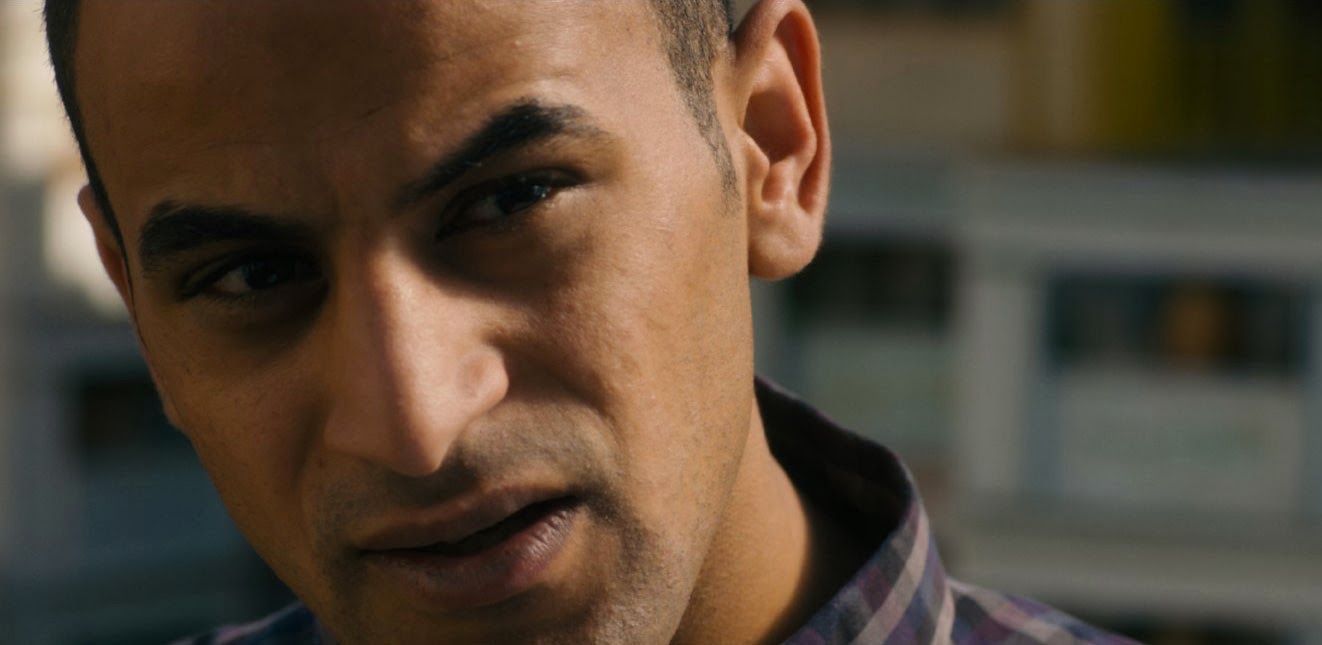
Our hero, whom we see as a grown young man (above) and as a boy (below) getting his tantalizing taste of cinema, is nicely played as an adult by Aniss Elkohen with a kind of sad reticence. The landlord of the apartment house (Abdellah Ferkous) in which our projectionist lives is a funny, charming character, while the theater owner Youssef Ait Mansour) -- who must, thanks to the economy, close his old movie palace -- is a sad one.  The film's themes take in everything from movies to the economy, gentrification, piracy, and somehow "making do."

Jellab gets good performances from her actors -- all of them -- who pull us into their characters and situations so that we maintain interest and want to know more. But there is no more. That's my only quibble, but it's one that arises with many of the short films I see. They work as calling cards for the filmmakers but leave the audience in a kind of limbo. Will Ms Jellab take her story on to full-length proportions or move to another subject entirely? We shall see. In either case, I'll look forward to the result.

Where can you view The Projectionist?  Currently, it's being shown at three film festivals:
The Richmond International Film Festival:  this coming Thursday, Feb. 27th, at 8:45 pm at the Byrd Theater, 2908 W Cary St Richmond, VA.
Rendez-vous du cinema quĂ©becois: Saturday, March 1st, at 5:15 pm at the Cinematheque Quebecoise 335, De Maisonneuve Blvd East MontrĂ©al, Quebec.
Luxor African Film Festival in Egypt, March 16-24, 2014. When we get more details on the date and time of the screening, we'll post that information here.

Friday, February 21, 2014

Andrew Fleming's BAREFOOT: The real movie for Valentine's Day is opening one week late....


I'm a sucker for an Andrew Fleming film. From the ahead-of-its-time bisexual movie Threesome, through his witchy The Craft to that sweet and loony deep-throat political satire Dick to the under-rated Nancy Drew and the marvelously crazy Hamlet 2, the work of this director and sometimes writer is distinguished by its sweetness, smarts, invention and honesty, no matter how crazy things get. (The only Fleming film TrustMovies didn't much care for was his remake of The In-Laws). Now comes perhaps his first honest-to-goodness attempt at a by-the-book "romance" featuring a hero and heroine up against odds that would make lesser characters quake (and many directors and screenwriters run for the hills).

From the outset, BAREFOOT, which Mr. Fleming (shown at left) has directed from a screenplay by first-timer Steven Zotnowski, is probably as unbelie-vable a premise as you're going to find on screen these days (ex-cept perhaps Winter's Tale), in which the elder son of a wealthy New Orleans family, owing major money to gang-sters and in trouble with just about everyone else, while working off his probation doing maintenance in a mental hospital, has one of those mutual love-at-first-sight moments with a new patient who's just checking in. Well, whatcha gonna do?

What Fleming & Zotnowski do is plot this cleverly and then play it for all it's worth. Fortunately they have a very good cast lined up to bring their love story to life, starting with a luminous Evan Rachel Wood (above) as a girl raised in isolation by a crazy mother and Scott Speedman (below) as the bad boy with a heart of gold (and the visage to match).

As my spouse said, just post-viewing, "This one was thoroughly paint-by-numbers -- but still very enjoyable."  That's almost true, except that, as usual with Fleming, the numbers he's using to paint by are quirky enough to -- at least for the time that the film is flowing by -- make you believe that such things as we see might actually be possible.

Speedman and Wood are always moment-to-moment real, and they know how to command the screen via both beauty and genuineness. Their chemistry together -- his strength against her vulnerability -- makes this charming little movie consistently percolate, finally bringing the sweet wish-fulfillment fantasy home. And Fleming knows how to move his film along, with smart, tight editing and pacing that keeps things flowing.

Add to this a supporting cast of fine actors, particularly  J.K. Simmons (as the doctor in charge) and Kate Burton and Treat Williams as Speedman's parents. Actually, every actor with a line to read or a visual moment comes through just fine. But the movie belongs, and rightly so, to its two would-be lovers.

The film whisks us off from Los Angeles to New Orleans and then gives us a road trip/occasional car chase back to square one. Along the way every small character who pops up adds to the sweetness and fun, and by the time the film is finished, you'll be, just as the filmmakers want you, in romance heaven.

Barefoot (the title refers to a quirk of the leading character) -- from Roadside Attractions and running 89 minutes -- opens this Friday, February 21 (though it should have opened one week earlier, as it would have made the perfect fit for Valentine's Day) in Los Angeles at the Laemmle Music Hall 3 and in New York City at the Quad Cinema.

Thursday, February 20, 2014

Kurdistan comes to NYC's Quad Cinema, as two Jano Rosebiani movies open: CHAPLIN OF THE MOUNTAINS and ONE CANDLE TWO CANDLES


According to Wikipedia, contemporary use of the word "Kurdistan" (of which there is no official "country," though the term can mean a particular region of Iraq) refers to large parts of eastern Turkey (Turkish Kurdistan), northern Iraq (Iraqi Kurdistan), northwestern Iran (Iranian Kurdistan) and northeastern Syria (Western Kurdistan) all of which are inhabited mainly by Kurds. These days, some 25 years after the awful al-Anfal genocide waged by Saddam Hussein, it's easy for younger people (and older ones happy to forget history) to imagine that Kuridstan somehow is its own special country -- which it might, one can hope, someday become.

Even here in New York City, considered one of the cosmopolitan capitals of the world, we see few Kurdish films. So this double debut of movies by Kurdish filmmaker Jano Rosebiani is a welcome treat. Rosebiani is from Iraq Kurdistan, and though he seems to have spent a good deal of his life here in the USA, his movies hark back to his home country. CHAPLIN OF THE MOUNTAINS, an odd kind of sweet/sour road-trip about American documentary filmmakers showing Charlie Chaplin films in the mountain towns, as two lovely ladies tag along, even deals with the results of the al-Anfal genocide, while ONE CANDLE TWO CANDLES proves a comedy, if a somewhat dark one, about marriage and equality in present-day Kurdish culture.

The first thing you may notice about both films is how beautiful each is, scenery-wise. This mountainous area of Iraq Kurdistan, being industry-free, has no pollution and so, film-wise, the colors register strong, bright and true. On the basis of these two films, the work of Mr. Rosebiani, shown at left, seem to possess a nice combination of Hollywood storytelling ability and indigenous, low-key reality and charm.

In One Candle Two Candles he offers a kind of present-day "take" on a folk tale that includes an entire little town beginning with a goat-herd who dearly would love to own a pair of shoes and a pretty young girl (above, left) whose father is forcing her into marriage to a rich old man.

There's also a kid whose dad owns a local restaurant where very fresh fish are tastily prepared; a woman famous for castrating her husband who now seems always on the lookout for new meat; a hunky young artist just come to town (above); a sweet but feeble-minded man who longs to marry, and a dwarf who loves to expose himself and dance; and that aforementioned shoeless shepherd (below, after the "miracle").
Yes, this is quite crew.

Rosebiani sets the comic tone pretty well and keeps it going nicely throughout, though for us westerners, drawing laughs from the situation of a rich and entitled old man who'd rather burn his would-be bride to death rather than lose her to a more appropriate younger man simply underscores the horrors of Muslim culture, tradition and religion as evidently practiced here. "Would anybody blame me if I killed you?" hubby asks his bride.

Clearly, the answer, on one level, is meant to be a resounding no. Fundamentalist religion per se is mostly kept on the outskirts of both these films, yet its hammerlock on the culture is felt all the same.

On the other hand, that culture, as shown in the "Candles" movie, does seem to have some tolerance for "the Other," at least as viewed in the handling of the castrator, the feeble-minded and the exhibitionist dwarf (above). Who is kept in prison -- and for how long -- is one of the movie's funnier running jokes. Nary a homosexual shows his or her face, however; some "others" are clearly better than other "others." For the skinny on Muslim/Islamic hypocrisy on this matter, turn to George Gittoes' excellent Miscreants of Taliwood.

Chaplin of the Mountains has more of a documentary feel (Rosebiani has been involved in a few films in this genre, too) as his two young film-makers travel the mountain roads, stopping in various villages to screen Chaplin movies for the assembled crowds. There always seems to be an interruption, however: a herd of goats, or the screening at a wedding in which one of the mothers insists on more dancing rather than a movie.

Along the way, bits of several different Chaplin films are shown, the background and character of the young Parisian woman (above, second from left) who tags along is unveiled, as well as the needs and confusion of another beautiful young woman, a journalist (above, second from right), who also accompanies the two male filmmakers.

We get a philosophical discussion of love versus marriage; feminism ("In this country, you say hello, and they think you want to have their baby"); and finally we realize that, as well as road movie, we're also on a "quest" that offers some suspense and excitement. When we finally reach our title character, it turns out that the actor chosen (shown bottom, left) is way too young to be playing a great-grandpa.

As Rosebiani wrote, directed and edited both films, he's the man to praise or blame for the results. Mostly, I am happy to say, it's the former. The movies are lovely to look at, enjoyable to steep yourself in, and you'll come out the other side most likely with a better (or at least some) understanding of Kurdish culture.

From Evini Films, Chaplin of the Mountains (running 91 minutes) and One Candle Two Candles (running 105 minutes) open tomorrow, Friday, February 21, at the Quad Cinema in New York City. The filmmaker will be present for a Q&A on Friday and Saturday following the 7:10 show of "Candle"; Jano with also appear with his star Estelle Bajou (above, right) on Saturday after the 9:30 showing and on Sunday after the 5:00 showing of Chaplin of the Mountains.

Wednesday, February 19, 2014

Best Foreign Language Film nominee, OMAR from Hany Abu-Assad, opens in New York and L.A.


Last time we heard from Palestinian film-maker Hany Abu-Assad, it was heralding his fine Golden Globe-winning and Oscar-nominated movie Paradise Now from 2005. He's back this year with yet another Oscar nod for his newest film OMAR, which has also been nominated for and won some prestigious awards. If it does not quite come up to the level of his earlier film, it is still very good and very much worth view-ing, as it demonstrates the culpability of both today's Israel in keeping Palestinians enchained, and the youth of Palestine's insistence on overthrowing Israeli rule by any means necessary.

Interestingly enough, you can side with whichever group you choose and probably still find that this film works for you. It isn't so much that Mr. Abu-Assad (shown at left) is being completely even-handed. No. All the Israelis shown here range from disgusting downwards, yet the Palestinians we see seem to exist in a culture so thoroughly secretive and backward that as much as we might like to root for the film's would-be lovers, the titular Omar and his Nadia, their characters and actions, not to mention those of their peers, keep getting in the way. The filmmaker, who both wrote and directed Omar, has first and foremost concocted a love story, which he then fills with all the elements of a mys-tery thriller. The movie does not jump genres; it consistently exists as a kind of blending of them. I think Hitchcock might have been proud of this one. Even if it offers little of the master's command of visual technique, it offers a plethora of surprising plot machinations and manipulations.

Through it all, what holds the film together is the performance of its star, the titular Omar, played with a riveting combo of heartache and strength by Adam Bakri (above). His lady love, not yet out of school and also the sister of his childhood friend, is played with girlish wonder and perhaps a hint of possible perfidy, by Leem Lubany (below).

Abu-Assad uses simplicity and naivete, together with the charm and beauty of his two young actors, to help us initially believe in this love story. I wish he might have deepened the couple's relationship a bit more; as it is, he manages to pull us in.

Around these two sweethearts orbit her brother Tarek (Iyad Hoorani, above) and their mutual friend Amjad  (Samer Bisharat, below, left), who has his own romantic interest in Nadia.

Once the terrorism/liberation plot is put in motion, we finally meet the Israeli agent named Rami (Waleed Zuaiter, below), who initially presents a kindlier face of Israel.  Who is using who and to what end is a question the movie asks over and over.

After betrayals, expected and not, we finally learn the answer and -- once our shock has subsided -- cynicism kicks in big-time. The ending is as satisfying as possible under these circumstances.

Unlike the excellent Israel/Palestine film, Mars at Sunrise (released a couple of weeks back) and more like last year's dark and probing The Attack, this one offers little in the way of hope. In fact, its nomination as Best Foreign Language Film may surprise you, but it is, as usual, unlikely to win. Just as nominees over the past decade, Ajami and Paradise Now, failed to bring home the Oscar, so I predict, will Omar. Right now, it appears to be all that the Academy can do is to honor Palestine with a nomination now and then.

Meanwhile, Omar -- released here via Adopt Films and running just 96 minutes -- opens this Friday, February 21, in Los Angeles at Laemmle's Royal, Playhouse 7, Town Center 5 and Claremont 5, and in New York City at the Angelika Film Center and the Lincoln Plaza Cinema. In the weeks to come the film will open across the country. To view all currently playdates, cities and theaters, click here and then click on View Theaters & Showtimes.

Tuesday, February 18, 2014

Horror returns home in Joe Begos' super-low-budget trifle, ALMOST HUMAN


Rhode Island stands in for Maine, not that most viewers will care or notice, in ALMOST HUMAN, the new horror/slasher/sci-fi debut of filmmaker Joe Begos, who has here concocted yet another variation on Invasion of the Body Snatchers that, of course, cannot begin to top the calm creepiness of Don Siegel's brilliant original. As both writer and director, Mr. Begos -- shown two photos below and looking barely out of middle school -- seems more interested in using what little special effects budget he had toward bright blue lights, loud
sound effects and visual electricity outages, as we see one character, a fellow named Mark (rotund actor Josh Ethier, who looks as if he might do comedy rather well), swept up into the sky in the middle of all that cacophony and icy blue shine.

Suddenly it's something like two years later, and one day a couple of hunters in the woods come upon Mark's naked body, encrusted in a kind of gelatinous goo (and the most interesting of all the various special effects we'll see in this movie). Mark has returned, it seems, except he is not quite himself, quickly and gorily dispatching those hunters and then anyone else he comes upon during his journey back home. Yes, Mark is the title character here, as are some others whom he changes along his merry, bloody way.


Begos uses his special-effects money in this section toward all gore, all the time, which grows a little tired rather quickly. Toward the end of his barely-80-minute movie, however, he comes up with some more interesting semi-creature effects which, though we've seen their like elsewhere, at least provide a respite from the blood-letting.

In the meantime, characters such as our hero, Seth, played at max speed with eyes a-popping pretty constantly by Graham Skipper (above) and our heroine Jen, (Vanessa Leigh, below), try to outrun, outgun and outwit our new resident alien.

In addition to the gore, there's some real tension here, a little humor, and an occasional surprise, and one can indeed marvel at Begos' ability to put it all together relatively effectively. Still one questions some little things: Why does Seth need to possess ESP (this is totally irrelevant to anything else and is used only to ratchet up some fake suspense). And how do you "hurt" these new beings? (Mark is shot in the head, knifed and then gets an axe in his back to no avail, but a little later his hand gets hurt and suddenly he grows awfully weak.)

So Almost Human remains pretty much a been-there, done-that exercise that, one hopes, will lead to some more interesting films from Begos down the road apace. The movie, from IFC Midnight, was supposed to have opened theatrically this Friday, February 21, in New York City and Los Angeles at the very special little Arena Cinema.  Update: The film will indeed open at the Arena, as planned at the same time as it receives a VOD release -- but I've just been informed that Almost Human will not open in New York City until Wednesday, February 26, here at the IFC Center. So if this one sounds appealing to my New York readers, stick it on your list for next week.

Monday, February 17, 2014

DVDebut (and streaming soon, we hope): Pelin Esmer's WATCHTOWER from Film Movement


Watching present-day films from the country of Turkey is tricky. They seem to represent modern living to some extent, as experienced by those of us who live in the west, but then we get these whiffs (sometimes much more than that) of cultural craziness that makes the movies seem as though they are coming at us from a different century. (Or two. Or three.) Think for a moment about movies such as Bliss, The Edge of Heaven or When We Leave (a German film, yes, but more about Turkey than Germany), and you'll have an idea of what I mean: violence, honor killings and women as chattel, to name a few fairly typical themes.

Interestingly enough, Turkey's most successful "international arthouse" filmmaker, Nuri Bilge Ceylan, has smartly managed to sidestep this by concentrating more on the male than the female, while offering themes that would seem to make Turkey more western than eastern. Hence, I suspect, his full acceptance by our cultural gatekeepers.

WATCHTOWER, from the female writer/director Pelin Esmer, shown at left, is one of the better and more interesting examples of new Turkish cinema because it faces head-on the question of woman's place in Turkish society and finds it greatly wanting. Yet, due to the story Esmer tells and the manner in which she tells it, we see the situation a step removed from the full-frontal, in-your-face, honor-killing set-up of Bliss. Here, a young woman takes charge of her life in a way that would never be necessary in most of the western world but that seems perfectly understandable in Turkey.

The location of the film, too -- a mostly un-populated, mountainous region of the country and the tiny bus stop with a shop or two nearby that services the area -- works beautifully to clue us in on how any kind of behavior that does not fit into fundamentalist thinking must finally be relegated to outsider status. Only if people do not know about it can deviation from the norm be tolerated.

The two main characters here (they pretty much make up the entire movie) are both running from their former lives, while dealing with a ton of guilt. Nihat (Olgun Simsek, above) has come to the area to work at the titular watchtower at the top of the mountain as a guard against forest fires. Seher (Nilay Erdonmrez, below) has left university suddenly with no explanation and is now working on the bus line that arrives and departs from the tiny station.

Part of the movie's pull is that we have little idea from what these two are trying to escape. Slowly this is revealed to us, and not, fortunately by any lumpy exposition. We learn in degrees, and in a way that seems believable to the situation. Dialog is kept to a realistic minimum, and both performers do an excellent job.

Initially there is almost no connection between these two people. When real connection comes, after a few months, it is fast and shocking and eventually leads to a guarded rapproachement. Among the movie's highlights are a fraught scene between the girl and her mother, and another scene of a natural act often witnessed in films but never, I think, seen in a condition as shockingly "solo" as here.

From Film Movement and running 100 minutes, the Watchtower DVD hits the streets this Tuesday, February 18, and as with most Film Movement titles, will probably be available on Netflix streaming very soon.
Watch for it.