Wednesday, July 22, 2015

Christian Petzold's PHOENIX explores post-Holocaust love, identity, guilt and avarice


That old standard, "Speak Low," gets quite the workout in PHOENIX, a new film from German movie-maker Christian Petzold, who seems, with each addition to his oeuvre, to be journey-ing further and further back in time and history. His Yella and Jerichow were relatively modern-day tales; Barbara took us back to East Germany in the 1980s; now his new one reaches all the way to immediately post-Holocaust, as the few Jews left were returning to their former homes throughout Europe -- or heading for Palestine.

As is the case in all of Petzold's work I've seen -- the co-writer (with Harun Farocki) and director is shown at left -- the plot relies on a very interesting, and usually only partially believable twist, played for all it is worth. And with this filmmaker, that means it's worth at least a watch. Phoenix, in my estimation, proves his most fully satisfying work to date because it takes the several themes at hand -- the Holocaust, self-identity (with emphasis on those of both Judaism and feminism), physical appearance, loyalty and love -- and blends them into a surprisingly effective whole.

If Herr Petzold could be said to have a muse, it would be his lead actress in several films: Nina Hoss (above, right, below, left and poster, top), who is as fine here as she always is, maybe even better. Ms Hoss has the ability to convince us that reams of subtext, as well as an enormous and roiling past exists within her slight frame and beautiful, expressive face -- all of which is true in the case of her character, Nelly.

Nelly has just returned from a concentration camp, where she was left for dead from a gunshot wound to the skull. In addition to being resuscitated, she has also undergone a major face lift, hoping to get something like her original face but coming up with a visage that is similar but also different enough to be a tad confusing.

Her friend Lene (Nina Kunzendorf, above) is making arrangements for the two of them to leave for Palestine, but Nelly is not ready for that. She wants to find her husband, Johnny (Ronald Zehrfeld, below), a pianist who used to accompany her on the piano when she sang professionally.  Clearly still head-over-heels about the man, Nelly can't abide the idea, planted rather firmly by Lene, that her husband ratted her out as a Jew to the Gestapo so he could play the get-out-of-jail-free card.

The set-up is clear and the movie proceeds from that set-up, full speed ahead but with enough ambiguity and mixed signals to keep us -- and its characters -- on our toes. Nelly's identity is locked into her love for Johnny more strongly than anything that happened to her in the camp as a Jew (this fact riles Lene not a little).

And though Johnny appears pretty much as Lene paints him, so obsessive and enormous is Nelly's love for the guy that she has us wondering if, maybe hoping that, she could be right. The movie rises slowly to some excellent suspense, some striking visuals, and to a finale that is absolutely on the mark -- emotionally, psychologically and dramatically sound.

Performances are fine from all involved, and one of the pleasures of the movie is that, while providing suspense and entertainment, it never slights the importance of the Holocaust to history (and German history), and in fact offers up a few choice ideas about human behavior and our ability to all too easily forget and even forgive.

Phoenix, from Sundance Selects -- the title refers to a club in which cabaret and other post-war amenities (above) are offered and at which our Johnny has a job, as well as to that famed Firebird rising from the ashes -- opens this Friday, Just 24, in New York City at the IFC Center and the Lincoln Plaza Cinema. In the Los Angeles area, look for it at various Laemmle theaters beginning July 31.

Monday, July 20, 2015

Bill Morrison's short art work, BEYOND ZERO: 1914-1918, arrives on DVD from Icarus Films


I suspect that the strange and highly unusual work of artist Bill Morrison -- his films resemble nobody else's that I've ever seen -- is an acquired taste. The first film of his I recall viewing (Decasia, when it first hit video some years back) seemed so strange that I could only now and then connect to it. It was too much for me. Still, it stayed with me over time and in ways I didn't expect. It was his 2010 short film The Miners' Hymns that finally got me hooked. By the time his The Great Flood opened at NYC's IFC Center last year, I'd become a fan -- despite the hugely hypnotic quality embedded in his work that can sometimes have me drifting off to sleep.

Morrison, pictured at right, combines old decaying film stock with fairly ancient documentary footage, and then wraps around this both art and color, putting it all at last to splendid musical scores that move us most powerfully. His newest work to become available on video, BEYOND ZERO: 1914-1918, takes as its subject The 'Great' War, WWI, but as ever, Morrison's real subject goes far beyond this -- to time and decay and the human condition and, hell, a whole lot more. And he gives it to us in a style that is all his own: alternately moving, chilling, hypnotic and while sometimes confusing, always fascinating to view.

The images are seldom straight-forward. Here, using World War I footage, he overlays this with other images that force us to think -- maybe feel, too -- out of the box.

Repeat viewings, I should think, are almost required in order to get anything like full understanding and appreciation. With most motion pictures I would consider this a drawback, as the payoff is too paltry. Not with Morrison. Between the wonderful music (this time it's from Aleksandra Vrebalov and played by Kronos Quartet, shown above, as one of the visuals roll by) and the vivid, haunting images, there's plenty to ponder and digest.

Among the many jewels are two particular scenes I'll remember for a long while. In one, military men atop a tall building ready a canon to fire -- but where? Into their own city? Or are they the city's conquerors? Does it matter, given the decimation about to occur?

In the final episode, we become aware of a tiny parachute in the sky, slowly descending... to what fate? The music, first pulsating, pounding and then often dirge-like, here lifts into a kind of beauty that brought to my mind Benjamin Britten's War Requiem -- not in style but in achievement. And the visuals simply amaze and then haunt.

And yes, there were moments during the film's 40-minute running time that my eyes glazed over. But I suspect that when I watch this one again, it will be those moments that maybe stand out. As I say, concerning the work of Mr. Morrison, repeated viewings are required.

Beyond Zero: 1914-1918, from Icarus Films is available now on DVD.

Saturday, July 18, 2015

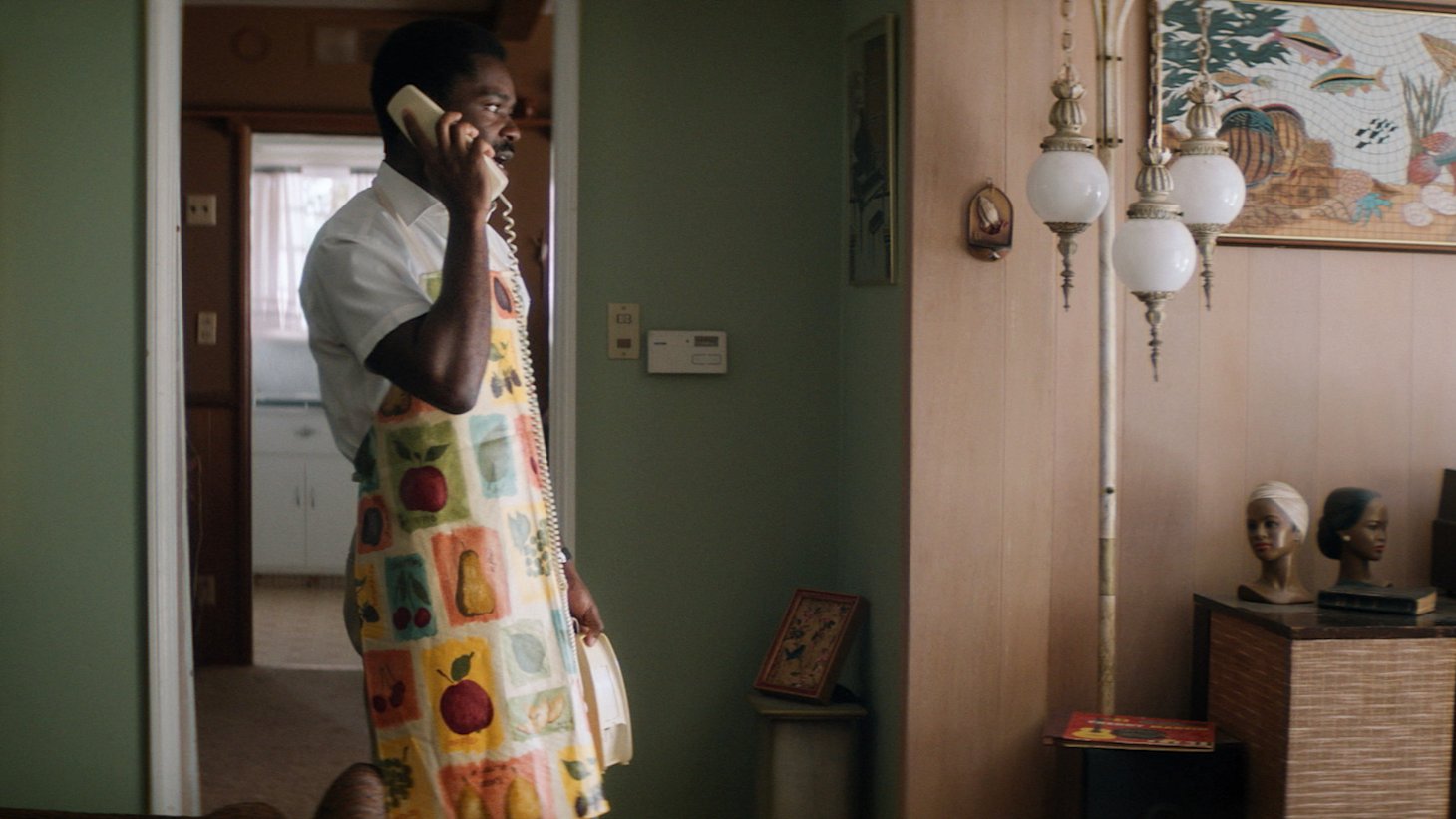
NIGHTINGALE: a new HBO movie starring David Oyelowo that's worth pondering


NIGHTINGALE too often bored me silly while I was in the midst of watching it. Soon after I finished however, it had me thinking seriously and darkly about the lives of Blacks here in America. Specifically those of Black men who are gay -- and what the closeted life they must lead, thanks far too often to their family and their Church, does to their sense of self-worth and their ability to gain autonomy.

Now, I should say that this movie -- made for HBO, directed by Elliott Lester (shown at left), written by newcomer Frederick Mensch and starring that crack actor David Oyelowo (above and below: recall his performances in the under-rated The Paperboy, the over-rated Selma and now Nightingale to understand just how versatile and charismatic he is) -- never once mentions the word "gay." It is possible, in fact, that the film's lead character cannot even admit to himself that there is anything homosexual going on here. What is going on proves both the strength and weakness of the film.

Mr. Oyelowo plays a fellow named Peter Snowden, a war vet (of perhaps the first Gulf War) who, when the movie begins, appears to be losing his grip on reality and has done something maybe rather bad to his invalid mother. As things progress, his grip weakens and loosens until he's pretty much the complete whack job we imagined at the beginning.

This arc is nothing new -- movies have been giving it to us ad infinitum for decades, from Repulsion backward and onwards. And this sort of thing is pure, irresis-tible catnip for actors, the kind of role that almost guarantees a nomination, if not an award. (Oyelowo will no doubt receive one or both at next year's Emmys.)

The problem is, the movie and its story grow more and more tiresome, as we wait for the other shoe (or in this case, pink slipper) to drop. Further, because this is virtually a one-man-show (like Locke, but nowhere near as inventive or well-done), there is just about nothing to watch here except the star, who gives it all he's got and then some -- as these roles do require.

Via many, many phone calls and the constant need to talk to himself (and the camera by which he is recording all this), we learn Peter's history and so can piece together his fracturing personality. He's got the hots for his best friend from the military, who is now married and clearly uninterested in -- even perhaps frightened about -- pursuing whatever relationship the pair once shared (if indeed they shared much of anything).

Because most everything that is going to happen is clear from scene one or two, the movie has nowhere to go. What makes it more interesting (after the fact) and very relevant is what we learn about Peter's history: how his mother rejected this "friend" of his, how religion played the most important part in her life, and how, together, all this conspired to produce a very sick young man.

None of the above is baldly stated, but all of it is there, embedded into the screenplay and performance. And this gives Nightingale added weight as thoughtful drama, even if the actual journey can be more than a tad tiring. Black Lives Matter, as the new saying goes -- even the gay ones -- which is something too much of the Black community has not yet learned.

You can see Nightingale via HBO now, and eventually, I'm sure, on DVD and a number of other digital venues, as well.

Wednesday, July 15, 2015

New treat from South Korea: Kim Seong-hun's clever, action-packed thriller, A HARD DAY


The continuing parade of Korean movies worth seeing hits a high-point of delight with the new actionful, alternately noirish and highly amusing thriller, A HARD DAY from writer/director Kim Seong-hun. All about the very difficult night, day and continuing span of time that our quite beleaguered hero, a police detective, is having -- the movie offers one thing after another going wildly wrong for this guy. When at last our hero cries, "Gimme a beak!" the phrase will seldom have sounded so plaintive -- nor funny.

This is because filmmaker Kim (shown at right) has found just about the perfect combination of tone and pace for this whirlwind of action, event, chase, and bizarrely unfurling plot that makes up the movie. Full of the kind of coincidence and convolution that keeps things cooking, the story gets better and bolder as it moves along. Coming in just under two hours (relatively short for a Korean film), Mr. Kim leaves his best stuff for the last, while ensuring that what precedes this is plenty good enough to keep us hooked.

His hero, played, with an increasing proclivity to appear unhinged. by a smart and unusually unassuming actor, Lee Sun-kyun (above), is most ably abetted by his co-star and nemesis, played by Cho Jin-woong (below). You could not ask for a better set of leading men than these two, whose crack performances compliment each other beautifully.

These two make up most of the movie all by themselves, with a good supporting cast of characters that includes wife, daughter and various police co-workers and bosses. But it's that delicious plot that hooks you and keeps you hanging on -- from the funeral scene, in which our hero's dead mom gets a bed-mate in her casket via a GI Joe toy, to foot and car chases filled with a rare combination of tension and delight.

Visually, the filmmaker does what he needs to but occasionally also tosses in a technically wondrous long shot to take our breath away. He also has fun with some Korean stereotypes: "Cops aren't gangsters!" notes our hero, with some anger. Really? Let's find out.

Mister Kim's movie is also full of little surprises and a lot of humor -- from a fortune teller's on-the-mark vision to the location of a missing key. And there's one scene in which you just know that a certain car is about to blow up, and the suspense keep building nicely. Then, hmmm... not quite.

The climax is a fine one -- except, there's more. And the rest is even better -- one of the most tactile, visceral, mano a mano combats yet seen, which is, at the same time, wonderfully clever and funny. If you don't yet know about the South Korean movie renaissance of the past decade or two, here's a good place to begin your education. If you're already a fan of this country's cinema, you'll be lining up for more.

A Hard Day -- from Kino Lorber, in Korean with English subtitles and running 112  minutes -- opens this Friday, July 17, in New York City at the Village East Cinema, with a limited national release to follow soon.

Monday, July 13, 2015

In his new narrative film, COURT, Chaitanya Tamhane explores India's idea of "justice"


The first shock of COURT -- the new Indian film that has its U.S. theatrical premiere this week at New York City's Film Forum -- comes from the riot of color that greets your eyes: rich, varied and beautiful. The we meet one of our main characters, an elderly teacher/performer/poet whom we first encounter in his teaching mode and then performing al fresco a poem about the times in which we live. This is India, but from the sound of things -- what our boy is railing against -- it might as well be right here in the good old US of A. Then the event occurs that sets the movie in motion, as police crack down on what is a remarkably peaceful, even dignified protest, arresting our performer in the process.

Though he finds some humor in the goings-on, the writer/director of Court, Chaitanya Tamhane (pictured at left), whose first full-length film this is, has given us less a satire, I think, than a sadly realistic look at what passes for justice in India today. From the police, who are clearly acting on orders from their superiors (though no higher-ups are named or shown, except perhaps by certain portraits hanging on the wall) to the chief prosecutor to the somewhat lazy and not-very-intelligent judge, it is clear from almost the first that this is a set up and railroaded job.

Yet none of this can be baldly stated -- by either the filmmaker or his besieged hero, the defense attorney (a fine performance by Vivek Gomber, above). Thanks most likely to the country's heritage of colonialism, decorum, along with way too many outdated laws from that British rule, must be preserved.

We learn a few of these laws along with decorum -- the judge (Pradeep Joshi, in background, below) refuses to hear one woman's case because she wears a sleeveless dress to court) -- via the public prosecutor (Geetanjali Kulkarni, above), whose main interest is getting this case over with and her career in higher gear.

The filmmaker takes us away from court as often as he lets us in: investigating the family of the man his client is accused of inducing-into-suicide (yes!) via his political rabble-rousing; into the family life of both the defense and prosecuting attorney; and finally allowing us to meet the wife of the dead man at the center of it all.

The scene in which our hero simply drives the widow and her children to their home speaks volumes about class differences in India. Mr.Tamhane and his cinematographer (Mrinal Desai) often use a stationary camera to capture their scenes, as characters move in and out of the frame very effectively.  (This also allows for the movie's most violent scene to take place -- charmingly and amusingly -- off-camera.)

The filmmaker's initial ending uses that stationary camera again to fine advantage, leaving us -- and Indian justice -- in darkness, while his actual finale offers a little too heavy-handedly a mash-up of a country in which tradition & modernity, magical thinking & science, raw youth & grizzled stupidity constantly lock horns.  And, as in so many of the world's so-called democracies today, power finds a way to stymie protest every time.

Court, from Zeitgeist Films -- in several different languages, including English, all with English subtitles -- and running a long but never boring 116 minutes, opens this Wednesday at NYC's Film Forum and next Friday in Chicago and Santa Fe. In the weeks and month to come, it will play another dozen cities throughout the country. For all currently scheduled playdates, cities and theaters, click here and scroll down.

Note: Geetanjali Kulkarni will appear in person 
at the 7pm show at Film Forum on opening night, 
Wednesday, July 15.

Friday, July 10, 2015

10.000 KM: Carlos Marques-Marcet's long-distance love story is hot, cool -- and real


Anyone who's ever been in, is now, or plans to undertake a long-distance love relationship will prove a shoo-in for viewing 10.000 KM, the new film from Spanish writer/director Carlos Marques-Marcet, his first full-length work. By turns sweet, funny, angry, sad (and a lot more in between), the movie should grab you from its opening shot -- of a couple cumming -- in which, while the sex is plenty hot and intimate, the talk that accompanies it proves even more so. These two lovebirds are fascinating to watch at work and at play.

Has Senor Marques-Marcet himself (the director is shown at right) been in this kind of relationship? Whether yes or no, the guy has captured the essence of it all, in particular the manner in which modern  technology allows us to appear to be "keeping in touch" while actually drifting farther apart and feeling additionally frustrated because we would seem to be so "close."  The director gives equal play to both his young man and young woman, doling out the good and not-so-good character-istics pretty equally and always deftly.

As the relationship grows (and maybe unravels), we peer into the themes of work and career vs relationship intimacy, as well as into male vs female needs and behavior. Humor and sadness bubble up in unlikely places -- trying to prepare a cooking recipe via Skype, dancing together while holding their laptops aloft -- and so do anger and hurt. As for sex, well, 10.000 KM proves rather definitively that in-person beats the hell out of digital every time.

The movie is a two-hander, something very difficult to maintain, and in recent seasons only the one-hander, Locke, has done this sort of thing any better. This is thanks to Marques-Marcet's skill and to the two actors he has used so well and who deliver performances that are about as real as you could wish. Who is the stronger character is a question that is raised as we move along, and the answer may surprise and unsettle you a bit. The actors chosen by the filmmaker also prove spectacularly well cast -- as sexy and real as each is talented and versatile.

David Verdaguer (above, right) -- those deep, dark eyes and lean, lithe body! -- proves as gorgeous and pliable as you could wish. Clothed or nude, he is always at his best, and the journey his character makes, in terms of both physical distance and emotions, is one that this actor brings to thrilling life.

Natalia Tena (above) is equally good -- visually and emotionally -- as a woman who works hard to understand her various roles and make them coalesce. Her explanation of how and why her man loves her is one of the highlights of the film. While her character's great strength is clear, so is her abiding need for both his kindness and his cock.

My only complaint is that the filmmaker has chosen to divide his movie in sections based on the days apart the couple has spent -- beginning with Day 2 and ending, if I am not mistaken, with Day 201. In between, we get days 16, 33, 40, 51, 71, 91, 93, 101, 106, 128, 132, 135, 141, 142, 155, 160, 162 and 171. I'm all for specificity, but this is overkill. Also, should we begin parsing the actual time between days -- hey, that early period was two weeks, but this last one spans more than three! -- we'll miss important moments having to do with the behavior on view.

Otherwise, 10.000 KM proves a model independent movie: genuine, thoughtful, amusing, moving and disturbing. If you're a fan of love stories, this may be the best you'll get this year (after the enchanting, adult fairy tale 5 to 7, of course).

From Broadgreen Pictures and running 99 minutes, the movie opens today, Friday, July 10, in New York City at the IFC Center, in Los Angeles at the Sundance Sunset Cinemas -- and will expand to other theaters around the country beginning next week.  For those of you not near NYC and L.A.,  the film hits VOD simultaneous to its theatrical debut today.