Tuesday, September 13, 2011

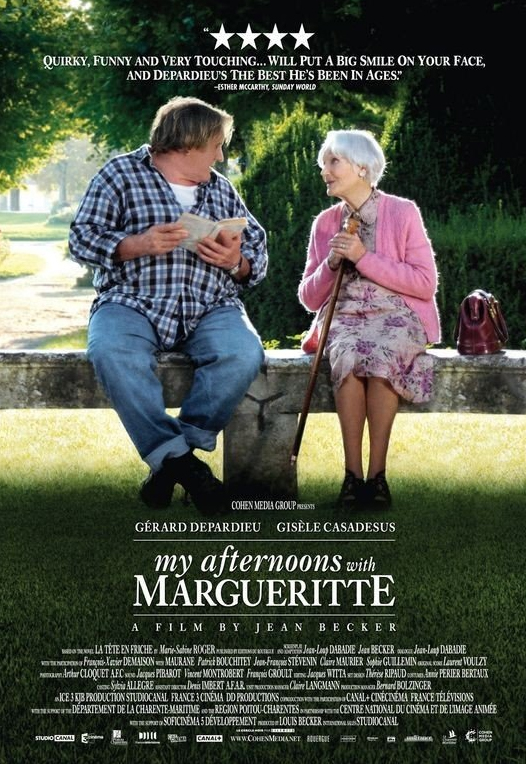
MY AFTERNOONS WITH MARGUERITTE: Becker's back with Depardieu & Casadesus


Becker's back, all right. That's Jean Becker, and I'll bet you've never heard of him. Or at least you heard of him so long ago (in 1983 his film One Deadly Summer won a bunch of Césars, including one for Isabelle Adjani as Best Actress) that by now you'd forgotten. TrustMovies hasn't, however, because Becker, shown below, also made one of TM's favorite films twelve years ago called Children of the Marshlands. I may be over-rating this star-studded nostalgic concoction, partly because, upon my first and only viewing, I was utterly blown away by the beauty and emotion of this sprawling, multi-generational look at French provincial life. (The film was never released here in the U.S., making its simultaneous debut and swan-song during the FSLC's Rendez-vous with French Cinema, 2000.)

Becker's latest, MY AFTERNOONS WITH MARGUERITTE (La tête en friche) is like a small, updated detail from Children of the Marshlands: 81 minutes, as opposed to 115, and taking place in modern times while still dealing, and beautifully, with French provincial life. One of its stars, the dear, wispy (you worry that she will blow away right in front of you) 97-year-old icon Gisèle Casadesus (shown below, and seen most recently as Mamé in Sarah's Key and Mme de Brog-lie in The Hedgehog), also had a plum role in "Marshlands."

Casadesus plays the supporting role in the new film, whose real star is Gérard Depardieu (below, right), he of the recent airplane urination, who, after viewing in this film, you may be tempted to claim has given his greatest role. He has not, by a long shot. Yet the fellow he plays here -- Germain Chazes: middle-aged, overweight, still sexy but nearly illiterate -- is so different from almost anything else the man has done, and he does the role superbly, that you are likely to be impressed all over again with the versatility and commitment of M. Depardieu.

Because My Afternoons with Margueritte (the double "t" in her name is intentional) is indeed a feel-good movie that will make you feel quite good, it will be easy for cynical audiences to pooh-pooh its very real worth. It offers us a slice of provincial life today in which characters bump up against each other angrily (while still loving and helping when possible), give in to typical prejudice (then try to rise above it), and are beset by a stinking economy that makes them have to choose between equally important concerns.

In addition, Depardieu's character Germain is beset from childhood (which we see in some beautifully created flashbacks: that's newcomer Florian Yven, above left, as the younger Germain) until the present with a mother from hell. This character (played very well in her salad days by Anne Le Guernec, and as an aging crone by Claire Maurier, below), as much as any holds the movie together and, for all its feel-good capacity, gives the film a continuing jolt of reality. When you're mom's against you, how good can life be?

The village life -- from the plaza in which Depardieu and Casadesus meet, to the bar and its "flies" below -- are brought to fine life by a cast who understands these characters, and a screenplay (by Becker and Jean-Loup Dabadie, from the book by Marie-Sabine Roger) that, however briefly, brings them to life.

The town bartender, played by Maurane (below) with a splendid combination of zest and sadness, adds to the talent on display. I wish I had the time and energy to talk about all the subsidiary characters, whom you'll  remember due to the actors' nailing their character so well, even in the brief screen time they are given.

One more word about Depardieu. His girth is just as great as it has been for some time now. In his mid-60s, the actor -- perhaps due to his fat layer wiping out his wrinkles -- looks maybe 45 to 50, max, and his relationship (even his love scenes) with lovely, young Sophie Guillermin (below, left) seem not just believable but somehow even appropriate. The guy is as sexy now as he was nearly 40 years ago. Go figure. And go see the movie, which offers foreign film fans a wealth of much-needed and appreciated humane pleasures.

My Afternoons with Margueritte, from Cohen Media Group, opens this Friday, September 16, in New York City exclusively at The Paris, and in Los Angeles at Laemmle's Royal -- with a limited, nationwide roll-out to follow in  the weeks to come.
Monday, September 12, 2011

Lorenz Knauer's JANE'S JOURNEY concen-trates on the work of one hell of a woman


We get some up-close-and-personal information about Jane Goodall -- the British primatologist and anthropologist considered to be the world's foremost expert on chimpan-zees -- in the new documentary about her that opens in New York this Friday and in Los Angeles, Friday next. But mainly what we see, hear and come to understand has much more to do with her work, early on with those chimps, and even more impor-tant, now, as she strives to save a dying planet and to bring us along with her on that mission.

Let's admit it right out: This film is hagiography of a sort. But when the folk around the subject at hand love and respect her as much as they clearly do, it's rather difficult not to present the woman as something special. Film-maker Lorenz Knauer (at left) and his crew have put together a nearly two-hour documentary about Ms Goodall that slips around the globe nearly as fast and often as the lady herself does it (she tells us at one point that she is rarely anywhere longer than three days at a time -- and this at age 77!). After a brief bit of early history, we learn of how she came to undertake, some fifty years ago, her pioneering study of wild chimpanzee behavior (below), and why her mentor Louis Leakey felt that a woman -- and a non-university-educated woman, at that -- would be best for this job.

The film begins as Goodall tells a very funny anecdote about Gorillas Get Me Pissed (oops, I got that title wrong) but in such a classy, gracious manner that you'll immediately be taken with the woman. And she holds you in this light, caring embrace throughout the film. We learn of her first and second marriages ("I chose two jealous men," she says) and the offspring of the first, nicknamed "Grubb," whom we eventually meet, along with his own offspring.

The scenes with the chimps, both the old and recent ones, are spectacular indeed, and the cinematography (above, by Richard Ladkani) and sound design are as good as anything we get from Hollywood blockbusters. The movie comes into its own after Ms Goodall goes to a particular seminar on chimps only to learn that in habitat after habitat, the animals are dying or being slaughtered. Overnight this seems to activate her "Activist" button, and since that time she has campaigned around the globe not only for safer animal habitats, but for the betterment of our planet and an end to its current destruction.

Of particular note is her work on American Indian reservations and her Root & Shoots program. We go from a fabulous and hidden "hippo pool" in Africa to the melting ice of Greenland; we hear celebs like Angelina Jolie and Pierce Brosnan talk about this untiring activist and her work. Best of all, we see this work in action and what it means. It will be almost impossible, I think, to come away from this film with anything less than supreme admiration for Ms Goodall and her work. The big question is, of course, how to wrest control of our planet from the individual and corporate wealth that currently controls and is destroying it -- so that Goodall's work can succeed and bear the kind of fruit that will count  Suggestions, anyone?

Jane's Journey, from First Run Features, opens this Friday, September 16, in New York City at the IFC Center, and on September 23 in Los Angeles at the Laemmle Monica 4.

All photos are from the film itself, except that of director Knauer, 
which comes courtesy of exposay.com 

Sunday, September 11, 2011

Special effects for art lovers: Majewski's THE MILL AND THE CROSS at Film Forum

TrustMovies (before there was a TrustMovies blog) once referred to filmmaker Lech Majewski as "one of the worst little-seen filmmakers in the world" and "pompous, pretentious and pedestrian." He came to that judgment having seen two of Majewski's movies -- The Garden of Earthly Delights and The Gospel According to Harry -- and posted reviews of same at Greencine (click the title links then scroll down to the reviews). Three years later, thanks to the combination of distributor Kino Lorber and the theatrical venue of Film Forum, he has just seen Majewski's latest opus, and -- what a difference!

Perhaps the biggest lesson TM has learned here is not to make quite such all-inclusive judg-ments until one has seen much more of a filmmaker's work. While he stands by his assess-ment of those two earlier films, he finds THE MILL AND THE CROSS, the latest work from this filmmaker, shown at right, something else entirely. Reminiscent at times of Peter Greenaway's Nightwatching and Rembrandt's J'Accuse, the film takes on an art masterwork, in this case Pieter Bruegel's The Way to Calvary, and builds an entire movie around it.  Majewski also, one suspects, was blessed with a much larger budget for this film, which includes a "name" cast and some truly mammoth special effects (well, mammoth for folk who enjoy fine art).

The most spectacular of these effects involves some new CG technology and 3D effects (no, you won't need special glasses) that weave layer after layer of perspective to blend Bruegel's painting with actors in vintage costume, space, landscape and atmospheric phenomena.  There will be times when your breath is taken away by the sheer "What's real and what's not? What's painting and what's people?" force of the visuals on display.

The movie also captures a remarkable sense of time and place -- Flanders in 1564 -- under Spanish occupation (this came as news to me, who evidently does not know his history all that well). Majewski sees this as a period of easy and obvious sexuality and freedom, ground down under the boot of the Spanish soldiers. One scene in particular of a young couple torn apart by these Spaniards-in-red is shocking, grueling and truly horrible in its random, unreasonable cruelty.

The use of animals during this time, living with them in ways that we today -- even farmers, I suspect -- could hardly imagine, is brought to interesting life, as well, and as the film moves on, it becomes a kind of Passion Play put on by the Flemish under the yoke of the Spanish.

Narration, what little there be, is provided by Michael York, left, who doubles as Bruegel's patron. The artist is portrayed by Rutger Hauer (below), and Charlotte Rampling (at bottom) plays a woman of the town whom the artist uses as the Virgin Mary (that's a switch for Ms Rampling!). All three make fine visual statements, with their by now iconic faces used quite well. (York's is a bit more bloated and aged than we remember, but that sometimes happens when you don't see an actor for a few years.)

But then there is that problematic dialog. Literally nothing these characters say to each other (or to the screen, to us) is much worth hearing. In fact, it is very nearly lame. (The screenplay, by Majewski and Michael Francis Gibson, is based on Gibson's book of the same title.) The movie, for all its fabulous and sumptuous artistic sense, does not go anywhere. It is a wonderful visual experiment that, for quite a length of time, has your eyes wide open and your mouth agape. But eventually and unfortunately it leaves your brain agape, too.

The Mill and the Cross (2010, 91 minutes) opens this Wednesday, September 14, at Film Forum. in New York and on September 30 in Los Angeles at Landmark's Nuart Theater.  Click here for FF screening times and here (then scroll down) to see a listing of other playdates, cities and theaters around the country in the weeks and months to come.

Saturday, September 10, 2011

9/11, 24/7 -- had enough yet? TrustMovies certainly has, but not, it seems, Film Forum.

Every magazine on the newsstands, every newspaper, every news show on television has been hammering home the anniversary of the "big day" like no one had imagined this was coming. Why, what a surprise! Both New York and The New Yorker wasted an issue on the subject. Frank Rich's article in the former, at least, proved a good antidote.

Please. It is not as though we have not been reminded of 9/11/2001 almost daily over the past decade -- what with the non-stop terror alerts from the Bush administration -- who by the way, ought to by now have been taken out and hung as war criminals/profiteers. Oh, but the Obama team is now leaking their earlier fear of reprisals and a possible military coup, should a prosecution even have been undertaken. So then, there is no rule of law -- not when the highest can get away with the worst.

All the crowing about how there has not been any successful terrorist attack since 9/11 begs the question: Some large portion of the responsibility for the fact that that Twin Towers toppled can be laid at the feet of the Bush administration -- who had effectively turned off  the watchdog protection that had been in place during the Clinton years.

So what does all the above have to do with movies.  Only that Film Forum, a movie house much loved by yours truly, is devoting its entire tomorrow to free pubic screenings of the following film.  I had earlier planned to make more of this, but having by now run afoul of the 9/11, 24/7 genie, I cannot devote another minute to this "cause."  It particularly rankles because I do not believe that most of America has even processed the event itself, the underlying causes, or even the fact that by arming and encouraging the Afghan rebels to fight the Russians during that earlier, ill-advised war, we managed to help create the very thing that would later attack us on our own soil.

Oh, well: history is nothing most Americans need bother themselves with. Particularly world history.  "We're all connected"? Only, it would seem, if it's some TV commercial that is telling us so.

The single good thing I have read about terror, alerts and precautionary measures comes from a friend of mine's blog -- Ray Errol Fox. His recent post is both fascinating and oddly hopeful. Click the link above and take a few moments, if you can, to read it. Anyway, as promised, here's the info on tomorrow's Film Forum program:

TIME: VOICES OF 9/11: A New Documentary Produced by TIME Magazine; Movie Has Exclusive New York Presentation at Film Forum on September 11;
Free Screenings Commemorate the 10th Anniversary of the Attacks

Film Forum announces its one-day exclusive presentation of TIME: VOICES OF 9/11, the stories of men and women whose lives changed forever on September 11, 2001. These screenings will be free to the public. Tickets will be available at the box office on the day of show, on a first-come, first-served basis.


TIME: VOICES OF 9/11 will be screened throughout the day, beginning at 1pm, on Sunday, Sept. 11, at Film Forum, West Houston Street (W. of 6th Ave). Check www.filmforum.org for showtimes.


TIME: VOICES OF 9/11 (2011) Directed & Produced by Kira Pollack. Co-Director & Director of Photography: Marco Grob. Executive Producer: Rick Stengal. Editor: Karlyn Michelson. Interviewers: Kira Pollack, Kate Pickert, Paul Moakley.


Below are some of the people you'll meet (as though you didn't know Mr. Giuliani already...):


DaisyKhan.jpg-Daisy Khan, Executive Director of the American Society for Muslim Advancement, one of the interview subjects in TIME: VOICES OF 9/11.  Photo credit:  Marco Grob for TIME Magazine.
Daisy Khan, Executive Director of the American Society for Muslim Advancement, one of the interview subjects in TIME: VOICES OF 9/11. Photo credit: Marco Grob for TIME Magazine.

JimRiches.jpg-Jim Riches, retired FDNY Deputy Chief, one of the interview subjects in TIME: VOICES OF 9/11.  Photo credit:  Marco Grob for TIME Magazine.
Jim Riches, retired FDNY Deputy Chief, one of the interview subjects in TIME: VOICES OF 9/11.
Photo credit: Marco Grob for TIME Magazine.

JosephPfeifer.jpg-Joseph Pfeifer, FDNY Chief of Counterterrorism and Emergency Preparedness, one of the interview subjects in TIME: VOICES OF 9/11.  Photo credit:  Marco Grob for TIME Magazine.Joseph Pfeifer, FDNY Chief of Counterterrorism and Emergency Preparedness, one of the interview subjects in TIME: VOICES OF 9/11. Photo credit: Marco Grob for TIME Magazine

RonDiFrancesco.jpg-Ron DiFrancesco, a survivor who worked on the 84th Floor of the south tower of the World Trade Center, one of the interview subjects in TIME: VOICES OF 9/11.  Photo credit:  Marco Grob for TIME Magazine.Ron DiFrancesco, a survivor who worked on the 84th Floor of the south tower of the World Trade Center, one of the interview subjects in TIME: VOICES OF 9/11.
Photo credit: Marco Grob for TIME Magazine.

RudyGiuliani.jpg-Rudy Giuliani, former Mayor of New York, one of the interview subjects in TIME: VOICES OF 9/11.  Photo credit:  Marco Grob for TIME Magazine.Rudy Giuliani, former Mayor of New York, one of the interview subjects in TIME: VOICES OF 9/11. Photo credit: Marco Grob for TIME Magazine.

ValeriePlameWilson.jpg-Valerie Plame Wilson, former CIA covert operations officer, one of the interview subjects in TIME: VOICES OF 9/11.  Photo credit:  Marco Grob for TIME Magazine.Valerie Plame Wilson, former CIA covert operations officer, one of the interview subjects in TIME: VOICES OF 9/11. Photo credit: Marco Grob for TIME Magazine.

The photos used in the opening paragraphs come from 

Friday, September 9, 2011

Heather Courtney's unusual documentary WHERE SOLDIERS COME FROM tracks our boys pre-, during and post-Afghanistan

Yet another in the documentary derby of films about America's current and colossal wartime misadven-tures that will, like all the other exam-ples, be little seen theatrically but may someday stand as an enduring record of the hubris and stupidity of our leaders and the sheep/lemming-like quality of our citizens, WHERE SOLDIERS COME FROM is actually one of the finer examples of the breed.  Though it might better be titled "Where Some Soldiers Come From," as its characters -- white-bread all, no Blacks nor Latinos -- inhabit Michigan's bleak Upper Peninsula (see shot at bottom of this post), the film works as a cogent and near-complete record of a handful of friends who enlist, serve and return home changed. Probably not for the better.

The filmmaker, Heather Courtney (at right), takes no particular political stance, yet like a watchful host, she's there to observe and record. And so politics, economics, sociology and psychology abound -- without ever being singled out or made more of than is necessary to the various situations and conversations at hand. And by focusing on a group of friends whom we view before, during and after this bout of "war," Ms Courtney comes closest to making her documentary as rich in character, event and resolution as are most narrative movies.

The three main young men on whom she focuses are would-be artist and pretty much the ringleader Dom (above) and his friends Cole (the pretty boy/party boy, below) and Bodi (the nerdiest of the three, but with his own brand of charm and grace, further below). These are good guys, all, and worth spending time with.

There is no way to discuss this film properly, even a little, without giving away certain spoilers. So I will say that, of all America-at-war documentaries over the past decade, this one is in many ways the lightest and easiest to take in. Where Soldiers Come From is about as positive a story to come of Iraq or Afghanistan as I have seen because the finality of death does not hit our three boys.

There are suspenseful moments while "in country" (Ms Courtney evidently went with them; it would be interesting learn how all that was arranged) and, yes, they come back somewhat traumatized. But compared to much that we have already seen, these guys were lucky. And their families are lucky to have them back safely.

We meet and spend time with those families (two moms are above) and overhear snippets of conversation that may make you cringe (how the election of Obama is going to change things), and learn that our guys do suffer at least somewhat from Traumatic Brain Injury due to the many explosions they've been near during their tour of duty.

They've become, each in his own way, more cynical and angry, too, about America's "mission" overseas and their part in it. So, as "happy" an ending as the movie provides, in retrospect, this is anything but. Why? Because this is now clearly the best America can offer its youth. Just as this is the best economy, employment and health care system it can offers its adults. (We see and hear bits about the latter from the families on view.)

I would think that any viewer who has kept even marginally "up" with the news of late (no, not Casey Anthony or the weather) will not be able to finish Ms Courtney's film without feeling renewed anger from a swift punch to the gut. That punch is understated, certainly, but her film is no less provocative for it.

Where Soldiers Come From (91 minutes) opens today in New York City at the Village East Cinema. Click here to see all the upcoming playdates, cities and theaters. And as the film was funded partially by POV and Sundance, I would hope we will eventually see it on public television and cable stations, too -- where it will find a much larger audience than it will inevitably have done in theaters.

Thursday, September 8, 2011

John Landis is back -- with the funny, charming, nasty, ironic BURKE AND HARE

I find it a little sad that the latest film from the ground-breaking (in terms of horror and humor) American director John Landis (Animal House, An American Werewolf in London) should go straight to VOD and  then open in one Manhattan theater, playing but twice daily. This seems particularly galling because Landis' new film, BURKE AND HARE, is such devilish good fun -- making use of some of Blighty's best comic talent and combining a host of genres -- comedy, horror, history, farce, nostalgia, economic satire -- into a single, extremely entertaining package. And all covered by a lovely layer of irony.

No, the film is not ground-breaking in any way, but then many of Landis' movies have not been (the director is shown at right). He has trafficked most in humor and horror, while broadening occasionally to includes genres as far afield as documentary. But there is no shame in making a quality product out of remnants, particularly when the pieces are as fine as the examples we have here. Starting from a good script by Piers Ashworth and Nick Moorcroft (both of whom gave us the funny St. Trinian's remake) that offers a wonderfully witty mix of the old and the quite new, Landis captures the place and time-period beautifully (early 1800s Scotland) and draws a host of good performances from his starry cast -- an interesting mix of comic pros (Simon Pegg and Andy Serkis in the lead roles), delightful oddball appearances (how often do you get to see Ray Harryhausen and Costa Gavras in front of the camera?!) and mainstream near-names (Isla Fisher as the "love" interest).

The tale itself is not a new one -- the story, or something like it, has been filmed a dozen times already (mostly recently in Glenn McQuaid's, I Sell the Dead), but it's a good one and Landis and his cast and crew give it style and charm aplenty. This is the story of the two Williams, Burke and Hare (Pegg, above, left, and Serkis, right), historical characters who went from grave robbing to serial killing in the space of one year.

Initially doing it to serve the needs of the then well-known and competing physicians/professors Knox and Monro (played juicily and respectively by Tom Wilkinson (above) and Tim Curry (below, right), our "heroes" discover that it's a mere step from robbing a grave to simply providing a victim.

Into the mix comes a theater troupe of aspiring actresses intent on doing Shakespeare with an all-female cast (here's another chance to see the delicious Pollyanna McIntosh from Exam!), a funny French photographer (done delightfully by Allan Corduner), a wonderfully philosophic hangman who begins and ends the movie (Bill Bailey, below) and various assorted criminals and police.

When the humor flags a bit, the visual takes over, (nice, widescreen photography by John Mathieson) or the performances, and then, all of a sudden, we're laughing again. One of the keenest examples of visual wit is to be found in the shot below, but you'll have to be there to fully appreciate it.

There's a sad moment, as a series of fabulous photos are destroyed and art goes down to expediency, and the finale, as Landis introduces his cast and wraps the whole thing up in a museum is simply lovely -- there's such genuine "movie love" here, you'll shiver.

So if you can't get out to see the film when it opens at IFC Center tomorrow (on its twice-daily, 12:25 and 8:30 pm, schedule), do stick it on your Netflix queue. We no longer experience that often the pleasures of good, professional (and, yes, beautifully old-fashioned) movie-making that a film like Burke and Hare provides. Enjoy!