Sunday, September 25, 2011

Fun time-waster to stream or rent: the Cox & Steinberg MISS NOBODY with Leslie Bibb

Are you cowed by simply dealing at all with Netflix streaming? Really: The amount of titles available are enough to cross your eyes. You start searching through the various categories and there are so many movies that sound at least at little enticing that, before you know it, your "Instant Play" queue is up to a couple of hundred titles. You quickly realize that you're not going to live long enough to watch all of them. So, instead of making your decision to watch one of them right there on the spot, you keep browsing and add a few more "interesting" looking films to your queue. Gheesh.

All of which brings us to today's "cover" -- MISS NOBODY, a 2010 Canadian film about climbing the corporate ladder in an unexpected manner, written by Doug Steinberg and directed by Tim Cox. We watched this one simply because we were growing crazed by all the options, and so decided to make an immediate decision. It wasn't a bad one. As fun, time-wasters go, the film is bright, well-cast and funny and charming enough to make up for its rather tired and a little old-fashioned plot, in which a pretty young woman named Sarah Jane (Leslie Bibb, above, and below, left) is passed over and over for any job promotion, until...

This lovely lass, who ordinarily would not hurt a fly, discovers she has a talent for aiding and abetting accidental deaths, and one by one various impediments to success find themselves... gone. Probably the most important bit of information that makes all of this quite acceptable in a rom-com killing tale is that Sarah Jane works for -- wait for it -- a sleazy pharmaceutical company whose other employees are, trust me, no loss to the planet when they leave it.

These include her "hottie" boss Brandon Routh, the snidely efficient Vivica A. Fox (above), a supremely officious and funny Patrick Fischler (below) and various other oddly assorted victims. The relatively inventive ways in which these folk meet their maker are fun (if not particularly original), and the romance that develops between Sarah Jane and a local cop (Adam Goldberg, center, two photos above) who rents a room in the home of her and her mom (Kathy Baker, asleep, at right, two photos above) is handled with some fun and flair, as is the relationship with her sort-of BFF Charmaine, played by Missy Pyle (shown at bottom).

No great shakes (but certainly good shakes), the movie rolls along nicely with its technical credits -- from the widescreen photography to sound, sets and lighting -- proficient and professional. In all, a painless way to spend 90 minutes.  And Miss Bibb, as the semi-clueless killer, is quite adorable.

Miss Nobody debuts via DVD this Tuesday, Sept. 27, from Inception Media Group, and will be available for sale, rental or, as I mentioned earlier, you can try streaming it.

Saturday, September 24, 2011

Jeff Phillips' @urFRENZ takes a timely look at internet use by children -- and parents

Beginning with the shot of an anorexic-looking young woman (she cuts herself, too) taking pills, getting dressed and then being quizzed by her BFF about the possibility of having sex with a new squeeze, @urFRENZ, the new beware-the-internet movie from writer/director Jeff Phillips, might set you to thinking you were (already) watching a dour remake of the delightful and smart Easy A. Sure enough, Phillips' movie is taking a page from the playbook of other internet films -- from Chatroom to Trust to the grand-daddy of spurious-web-identity tales, Craig Lucas' The Dying Gaul.

The good news is that Mr. Phillips (shown at right) has staked out his own claim to the area, by showing us what can happen when parents (even with what might pass for good intentions) start using the web with an assumed identity. At the end of the film, we are told that it was based on real events, and if you've been combing the newspaper over the past year or so, you'll perhaps have read about just such things. (The New York Times did a very long and fascinating article about this some weeks, maybe even months, back.)

Despite its initially seeming pretty teenage-typical, @urFRENZ, due to quite decent writing, directing and acting, pulls you into its tale of unhappy high school girls (they look like post-college grads, but this is fairly standard casting for R-rated teen films) and the parents who ostensibly love them -- but have some very odd ways of showing that love.

The saddest of the girls is outsider Catharine (Lilly Holleman, above) who used to be friend with the more popular Madison (Najarra Townsend, below), and a certain young man named Brandon who "friends" them both, eventually, on the movie's titular internet site. Who Brandon is fairly quickly becomes apparent, and provides the movie with its moral quandary, as well as its warning about the dangers of fighting fire with fire.

The filmmaker has done a particularly good job with his various family scenes; they have the ring of truth (and the boredom of inter-generational mealtime down pat). I wish he had not opted for two too many coincidences -- one of which places a character in exactly the right place at the right time to overhear a certain conversation. This is convenient, all right, but it also deadens the reality. Other than that, the movie, despite its having a couple of heavy-duty dramatic scenes, generally manages to avoid melodrama and keep us believably on course.

While all the performacnes are good, the movie belongs to the actress who play's Madison' mom: Gayla Goehl (above, left, with Michael Robert Kelly, who plays her intern and internet guide).  Ms Goehl is feisty, funny, caring, and finally frighteningly stupid as the fake web identity from hell. Truth and trust, gossip and reputation are all given a going-over by the film. And while nothing we learn should surprise us, the movie makes it looks all too easy to render terribly destructive results via simple texting. Or photo sharing. (Interestingly, Madison's Mom -- the movie's most dishonest character -- has a day job as real estate broker.)

@urFRENZ, from Brookwell MacNamara Entertainment, began its theatrical one-week run yesterday in Los Angeles at the Landmark NuArt.  A DVD and maybe streaming cannot be far behind, so if you can't get to L.A. to view it in a theater, stick this one on your see-it-later list.

Friday, September 23, 2011

Ted Woods' WHITE WASH explores the connection between Blacks and water

Sure, it could be a better movie, but that's pretty much beside the point. WHITE WASH, the new documentary from first-time filmmaker Ted Woods is such a fascinating look at a little-explored topic that it simply demands to be seen -- and then discussed. Its subject is ostensibly Black surfers (yes, they do exist), but the movie goes much deeper, exploring the very connection (or seeming lack of one) between American Blacks and one of the four primal elements: water.

Early on in the film, the director and his narrator, Ben Harper tell us, "America's history of racial exclusion, both consciously and uncon-sciously, has made Blacks in the world of surfing all but nonexis-tent."  In addition to Black history, Woods (shown above, left, with Michael Green, founder of Brooklyn Surfing), gives us some surfing history, too -- as James Cook, in 1778, arrives in the Hawaiian Islands and catches sight of the natives enjoying the sport.

From there it's but a skip and a jump to Blacks and swimming, slavery and the use of rivers for escape. This is history as we've been told it previously, but here, with the place of water raised to the ultimate, it results in a story of how racism, finance and water culture combine in ways that I trust you will not have heard before. And while its was clearly in the (seemingly) best interests of Whites to discourage Blacks from approaching the water, what is even more strange and troubling is how and why Blacks have accepted this scenario to the point where they themselves discourage Black surfing. "It's a white sport!"

Yes, well -- it certainly wasn't originally. One of the most revelatory segments in the movie shows us a scene from Bruce Brown's famous ode to surfing The Endless Summer that takes place in African and would seem to indicate that the natives there had never before seen surfers until the white boys showed up to amaze them. According to this film, that scene was simply not true.


We also learn about The Inkwell (above, and not the one on Martha's Vineyard, but a section of Southern California beach near Santa Monica that was frequented by Blacks back in the 1950s and 60s -- until it was suddenly off limits to them -- and one of the early Black American surfers Nick Gabaldon. Among the several Black surfers the moviemaker highlights (in truth, there just aren't that many of them) is Sal Masekela, who tells us a lot of interesting stuff, most piquantly in his statement that he has never understood the phrase about how you "catch a wave," On the contrary, he explains, it is always "the wave that catches you."

The movie makes use of some terrific archival footage, well-integrated into the whole. While I might have wanted a little less music -- or little less volume (at times, it tends to drown everything out), this is a small carp, considering how eye-opening on several levels the film proves to be. In the final scenes, the documentary becomes an out-and-out paean to surfing -- but from the least likely folk you might imagine. Until, that is, you've seen this film.

White Wash, via Trespass Productions, opens today, Friday, September 23, in New York City at the Quad Cinema. And elsewhere, I would hope. This movie has far too much to say to both blacks and whites (all of us in between) for it not to be distributed more widely.

Gabor Kalman's THERE WAS ONCE... is a Holocaust documentary worth keeping

If the job of a good documentary is to document, then Gabor Kalman -- the director and co-producer (and also one of the subjects) of the very fine Hungarian Holocaust film THERE WAS ONCE... -- has done his job, and then some. His film tells of how Gyöngyi Mago, a present-day Catholic school teacher in Kalocsa, Hungary, discovers an interesting, some might say, shocking, part of her local history: a thriving Jewish community was once part of Kalocsa but has now vanished entirely.

As she researched, Ms Mago came upon Kalman's name and contacted the man (shown at right), who -- as have done literally all the Holocaust survivors from this town -- had gone on with his post-trauma life completely away from Kalocsa and even from Hungary itself. Kalman turned out to be a documentary film-maker, and so, as soon as Mago and he connected, this film began its formation. And while the film-maker may not be a grand stylist, he knows how to assemble a movie in which the facts stand out and the story comes together in a manner that grabs and holds you.

I say Kalman is no stylist -- yet even in this area, he has managed to give us a few memorable flourishes that should remain with your for a long while.  One of these, shown above, is a photo of an elementary school classroom in a Jewish school in which the lighted figures (five of them) are the only survivors. The rest, including the teacher, were lost to the Nazis. Kalman comes back to this shot, again and again, playing with it in ways that connect the figures and bring additional meaning, memory and poignancy to the proceedings.

As for school-teacher Mago, shown above, she keeps at her task of uncovering and exploring until she has unearthed and interviewed a number of survivors -- whose feeling about their "home town" range from angry to heart-breaking.  Ditto those of the non-Jewish townsfolk she interviews, many of whom claim there was no anti-Semitism experienced in pre-WWII Kolocsa. This seems an exaggeration; in any case, as we learn, there is plenty of it afoot currently, as a rock pierces the heads of one of the women at the present-day memorial service.

We get a good dose of Jewish-Hungarian history here: How the Jews first came to Kalocsa and slowly assimilated. We get reminiscences, some of which are hard to hear and even harder, one realizes, for the speakers to bear. We see what "objects" (a Herend porcelain figurine, for instance) mean to a survivor. Finally, the movie asks a pertinent question -- What is home? -- and allows one of the survivors to ruminate on the total dissolution of family ties that was brought about by the Holocaust.  "We were supposed to be living -- and dying -- in Kalocsa," he tell us.  This documentary is one for the books, an important addition to the historic record, and a moving account of discovery, memory and setting up safeguards.

There Was Once... opens today, Friday, September 23, or a one-week run in New York City (at the IFC Center) and in Los Angeles at Laemmle's Sunset 5.

Thursday, September 22, 2011

Cam Archer's SHIT YEAR gives Ellen Barkin quite a workout. Which she aces like a pro.

As one of those not overly impressed with the Wild Tigers that filmmaker Cam Archer has known, back when his debut feature of a similar name was released in 2006,  TrustMovies came to SHIT YEAR with no particular expectations.  (He does think the this is great title, however, and a great poster, too -- one he can imagine adorning dorm rooms from coast to coast, not to mention the walls of film buffs everywhere.)

Mr. Archer, pictured at right, has shot his new film in a kind of high-contrast black-and-white, and the fine cinematography (by Aaron Platt) goes a long way toward making the film as pleasurable to view as it often is. The rest of the way is provided by its star Ellen Barkin, who alternates from the fun to the bizarre to the sad throughout. The actress gives the film what focus it has, and if you find her -- and/or the character she is playing here -- as interesting as do I, you'll probably be hooked enough to continue for the movie's sometimes rather heavy-going 95 minutes.

Ms Barkin plays an actress named Colleen West, who, we learn has recently played in a piece of legitimate theater opposite an actor named Harvey West (a lean, lanky, very pretty and big-basketed Luke Grimes, shown below, right), with whom she has a goes-nowhere affair.

With a career on the skids, she gives a "good-bye" interview (below: Is this radio? TV?) and then retires to a very nice two-story "cabin" in the country.

There she meets an overly-friendly, doll-making neighbor, played with sweet and ditzy charm by Melora Walters, all the while having fantasies about her ex-paramour that involve (I think) having him cloned (below) -- or something approaching that -- by a group of sci-fi-like people (led by Theresa Randle) who evidently cater to this sort of thing.

Later in the film, her brother (an interesting Bob Einstein) shows up to hang out some neither dirty nor clean laundry that gives us a peek into her family history. Now, none of this is especially riveting. Nor is it boring. It's all quite watchable, hanging together (barely) thanks to Ms Barkin's commanding creation of character and the often beautiful and artistic photography (above and below).

Clearly, Mr. Archer means this to be a dramatic look at an actress trying to come to terms with age, obsession, identity and the like. We see that, but this sort of thing has been done much better elsewhere (Persona, for one example; Opening Night for another), and while this particular story is interesting enough and certainly different, it never involves us on any emotional level and -- except for that provided by the acting choices of Ms Barkin -- is very nearly bereft of any genuine humor. Not that we have to laugh, mind you. But there is something about the "fraughtness" of all this that is a bit of a drag.

Shit Year opened yesterday in Manhattan at IFC Center.  A run at the Texas Theater in Dallas will follow on September 30, and then the film will begin a limited national rollout.

Cam Archer's portrait, seven photos above, 
is by Cristina Grosan, shot for NisiMazine, 
the 2010 Cannes issue.  TrustMovies regrets 
not listing this credit sooner.

Wednesday, September 21, 2011

TOAST opens -- to give us a taste of Britain in the 60s and the boyhood of Nigel Slater

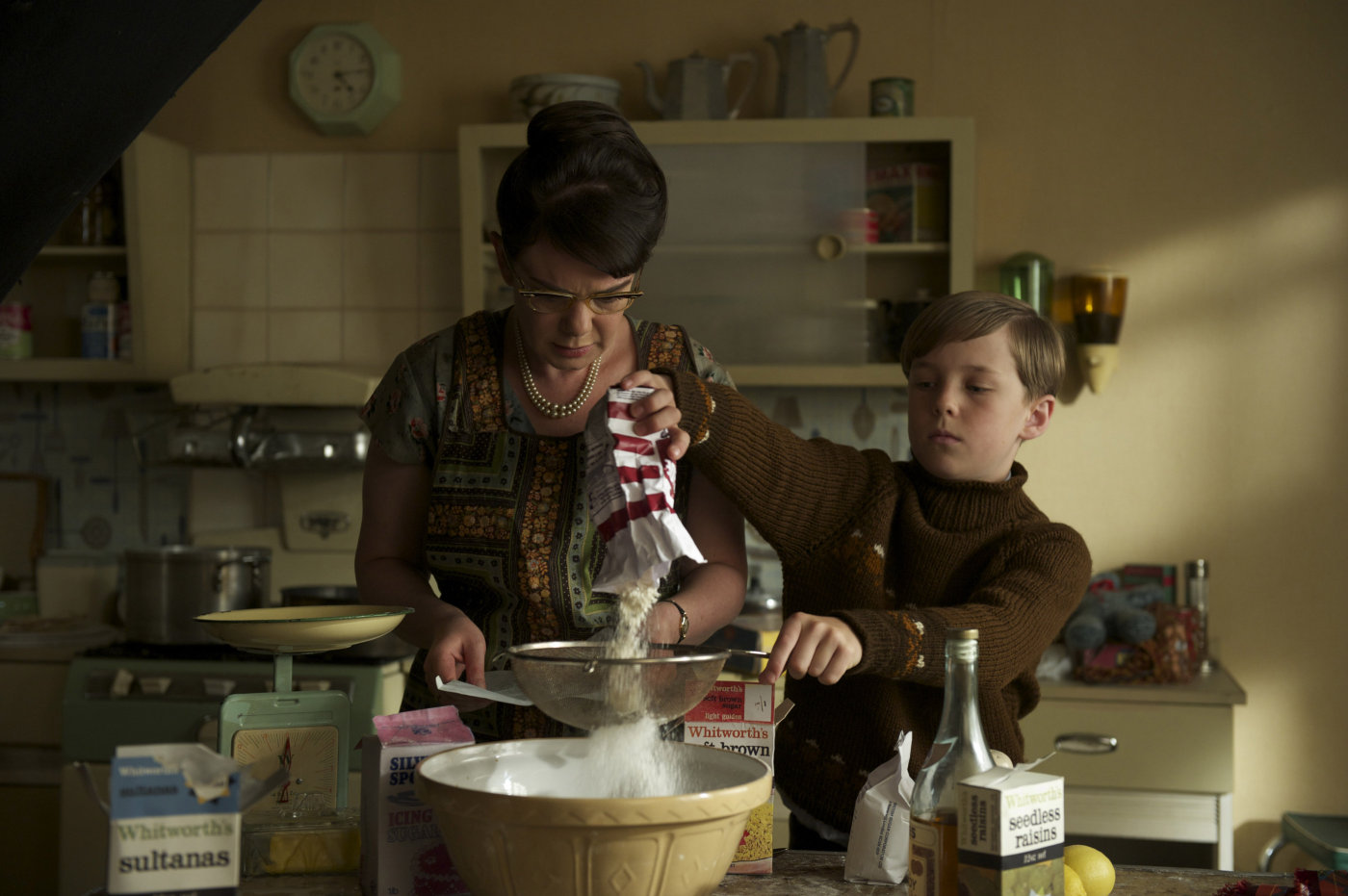
Toast? Ah, TOAST! The movie and the thing itself -- which proves the only bit of food our hero's mom can prepare in an edible manner -- are utter glories. This is a film, the style of which is so perfectly suited to its characters, content and theme, that it seems to self-propel, from first frame to last. (All movies, of course, should manage this, but how few ever do.)  If there were an award for movie buoyancy, Toast -- which, though dealing with some very sad things, keeps putting a big, fat grin on your face -- would win it hands-down.

Toast is a joy that gives Helena Bonham Carter yet another plum role, which she goes at with gusto (what a versatile actress she is!). Ditto, Freddie Highmore (above and below, with dessert) and Oscar Kennedy, who play our hero, respectively, as a young man and young boy. In telling the tale of the coming-of-age of Nigel Slater, on whose memoir the film is based, director S.J. Clarkson, shown at right, gets just about everything right, leaving you on a kind of cloud nine that is leavened with a profound, alternately sad and joyful, understanding of how the world (well, sometimes) works.

One of the great strengths of the movie is that our hero, Mr. Slater, comes off as anything but heroic throughout the film. He must deal with a dysfunctional family, but one that is dysfunctional in very odd ways that leave him ill-equipped to handle most anything -- as a child or as a young adult. When Ms Bonham Carter is introduced as the not-really-that-wicked stepmother-to-be, she comes off as a woman simply putting her own welfare first but trying to be as fair as she can. That young Slater will have none of it, ever, makes him less sympathetic but infinitely more real.

As his distant dad, Ken Stott (above) is terrific, too, turning what could be an all too typical character into something strange, funny and little sad. The whole cast is on a par, and Lee Hall's screenplay (from Slater's memoir) seems to have chosen just the right incidents, giving them all their proper weight.

From the scenes of Nigel as a boy -- at home, cooking with mom (above) or shopping (below)

to those once Highmore takes over the role (below) and begin to discover his road in life, the movie never loses momentum.

There's a scene late in the film that I think I have never seen anything quite like -- when a character, in what seems like a single instant, discovers his sexuality, is turned on something fierce and then immediately hung out to dry.  It's an amazing few moments, and like so much in this fine, funny, intelligent film, leaves you, as it leaves the character, initially annoyed -- then wistful, thoughtful and maybe just a little bit more determined to succeed.

Toast, from W2 Media, opens this Friday, September 23, in New York City at the Angelika Film Center and at Cinemas 1,2,3.  Click here to see further playdates -- with cities and theaters -- all across the country.

Tuesday, September 20, 2011

Andrew Haigh's WEEKEND finally arrives, trailing beaucoup press and awards....

...which are, for the most part, deserved. It's been awhile since any movie showed us a relationship-in-the-making with such finesse and acuity. Before Sunrise, as has been noted elsewhere, comes to mind. Both films rely heavily on dialog, on the chemistry between the two lead performers, and on the filmmaker's ability to capture the parry/feint/thrust that goes on actively (or passively) in most burgeoning relationships.

Andrew Haigh, the filmmaker of WEEKEND (shown at right: he wrote, directed and edited the movie) has done a splendid job of  this, coaxing two tremendously real performances (or maybe he simply allowed his two leading actors to "be") that are spot-on for the film's entire 96 minutes. The movie has the look and feel of improvisa-tion yet the writing is full of smart, quick, well-chosen dialog that helps create character, even as it advances the plot (such as it is) and fills us in on people, place, time frame, history, the lot.
Oh, yes -- and our two protagonists are men: Russel (Tom Cullen, above, left) and Glen (Chris New, right). So this year's top "relationship" movie thus far is, ummm, about gays. Because of the skill with which Mr. Haigh has guided his film and brought it home, it is easy to understand what all the advance press and praise is about. And the film will certainly play well to intelligent gay audiences. It might also play as well to straight audiences -- if they will let it. I suspect not, but still, we must live in hope.

In passing, and via that very real dialog, we learn in what profession each man is employed, that Russel is still semi-closeted, while Glen is anything but, and that, as the relationship begins to build, how the two alternate places in the catbird seat. I do wish I could have understood more of that dialog, however. Because of the accents (Cullen hails from Wales and New from Britain), I missed a certain amount and so will rent the DVD when it appears and hope for English subtitles.

If there is to be any fault leveled against the film, it might be that it is so very small. But that, according to filmmaker, is what he wanted: " to explore some of the more subtle aspects of the gay experience, especially how people deal with the weight of being different and the choices they make because of it."  In this, Haigh has succeeded in spades: Why, perhaps, Russell (above) works as life guard or Glen (below) feels the need to be always so quick on the trigger.

Most of all, I believe, we learn what these men are afraid of, and -- even more haltingly -- what they want. The movie gets as close as anything I have seen to the heart of commitment, as well as to our innate fear of this. The final scene between Russell and Glen is extraordinary, and Haigh's ending is a real achievement. I could go on, but you need to see Weekend (forget the old Godard movie; there's no connection) as soon as you can, before you hear too much and either expect too much or have certain scenes spoiled.

The movie, from Sundance Selects, opens this Friday, September 23, in New York City at IFC Center -- with a national rollout to follow. Click here and then scroll to the right to see upcoming release dates, cities and theaters.

All photos are from the film itself, except that of Mr. Haigh which comes courtesy of indieWIRE and was taken by Brian Brooks.