Tuesday, June 16, 2015

Amazon streaming: MOZART IN THE JUNGLE -- a loose, lovable and very smart little series


For several years now Netflix has been hailed as the new "content provider" that -- in addition to offering its usual DVD and Blu-ray discs for rental, as well as tons of movies and TV series to stream -- is creating its own first-rate series such as House of Cards, Orange is the New Black, and the recent and brilliant Daredevil. Lately, however, Amazon,  the behemoth we all love to hate, is making its own inroads into original content, with the award-winning Transparent and a bunch of other new, how-did-these-get-here-so-fast? series, among which MOZART IN THE JUNGLE is most definitely worth your time. (A recent issue of New York magazine profiled Amazon's sudden explosion into original series with an excellent article you might want to read -- if you haven't already.)

Having found Transparent a wonderfully rich example of original, unusual dramedy, TrustMovies moved on recently to this newer series and was very quickly hooked. Mozart in the Jungle seems to me an almost perfect example of what Amazon Studios (the "content" arm of the behemoth) seems intent on providing: original content that, while nowhere near close to blockbuster/ mainstream level, will give a certain smaller segment of sophisticated television viewers exactly the kind of thing for which they're always searching.

Mozart... offers up a smart plot situated in a venue that neither TV, movies nor practically any source from which we get our "drama" has cared to go -- that of the big-city symphony orchestra: that "jungle" of the title. The brain-child of a most creative threesome: Roman Coppola, (above, left), Jason Schwartzman (above, right) and Alex Timbers (shown at right) (based on the book by Blair Tindall, Mozart in the Jungle: Sex, Drugs and Classical Music), the series should be a shoo-in for anyone who's ever been involved in the classical music scene.

Yours truly worked at New York City's Philharmonic Hall -- now Avery Fisher Hall -- for several years back in the 1960s. But even if you have never been involved with symphonies and the like, the series is well-executed enough to pull you in. Watching it made me realize, among many other things, that despite how much has changed in the intervening decades, much remains the same.

Prime amongst those things that never seem to change is the necessity of fundraising -- above almost everything else. Wait: forget "almost." Fundraising is all. The person responsible for this on Mozart... is Gloria Windsor, played by Broadway veteran Bernadette Peters (above, left), who -- as do literally all the actors on the show -- turns her character into a multifaceted surprise and delight.

Mozart's creators understand quite well how conducting, performing in and running a symphony orchestra is full of compromise, no matter how dedicated to "art" are the people involved. These would include especially the symphony's new conductor, Rodrigo, a role just about perfect for the charismatic Mexican actor Gabriel García Bernal, who here gives maybe his best performance yet, as the bizarre-but-fully-dedicated enfant terrible who wants to take this orchestra to a new plateau.

Rodrigo's relationship to the conductor he is replacing (a marvelous turn by Malcolm McDowell, above) is a complicated one, and as the series progresses, this becomes more focused, specific, funny and moving.

The orchestra itself is composed of a raft of smart and talented actors -- from Mark Blum and Deborah Monk to Saffron Burrows (at right) as the crack violist and Lola Kirke (below) as a young oboist hoping to break into the ranks of the anointed. How the latter achieves this -- and then doesn't -- provides some of the surprise and believa-bility, coupled to the kind of charm and entertainment that makes for the series' great success. As befits a show brought to life by the likes of Mr. Schwartzman, Mozart... is above all loose and lively, never underscor-ing its points nor pushing too hard.

Mozart in the Jungle treats its characters -- virtually all of them -- as living, breathing, complicated human beings, whose needs and desires often conflict with those of their nearest and dearest -- not to mention with what they themselves sometimes want.

The series also addresses class and economics, and while it comes down firmly on the side of the underdogs and "art" over the wealthy and corporate, it never handles this in the usual obvious and stupidly facile fashon. Mozart's creators understand the complications of living in the real world and what this means to the idea of creation and compromise.

Victory, as is only sometimes (and not often enough) the case, goes to those who can best roll with the punches -- a scenario beautifully demonstrated by the final episode in this first season.

The show is also unafraid to introduce an oddball new character for a one-time appearance -- Wallace Shawn (above) is one example -- or offer up a memorable supporting turn from another who appears only now and again, such as the beautiful and charismatic Nora Arnezeder (below: remember Paris 36?).

Shows like Mozart... don't set the world afire. That's not their job. Rather they appeal to to those of us who want something different but of high quality in both its artistic ambitions and entertainment quotient. This series delivers on both levels. It's streamable now, only via Amazon, where Prime members can watch it free.

Sunday, June 14, 2015

Sunday Corner with Lee Liberman: OUTLANDER ends w/NC-17 stunner To Ransom A Man's Soul


After reading Diana Gabaldon's Outlander novels and seeing showrunner Ronald D Moore's 16 episodes of book 1 on Starz, I find both artists waging guerrilla social warfare between the covers of a classic bodice-ripper. Real emotional, historical, and medical content sabotages the saccharin romance formula we wouldn't be caught dead reading/watching -- "Jesus H. Roosevelt Christ!" (heroine Claire's favorite swear). While likely finding few converts among Edith Wharton or Hilary Mantel fans, OUTLANDER has elevated the content value for romance consumers above that of say, Downton Abbey, while keeping faith with all the tropes of the genre.

There's Jamie, daring noble hero; Claire, lovely stubborn heroine, a WWII nurse who has fallen through time from 1945 back to 1743; sadistic villain, Captain Jack Randall; and throbbing plot doings that include the beautiful mysterious Geillis and McKenzie clan politics.

A cinematic ending tops off book 1-- a wide-angle portrait of wind-swept lovers embracing on a gorgeous 18th century sloop as they leave their troubles in Scotland and cross the channel to new adventures in France -- a picture perfect image befitting the paperback book covers on the turn-stand at your local drugstore.

But it so happens that Gabaldon's 3 science degrees and her faithful interest in the details of history, medicine, and human behavior add surprising substance to the pocket romance formula. Filmmaker Moore mostly succeeds in following her intention. At least this pair is forcing the romance consumer to think as well as feel; at best the last episodes of Book I may help redefine how rape is portrayed for the violence it is, not the male fantasy it has always been. Here's how Outlander ups the game.

First is 20th century medically-trained Claire's confrontation with a woman's place in the 1700's -- not to her liking. Having disobeyed her new husband Jamie, she falls into the hands of the British, forcing Jamie and his MacKenzie relations to mount a dangerous rescue. According to custom, justice must be be meted out to Claire for having put all the men's lives at risk. Jamie beats her with a strap, to which she responds with 20th century outrage. We are taught to work fast to distance ourselves from a violent partner. Here we are gently persuaded to 18th century realities. Jamie is a gentleman and a leader, not violent except in combat. Gabaldon forces us to confront the perils of a time in which punishment is demanded when one person endangers the welfare of many. Ultimately we and Claire grudgingly come to differentiate between "abuse" and "justice." The threats to their relationship seem to result from Jamie and Claire's roots in different millennia, but all partners negotiate differences as deeply felt as theirs. The battles with each other (above) stand in for the struggles in every relationship in which mutual respect is hard won.

Even more trauma unfolds with Jamie's later capture by the British (a price remains on his head for a false accusation) and falling into the hands of villainous captain, Black Jack Randall, a sadistic, morbidly dark homosexual. Pictured below, Claire has gotten into the prison and Jamie persuaded Randall to release her in return for his submission to sex.

An episode and more is devoted to Jamie's plight in prison and later rape and torture by the mad captain. It unfolds in flashback after the MacKenzies have driven a herd of cattle into the prison, snatching up Jamie during the ruckus and delivering him to a monastery. Randall's abuse reflects Gabaldon's intuitive or actual knowledge of behavioral psychology. Randall is not just about rape and torture -- he seeks to possess Jamie body and soul by making Claire repellent to him. Hence Randall impersonates Claire while both physically torturing and making love to him -- in effect he 'conditions' Jamie to be repelled by his wife as if she were his instrument of torture. Fine direction by Anna Foerster shows but mostly infers Randall's manipulating Jamie into submission, leading to his fevered, delusional state after the rescue, rejecting Claire and begging for death. In the film, Moore mysteriously puts in clan member Murtagh's head the idea that was properly Claire's to restore Jamie's sanity --joining him in his darkness. We see Claire's intuitive version of a modern cognitive behavioral therapy called 'exposure therapy' that is used now to treat soldiers and other victims of PTSD.

In a modern therapeutic setting, a patient is repeatedly walked through violent memories which gradually lose their hold in a 'de-conditioning' process that extinguishes their power. Claire's method is cruder and more drastic. Using opium and Randall's lavender scent she impersonates him, rousing Jamie from his delusional state to fight off his torturer which he could not do in prison. In the book they tear apart his monastery cell until both are spent, but Jamie wakes in the morning with his fever broken, in effect having defeated his torturer. In Moore's version the brawl is too brief and Claire talks it through with Jamie, a less medically- feasible means of recovery -- "talk" does not pierce a delusional state, as anyone knows who has tried to reason with an addict. Gabaldon's version played out logically in the beautiful abbey chapters concluding her first book.

There, in a French monastery headed by a Fraser uncle of Jamie's, unfolds a plausible respite and recovery for the characters and the reader. Moore's abbreviation of the rape aftermath and recovery is my first major quarrel with the filmed version of Gabaldon's work. It short-changes Jamie's recovery and also our own from perhaps the most dramatic story-telling ever on television. At least one episode (The Watch) could have been dropped to allow it.

Still, a catharsis is pronounced and we accept it, for as the Frasers sail away to France, the gorgeous, sweeping sea departure morphs in our minds from a scene on a romance book cover to overwhelming relief that our couple's relationship has survived.

Much more happened in the second 8 episodes of the first book including a witch trial, a visit to Lollybroch, Jamie's ancestral home (above), and our introduction to two lovely characters -- sister Jenny and brother-in-law Ian (Laura Donnelly and Steven Cree, below) -- who will reappear in future. Also Claire reveals to Jamie the story of her time-travel through the stones; he takes her there and tells her to go back: "There is nothing for you here except violence and danger...." (see photo at bottom).

Despite the rest of the sturm and drang that befalls our hero and heroine, there's not anything on tv that can top the authentic portrayal of maturing love in Outlander and also the treatment of rape as the violence and betrayal that it is. It could not be told as well with a female victim without seeming politically incorrect in the extreme. Also, with Jamie as the victim, male viewers (40% Outlander fans are men) are very able to empathize with such cruelty, which conflicts with the male rape fantasy of women. The recent rape of Sansa in Game of Thrones instantly felt outdated and unworthy. Can a film industry largely run by men improve its thinking on this subject? Maybe Outlander will be a turning point.

The Gabaldon/Moore Outlander seasons have achieved some unusual emotional coups. Tobias Menzies and Sam Heughan were particularly brave and vulnerable in their painful scenes as sadist and victim. All the artists involved deserve kudos for taking the bodice-ripper genre into believable realms of human emotion.

Outlander is available now on demand at Starz. My earlier review of the first 8 episodes is here. Moore reports that filming is in progress on Gabaldon's second book, Dragonfly in Amber which moves Jacobite politics to a new setting -- the French court of Louis XV.

(The above post is written by our
monthly correspondent Lee Liberman.)

Thursday, June 11, 2015

Streaming follow-up: fans of Spain's gorgeous GRAN HOTEL finally get a third-season finale!


If comments on this blog are any indication, that delectable and beautiful soap opera via Span-ish television, GRAND HOTEL, has got to be one of the more popular foreign TV offerings currently avail-able on Netflix streaming. Fans have been begging the famous "content distributor" to give them that final season for nearly a year now. At last, here it is -- in 24 episodes of 44 minutes each.

When Season Two ended with the shock and jolt that left many of us with our mouths hanging open, some of us imagined that this indeed was indeed the end of the series -- in which the characters, many of whom were very bad people, got what they deserved. Still, we wondered, what about all the others? Now we know.

The series, based on an idea by a man and woman whom I would guess are the Spanish equivalent of what we over here in the USA call showrunners -- Ramón Campos (above, right) and Gema R. Neira (above, left), both of whom produced and collaborated on the writing of most, maybe all, of the episodes -- takes place in and around the titular grand hotel (filmed at the famous Palacio de la Magdalena) in the lush and verdant seaside locations of Santander in Cantabria, Spain.

Both outdoors and indoors, the series is a visual knockout, what with the gorgeous exterior shots and the highly detailed interiors -- oh, the flatware and china, the exquisite decor and costumes -- Gran Hotel proves a non-stop feast for the eyes. Comparisons have and will continue to be made to Downton Abbey, and they are certainly apt. But for my money this Spanish series beats out the British one, bigtime. Even if, I must admit, the third season does have its longueurs now and again. In order to reach its finale via those 24 episodes, a certain amount of padding is present.

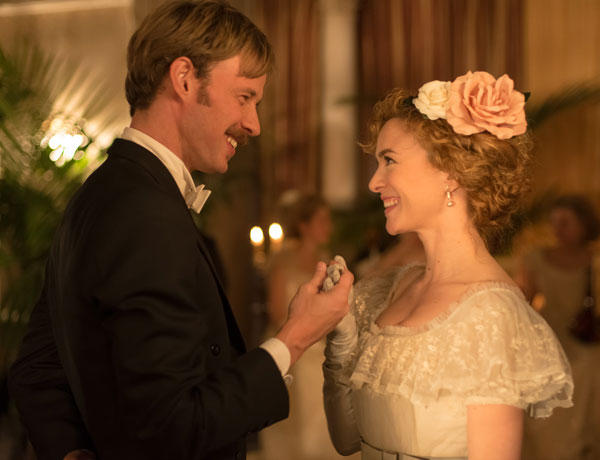
Still, if you become as heavily involved with all these many, many characters as did I (and clearly many other viewers), it may be difficult not to become absolutely wrapped up in the often silly but always enjoyable plotting. This final season offers up the Alarcon's spoiled-rotten ladies' man son (Eloy Azorín, above, left) suddenly smitten with a nurse named Laura who has come to care for the wounded after season two's sudden "mishap." As played by Marta Hazas (above, right), this character proves a wealth of surprise, fun and, well, you'll find out....

Of course we have more of the Inspector Ayala (Pep Anton Muñoz, above, left) and his not-so-swift assistant (Antonio Reyes, above, right), both of whom manage to become even more fun as the series progresses, along with our ever-kept-apart lovebirds, Alicia and Julio (Amaia Salamanca and Yon González (on poster, top, and in the photo just below it), who remain as engaging as ever, though Ms Salamanca seems to have grown older and less lustrous, given all her poor character has had to put up with over 66 episodes.

Gran Hotel has become one of my favorite shows, due, I think, to the Spanish-ness of it all. I found it even more of a soap-opera than Downton Abbey, yet I liked it much better. These are some of the most memorable characters you'll spend this much time with -- so specific and interesting, despite the fact that they -- some of them, at least, like Doña Teresa, played by the very fine Adriana Ozores, shown center, above, in one of her more provocative moments -- get away with murder and somehow we still care about them. (This is one of the series' more troubling and interesting accomplishments.)

Then there's the whole "randy priest" thing involving our lying, murdering and adulterous Sofia (Luz Valdenebro, at ), along with the surprise of Javier finally learning to commit to his nutty wife (and the fact that he can only get an erection with her, of all things!).

And then, especially, there is Belén (played with enormous steel and force by Marta Larralde, shown center, above) -- who for some reason, despite her truly nasty deeds and utterly heartless demeanor, I'll remember best and with real fondness from the episodes in which she gives birth to and then loses her offspring -- a time in which she was most human, caring, vulnerable and sad.

Is there a villain in TV history you can hate more thoroughly yet find so damned sexy and alluring as that key character, Diego, played with such relish and smarts by Pedro Alonso (above, left)?  I doubt it.

This season, there are several new and very enjoyable characters, led by Alicia's dear friend Maite (played with delicious verve and flair by Megan Montaner, above) and the hotel's new and unusual maître d' (essayed by that fine and duly famous Spanish actor Lluís Homar, below).

With all its silliness and faults -- maybe even because of them -- I believe this to be an extraordinary series, like nothing else I can recall seeing. Its take on power, money and the coming of the Spanish middle class, and its joining, toward the end, of the wealthy to the poor (via "Duke" Alfredo and Doña Angela and her crew) I found most moving and progressive. Podemos would surely approve.

Gran Hotel, can be seen now via Netflix streaming or on DVD and Blu-ray. Do check it out. (That's the lovelorn, lovable and ever-naive Andrès, above, a waiter-turned-heir who is played by the uber-lovable actor, Llorenç González.) 

Tuesday, June 9, 2015

Hot doc: Crystal Moselle's THE WOLFPACK and its film-educated, home-schooled family of men


Do audiences seek out documentary films without first knowing the theme and/or subject involved? I would doubt it. Narrative movies can pull in a crowd by virtue of their stars, their popular genres and more often simply via their much larger budgets -- which allow for mammoth advertising. With their usual miniscule budgets, docs must rely upon at least some advance word-of-mouth via film festivals and the ensuing publicity these can bring.  So it is with THE WOLFPACK, the new documentary from first-time filmmaker Crystal Moselle, which won the Grand Jury Prize at this year's Sundance Film Festival and was nominated for top awards at three other fests.

Ms Moselle, shown at right, tackles the subject of a particular New York City family, living at the time of the filming on the Lower East Side and made up of six male adolescents, ranging in age when filming began from eleven through eighteen, and their one sister, of whom we see very little, and who seems to be maybe handicapped. Ruled by their Peruvian emigrant father's somewhat iron hand, home-schooled by their midwestern American mom, and confined for almost their entire life to the four-bedroom apartment in which they grew up (they were supposedly allowed outside only briefly and sometimes but once per year), their entire cultural life appears to have been built and groomed via the many, many movies they were allowed to watch and re-watch on videotape and DVD over the years.

Their story has now been told in various places (newspaper and magazine articles), though it is likely to reach its largest audience via this new documentary. The idea of young men raised only by two parents and a library full of films -- and what has become of them, how and why -- would seem near-irresistible for anybody who loves movies and thinks that film offers some meaning and importance to our lives. Ms Moselle has stated her first encounter with the boys was pure serendipity: She was walking down First Avenue in Manhattan in the spring of 2010 when one boy, dressed in a black suit, sporting dark glasses and weaving through the crowd, ran past her -- followed by another and another and another. Her instincts took over, she says, and she simply had to run after them. From that meeting, this movie -- finally finished five years later -- was born.

Viewed from any perspective whatsoever, the story would seem to be a major keeper. So how is the documentary that Ms Moselle has made from it? Interesting, that's for sure. It raises every bit as many questions as it answers, given Ms Moselle's decision to to film it with almost no exposition about the family or how her film came into being. She simply sits us smack in the middle of things and lets her young men do the talking and showing. There seem to be none of those "re-creations" so favored these days by some of our documentarians. And because Moselle seems to have been taken in and accepted as part of the family, she does little of the usual talking-head-interview type of thing. Instead she catches her subjects on the fly, as it were, mostly inside their apartment, but occasionally, as above with a day at the beach, outside of it.

We learn some of the boys' favorite films (Reservoir Dogs, The Godfather and The Dark Knight lead the list) and we watch them stage their own re-creations (above, below, and in the penultimate shot -- the last of which I don't believe was included in the film itself) from the movies they love. Yet we learn almost nothing about what movies have meant to the kids in terms of life lessons, ideas, culture, morality, and the like. What does their preference for movies that are heavily violent say about anything? Is this simply machismo coming to the surface, their father's choice of films, or what?  The boys certainly seem well-spoken and intelligent, but Moselle prefers to not engage them in any philosophical or deeper way. She prefers to simply watch and listen.

We see and hear the boys' mother (below, in a publicity shot, surrounded by her brood; sorry, I could find no photo of their dad) and thus learn something of the family's history. There appears to have been some abusive behavior going on, but perhaps nothing so horrible that it could not be worked out or around. We finally, after maybe half the film, view the father, who seems uncomfortable around the camera, perhaps from residual guilt, or maybe from the same fear he has always had of the manner in which New York City treats its immigrants and anyone who can be construed as "the other" -- a fear that initially led to his keeping his children always in the home.

The boys themselves seem to have matured into pretty "decent" guys. We get some sense of differentiation between them, though not nearly enough, by the time the movie ends (it lasts only 84 minutes). I do wish Moselle had better identified each young man during the end credits, when she introduces them by name and sight, yet often with their face obscured by some costume or mask. Her decision to let the family speak for itself and to leave herself, as filmmaker, mostly out of the picture was certainly brave -- as well as wise in some respects, if disappointing in others.

To have told it all would have no doubt meant making a three- or four- (or more) hour movie. Yet the one that has emerged, even at less than an hour-and-a-half, seems at times attenuated and repetitive. My feeling is that Moselle's decision as to what to include and what to leave out could have benefited from some different choices. As it is, this documentary, which certainly could have been better, is still unmissable for folk who enjoy the genre, believe in the power of movies to affect us, and care to get at least some sense of how autonomous lives can be formed -- even under pretty trying and unusual circumstances.

The Wolfpack, from Magnolia Pictures, opens this Friday, June 12, in New York City at the Elinor Bunin Munroe Film Center and the Landmark Sunshine Cinema, and in Toronto at the Bloor Hot Docs Cinema. In the weeks to come, it will play many more cities across the country. Click here to see all currently scheduled playdates.

Saturday, June 6, 2015

Yoon-suk Choi/John Kafka's animated BACK TO THE JURASSIC proves a charming little winner


Are you tired of paying top dollar to see a new big-budget animated film in a theatre? Recent samples, often in 3D, can cost a family of five more than $100 to view. You and your kids might want, instead, to settle in on your couch and watch a new animated movie -- BACK TO THE JURASSIC -- that arrives, if I'm not mistaken, via a combo of Hollywood and South Korea, this coming Tuesday on DVD and Blu-ray.

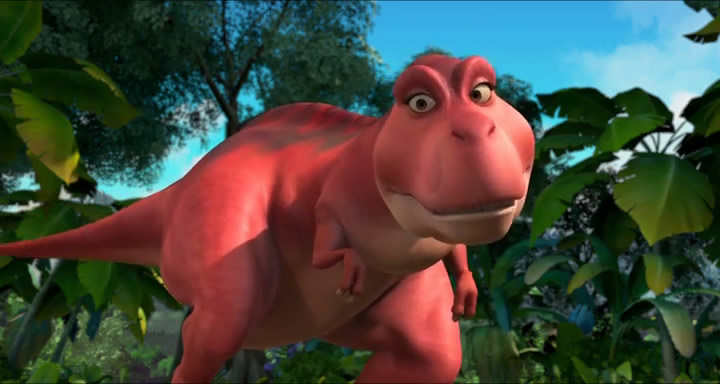
Directed by Yoon-suk Choi and John Kafka, this what-you-might-call B-movie animation tells the tale of a dinosaur-obsessed school kid, his younger sister and best friend, Max (above), all of whom live in a town seemingly devoted to dinosaurs and their ilk (everything, from the museum to the local diner, is dino-themed). This youthful crew ends up taking a unexpected trip via time machine back to the Jurassic period where they encounter a multitude of dinosaurs, one of which (below and voiced by Melanie Griffith) takes a maternal interest in the threesome -- due to that time machine's looking an awfully lot like the dino egg she so recently was hoping to hatch.

TrustMovies admits that he was not expecting much from this movie, when he settled back on his daughter's couch with his grandson and began to watch. But what do you know? The film proved much better than expected. Charmingly plotted and written, and featuring voices of some first-rate talent (along with some second-rate who are used quite well), Back to the Jurassic is enchanting and fun from first frame to last.

Full of energy and more wit than you might have imagined, the movie handles themes like disobedient children, over-protective parents, sibling rivalry, and of course dinosaurs of both the benign and scary varieties with aplomb and pizazz. It proves consistently entertaining for the kids (my seven-year-old grandson rated it very highly and immediately told me that he wanted to see it again), while providing an easy, pleasant watch for adults, too.

The animation is very well done: immensely colorful, alternatingly bright and dark, and always enjoyable to view. The movie will immediately grab the attention of young kids and keep them focused (at one point I asked my grandson if he had understood one of the more sophisticated moments/situations, and sure enough, he had), and I suspect you adults may be surprised at how often this movie has you smiling.

Once the kids land in the prehistoric period, their respective parents must high-tail it after them and bring the crew back home. Mom (above, left) is voiced by Jane Lynch, but thanks to the very poor and incredibly incomplete website of the film's distributor, Alchemy, plus almost no information about the film available on the imdb, I don't know who voices Max's dad. Traveling through time and back is pretty much the plot, with the protagonists (the kids, parents and good dinos) set against their antagonists (a couple of very bad dinos, voiced by brothers William and Stephen Baldwin).

Running just 86 minutes, this fleet and frisky film is worth a look if you have young kids. It hits the street this coming Tuesday, June 9, on both DVD and Blu-ray. 

Wednesday, June 3, 2015

Back to the old haunted house: Ted Geoghegan's pretty nifty genre debut, WE ARE STILL HERE


Moviemakers never seem to tire of taking us for another visit to that haunted house -- these days most often with elements not just of the expected ghost story but of related genres like horror and slasher, too. The latest foray into this combina-tion comes from a fellow named Ted Geoghegan, whom many of us critics have worked with in his capacity as a movie PR person. It always good to discover someone you know so adeptly changing hats (it happened just last month, too, with John Stuart Wildman and his genre piece, The Ladies of the House), and now here we have Mr. Geoghegan's oddball, enticing, very well-cast and -acted, tart n' tasty horror, WE ARE STILL HERE.

The filmmaker, shown at right, does some unusual things within this fairly typical genre, most surprisingly leaving much of his exposition to be finally shared with his audience during the end credits! He also plays fast and loose with any ground rules concerning his "monsters," who appear to inhabit only the house -- in the cellar, of course, and Geoghegan, along with his production design (Marcella Brennan) and art director (Sean Hughes) have created quite a creepy version of same -- but then suddenly seem to be able roam a bit farther and wider.

The "we" of the title -- those monsters, 'natch -- are done quite effectively, too, for the low-budget efficiencies they are (one of which is shown above). They'll bring new meaning to that old wartime saw, "Don't fire until you see the whites of their eyes."

The filmmaker, who both wrote and directed this little foray into fright, doesn't explain much of anything upfront, as his heroic couple, played by the lovely Barbara Crampton (fans will immediately recall Stuart Gordon's Re-Animator and From Beyond) and Andrew Sensenig (above, left and right, respectively). Why they have arrived at this, of all houses, is a big question. Just fate, I guess.

Once the movie gets started and the newcomers are paid a visit by their "neighbors," including a smart, nasty little performance from Monte Markham, above, you'll probably feel that glue binding your tush to the chair. This "house" evidently needs a crew of victims every so often, and these newcomers certainly seem to fill the bill.

They are soon joined by their good friends (and sometimes spiritualists) Jacob and May (Larry Fessenden, above left, and Lisa Marie, above right, both doing a bang-up job: He all loosy-goosy funny, she quite caring and serious). Soon after, that other couple's son and his girlfriend arrive. Naughtiness (accompanied by blood and guts) ensues. The "seance" Geoghegan has concocted is one of the better ones seen on film in awhile, in which Mr. Fessenden truly excels.

Geoghegan knows how to create both suspense and a smart sudden shock, and he gives these to us with enough frequency to make the movie worthwhile for genre fans. He also draws fine performances from his cast, with Fessenden and Ms Marie delivering surprisingly rich additions, while Ms Crampton, above, is even better here than she was in the better movie You're Next (a survival-thriller classic, by the way, which you must see if you somehow missed it). Her warmth and concern help hold the movie together and keep us rooting for her against what look like heavy odds.

The filmmaker also understands how to swivel on a dime, and so his movie often keeps us nicely off-balance as its twists and turns are spinning. He makes particularly good use of his "townspeople," above, who do not, shall we say, offer these newcomers much of a warm welcome. And his cinematography (by the fine Karim Hussain) knows its way around lighting, mood, and atmosphere.

As to "just desserts," it's difficult to say; we don't know enough, finally, to understand the "why" of much that has gone on. Overall, though, Geoghegan does an adequate job of piecing his story together without too heavy an explication, while doing a bang-up job of scaring our pants off.

We Are Still Here (indeed!) -- from Dark Sky Films and running just 84 minutes -- opens this Friday, June 5, here in New York at the Cinema Village and in L. A. at the Laemmle Music Hall 3. Simultaneously, it can be viewed via VOD.