Showing posts with label soap opera (gussied-up). Show all posts

Sunday, August 13, 2017

August's Sunday Corner With Lee Liberman -- Game of Thrones (GOT): it's about what?


Chaos is a ladder...
only the climb is real; 
the climb is all there is. 
 .....Littlefinger 

 House Rep Ted Lieu, D, CA, panelist on an MSNBC news program, pushes forward his toy replica of the Iron Throne, announcing that what's missing from GAME OF THRONES on Capitol Hill is beheadings -- we've got collusion, lying, coverups..... Lieu's glee speaks to the GOT phenomenon -- as though each TV moment were happening in real life. Slavish analysis of every episode in multiple media outlets reflects peak fever over George R.R. Martin's popular saga, The Song of Ice and Fire turned HBO-blockbuster as it moves into its concluding seasons directed by writer/show-runner team, David Benioff and D.B. Weiss. (See Martin, center; Benioff, left; and Weiss, below.)

Novelist Martin has been called 'the American Tolkien' in the epic fantasy genre. There is plenty of fantasy to go around -- a lethal army of walking dead, dragons the size of 747's, three-eyed ravens who see everything there is or was, and a messiah-king risen from the dead. But the hard core of GOT is human and political drama in a medieval setting (inspired by medieval European monarchies -- the British War of the Roses is cited). It is a time of wood, steel, leather, fur, and fire in which magic takes a back seat to complex human relationships, intertwined familial connections, political intrigue and wars of conquest. The writers offset warring with just enough lingering, quiet intimacy among characters to make you feel their world is real. These bits of human magic are the series' glue.
(Below, Jon and Daenerys.)

In its favor, the story make us care a great deal about its main characters; it stirs thought about religion, politics, ethics, and especially power; and wanders the globe for gorgeous visuals-- Ireland, Croatia, Spain, Iceland, Morocco. On the down side, GOT tirelessly offers up nudity, sadism, and gore. There are two or three heart-warming scenes of love-making to date, the unsexy rest are rapes or annoying soft-porn panders to male juvenilia. The project overall is better than its lowest common denominators, but the quality is demeaned by all that pandering.

The narrative begins in Winterfell, Land of the North, one of the seven kingdoms of the continent of Westeros, and it shifts to other kingdoms involved in the power struggle over the Iron Throne in King's Landing, the rule of which includes dominion over the seven kingdoms. The very first scene in Season One introduces us to Westeros's unseen threat -- the Night King and his Whitewalker army who will come from the frigid north. The threat makes a nice stand-in for modern-day global warming -- an incipient catastrophe that nations are too busy fighting each other to band together and vanquish. Three great families fight over the Iron Throne (below, l to r. Khal Drogo, siblings Daenerys and Viserys Targaryen, the Lannisters, King Baratheon, the Stark family).

Our sympathies are engaged foremost by the appealing Starks in their northern home of Winterfell -- headed by Ned (Eddard), the Warden of the North, his wife Catelyn Stark, and six children. In the first episode, they are visited by the ruler of Kings Landing, Robert Baratheon and his entourage including his Queen, Cersei Lannister, her soldier twin brother, Jaime Lannister, their articulate, sardonic brother, dwarf Tyrion Lannister, and the three young Baratheons (unknown to King Robert, the offspring of Cersei and Jaime's incestuous relationship). 

The King, old warrior companion of Ned Stark, has come to offer Ned the post of 'hand of the king' (chief domestic and military advisor). Events that transpire there and soon after lead to enduring hostilities between the Lannisters and the Starks. Cersei is the luminous and power-mad villain of the saga, and dwarf Tyrion, the intellectual and pragmatic center. (Tyrion, Cersei, Jaime, below).

The Targaryens have ancestral claim to the throne. Robert Baratheon became king by deposing the mad Aerys Targaryen. The Targaryen children escaped assassination by fleeing to the (Asian/African-like) tribal continent of Essos. Daenerys Targaryen matures with the drive to re-take the Iron Throne. Meanwhile she has conquered some Essos peoples, freeing slaves and working toward establishing humane rule. Her reputation, however, is based on her having emerged unscathed from the ashes of husband Khal Drogo's funeral pyre carrying three reptilian offspring; she becomes known thereafter as the Mother of Dragons (below).

Ned Stark's bastard son, Jon Snow, is destined to join the Nightwatch, a group of misfits/warriors whose job it is to guard the 700-plus ft high, 300-mile long wall of ice that separates Winterfell from the Wildlings in the North (a concept reminiscent of Emperor Hadrian's wall built to divide Roman Britain from the unruly, unconquered tribes of Scotland).

Jon Snow befriends the wild folk beyond the wall, a rugged free people one might compare to medieval era Scottish Picts or Scandinavians (below, Jon and Ygritte, a Wilding, and yes their adventures together, love affair, and her death offset the tacky brothel scenes).

Menaced by the Night King (below) and frigid climate, the Wildings are persuaded by Jon to move to the Winterfell side of the Wall, where he hopes they will have easier lives and also join the coming battle against the Night King's army. For this strategic wisdom, Jon is killed by some in the Night Watch who have always fought Wildlings and are too conservative to think outside the box. GOT's audience is grief-and horror-struck -- there was something beyond ordinary about Jon Snow.

Grief lasts until the following season when Jon Snow rises from the dead and is declared King of the North. Jon's parentage is disclosed in Season 6; he is revealed not to be Ned's son but his nephew -- the child of Ned's sister Lyanna Stark and her lover, Rhaegar Targaryen (much older sibling of Daenerys and Viserys). The knowledge goes with Ned to his grave to protect Jon from assassination, as the Baratheons and Lannisters want no living claim to the throne other than their own, which they prove early and often.

We are now in Season 7 where Daenerys and Jon have a frosty first meeting, the fire and ice of Martin's saga title, on whom the battle for the Iron Throne and the struggle to turn back the Whitewalker army will depend. The dwarf, Tyrion Lannister, having killed his father and escaped his sister Cersei's wrath, has become Daenerys 'hand' and helpful guide to the sociopathy of the Lannisters.

The above brief omits the separate story lines of each of the Stark children in their sometimes plodding, far-flung travels and other villains, heroes, and minor characters. As the series and years have progressed, we've watched children and dragons grow up and many die whom we mourn but must be gone before the final battles occur. There's a story line exploring the rise of an extreme religious sect, the Sparrows, with its twisted Iran-like authority, and we've adventured to other Westeros kingdoms and met some minor characters with possible importance. One is Gendry, a bastard son of Robert Baratheon who missed his rendez-vous with death by the Lannisters; another is schemer Lord Baelish, called Littlefinger; and there is also kind Samwell Tarly (below), who studies to become a Maester (healer, scholar, advisor), discovers the means to kill Whitewalkers, and may even be the author of the fire and ice origin tale (a fan theory).

It is soap opera, adventure, and spectacle for a mass audience but what heightens it now is the politics of authoritarianism in our own century. Lately, GOT has become a convenient narcotic to help sublimate anxiety over an infantile U.S. president and his scary responses to environmental and military threats.

Jon Snow poses the global threat to Tyrion Lannister: "Grumpkins and Snarks you called the Whitewalkers...How do I convince people that don't believe me that an enemy is coming to kill them all?". Tyrion replies: "Peoples' minds aren't made for problems that large...It's almost a relief to confront a comfortable, familiar monster like my sister [Cersei]."

In Season 7 (and 8 to come) the remaining players reconnect after terrible solo adventures. Little Arya is now a lethal assassin; Bran, after a crippling fall has become a seer (our vehicle to know things other characters do not, such as Jon's origins); and Sansa, a shallow pre-teen, has grown into commanding womanhood; they have now reassembled in Winterfell. Jon Snow has made his case to Danerys about the coming onslaught of the Night King's army and the need to fight them together -- dragon fire against Whitewalker ice. The two extraordinary Targaryens size each other up with suspicion and the hum of attraction.

Jon tells Daenerys that her followers believe she can make the impossible happen -- build a world that is better than their old one; but "if you use your dragons to melt castles and cities, you're not different, you're just more of the same." Season 7 is a turning point in which we move from picaresque adventure into the confrontations among the main characters that will lead to resolution, filling watchers with dread and hope. Jaime leading Cersei's army and Daenerys leading hers, fly at one another, blasting the battlefield with unimaginable results, all "fire and fury, the likes of which the world has never seen". But Danerys' first battlefield is a desolate plain -- not a castle or city.

Note: There are too many actors to name but American-birthed GOT is populated by top talent from the largely UK acting establishment such as Sean Bean, Diana Rigg, James Broadbent, Anton Lesser, David Bradley, Jonathan Pryce, Mark Gatiss, Charles Dance, Ian McShane, Iain Glenn, Ciaran Hinds, Clive Russell, Aidan Gillan, Julian Glover, James Cosmo, Michelle Fairley, Lena Headey, Max von Sydow, Natalie Dormer, Rose Leslie, Ellie Kendrick, Oona Chaplin,and Gemma Whelan, to name some. A few young Brits have gotten career boosts since GOT's first season in 2011: Richard Madden, Kit Harington, Maisie Williams, Sophie Turner, Isaac Hempstead Wright, John Bradley. Americans are few but notable: Peter Dinklage (Tyrion Lannister), Jason Momoa (Khal Drogo) and the exceptional Pedro Pascal (Oberyn Martell).

Added note: This slide-lecture features GOT's costume designer and the research, design process, and constraints that go into costume design.

The above post was written by 
 our monthly correspondent, Lee Liberman

Sunday, December 6, 2015

Sunday Corner with Lee Liberman: Spanish telenovela, THE TIME IN-BETWEEN proves a soapy, entertaining, historical romance


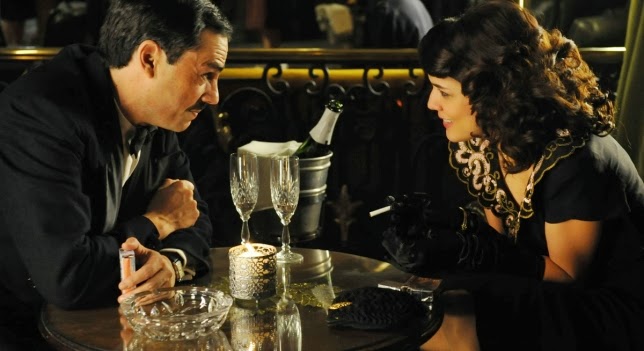
Having liked the relentless Spanish caper, Gran Hotel, I figured there might be something to THE TIME IN-BETWEEN (El tiempo entre costuras), released in 2013 to huge Spanish viewership, now distributed in many languages and streaming on Netflix. Dubbed a Spanish Downton Abbey, the series, based on a recent novel by Maria Dueñas, spans the young adulthood of seamstress, Sira Quiroga (Adriana Ugarte, shown left), whose quixotic rags-to-riches maturity takes place during the Spanish Civil War and the run-up to WWII.

Melodrama is the link between Gran Hotel and The Time In-Between; the former is a fast-paced satire of the genre, while the latter is an unapologe-tic tear-jerker -- much more old-time melodrama in which Little Red Riding Hood escapes the wolf by the skin of her teeth than spy-thriller romance. (From the sample I read online, the novel is better.) The swooning score, tear-stained cheeks, giddy girl-crushing, and other emotional manipulation almost buries the thing. But shame on me -- I got hooked anyway. If nothing else, the series offers immersion into the domestic life and political atmosphere of a period we may know only through Hemingway's war writing and Pablo Picasso's famous war painting Guernica. The landscapes and architecture of Madrid, Lisbon, and nearby Moroccan cities of Tangiers and Tetouan are seductive, especially the rhythmic calls to prayer and throbbing markets. I was surprised at the proximity and intertwining of the cultures of these Iberian cities (see map above).

Sira, our heroine, grew up poor in Madrid and is pregnant in Muslim Morocco (then a protectorate of Spain with a Spanish population and infrastructure), when Ramiro, her handsome boyfriend (Rubén Cortada, pictured below) dumps her. She passes out on a bus and finds herself in a hospital in the city of Tetouan, the Moroccan capital of the Spanish protectorate. The police commissioner installs her in a hostel with orders to work and pay off the hotel bill in Tangiers that Ramiro left behind. An oddly acquired cash windfall enables her to start her own dressmaking business that flourishes due to the patronage of the German wives whose husbands serve the German embassy.

Meanwhile the Spanish Civil War has sealed off Madrid, and Sira, now self- supporting, is unable to go home where war rages nor bring her mother to safety in Morocco. War is out of sight, but politics is asserting itself in the anti-English, jingoistic chatter of her German clients whose husbands are tasked with influencing leader Francisco Franco to join the German side as WWII approaches.

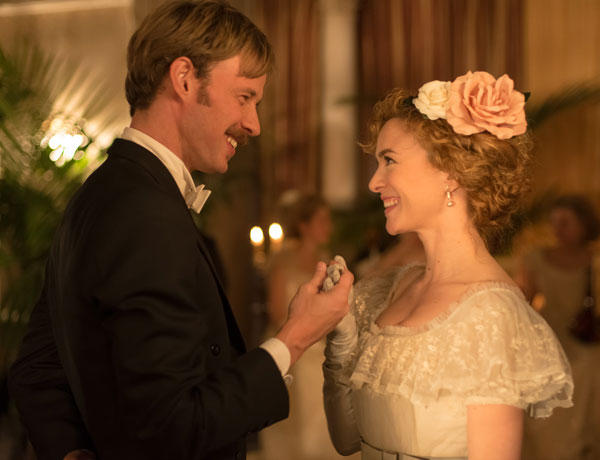
Sira's confidante, Rosalinda Fox, is the lover of Juan Luis Beigbeder, a Spanish high official stationed in Tetouan (a real-life couple, here played by Hannah New and Tristán Ulloa, above). Beigbeder was deeply opposed to Hitler and eventually failed to persuade Franco not to join the Axis countries. His relationship with Rosalinda, an English woman, was used to remove him from power once Franco joined the Axis (no doubt in exchange for German aid in winning his civil war). But in the meantime Sira has been recruited to spy for the English, whose interest, like her own, lies in keeping Spain out of the coming war.

Sira's infiltration of the German social scene leads to her entanglement with sexy beast, Manual Da Silva, a Portuguese entrepreneur (the excellent Filipe Duarte, above), who is close to inking a business deal with the Germans that will enable them to corner the tungsten market (the mineral required for munitions manufacture). And on we go with cloak and dagger involvement in the German build up to war mixed with sewing ball gowns for clients and gossiping to probe for information. We are treated to a host of plot contrivances and elegant fashions of the late 30's worn to perfection by our beautiful heroine.
'
The time in-between' may refer to the period between the two world wars but is definitely Sira's method of communicating with her English spy-master, Alan Hillgarth (also a historical figure, here played by Ben Temple) -- she uses Morse code marked as stitches on paper dress patterns ('costuras' = 'seams'). An attractive English journalist, Marcus Logan (Peter Vives) becomes Sira's love interest, mostly from afar, as she will blow her cover with her German clients if she is seen with an Englishman. Above, the pair are on the run from Da Silva's hit men. (Vives, whose biography reports he is a classical pianist, may have graced us with a melodious sample of Schubert from the stage of a concert hall at which our characters assemble in Episode 12.)

Once launched into Sira's world of espionage and couture, I gave into Adriana Ugarte's warmth and magnetism, despite tsk-tsk-ing all the way through at sappy melodramatics that drown real moments of sentiment. Some ruthless editing and direction could have cut the silliness from this romance of politics, adventure, and beauty in a time and place we know so little. The Spanish have plenty appetite for melodrama -- the series that have made it to Netflix, including Velvet and Gran Hotel, wallow in it.

The above post is written by our correspondent, 
Brooklyn-based Lee Liberman, who  
checks in monthly on a Sunday.

Thursday, June 11, 2015

Streaming follow-up: fans of Spain's gorgeous GRAN HOTEL finally get a third-season finale!


If comments on this blog are any indication, that delectable and beautiful soap opera via Span-ish television, GRAND HOTEL, has got to be one of the more popular foreign TV offerings currently avail-able on Netflix streaming. Fans have been begging the famous "content distributor" to give them that final season for nearly a year now. At last, here it is -- in 24 episodes of 44 minutes each.

When Season Two ended with the shock and jolt that left many of us with our mouths hanging open, some of us imagined that this indeed was indeed the end of the series -- in which the characters, many of whom were very bad people, got what they deserved. Still, we wondered, what about all the others? Now we know.

The series, based on an idea by a man and woman whom I would guess are the Spanish equivalent of what we over here in the USA call showrunners -- Ramón Campos (above, right) and Gema R. Neira (above, left), both of whom produced and collaborated on the writing of most, maybe all, of the episodes -- takes place in and around the titular grand hotel (filmed at the famous Palacio de la Magdalena) in the lush and verdant seaside locations of Santander in Cantabria, Spain.

Both outdoors and indoors, the series is a visual knockout, what with the gorgeous exterior shots and the highly detailed interiors -- oh, the flatware and china, the exquisite decor and costumes -- Gran Hotel proves a non-stop feast for the eyes. Comparisons have and will continue to be made to Downton Abbey, and they are certainly apt. But for my money this Spanish series beats out the British one, bigtime. Even if, I must admit, the third season does have its longueurs now and again. In order to reach its finale via those 24 episodes, a certain amount of padding is present.

Still, if you become as heavily involved with all these many, many characters as did I (and clearly many other viewers), it may be difficult not to become absolutely wrapped up in the often silly but always enjoyable plotting. This final season offers up the Alarcon's spoiled-rotten ladies' man son (Eloy Azorín, above, left) suddenly smitten with a nurse named Laura who has come to care for the wounded after season two's sudden "mishap." As played by Marta Hazas (above, right), this character proves a wealth of surprise, fun and, well, you'll find out....

Of course we have more of the Inspector Ayala (Pep Anton Muñoz, above, left) and his not-so-swift assistant (Antonio Reyes, above, right), both of whom manage to become even more fun as the series progresses, along with our ever-kept-apart lovebirds, Alicia and Julio (Amaia Salamanca and Yon González (on poster, top, and in the photo just below it), who remain as engaging as ever, though Ms Salamanca seems to have grown older and less lustrous, given all her poor character has had to put up with over 66 episodes.

Gran Hotel has become one of my favorite shows, due, I think, to the Spanish-ness of it all. I found it even more of a soap-opera than Downton Abbey, yet I liked it much better. These are some of the most memorable characters you'll spend this much time with -- so specific and interesting, despite the fact that they -- some of them, at least, like Doña Teresa, played by the very fine Adriana Ozores, shown center, above, in one of her more provocative moments -- get away with murder and somehow we still care about them. (This is one of the series' more troubling and interesting accomplishments.)

Then there's the whole "randy priest" thing involving our lying, murdering and adulterous Sofia (Luz Valdenebro, at ), along with the surprise of Javier finally learning to commit to his nutty wife (and the fact that he can only get an erection with her, of all things!).

And then, especially, there is Belén (played with enormous steel and force by Marta Larralde, shown center, above) -- who for some reason, despite her truly nasty deeds and utterly heartless demeanor, I'll remember best and with real fondness from the episodes in which she gives birth to and then loses her offspring -- a time in which she was most human, caring, vulnerable and sad.

Is there a villain in TV history you can hate more thoroughly yet find so damned sexy and alluring as that key character, Diego, played with such relish and smarts by Pedro Alonso (above, left)?  I doubt it.

This season, there are several new and very enjoyable characters, led by Alicia's dear friend Maite (played with delicious verve and flair by Megan Montaner, above) and the hotel's new and unusual maître d' (essayed by that fine and duly famous Spanish actor Lluís Homar, below).

With all its silliness and faults -- maybe even because of them -- I believe this to be an extraordinary series, like nothing else I can recall seeing. Its take on power, money and the coming of the Spanish middle class, and its joining, toward the end, of the wealthy to the poor (via "Duke" Alfredo and Doña Angela and her crew) I found most moving and progressive. Podemos would surely approve.

Gran Hotel, can be seen now via Netflix streaming or on DVD and Blu-ray. Do check it out. (That's the lovelorn, lovable and ever-naive Andrès, above, a waiter-turned-heir who is played by the uber-lovable actor, Llorenç González.) 

Friday, August 29, 2014

Streaming guilty pleasure (& what a pleasure!), the smart 'n spicy Spanish series GRAND HOTEL


Sure, it's a soap opera. Yes, it's a tele-novela. But there are times in one's life that sinking into a sleek, sure-footed piece of glamour like the Spanish television series GRAND HOTEL can be just the ticket to out-and-out pleasure. Think of it as the Spanish answer to Downton Abbey, with all the upstairs/downstairs goings-on, the coincidences and overheard conversations -- only a lot more fun.

TrustMovies is now finished with the first season of this very enjoyable show (it's streamable via Netflix) and will definitely be watching the rest of the episodes. (Netflix offers the first two seasons in a total of 14 episodes.) It's also a chance to see some fine Spanish actors strut their stuff -- from some old-timers like Concha Velasco and Adriana Ozores (below) to some hot, young newcomers such as Amaia Salamanca and Yon González, (above) who play the not-quite lovers kept apart by circumstance and class.

The cast (major players are seen below) is extraordinarily well-chosen, and each actor delivers the role in spades. The performances are juicy, all right, but they are all so on-target and specific that the series never tumbles over into camp. It may come close now and again, but these steadfast actors, together with scripts that keep the pacing fast and the characterizations smart, save the day.

The story?  Well, a young man named Julio (González, below) comes to the fine, titular establishment looking for his sister, who was employed there as a chambermaid but who has now disappeared. He manages to get a job at the hotel while looking for clues as to what happened to sis -- often with the help of the daughter (Ms Salamanca) of the hotel's dragon-lady owner (Ms Ozores, above, second from left).

Along the way Julio befriends the dragon lady's son (below, right, who proves a nasty, unfeeling shit), along with another of the serving staff, whose mother (Ms Velasco) is in charge of the chambermaid staff. All the while, class and economic differences are made plain, and we see what the one per cent against the 99 looked like a century ago.

At least one murder occurs, and a high-level detective is sent from the big city to investigate; financial problems pile up, and both the dragon lady's daughters find themselves in a troubling romantic situation: one from a husband who now wants out of his marriage, the other from a suitor who doubles as the hotel's manager (at left in the photo at bottom) and is one supremely nasty piece of work.

All this is deftly juggled for terrific entertainment. And the look of the series is spectacular. From the opening credits, using archival photos, to the sets, costumes and antique cars--everything proves a visual knockout.

So, if you want to spend some time (14 episodes with each one around 45 minutes in length) in this glamorous venue with characters you'll come to care for (or hate), take a chance on Grand Hotel. Stream it now on Netflix, and you'll be hooked by the time you've hit episode three.... 

Tuesday, December 24, 2013

HEMLOCK GROVE: Netflix's not-so-hot but very well-cast original series proves mostly vamping

Various dictionary definitions of "vamping" tell us that it is something patched up or refurbished, maybe rehashed, as in a book based mostly on old material. All this could easily describe HEMLOCK GROVE, the original Netflix series that you are likely to have heard the least about, what with House of Cards, Orange Is the New Black, Lilyhammer and even Arrested Develop-ment (not entirely original to Netflix) stealing most of the thunder. But the definition of vamping that most applies to this odd and derivative series is the one that comes from music: an introductory musical passage commonly consisting of a repeated succession of chords played before the start of a solo. Its purpose: to keep that solo at bay for as long as possible.

This solo, in the case of Hemlock Grove -- written/developed/executive produced by Brian McGreevy (at right, below) and directed (six of the episodes, at least) by Deran Sarafian (at left) -- is the question that anyone watching the series will be asking from the very first episode in season one (the series has already been renewed for a second season): Who's the creature that's doing the killing? To avoid answering this question, the series simply vamps. And vamps. And vamps.  There is at best maybe two hours of content (or, say, one full-length movie) to this 13-part show, each part of which takes nearly one hour to unfurl. What this means is an incredible amount of vamping. So much so, that you may very well take

to screaming "Get the fuck on with this!" any number of times during any number of episodes. Because of this vamping, some very good actors are left twirling in the wind, as it were, having to repeat their actions, if not their exact words, again and again, just to keep that solo at bay. This is especially true of Famke Janssen (below) and Dougray Scott, as, respectively, the matriarch and patriarch of branches of the family that control the titular town. (The Janssen character really has the town under her thumb; Scott is simply a sex toy/in-law.) The series has been organized and written very much in the style of soap opera, with all the neces-sary over-writing/under-acting that goes along with this tiresome genre.

TrustMovies actually stopped watching the series twice, then went back to it after a time. As with most soaps, it was quite easy to pick up again. (There is so much vamping going on that nothing much happens. Consequently, anything you've forgotten won't matter much.) Lots of characters are introduced along the way, a number of them pretty young girls who get "offed" by the beast, but two young men finally prove to be the heroes of the piece: Bill Skarsgård (below, left), who plays Janssen's creepy son, whose character broadens a bit during the 13 hours, and sensitive lunk Landon Liboiron (below, right), who plays a new-in-town, gypsy type, high school student with his own mom (Lili Taylor) in tow.

Though the Janssen side of the equation is clearly pretty weird (read supernatural), we learn fairly quickly that Liboiron's family are, uh, werewolves, and we see the special effects department in full force for one major transformation (below) early on.

There's an investigator from the Fish & Wildlife department snooping around who has some connections with a certain branch of the Catholic Church, various police officers who behave crassly or nicely as the script necessitates, and various other family members, each possessing his or her own sad story.

Oh, yes, and the family owns and operates a hospital/medical/
experimental center with another bizarre character (Joel de la Fuente) in charge, and a very secretive, big box inside of which resides... (another question viewers will want answered).

Not to worry. The nasty beast is indeed unmasked in the penultimate episode (this is not one of those keep-the-answer-out-of-reach series like The Killing), and the final show answers some more question but mostly keeps things open for season two.

As I say, there is only enough content here for a couple of hours, but if you're particularly taken with any of the performers or characters, you may give in to the ongoing blather, which certainly succeeds in keeping the series going but not in making it exciting or especially interesting.

By Episode 9, a little suspense and anticipation are engendered, and we get a funny/lovely/creepy story about a fairy -- which shows how some decent writing can suddenly bring a whole series to real, detailed life. But then it's back to the same old tired stuff, mostly family arguments. There is one pretty interesting character: A strange young girl (Freya Tingley, shown center, above) who's determined to become a writer. McGreevy, I am guessing, must have based her on himself.

We do eventually learn the name of the beast -- it's a vargulf, for anyone interested. Some of the directors here seem overly fond of handing us suspenseful moments that come to absolutely nothing. More vamping, I suppose. The pacing is often glacial, due to all the gazing into each other's faces, while pronouncing the strained dialog. There's a good deal of sex, too, but it's nothing you won't have seen elsewhere and better.

It often seems as if, in Hemlock Grove, the creators simply tossed everything they could think of into the mix, feeling sure that something would stick. Something does. But too much else stinks. The show can be streamed only on Netflix, where you can see as much or as little in one sitting as you can handle.