Thursday, September 10, 2015

Digital & DVDebut: Madellaine Paxson's creepy, frisky, funny genre piece BLOOD PUNCH


What might you get should you shake together Groundhog Day, The Treasure of the Sierra Madre, Time Crimes, Scarface, Edge of Tomorrow and Jean-Paul Sartre's No Exit? That's some range of styles and genres, I know, and I doubt very much whether all those movies (and one play) were on director Madellaine Paxson's and writer Eddie Guzelian's conscious minds as they came up with the funny, frisky and occasionally ferocious BLOOD PUNCH, the award-winning-at-festivals genre piece currently making its DVD and digital debuts this month. But you've got to hand it to them: the duo has turned out a nifty little movie that would probably make all those other movie-makers, along with that famous French philosopher, duly pleased.

Paxson (shown above) and Guzelian begin their film as our brainiac hero, Milton (Milo  Cawthorn, below, right), awakens into, yes, a nightmare. Then we flash back a bit to the drug rehab center and a support group in which the stories told by the members are about to bore us to death when a new girl named Skyler (Olivia Tennet, below, left) suddenly opens up and changes everything.

We're then whisked off to a mountainside retreat where we meet Skyler's original boyfriend, Russell (the very hot Ari Boyland, below), and all sorts of weird things begin to happen. If M. Sartre insisted that hell was other people, and Groundhog Day indicated that it might consist of constant repetition, Blood Punch combines the two, along with some other ideas, to offer up a quite original little hell of it own.

What distinguishes the movie, in addition to its smart and tingly story, are the especially good performances Ms Paxson draws from her excellent cast.  Cawthorne's nerdiness works well for the humor, but the actor also possesses enough sex appeal and strength to work as the films more-or-less hero, while Tennet is full of sass and naughtiness and enough mystery to keep us guessing.  Boyland -- with his goofy grin, gorgeous body and face, and loose-canon menace -- is a cringe-worthy delight. I wish he'd been given a little more to do.

The movie -- a combo of sci-fi, fantasy, horror and scientific mystery -- is basically a three-hander (which for a time, moves up to five characters). What holds us in thrall most of the way along is the simple question of what is happening here, and why. That the filmmakers manage to pull this off for a full 107 minutes (that's long for this genre) should give you some sense of how special this particular movie is.

From a technical standpoint Blood Punch is well done, too. What special effects there are tend toward the bloody variety, though much of this is used for humor rather than ugliness. And the filmmaker's choice of music is smart and original, as well.

From Midnight Releasing, the film hit DVD and Digital venues as of September 1.

Wednesday, September 9, 2015

Mélanie Laurent's beautifully-acted BREATHE creates its own special, unsettling genre


TrustMovies won't attempt to define what the new and special genre mentioned in the headline above actually is, for fear of unveiling a spoiler en route. Best to simply say that this new film begins as one thing and ends as quite another, with each step along the way providing a believable and enjoyable experience. BREATHE does not so much jump genres as turn into its own, sui-generis example. In the annals of oh-my-god-how-did-we-get-here? stories, this one is a keeper: psychologically, emotionally and intellectually sound.

Mélanie Laurent (shown at right) -- the film's director and co-adapter (with Julien Lamborschini) of the novel by Anne-Sophie Brasme -- is best known as an international actress of some repute (Enemy, Inglorious Basterds and Now You See Me, plus, in her home country, a couple dozen good French films). Breathe is her second full-length feature as writer/director (her first, The Adopted, was not released over here), and by any standard, it's a good one. Tracking the life of a very pretty, intelligent, somewhat shy and unformed high-school girl, the movie stays close to the kind of reality with which most of us can identify, having lived through something at least vaguely similar while growing up.

Parental problems, peer relationships, what to do about sex, and then, finally, the kind of attraction to another person that can become obsessive -- all these are threaded throughout Ms Laurent's narrative easily and gracefully, and the performances the filmmaker has drawn from her excellent cast are spectacularly good without a bit of grandstanding on the actors' part.

In the lead role of Charlie, the beautiful Joséphine Japy (two photos above) gives the kind of fluid, moment-to-moment performance that allows us to see the inner and outer young woman equally well. Matching Ms Japy is her co-star, Lou de Laâge (above, left), who, as the new student Sarah, creates a figure of sophistication, sex appeal, mystery and occasional vulnerability and nastiness that begins to haunt us just as she does Charlie.

The more we learn about Sarah, in fact, the more problematic she becomes and the more we fear for Charlie. What finally happens may be unjustifiable on some level, but it is completely understandable on another. The movie becomes a kind of morality tale of and for youth: Your actions have consequences, children, and some of these will be unintended and -- unfortunately -- permanent.

The rest of the fine cast are up-to-snuff, too: Ms Laurent is able to draw specific and terrific moments from her entire ensemble, with the versatile and glowing Isabelle Carré especially commendable as Charlie's emotionally-abused but all-to-wiling-to-go-there mother.

The French -- ever philosophic and often deliberately contrary -- are particularly good at serving up stories that at first glance look typical, even run-of-the-mill. Then, by broadening and deepening them via characterizations and behavior that are anything but run-of-the-mill, they hook us and take us places we might never choose to go.  Breathe is one of the better examples of this. Miss it at your peril.

From Film Movement and running a succinct 91 minutes, Ms Laurent's movie opens this Friday September 11, in New York City at the IFC Center and on Friday, September 18, in Los Angeles at Laemmle's Royal. To view all currently scheduled playdates, click here and scroll down.

Tuesday, September 8, 2015

In Morgan Matthews' A BRILLIANT YOUNG MIND, a smartypants adapts to life and love


Asperger is fast becoming the syndrome of choice for movie-makers who want to explore smarter-than-thou characters who also suffer from not fitting in. All the better, of course, if a happy ending can be arranged in which their skill allows them to triumph over their oppressors. A BRILLIANT YOUNG MIND (formerly known as X+Y), written by James Graham and directed by Morgan Matthews, based in part on the latter's earlier documentary feature, Beautiful Young Minds, somewhat subverts this scenario to good effect.

If, as many viewers noted about last year's award-winner The Theory of Everything, there was damned little science shown in this movie about one of the world's great scientists, that is not true of this new film about an Asperger-plagued mathematics whiz, nicely limbed by Asa Butterfield (below, of Hugo and Ender's Game). We get a good dose of higher math here, and the experience is bracing -- even if we don't fully understand that math. Mr. Matthews, shown at left, has wisely combined a smart mixture of math, handicap, coming-of-age, and competition.

If the end result seems attained a tad too easily, there is also a sacrifice involved -- which goes some distance in making the movie more palatable for thinking adults. And if the filmmakers' "take" on Asperger is nowhere near as strong and real, say, as in the better movie, Adam -- which makes the syndrome something not able to be conquered by love and/or wishful thinking -- at least viewers can take respite in the raft of excellent performances that this newer movie offers up.

As the math whiz's mom, veteran Sally Hawkins (above, right) gives another dazzlingly energetic -- funny, moving, real -- performance, aside the two men who mean most in her life: her late husband (a lovely job by Martin McCann) and the tutor with emotional and physical problems of his own who has taken her son under wing (Rafe Spall, above, left).

Add to the mix another crack job by the versatile Eddie Marsan (above) as the group tutor who travels with the kids to Taiwan for the qualifying round of the Math Olympiad, and you have a terrific little ensemble. Hawkings, Marsan and Spall are masters at combining quirky reality with the kind of improvisational style that ends up seeming like life "heightened" -- funny, moving, surprising.

A little love interest is provided by Jo Yang (above, left) as the Chinese girl our hero hooks up with in Taiwan. But the movie's most memorable performance, oddly enough, comes from a supporting actor, Jake Davies, below, who plays the angriest, darkest of the young contenders. Davies, together with the role Graham has written for him, brings all the complexity and difficulties of Aspergers to the fore, confronting us with the kind of reality that feel-good films can't handle. A Brilliant Young Mind is good, all right. But I'll bet you'll wish it were better.

The movie, from Samuel Goldwyn Films and running 111 minutes, opens this Friday, September 11, in New York City and Los Angeles, with a nationwide rollout to follow soon.

Monday, September 7, 2015

A great film finally hits USA screens -- Edgar Reitz's HOME FROM HOME: Chronicle of a Vision


First released around the world in 2013 but only now seeing its U.S. theatrical debut (thanks to Corinth Films), HOME FROM HOME: Chronicle of a Vision is the work of a German filmmaker -- Edgar Reitz -- not so well known in the USA, probably because much of his work (like that of another under-seen German filmmaker, Dominik Graf), has been made for German television. Herr Reitz, shown below, is the filmmaker best known for the Heimat series (and its offspring). TrustMovies has not seen that very lengthy, three-pronged, multi-part endeavor, but now, having viewed this film, Heimat is on his list.

Home From Home itself runs over three and one-half hours, but before you decide to take a pass, let me say that this is one great film: rich in theme and characterization and done in an old-fashioned story-telling manner (but using up-to-the-minute technology) to produce something that will rivet you visually, intellectually and emotionally from first scene to last. As both director and co-writer (with Gert Heidenreich), Reitz knows how to grab us immediately and hold us fast throughout.

His dialog and story, narrated by its protagonist, Jakob Simon -- played with a fine combination of sweet naivete, strength and almost idiot-savant intelligence by newcomer Jan Dieter Schneider, shown at left -- are offered up in a manner that is beautifully rendered: literary, often flowery, full of specifics, yet sounding real and of-its-time, artful and rich in ideas. (It's a pleasure to read the fine English subtitles.)

Visually, Home From Home is spectacular. Anyone who appreciates sumptuous black-and-white cinematography should have a field day here. Further, all this is occasionally leavened with moments of sudden color that adheres to certain objects: a molten red horseshoe, blue wall, orange geode, brown eyes and the like.

Initially, this may remind you of that too-much moment of red tossed in toward the end of Schindler's List. But, no: this use of only-now-and-then color occurs often enough throughout -- at moments and with objects of some importance to the film -- that it lends a kind of mythic quality to a story that is indeed that.

Home From Home is a film about coming-of-age of an exceptional young man under exceptionally trying circumstances, and it is also a tale of a country, a people, experiencing the need to expand and emigrate, perhaps for the first time in its relatively young history. Occurring in the mid-1800s, it takes place in a small German town, where everyone knows everyone, and in fact may even know everyone in the next town over, as well.

We have father/son conflict and mother/son love, brother-to-brother competition, a banished sister, adventure, incipient sexuality, the joy of learning, the drudgery of work, near-death and death itself. Moments happen, from the hugely important to the mundane, and they are all part of the wondrous tapestry Reitz has fashioned, as our hero Jakob, with his fascination for Brazil and its natives and their language, grows from boy to young man in the midst of a German town that is re-created about as well as any time and place of two centuries past that film has so far given us.

The rest of Reitz's cast is equally fine; each family member or friend comes to fully rounded life. (Look for a lovely few moments from Werner Herzog, too, in a small but pivotal role near the movie's end.) It is so unusual to find a film this old-fashioned in its depiction of a family saga yet thrillingly current in its technology and thematic concerns. This is a wonderfully humane work, as well: Reitz, while understanding the economic and class disparities present, does not go out of his way to find villains to pillory. Just getting on with the life of the time is difficult enough.


Another top-notch example of the Corinth Films catalog, Home From Home, after appearing yesterday at the San Joaquin International Film Festival Autumnfest, will open in New York City for its U.S. theatrical premier at Anthology Film Archives for a one-week run this Friday, September 11. It will the hit Hartford, Portland (OR), Cleveland and Scottsdale in the weeks to follow -- and maybe more cities, once word-of-mouth begins. Click here then scroll down to view all currently scheduled venues and dates. Note: The director and his star will be available for a Q&A following weekend AFA screenings in New York. Several of Herr Reitz's other films will screen alongside Home From Home. Consult the AFA schedule for details .

Sunday, September 6, 2015

Try putting yourself in this community's shoes: Nichols and Walker's doc, WELCOME TO LEITH


What an unsettling documentary is WELCOME TO LEITH -- and for reasons that go well beyond the immediate problems at hand for the minuscule community of Leith, North Dakota, in which the events we view take place. A tiny town with only 24 residents, Leith suddenly got a new one back in 2012, when a fellow named Craig Cobb arrived and began buying plots of land. The rare newcomer would normally be welcomed in a place like this, and so he initially was -- until the Southern Poverty Law Center (SPLC), which had been tracking Mr. Cobb for a long while, unveiled him as a notorious white supremacist with plans to take over the town and its government. Owning twelve plots of land, as he eventually did, would make this rather easy in a town of 25.

However they managed this, the dual directors -- Michael Beach Nichols and Christopher K. Walker (pictured above with Mr. Nichols on the left) -- were given surprising access to both the townspeople and the white supremacists, including especially Mr. Cobb (below, center) and his sort-of deputies, a couple named Kynan Dutton (below, left) and Deb Henderson (below, right).

What this access and its resulting information achieves has less to do with changing any minds and hearts -- most viewers, I suspect (or at least hope), will reject Cobb's message as loathsome and dead wrong -- but what will begin to trouble them, perhaps, is whether or not the man and his followers have any right to voice that message. And, further, what, in terms of hate speech, constitutes a real threat to life and limb?

The filmmakers seem to have been about as "fair and evenhanded" as possible in showing us the two sides. Mr. Cobb comes across as nasty, hateful and perhaps near-certifiable (hearing his past via a rep from the SPLC adds to this assessment). And seeing him parading around carrying a loaded rifle doesn't help matters.

But as the movie continues and testimony is considered (and then withdrawn and/or waived), some doubt settles in regarding just how huge a threat Cobb and his followers actually were. I sure as hell wouldn't want them anywhere near my local community, but, still -- what exactly does our first amendment mean and guarantee? That the film will raise this question so strongly among alert viewers is a testament to its search for more than blame and simple answers.


Along the way, we meet the pre-Cobb inhabitants of Leith, and quite a decent lot they prove to be. One of them is a black man whose very presence in Leith, perfectly fine by everyone else, becomes a slap in the face to the supremacists whose dirty tactics involve everything from ugly slogan-spouting to blaming/shaming one of the other citizens for the death of his own daughter.

Less of an it-could-happen-here! warning (America has few remaining towns as small and distant as Leith) than an exploration of how hate speech can or might turn into hate action, and what, if anything, can be done about this beforehand, Welcome to Leith, in both what it shows us and what it asks us, proves troubling to the max.

The documentary, from First Run Features and lasting 85 minutes, opens theatrically in New York City at the IFC Center this Wednesday, September 9, and will hit another 20 cities around the country over the coming weeks and months. You can view all currently scheduled playdates by clicking here and scrolling down.

Addendum: Welcome to Leith hits video today, 
February 9, 2016 -- for sale or rental. 
So there's no excuse not to see 
this surprising, troubling documentary.

Saturday, September 5, 2015

Oh, lordy! Timothy Woodward, Jr.'s jaw-dropping CHECKMATE make its DVDebut


If you've a mind (and the patience or maybe courage) to discover what bottom-of-the-barrel currently looks and sounds like, movie-wise, by all means watch CHECKMATE. This brain-boggling, jaw-dropping piece of nonsense features a bunch of actors who've all seen better days and now make utterly disposable films -- the least of which may be this one, which occasionally comes very close to entering the realm of unintentional camp. It's almost bad enough to be good.

Why is Checkmate so terrible? The director/co-producer, Timothy Woodward, Jr., shown below, hasn't a clue to most anything from pacing to action, and he is saddled with one of the worst screenplays imaginable, credited to Calvin Cox, Jr., Jennifer Lynch and Henry Mitchell, who are, according to the IMDB, neophytes all.

These writers' objective, it soon appears, is to discover how many times they can cram the word "fuck" (and its many variations) into a single full-length film. If you start tallying from the beginning, Ill bet you'll be well into the triple digits before the movie ends. Their one remotely original idea (perhaps only because this particular reviewer has not seen it done previously) is to make one of their characters a priest who doubles as a paid assassin.

In any case, the bank robbery around which the film revolves is embarrassingly staged, as are the actions of the police on hand. There's lots of over-acting on view, to be expected when the script is this bad. And, perhaps because the filmmaker is a Southern boy who wants to toss a bone to Christian fundamentalists, we get a simultaneous sub-plot involving God and the devil in a chess match. But the filmmaker clearly doesn't know chess well enough to allow us to see any of the moves being played. So this, too, fizzles out. Whew.

Films like Checkmate do serve a purpose. They act as a kind of touchstone for all else you might view. After this one, just about anything you watch will appear to have some merit. The movie hits the street this Tuesday, September 8, on DVD.

Friday, September 4, 2015

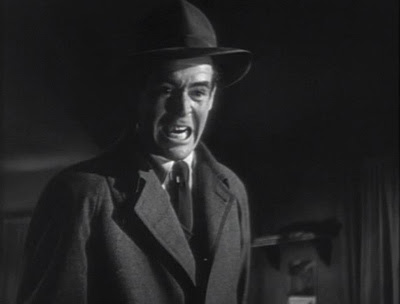
The actor's actor: Robert Ryan festival begins today at New York's Anthology Film Archives


"What a man!" That was how my grandmother always remembered her accidental meeting with actor Robert Ryan in a California bus or maybe train station (I was a kid at the time she first told me about this and can't remember which it was). They chatted for awhile, long enough, at least, for her to recall, "He was a perfect gentlemen, and so gracious and kind!" She felt he was hoping to get to know her further, but when she explained to him that she was married, he immediately stopped that line of pursuit.

A huge movie buff, my grandmother followed the lives and performances of actors and actresses as though they were family, and although Ryan's acting often left her cold -- he was too good at playing villains -- she never forgot that meeting, and the actor moved immediately to the top of her list, replacing even Robert Taylor, whom I always thought she kept in primary position only because he was married to her favorite actress, Barbara Stanwyck.

Grandmother would have been first-in-line to view the new series -- Robert Ryan: An Actor's Actor --beginning today at Anthology Film Archives in New York City. Offering only six of the actor's many movies, the films chosen manage to display Ryan's range and capabilities quite well. TrustMovies has seen five of the six (there were no screeners for About Mrs Leslie) and can attest to Ryan's enormous charisma and talent in each. Any one of the films is a must-see if you haven't, and probably a view-again, if you have.

You can check out the entire schedule here, as well as finding info about, directions to and ticket availability at AFA by clicking the appropriate links.

Wednesday, September 2, 2015

Eskil Vogt's startling and original new film takes us far and fiercely into the mind of the BLIND


What an unusual -- and unusually intelligent and psychologically astute -- movie is BLIND, the first full-length film to be directed by Eskil Vogt, the fellow who earlier co-wrote two other highly-regarded Norwegian films, Reprise and Oslo, August 31. Most films about the blind use this handicap for purposes of thrilling us (Wait Until Dark), plucking our heartstrings (At First Sight) or, more lately, showing us how the loss of one valuable sense only leads to the heightening of all the others (Netflix's brilliant new comic book-based series, Daredevil).

What interests Mr. Vogt, shown at left, is something else entirely: the state -- mental, physical, sexual, spiritual -- of being blind and what this can do to the suddenly no-longer sighted. That's a big order. What makes Blind even more impressive is how quietly and intelligently the filmmaker manages this. He allows his heroine, Ingrid, (Ellen Dorrit Petersen, shown below) to narrate, bringing us into her life in her own quiet manner, and we're of course with her all the way. Poor girl.

The key, she tells us, lies is in remembering things correctly. Such as the dog -- a German Shepherd -- or a department store. And so she remembers both. But wait: What is the dog doing inside the department store? Oh, yes -- and the poor girl's husband: addicted to porn web sites and voyeurism! The first fifteen minutes of the film, in fact, are practically a voyeur's delight. What with all the porn we see, and that sleaze of a hubby.

And then there's the neighbor (Vera Vitali, above) -- a divorced mom with a young son to care for. Wait a minute: I'm wrong. She has a daughter. And about that husband: there are actually two of them, one portrayed by that excellent actor, Henrick Rafaelsen (of The Almost Man), below, left, and the other by Marius Kolbenstvedt, below right, and also first-rate. There is so much going on here, but Mr. Vogt juggles it all quite snazzily, with superb visual flair underpinned by psychological realism and performances that make the bizarre seem almost credible.

Fantasies abound -- of being watched, of being highly sexual, of being another person entirely -- and the movie offers a surprising amount of humor, too. (Does that device for sorting laundry when you're blind actually exist? If not, someone should invent it!) And because the characters here are cultured and au courant, there are references aplenty for us to latch onto (the director's cut of Mask figures in rather prominently).

Oddly, as the movie grows weirder and crazier, it also becomes clearer what is going on. This juxtaposition works with surprising brilliance, finally offering up a film that is about as original a look at the world of one very particular blind person as you are likely to encounter.

From KimStim and Fandor, Blind opens this Friday, September 4, in New York City (at the IFC Center) and next Friday, September 11, in Los Angeles (at the Cinefamily), simultaneous with its debut on Fandor.
However you choose to see it, do.