Showing posts sorted by relevance for query Outlander. Sort by date Show all posts

Sunday, June 14, 2015

Sunday Corner with Lee Liberman: OUTLANDER ends w/NC-17 stunner To Ransom A Man's Soul


After reading Diana Gabaldon's Outlander novels and seeing showrunner Ronald D Moore's 16 episodes of book 1 on Starz, I find both artists waging guerrilla social warfare between the covers of a classic bodice-ripper. Real emotional, historical, and medical content sabotages the saccharin romance formula we wouldn't be caught dead reading/watching -- "Jesus H. Roosevelt Christ!" (heroine Claire's favorite swear). While likely finding few converts among Edith Wharton or Hilary Mantel fans, OUTLANDER has elevated the content value for romance consumers above that of say, Downton Abbey, while keeping faith with all the tropes of the genre.

There's Jamie, daring noble hero; Claire, lovely stubborn heroine, a WWII nurse who has fallen through time from 1945 back to 1743; sadistic villain, Captain Jack Randall; and throbbing plot doings that include the beautiful mysterious Geillis and McKenzie clan politics.

A cinematic ending tops off book 1-- a wide-angle portrait of wind-swept lovers embracing on a gorgeous 18th century sloop as they leave their troubles in Scotland and cross the channel to new adventures in France -- a picture perfect image befitting the paperback book covers on the turn-stand at your local drugstore.

But it so happens that Gabaldon's 3 science degrees and her faithful interest in the details of history, medicine, and human behavior add surprising substance to the pocket romance formula. Filmmaker Moore mostly succeeds in following her intention. At least this pair is forcing the romance consumer to think as well as feel; at best the last episodes of Book I may help redefine how rape is portrayed for the violence it is, not the male fantasy it has always been. Here's how Outlander ups the game.

First is 20th century medically-trained Claire's confrontation with a woman's place in the 1700's -- not to her liking. Having disobeyed her new husband Jamie, she falls into the hands of the British, forcing Jamie and his MacKenzie relations to mount a dangerous rescue. According to custom, justice must be be meted out to Claire for having put all the men's lives at risk. Jamie beats her with a strap, to which she responds with 20th century outrage. We are taught to work fast to distance ourselves from a violent partner. Here we are gently persuaded to 18th century realities. Jamie is a gentleman and a leader, not violent except in combat. Gabaldon forces us to confront the perils of a time in which punishment is demanded when one person endangers the welfare of many. Ultimately we and Claire grudgingly come to differentiate between "abuse" and "justice." The threats to their relationship seem to result from Jamie and Claire's roots in different millennia, but all partners negotiate differences as deeply felt as theirs. The battles with each other (above) stand in for the struggles in every relationship in which mutual respect is hard won.

Even more trauma unfolds with Jamie's later capture by the British (a price remains on his head for a false accusation) and falling into the hands of villainous captain, Black Jack Randall, a sadistic, morbidly dark homosexual. Pictured below, Claire has gotten into the prison and Jamie persuaded Randall to release her in return for his submission to sex.

An episode and more is devoted to Jamie's plight in prison and later rape and torture by the mad captain. It unfolds in flashback after the MacKenzies have driven a herd of cattle into the prison, snatching up Jamie during the ruckus and delivering him to a monastery. Randall's abuse reflects Gabaldon's intuitive or actual knowledge of behavioral psychology. Randall is not just about rape and torture -- he seeks to possess Jamie body and soul by making Claire repellent to him. Hence Randall impersonates Claire while both physically torturing and making love to him -- in effect he 'conditions' Jamie to be repelled by his wife as if she were his instrument of torture. Fine direction by Anna Foerster shows but mostly infers Randall's manipulating Jamie into submission, leading to his fevered, delusional state after the rescue, rejecting Claire and begging for death. In the film, Moore mysteriously puts in clan member Murtagh's head the idea that was properly Claire's to restore Jamie's sanity --joining him in his darkness. We see Claire's intuitive version of a modern cognitive behavioral therapy called 'exposure therapy' that is used now to treat soldiers and other victims of PTSD.

In a modern therapeutic setting, a patient is repeatedly walked through violent memories which gradually lose their hold in a 'de-conditioning' process that extinguishes their power. Claire's method is cruder and more drastic. Using opium and Randall's lavender scent she impersonates him, rousing Jamie from his delusional state to fight off his torturer which he could not do in prison. In the book they tear apart his monastery cell until both are spent, but Jamie wakes in the morning with his fever broken, in effect having defeated his torturer. In Moore's version the brawl is too brief and Claire talks it through with Jamie, a less medically- feasible means of recovery -- "talk" does not pierce a delusional state, as anyone knows who has tried to reason with an addict. Gabaldon's version played out logically in the beautiful abbey chapters concluding her first book.

There, in a French monastery headed by a Fraser uncle of Jamie's, unfolds a plausible respite and recovery for the characters and the reader. Moore's abbreviation of the rape aftermath and recovery is my first major quarrel with the filmed version of Gabaldon's work. It short-changes Jamie's recovery and also our own from perhaps the most dramatic story-telling ever on television. At least one episode (The Watch) could have been dropped to allow it.

Still, a catharsis is pronounced and we accept it, for as the Frasers sail away to France, the gorgeous, sweeping sea departure morphs in our minds from a scene on a romance book cover to overwhelming relief that our couple's relationship has survived.

Much more happened in the second 8 episodes of the first book including a witch trial, a visit to Lollybroch, Jamie's ancestral home (above), and our introduction to two lovely characters -- sister Jenny and brother-in-law Ian (Laura Donnelly and Steven Cree, below) -- who will reappear in future. Also Claire reveals to Jamie the story of her time-travel through the stones; he takes her there and tells her to go back: "There is nothing for you here except violence and danger...." (see photo at bottom).

Despite the rest of the sturm and drang that befalls our hero and heroine, there's not anything on tv that can top the authentic portrayal of maturing love in Outlander and also the treatment of rape as the violence and betrayal that it is. It could not be told as well with a female victim without seeming politically incorrect in the extreme. Also, with Jamie as the victim, male viewers (40% Outlander fans are men) are very able to empathize with such cruelty, which conflicts with the male rape fantasy of women. The recent rape of Sansa in Game of Thrones instantly felt outdated and unworthy. Can a film industry largely run by men improve its thinking on this subject? Maybe Outlander will be a turning point.

The Gabaldon/Moore Outlander seasons have achieved some unusual emotional coups. Tobias Menzies and Sam Heughan were particularly brave and vulnerable in their painful scenes as sadist and victim. All the artists involved deserve kudos for taking the bodice-ripper genre into believable realms of human emotion.

Outlander is available now on demand at Starz. My earlier review of the first 8 episodes is here. Moore reports that filming is in progress on Gabaldon's second book, Dragonfly in Amber which moves Jacobite politics to a new setting -- the French court of Louis XV.

(The above post is written by our
monthly correspondent Lee Liberman.)

Sunday, October 12, 2014

"How can I remember something that hasn't happened yet?" Moore/Gabaldon's OUTLANDER


This month's Sunday Corner was written by 
our oft-times correspondent, Lee Liberman

The Starz network has come into its own with OUTLANDER, new rival to Game of Thrones and Downton Abbey for saga-binging. An historical romance fantasy adventure, the series was developed and is executive-produced by sure-footed tall-tale teller, Ronald D. Moore (Star Trek Next Generation, Battlestar Gallactica, et al). It's also the product of collaboration between Moore and best-selling novelist Diana Gabaldon. Her imaginative story-making is industry (many books, now yielding travel and knitting industries) and her creation of lovely heroine Claire is a gift to women which I'm sorry to say, Moore messes with slightly. He's too smart to greatly alter Gabaldon's beloved franchise (and its ready-made audience), but Claire is diminished on occasion with doe-eyed helpless affect that contradicts her character. (Take a note, Mr.Moore, from Game of Throne's Arya Stark and Ygritte and Downton's Mary Crawley.)

(Sonia Saraiya, writing for the A.V.Club, points out that the pull for women to both Downton Abbey and Outlander is the focus on the perils of womanhood even among upper class women; both projects are both feminine fantasy and feminist critique, as women silently or explicitly voice objection to their status as property rather than person.)

Moore (above, left) and Gabaldon (above, right) may influence each other going forward. Moore is a master of suspense, extracting intensity and emotion from events that flow smoothly through Gabaldon's exposition. He errs, however, in condensing her narrative in spots, jamming kidnappings, attempted rapes, and sadistic beatings so close together that the viewer's willingness to suspend disbelief is taxed (episode 8 contains two attempted rapes). To his credit though, Moore makes magic devoting an entire episode to the heroine's engrossing confrontation with the story's villain and another full episode to the consummation of the relationship between hero and heroine -- these events near perfectly rendered on film.

Our heroine Claire Randall (Caitriona Balfe, above) establishes her cred when we first meet her as a WWII British army nurse serving at the front and covered in soldiers' blood. She and husband Frank (Tobias Menzies, below, left) have been separated by war, he having served as a spymaster in London for the duration.

At war's end they reunite for a second honeymoon in the Scottish Highlands, where Frank, an historian about to take up a post at Oxford, is researching his ancestry -- in particular of one Black Jack Randall, a notorious British army commander who served 200 years earlier in the same Highlands locale. The couple visit historic sites near the town of Inverness including the clan MacKenzie castle ruin, above, where infamous Black Jack and his dragoons (armed soldiers) suppressed rebellious Scots during the Jacobite era. Frank Randall's history lessons become touchstones for Claire as her story unfolds.

Centuries-long Protestant vs Catholic struggles in Europe surface here in the Jacobite uprisings that came to a head in the 1740's. The Jacobites were supporters of Catholic Stuart King James II ('Jacobus' means 'James' in Latin) and they continued to plot the overthrow of Protestant King George II, aiming to restore a Catholic Stuart to the English throne. The rural Highland population was still governed feudally by clans whose fighting men skirmished intermittently with British occupiers (oh Braveheart!). Sad to report of actual events, the Scotch were decisively defeated in 1746 at the battle of Culloden. They suffered terrible losses, after which the British put the clans out of business for good (including the MacKenzie, into whose hands Claire falls), even shipping rebel fighters to colonies as indentured servants. (The Scottish independence issue was settled again -- for now -- by election on September 18, 2014 with a vote to retain ties with Britain.)

A few days into their Highlands holiday, Claire motors 5 miles from Inverness on her own to revisit an ancient henge of stones on a hill. As she grasps the tallest stone, the wind rises and roars, heaving Claire through time. She lands in place at the ancient site among the stones -- 200 years earlier in 1743.

At once she finds herself caught up in a skirmish between British soldiers and MacKenzie men and is soon waylaid by her husband's Randall ancestor, also played by Menzies (above), whose Edmure Tully in Game of Thrones was lightweight material for his acting chops. Here he plays charming Frank and evil Black Jack so well that we hate bad Randall on sight and become torn over Claire's determination to return home to mirror-image Frank. (Also, we see what acting is about as Menzies transforms himself, below.)

For now, about to be raped by Black Jack, Claire is involuntarily rescued by a hairy lout in a kilt who delivers her to a hideout where clan MacKenzie war chief, power player, and enforcer, Dougal MacKenzie, acted by the marvelous Graham McTavish (shown six photos below), is waylaid by his nephew's dislocated shoulder.

That would belong to our hero, Jamie, who can barely sit up, never mind ride, and they must move, as Black Jack is in the area. His prey includes Jamie, who has a price on his head for a murder he did not commit. Jamie is young laird of his own small estate, but is forced to hide among his MacKenzie relations to avoid capture. Meanwhile Claire knows dislocated bones. Ordering clansmen to step aside, she wrenches the shoulder back in place and fashions a sling, scoring a few points with her abductors. Jamie, played by drop-dead gorgeous Scotsman, Sam Heughan (above), completes our introduction to the four characters we will come to know best in the first 8 episodes of Outlander that have already aired and are available at Starz. The remaining 8 episodes of the 1st season will air April/May 2015.

The company treks on horseback a long two days and nights -- a mere 15 miles to Castle Leoch (below), no longer the ruin Claire visited two days ago with her husband. Dougal and his older brother, Laird Colum MacKenzie, now seek to assess the English woman found in her muddy 'shift' (a 1940's era street dress) whose cover story of origin doesn't add up to them any more than it did to Black Jack. Each side suspects she's a spy for the other. Claire narrates as she navigates, using her wits and her knowledge of history, plant life, and medicine to carve out a use for herself as healer without betraying that she came from the future and intends to return.

During Claire's "guest" detainment, we come to know Scottish life and its dangers circa 1743 -- a clan gathering for pledges of loyalty to the laird, a violent pig hunt, life on the road collecting rent from MacKenzie tenants that includes Dougal's politicking for the Jacobite cause, "walking wool" in which the warm piss of the woolers is used to set the dye, below, and notions of magic, Satan, and harsh punishment that fill daily life.

Moore teases -- no, torments -- the viewer with hints of the unspoken attraction between Jamie and Claire as you watch them rely on each other and become friends. Perhaps Jamie began to love her from the moment she shoves his shoulder back in place; at any rate he acts as a protector and soon Dougal half falls for her too, though he'll kill her if she's a danger to the clan. As for Claire, she is attracted to the princely Jamie but shrugs him off; her love for Frank and desire to return to home uppermost. As the story moves forward, she begins to worry about the battle at Colloden Moor three years hence that will decimate the MacKenzies -- English tyranny seen up close has led her to sympathize with the Scotch. She can't warn them -- they won't believe her.

Can history be influenced in some other way? Much drama will unfold under the doomsday cloud of Colloden, 1746, invisible to all but Claire. There are internal politics at Castle Leoch too, as Dougal machinates to protect his succession to laird (his brother ails), eventually using Claire as pawn to prevent Jamie from becoming a threat to his ambition.

Author Diana Gabaldon was scientist before novelist. She has a Ph.D in ecology, a Masters in marine biology, and a BA in zoology. Her knowledge informs Claire's new old world as she struggles to apply 20th century knowledge of health care using the healing sources available in 1743. Caitriona (Irish and Gaelic for Catherine/Catrina) Balfe is a fresh and unusually lovely leading lady. An Irish model turned actress, her breakout role is Claire, as Jamie will surely be Sam Heughan's. He is the more pitch-perfect actor, however, whether in moments of strength or vulnerability, whereas Balfe needed better direction (or intuition) regarding the aforementioned damsel-in-distressing. The scared looks are false, undercutting her otherwise natural and intelligent revelation of Claire. (Oh, well, not to expect too much of a bodice-ripper.) Balfe actually is burdened with the most work -- almost every scene is on her shoulders, plus narration. I'll forgive some eye-rolling and helpless cries for now and hope as the series matures, so does the work of the actress in sparing us cheesy moments that could be handled with stalwart restraint by so resourceful a heroine as Claire.

The cast as a whole bristles with charisma and authenticity. Gary Lewis' Laird Colum MacKenzie (above) lives on borrowed time in pain, Claire tells us. She recognizes the degenerative bone and connective tissue disease that ended the life of (not yet born in 1743) Toulouse Lautrec at 38. The entertaining retinue of loutish MacKenzie men are a mixed bag of Seven Dwarfs, Braveheart's men and Shakespeare's gravediggers. A shout out to Stephen Walters for obnoxious Angus; Grant O'Rourke (far left) as Rupert; and Duncan LaCroix (second from left) as Murtagh -- the wise explainer-of-things who has Jamie's back. Also note Bill Paterson as Ned Gowan, the clan's educated, meticulous solicitor.

Castle Leoch's housekeeper and cook, Mrs. Fitzgibbons (shown below) is brought to life by Annette Badland -- and never was a mistress below stairs so irresistible.

Enigmatic healer, Giellis, (whose story develops later) is played by fetching Dutch actress, Lotte Verbeek, shown below, left. The lovely score by Bear McCreary (shown surrounded by his instruments in the photo at bottom), whose award-winning work Moore has used many times, simply takes you there. I liked his intermittent insertion of soft strains of forties era tune to remind viewer that Claire is intent on leaving, Mrs. Fitz's "getting-things-done" riff, and the elegant switch from Highlander to Baroque music while Claire is dining with an aristocratic English General and his entourage.

One last topic, and it's about sex. Aside from too many attempted rapes and bodice rippings, Outlander has certainly less of the gratuitous flesh and limb-flailing fashionable in most cable series. For the sex-in-chief, we are graced with an awkward first time sexual coupling that gradually matures during one evening of dining and talking from "jackhammer sex" (Sex and the City's Carrie Bradshaw's phrase) into moments of genuine lovemaking. Although the tender moments are brief, the episode is unusually eloquent and fresh because it speaks truth. The actors and director(s) have done something rare -- created a portrayal of unfolding love expressed physically. I can't speak for male viewers, but if this episode starts a trend, film makers will captivate women who see little of themselves expressed in sex on screen.

Also Tobias Menzies is memorable for his vivid narration and flashback portrayal of Black Jack at his most vile, so foul that one of his own dragoons passes out as it unfolds. It is not incorrect to juxtapose these scenes -- torture has deeply sexual meaning for Jack. (More and worse of that to come in future episodes.) In the end, reader/viewer, if you don't refuse to watch romance bodice-rippers on principle, you may find this one of the more compelling of the genre, with likely much more story to unfold as Gabaldon's many novels about these characters are filmed. 

Sunday, April 19, 2020

April's Sunday Corner With Lee Liberman: MY BRILLIANT FRIEND -- a quiet tale of violence


The following post is written by our 
monthly correspondent, Lee Liberman

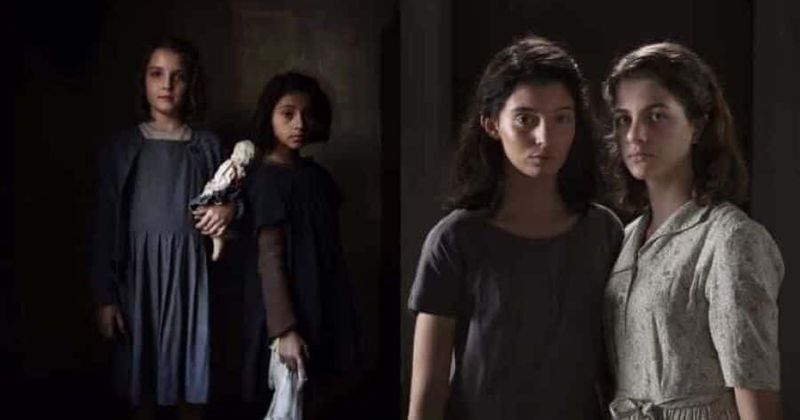
This heart-full Italian series, co-produced by HBO, is so absorbing that the woes of present-day pandemic drift imperceptibly down the grimy byways of poor suburban mid-century Italy on breath of air. Based on much-loved and admired novels by pseudonymous writer, Elena Ferrante, the story explores the challenging, adoring, quietly violent bond between two girls, Lila and Elena (Lenu), whose lives are yoked to a neighborhood of drab low-rises outside Naples. Series one begins in childhood and lasts through adolescence; their young adult relationship unfolds in the second, episodes dropping Monday evenings, now more than half concluded.

In the opener we glimpse storyteller Lenu, age 60, tapping out the story on an Apple computer. Tinged with bitterness, her tale paints pictures of dominance, machismo, submission, self-abnegation that will unfold in four series — one per novel.

The set (left) is described as one of the largest in Europe, an entire neighborhood recreated including apartments, shops, dusty streets and island vistas (Ischia, below) described in the novels.

The sets and locales are magnets for tourists, creating a boom not unlike what ‘Outlander’ inspired in Scotland. The difference is that “My Brilliant Friend” is true literary and film beauty; ‘Outlander’, despite its Jacobite history attracting genuine interest in Scotland’s clan past and wars with the English, does not climb out of the paperback fantasy/romance genre.

‘Brilliant’s’ director, 43 year old Saverio Costanzo, manages to burn into your mind the waste inherent in post-WWll poverty, emotional and physical violence nurtured in a small neighborhood governed by petty extortion and the secrets everyone knows. (Below, Costanzo, center left, above young Elena, “Lenu” with her parents, far l, siblings, and crew members.)

Costanzo is quoted in the Guardian: “It’s a story that somehow belongs to everyone. I found myself…in Elena’s and Lila’s shoes. It’s like a mirror...a kind of miracle that happens very rarely…..”. Michelle Obama is an admirer; Hillary Clinton is quoted: “...hypnotic... I could not stop reading or stop thinking about it.”

Both girls are brilliant —differently. Lila is an instinctive philosopher and didact; she sponges up everything there is to know on all subjects, a strangely exceptional child for whom the very young actress, Ludovica Nasti, is a perfect fit. (Nasti, is like a giant...a genius… says Costanzo.) Lenu, played in childhood by Elisa del Genio, is smart but must work to achieve. When she does, she is number one, but her winning is the product of dogged effort not genius. In their poor household, Lenu’s mother, grudgingly, cruelly, goes along with her advancing in school at the urging of an empathic teacher (Dora Romano, below).

Lila’s father, the gnarly owner of a shoe repair shop, dismisses education beyond elementary school for his daughter; her defiance and his brutality are the outcomes. It is the dis-affirmation of her sharp little mind, her right to succeed using her intelligence, that undergirds Lila’s perpetual spite and later self-destructive life-choices. Later you hear her father’s cruelty in Lila’s young adult voice as she forewarns Lenu: Don’t listen — the witch inside me is talking. Lenu has been positioned as the submissive, like Lila’s brow-beaten mother.

It is hard to convey how engrossing the story of these two little girls becomes. You float through childhood with them, pushing boundaries, daring, competing, yet supporting each other, recalling your own neighborhood confrontations, games and escapes as you share in theirs, likely more violent than your own.

Then come the bully-cum-mobsters, the flirtations, the books, the rain deluges, the parental shoutings, the ignored violence (even killings) the street peddler’s calls, streets fogged with dust. They sit on a bench reading and reciting ‘Little Women’ to each other, the pages of their shared copy increasingly tattered. The genteel poverty of Alcott’s ‘Little Women’ was lovely beauty to these waifs in their homely world; Jo, the writer, is their goddess.

By the third episode, rightly called ‘the Metamorphoses’, the girls are adolescent, and Lenu (Margherita Mazzucco) is mortified by the blood between her legs — is she dying? The sharply-dressed Solara brothers (they look like light is ‘shining down on them’) flatter and cajole a shy girl into their new car. ‘Those guys don’t just kiss, they bite like mad dogs’, says Lila (Gaia Girace). Sure enough, the shy girl is dropped off bruised, devoured.

Lenu discovers the power her body has over boys, even with her acne-spotted face, and secretly savors Lila’s defiance. Suddenly the fights in the street aren’t the noise of adults swirling overhead, but involve themselves.

The girls’ relationship waxes and wanes. Lila resents Lenu’s being in school; she proves her superiority by teaching herself Latin and Greek in secret. At other times, Lila teaches Lenu how to analyze text, prodding her to improve, living through Lenu’s success. To Lenu, her life is flat without the dynamite of Lila.

Lila’s defiant marriage to the thuggish Stefano (Giovanni Amura, below) steps her up from poverty into comparative luxury and offers a new target for her anger. She provokes his repeated beatings (boasting they make her stronger) and more drama is injected into the girls’ friendship.

Lila buys Lenu her high school books — her mother weeps with gratitude — our first shred of sympathy for the desperately angry woman. Then, in the chapter called ‘Erasure’, Lila turns on her friend, mocking her cruelly, transferring her rage on to Lenu who is climbing out of the neighborhood milieu into a more socially-conscious one.

As the girls mature, Lila continues to sharpen her claws on Lenu, and we imagine their adult friendship uneasily. (Ferrante describes the feral Lila as acting with “a hiss, a dart, a lethal bite.”) Lenu pines for Nino, Francesco Serpico, (below); the married Lila gets between them.

Still we watch, our own youth and dashed dreams immersed in theirs as Lenu’s passivity and Lila’s betrayals mount up. The story-telling is so dreamily fine, the atmosphere so reminiscent of one’s own despite all its differences in time and place, it will transport you there from the view of deserted streets out your windows.

View the series trailer here.

Note: If you would like to see more about epidemics, superstition, masks, and handwashing, check out the following:
Downton Abbey, Season 2, episode 6 for the 1918 Spanish flu (PBS, passport; Amazon Prime).
Outlander, Season 3, episode 10 for a shipboard typhoid outbreak in the 1700’s (Starz, Netflix).
The Physician, lovely film with Ben Kingsley and Stellan Skarsgård, for a battle with the black death in 11th century Persia (Netflix).
Ken Follett’s World Without End episode 106 for arrival of the black death in 1341, in which ancient Persian texts are used to guide the treatment of the plague (Starz).

Sunday, November 19, 2017

November's Sunday Corner With Lee Liberman: BLACK SAILS


What’s to be done with the unwanted ones, 
the men who do not fit, 
whom civilization must prune from the vine 
to protect it’s sense of itself? 
Every culture since earliest antiquity 
has defined itself by the things it excludes. 
As long as there is progress, 
there will be human debris in its wake…
Sooner or later one must answer the question: 
what becomes of them? 
In London the solution is to call them criminals 
and throw them in a deep dark hole. 
I would argue that justice demands 
we do better than that; 
that a civilization is judged not by whom it excluded 
but how it treats the excluded. 
(...from Season Four, Episode 10) 

An unexpectedly original, ambitious, and close-up look at piracy during its heyday, BLACK SAILS (on demand at STARZ) is a prequel to Robert Louis Stevenson’s famous novel “Treasure Island”. The series is set in early 1700’s Bahamas ahead of Stevenson’s yarn and winds down with the burial and abandonment of a fabulous cache on ‘Treasure Island’s mysterious Skeleton Island. Fictional characters from the novel mix with real pirates of history to make the colorful and mostly entertaining tale spun by co-creator’s Jonathan E. Steinberg and Robert Levine (l and r, below).

I emphasize ‘mostly’ because the show-runners did not get a grip on the story until season two. The project’s attachment to producer Michael Bay’s first TV project (he of Armageddon, Pearl Harbor, and Transformers blockbuster riches) likely enticed STARZ to approve four seasons even though season one was a dud. (New Yorker critic David Denby called Bay “stunningly, almost viciously untalented”, to which Bay is reported to have replied: “I make movies for teenage boys. Oh dear, what a crime.”)

But never mind — Black Sails’ fanbase was rapturous and went beyond teenage boys. After season one, the writers developed a thought-provoking narrative surprising for an action series. Set in a pirate milieu we know most through myth and fable, we find the machinations of the colonial powers, the slave trade, and a community of maroons (slave escapees) who are hidden away from island civic life with lethal ways of staying hid, their own rituals and hierarchy.

There are plenty of invigorating ship battles, land skirmishes, personal conflict, and roiled forces of nature photographed so intimately you can feel the sea boil and the sun parch. But the action derives its thrills not from adventure but because you have become engrossed in the lives of the characters, acted by a terrific cast hailing from at least six countries.

The theme of Black Sails is a tug of war over Nassau between colonial Britain and rebel pirate desires for a haven of their own. The pirates hoped to make their new world not just an extension of the old but autonomous and free — pirate havens were early democracies before the great powers got around to them, organized to provide as much individual liberty and equality as possible. Here, their collective self-government grows into a collaboration between maroons and pirates, the former adding their numbers to throw at British and Spanish military who sought to quell slaves and hang pirates. One rides out this narrative knowing the rebels are doomed — the pirate heyday will last just a few decades, after which international piracy laws and military presence will end their golden era. 

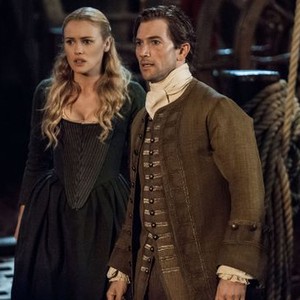
The first season involves pirate pursuit of the Urca, a Spanish galleon carrying a vast treasure, adventure that deserved no more than a couple of episodes. The booty remains at issue among the Spanish, British, and pirates from series start to finish, eventually ending up on Skeleton Island, respectfully teed up to mesh seamlessly with Robert Louis Stevenson’s novel. One character, Eleanor Guthrie (Hannah New), who fenced pirated goods and managed commerce in Nassau’s pirate haven, lurches between wanting Nassau to be self-governed, and coming to embrace new British Governor, Woodes Rogers (Luke Roberts), first as his captive, as a means to this end (Ms New and Roberts are shown below).

Woodes Rogers was a (real) Brit who inherited his family shipping business, became a sea captain and was appointed Governor of the Bahamas twice, eventually establishing order, although (accurately) Black Sails leaves him bankrupt and defeated after his first stint on the job. His assignments as governor grew out of the rise of armies in Europe whose missions included stamping out piracy because it disrupted commerce and the slave trade.

The pirate response to colonial corruption led them to evolve their own self-management. (‘Every man has a vote in affairs of moment…’) Among them were refugees from persecution and sailors experienced in navel warfare seeking employment. According to Pirate Captain Bartholomew Roberts (1682-1722), there are low wages and hard labour in an honest service, while the life of a pirate offers reward and liberty.

Among the pirates in Black Sails’ fictional world are Stevenson creations Long John Silver (Luke Arnold), Billy Bones (Tom Hopper) and Captain Flint (Toby Stephens), shown above, from left.

More major players were pirates who did exist such as Charles Vane (above, far r) created by the unexpectedly magnetic Zack McGowan. Vane was a protégé of Edward Teach — more famously known as Blackbeard (at right) played by Ray Stevenson.

Also real, was the dandyish, erudite Captain Jack Rackham (Toby Schmitz) who produced the famous skull and crossed swords flag and contemplates his legacy: “It’s the art that leaves the mark; it must transcend.” (Writer J. Steinberg comments: his piece of artwork will outlive him and all of us.)

Rackham’s brooding pirate lover, Anne Bonny (the very good Clara Paget) is shown below, with Vane and Rackham.

Flint, however, is the impresario, carrying this saga on his steely frame. Toby Stevens has the same upright bearing of his mother, Maggie Smith, in her portrayal of Violet, Countess of Grantham of Downton Abbey. Their show of determined obstinacy and resemblance is marked.

Flint owns Black Sails, yet is unknowable. Our interest in him, beyond observing his ferocity and genius for leadership, develops in season two when his backstory begins to unspool slowly in flashback culminating in episode 2.5. We see him in early career as affable young Lieutenant James McGraw, assigned in 1705 as naval liaison to the Hamiltons in London —the elder Hamilton an earl and son Thomas a member of Parliament, whose wife Miranda (Louise Barnes) is penetrating, wise, and lovely. Thomas Hamilton (Rupert Penry-Jones) wants to assemble a colony on Nassau, install an honest governor, and most notably, grant full pardons to the pirates — a scheme that is anathema to his father, the earl. (Below, from l, Miranda, Thomas Hamilton, James McGraw.)

McGraw slowly embraces the reform idea and comes to admire Thomas’s idealism. (Miranda says: you can recognize a great man by his relentless pursuit of a better world.) She knowingly seduces McGraw into an affair with both herself and her husband. The elder Hamilton gets wind of it, and uses their ‘disgrace’ to thwart the despised plan. Thomas is confined to an institution or dead; Miranda and McGraw are permitted to vanish. They go to Nassau where he morphs into his Ahab-like Captain Flint and they share a home when he’s not pirating.

We now see that Flint’s rage at being designated a non-person because of his love for a man has driven him headlong into a relentless career getting even with the establishment. McGraw’s naval mentor, Hennessy, when dismissing him from service, intones: “Every man has his flaws but not this, it is too profane.” Later Miranda insists he is ‘fighting to fight’ always in the midst of violence and danger to forget his shame over having loved Thomas.

Flint channels his remaining bits of humanity into a working relationship with John Silver, an ingenious fellow who loses his leg during the series (and gains the ‘Long’) but is more than Flint’s equal in getting his way. Together they become an unparalleled team and defeat Woodes Rogers at sea, ending his first governorship of Nassau. Silver orchestrates an agreement between the pirates and the maroons (he has fallen in love with the queenly Madi). And there’s an improbable series end for Flint, as Silver both drives him out of piracy and devises a heart-rending rescue for him (bottom image).

As the tale progresses, much relationship deepening and fracturing increases the series' addictiveness along with stunning sea action sequences and absorbing visits to Cuba (run by Spain) and several American colonies. We grow with Max, (Jessica Parker Kennedy, below) a beautiful, mixed-race prostitute who loves women and climbs her own ladder of power. Hannah New’s Eleanor Guthrie fares less well. This is New’s second major role, following the Spanish series “The Time In Between” (Netflix) in which, speaking fluent Spanish, she was lovely. Here, she has unconvincing ‘badass’ moments in which too many “f—k” swears make her less not more so. She is too much of a nurturer for this part. However the excellence of the ensemble as a whole and the increasing urgency of the story arc once underway does not leave the viewer wanting.

If adventure is your thing, thoughtful revelations about race, love, and power in the context of chaos and competition among players will be a bonus. If you normally shun the adventure genre, you will find much here to satisfy your need for deeper material once you slog through (or better, skip almost all) season one. The Flint/Silver relationship especially takes you into their power struggle, willingness to kill each other, and well of genuine caring that matures through the seasons. Black Sails was filmed in Cape Town, South Africa (on a set and with ships just repurposed by Outlander for its voyage to/in the Bahamas during the late 1760’s, debuting now on STARZ).

Each episode opens with a smashing musical theme by Bear McCreary (also the music director for Outlander) using the hurdy-gurdy to striking effect; it accompanies a spectacular series of computer-generated alabaster and bronze pirate sculptures inspired by Rodin, Bernini, and anonymous carvings found on ships, crypts, and gravestones in Baroque, Gothic, and Rococo style. Watch this.


The above post was written by our 
monthly correspondent, Lee Liberman.