Monday, May 26, 2014

Bridging the gaps (generational & technological) -- Livia De Paolis' first full-lengther, EMOTICON;)


Just because of the themes that her new movie deals with, TrustMovies is inclined to give newcomer (to me, at least) Livia De Paolis a pass for delivering a decent film about bridging both the generation gap and the technology gap. That first gap, spanning the generations, is ever with us; the second -- which the fear of and/or disinterest in prevents many older adults from learning what they need in order to make use of the Internet -- is new to this millennium. Both are worth dealing with, but doing so in a single 80-minute movie such as EMOTICON;) is quite a bit to bite off.

That Ms De Paolis can't handle it all in a completely professional manner is not surprising; that she manages as well as she does (she's the lead actress, writer, director and producer) in this, her first-full-length film, is nothing to sneeze at. What comes through most strongly is the filmmaker's sincerity, and if this sounds somehow paltry, it, too, is nothing to be sneezed at. This sincerity is found in everything from the various performances to the writing, which, if it sometimes lacks polish and panache, makes up for this via the reality Ms De Paolis brings to the events and dialog.

The generations here actually number three: There is Walter (Michael Christopher, above, left), the 60-plus fellow that our 30-something heroine, Elena (Ms De Paolis) is dating.

Then we have Walter's two teenage kids (both adopted): Amanda (Diane Guerrero), above, right) and Luke (Miles Chandler, below, right), and their various friends.

There's Walter's ex-wife and the kids' mom (Christine Ebersole) and Elena's professor (a giddy but wonderfully stable Carol Kane, below), who is advising Elena on this Internet Communications project she's trying to work through.

The kids and Elena get off to a bad start but soon are actually helping each with their romantic problems -- some of which are solved, while others cannot be. De Paolis understands that life is more complicated than we'd prefer, and she allows those complications to surface and take their toll.

There's a trip to Mexico, bonding, a physical condition that proves a game-changer -- and the results of all of this, which, again, are as negative as they are positive. You might want smoother elisions now and then -- the movie keeps stopping and starting -- but that will probably come for De Paolis with time and more experience. Meanwhile, the filmmaker has given us a mostly intelligent, thoughtful and entertaining start, regarding a subject -- adapting our lives around the Internet -- that we've only begun to try to figure out.

Emoticon;) -- from Indican Pictures -- opens today, Friday, May 30, at the Cinema Village in New York City. Elsewhere? I'm checking now and will post the information here, once I've corroborated it.

Sunday, May 25, 2014

Manoel de Oliveira's GEBO AND THE SHADOW tells a simple story via a starry cast of seniors


He's back. The world's oldest living filmmaker, Manoel de Oliveira, who clocks in at 105, has made yet another full-length feature (of course, he was only 103 when this one was first released), GEBO AND THE SHADOW, which, thanks to Anthology Film Archives here in New York City, is finally getting a week's theatrical release in the USA. Unlike his last couple of full-lengthers -- Eccentricities of a Blond-Haired Girl and The Strange Case of Angelica -- both of which were oddities that didn't easily give up their meaning(s), this new one is as straight-ahead simple as you could wish.

As far back as 2001 and this filmmaker's I'm Going Home, I've off and on been suggesting that maybe it was time that de Oliveira (pictured at right) hung up his camera and typewriter. But then, in 2003, he made A Talking Picture, to my mind one of his best ever, so I determined to keep my mouth and computer shut on the subject. His films are seldom uninteresting, at least in pieces, and his latest is actually one of the more interesting endeavors, if only because it proceeds at such a measured pace, with its theme and story so blatant and repeated that no one could go away from this work wondering what it meant.

This is a dysfunctional family film of major proportions, as it tells the tale of the "missing son," whose absence means that life barely moves and never changes for mother (Claudia Cardinale, above), father (Michael Lonsdale, below), and daughter-in-law (Leonor Silveira). Each seem in thrall to their image of the missing son, with father taking it upon himself to constantly lie to mother to protect her and help keep her spirits "up" (which she never manages to do).

During the first third of the film, everyone complains constantly; in the second third (slight spoiler ahead), missing son shows up but little changes; and then, in the third section, change of a sort does come. The screenplay and its dialog is given to philosophizing a lot: "Were we put into this world to be happy?" (Evidently not.)

Dad keeps busy with his figures and additions (he keep the books for a local company), mom complains and makes coffee for guests (Jeanne Moreau, above, left) and Luís Miguel Cintra (above, second from right).

The philosophizing gets downright crazy, once the son (Ricardo Trêpa, above) takes to doing it: "Deep down, those who kill are those with the biggest hearts." Oh, absolutely! Once the climax occurs and then the denouement, we are left with this moral: The wages of pretense are abysmal in the petty lives of the petite bourgeoisie.

The performers here are only asked to play one note, and being ultra professional -- with great faces that have aged beautifully because they have aged with reality (unlike most of the Hollywood crowd) -- they play that note quite well.

Beautifully shot (by Renato Berta) using a color palette of rich hues of green, brown, and rust, then lighted with a golden glow (the movie is almost exclusively interiors), Gebo and the Shadow is minimalist in every way except the cinematography. The movie -- in French with English subtitles and running 95 minutes -- opens this Wednesday, May 28, and runs through Tuesday, June 3 at Anthology. For directions to AFA, click here; for tickets, click here.   

Streaming à la française: Dujardin's & Lellouche's crass, funny, smart THE PLAYERS (Les infidèles)


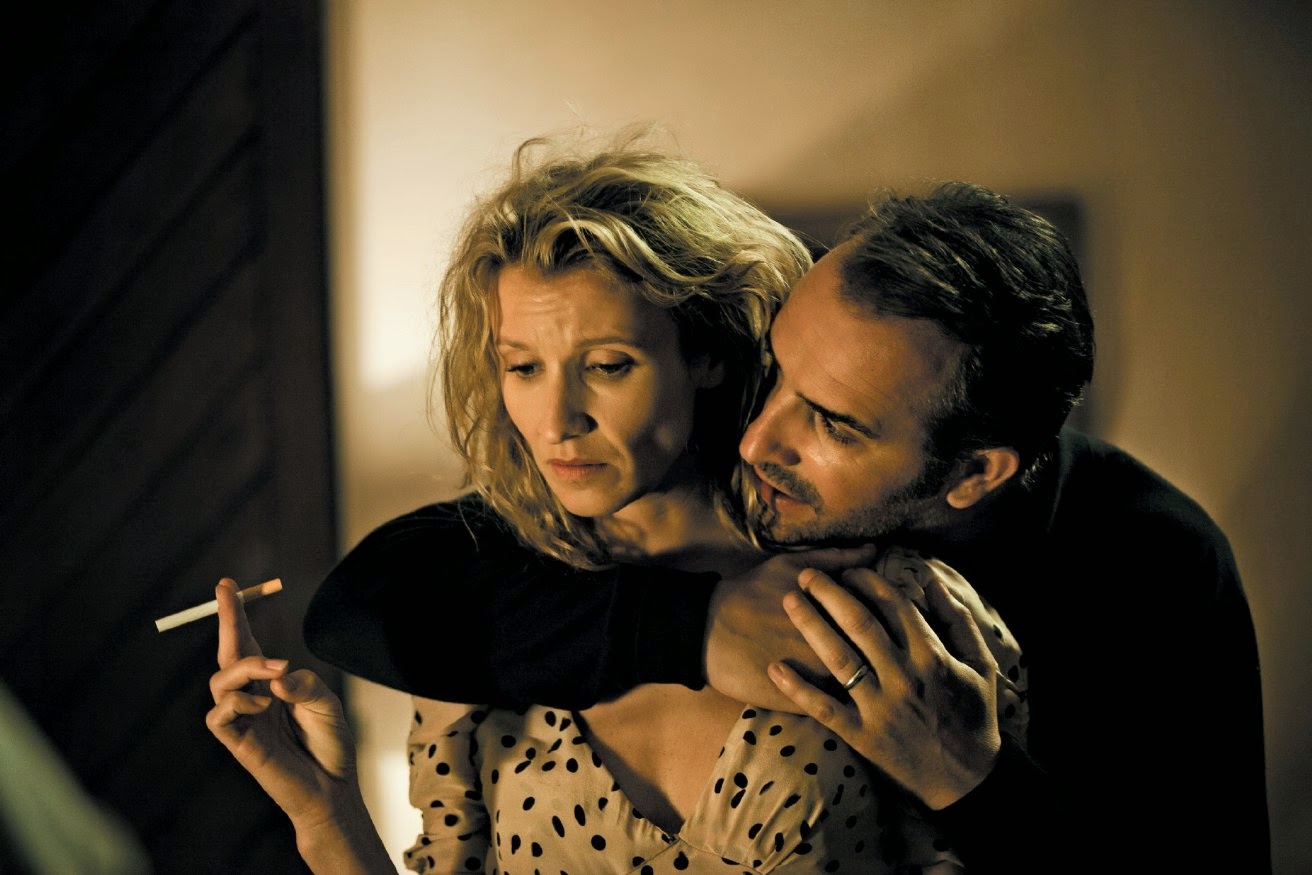
When I first heard about Les infidèles -- which I believe translates as The Unfaithful, but was instead titled THE PLAYERS for its American release -- I was excited at the prospect of seeing one of my favorite actors, Gilles Lellouche together with Jean Dujardin, whom I am always happy to view in any kind of "normal" role rather than his "stunt" performances in the OSS 117 series or his Oscar-winning The Artist. While The Players came and went from theaters in a blink-of-an-eye limited release this past April, here it is already on Netflix streaming.

The subject here is ostensibly infidelity, but it's really more about men, the male libido, and the many outlets for sex that modern times gives us guys. And while you could hardly find two more attractive and sexy males than Messieurs Lellouche and Dujardin, what this movie does best is hold today's male and his near-constant urges up to close scrutiny via a comedic and satirical approach. The characters played by these two French stars are paragons of just about nothing virtuous at all. They're generally crass, dumb and as self-satisfied as they are self-deluded.

The movie's style is to tackle its subject via nine (maybe ten: I think I lost count) stories that range from three or four minutes in length to maybe 15 or 20 directed by eight filmmakers (including Dujardin and Lellouche). Two of the three shortest segments (all directed by Alexandre Courtès) are also the funniest: the first, a breath-takingly vulgar and hilarious visual joke, the second (starring Guillaume Canet) a new "take" on the almost-found in-flagrante-delicto situation that builds to a fast, shocking and darkly funny visual punch line.

The longer segments are varied in both length and success, though there's not a one that doesn't deliver a few laughs and entertainment while provo-king some interesting thoughts. The first (directed by Fred Cavayé) and final segments (directed by Lellouche and Dujardin) deal with the same two friends who like to go out together (leaving their respective wife and girlfriend at home) to find some nice young ladies to fuck -- often together in the same hotel room. Notes one, as they clean up their private parts after the girls have left, "You know, a shrink might say that that guys like us who are Don Juan types are actually gay." Bullshit, insists the other.

The pair are seen again on a trip to Las Vegas, as they fight and make up and try to get laid and finally discover their "better natures."  This finale's a fitting tribute to all sorts of ideas... and celebrities. There's also an amusing Unfaithfuls Anonymous episode, in which the group leader is played by  none other than that crack French actress Sandrine Kiberlain (below) -- who is very funny.

Another long segment, directed by Michel Hazanavicius, goes on past its sell-by date but does provide a look at Dujardin as a woefully obtuse womanizer. Yet another episode (below), the most serious of the bunch and the only one directed by a woman (Emmanuelle Bercot), nails the idea of truth-telling and what this can do to a long-term relationship.

Perhaps the best of the bunch is the one (below) starring Lellouche as a "happily married" dentist involved with a teenager (Clara Ponsot, below) whose behavior and activities quickly begin to show him (and us) how over-his-head he is in his "relationship" with this youngster. As directed by Jan Kounen (Coco Chanel & Igor Stravinksky), this episode is both smart and sturdy.

As usual with European films vs the American model, many of us here in the good 'ol USA -- particularly those used to viewing mainstream blockbusters -- complain that the actors and actresses aren't good-looking enough. No. Instead of all of them being cut from the same cloth, European performers tend to look real. We're also not used to movies willing to serve up a dose of entertainment that nails the male to the wall.

So, those of you who can take it, "stream a little stream" of The Players and see how you well you survive. You can find it now on Netflix. And maybe elsewhere, too.

Saturday, May 24, 2014

Streaming: Jennifer Siebel Newsom and Kimberlee Acquaro's MISS REPRESENTATION tackles the way our media portrays women


Stick with MISS REPRESENTATION, please. I ask this because the introductory few minutes are so thuddingly repetitive and so full of what's wrong with the media vis-à-vis women that the movie looks more like the problem than the solution. Yes, I understand that women are angry at how they are almost always portrayed, but using two or three really choice examples of this might work better than flooding us with 20 or 30 of the same old/same old. Once it calms down, however, the documentary -- from Kimberlee Acquaro and Jennifer Siebel Newsom (the latter, who narrates and is featured in the film, is shown below) -- grows more interesting by leaps and bounds.

Once we get into some of the shocking statistics, the facts and figures marshaled here are often fascinating, and so the movie definitely hooks us. Particularly interesting is the look at post-WWII life in the USA, in which the "re-domestication" of women (after their livelier and necessary time on the assembly lines helping the Allies conquer the Axis powers). The late 1940s and 50s were pretty dreadful to women in terms of their empowerment.

The documentary does a nice job of combining, archival footage with present-day (well, 2011, when the film was first seen) interviews with various women and a few men (Jackson Katz, above, is particularly telling on the subject of machismo).

Along the way we hear from everyone from Cory Booker (on spiritual healing!) and Glora Steinem to Pat Robertson and Rachel Maddow (above) -- who comes off as particularly bright and well-spoken. (Mr. Robertson's statement about "women's agenda" is both hilarious and scary.) We also hear from actresses such as Geena Davis (shown at bottom) and Daphne Zuniga, both of whom have pertinent contributions to make.

The use of one of these interviewees, however, does a lot to sink what the filmmaker seem to be trying to achieve. When you place a former Secretary of State for the George W. Bush administration, Condoleeza Rice (above), as any arbiter of fact or truth, you're in big trouble. Ms Rice proved herself a liar and a war criminal, as part of that ignoble group who led our country into an unnecessary was in Iraq by virture of lies told over and over again. The whole pack of them ought to be serving time, if not shipped off to the mideast and forced to fight on the ground the war they started that has now taken so many American and Iraqi lives. What does seeing Rice used here as some sort of "model" say to women? Yes, she is intelligent and she was powerful, but ignoring what she did is reprehensible in the extreme and as hypocritical as it would seem possible to be.

That said, there is plenty to chew on in this documentary that may be three years old but whose subject remains as timely and unsettling as ever. You can see it now via Netflix streaming and other venues.

Friday, May 23, 2014

Jim Mickle's COLD IN JULY: It's a nasty, macho world we live in, boys and girls. Also a tad fake.


With COLD IN JULY, the  team of Jim Mickle (writing & directing, shown below) and Nick Damici (writing) continues its simultaneous ascent/descent. The budget grows larger and the cast starrier, while the movie's credibility level continues to sink. From Stake Land -- among the best modern zombie movies and a genuinely scary and involving one, rather than the often livelier quasi- ([Rec] 3) or full-out (Stalled) comedic versions -- through their remake of the original and better Mexican cannibal tale, We Are What We Are, we now arrive at this new film, opening today, which you must take a very large leap of faith to buy into some of its ridiculous coincidences and unbelievable actions.

This is too bad, because much of the initial story seems gripping and relatively original for this revenge/thriller/
family-in-jeopardy genre. Further, where it goes is exactly not where you'd imagine, which makes it all the more fun. Rather than give away most of the plot -- which many of our reviewers have already so helpfully managed to do -- let me just point out that when our hero (a nicely befuddled and frustrated Michael C. Hall, below), an utter novice at what he has decided to do, is tailing, rather obviously, a carload of dirty cops, they don't seem to notice. Hall's car get awfully close to the cop's car (at some point there's no other traffic around. Still nobody notices).

Further, when those cops leave a living, breathing man drugged out and spread across the railroad tracks in front of a soon-to-be oncoming train, they don't bother to wait the minute or two for that train to arrive to make sure their dirty deed is completed. If you buy into this kind of nonsense, you'll accept most anything a movie-maker cares to throw your way. (The film does take place in Texas, where the citizens sometimes seem dumber than many of us are used to, if that's any excuse.)

OK. So this is indeed fake, but that first-rate cast -- in addition to Mr. Hall, we have Sam Shepard (above, left) at his quietly menacing best and Don Johnson, making the kind of movie-stealing comeback that should give his career a permanent kick in the pants -- may keep you somewhat enthralled, as will the plot twists and turns while the movie goes from one sub-genre to another and another and another until we come upon, yes, snuff film-making in one of the ugliest scenes I've witnessed on screen in my life (we're spared the gore, but the set-up is so awful and complete that there's no need for the bloodshed).

We're mostly in darkest film-noir/macho-man territory here, and though the movie tries to make a bit of fun out of this, it also manages to go ridiculously macho-sentimental at its conclusion, handing us yet another if-you-believe-this-you'll-buy-anything scene that ought to be short, swift, angry and ugly but instead drags on in its manipulative and stupid way until you want to scream, "Get this the fuck over with!" Well, it at least allows us men to feel all choked up over one of the three guys. Those of us, that is, who are not by then rolling our eyes.

Cold in July, which has been adapted by Mickle and Damici from the novel by Joe R. Lansdale, is one of those casually unthinking misogynist movies in which women exist to natter and annoy (like the Hall character's wife, played by Vinessa Shaw) or are around to provide sex or to be tortured and killed. Otherwise, it's all tight-lipped macho stuff, all the time. Well-photographed and edited, the film looks good and gets the surface exactly right. Below, where it counts, there's way too much bullshit.

The movie, from IFC Films and running 109 minutes, opened today in New York City at the IFC Center and in Los Angeles at the Sundance Sunset Cinemas. Simultaneously, it's available via VOD. 

Thursday, May 22, 2014

Love and learning, Binoche and Owen light up Fred Schepisi's diverting WORDS AND PICTURES


How bracing, not to mention entertaining, it is to hear smart dialog served up by classy actors on a subject -- education -- that gets too little worthwhile attention. (The fight here in the USA between public education and charter schools is mostly a distraction from what is going on: the breakdown of our educational system as part of the ever-widening breakdown of our entire democratic system of government, sacrificed at the altar of corporate welfare, Wall Street, the banking system and the ever-wealthier one per cent.)

Don't worry, you folk who would prefer not to face up to our current times: WORDS AND PICTURES, the new film from one our long-time favorite Australian directors, Fred Schepisi (shown at right), isn't remotely political. Yet the fact that it more than touches on what comprises a good teacher/educator also makes for a movie that can't help but get you to thinking a bit. The screenwriter, who has done an expert job in the teaching realm, if a bit less so in the plotting and execution of the romance-and-the-obstacles-to-this department, is none other

than Gerald Di Pego (at left), whose resume indicates a lot of TV writing and some movies (Message in a Bottle, Instinct, Phenomenon, Angel Eyes) that might seem more feel-good fantasy than rigorous reality-based. That Di Pego manages to address his subject with a mind and hand that encompasses not only what it means to teach well but also the needs and concerns of administrators and fund-raisers (this is a private school, by the way) makes for relatively intelligent viewing. And the budding love story between our two leads -- Juliette Binoche and Clive Owen, who make the best adult lovers (sassy, smart, and very lived-in) -- we've seen in some time, just adds to the fun.

Owens (above) plays Jack Marcus, a once successful writer now teaching for a living with an alcohol problem growing bad enough to threaten his job. Binoche (below) has the role of Dina Delsanto, a famous artist felled by rheumatoid arthritis, struggling to keep the disease in check via the right medication cocktail that her doctor has not quite found.as yet.

The two of them -- both are feisty, mouthy and give as good as they get -- make terrific antagonists whom you just know will eventually be protagonists, and both actors could hardly be better in the roles.

The centerpiece of the movie is the disagreement that arises between the two and their respective areas -- he teaches English, she teaches art -- and leads to a competition in which the students try to prove which is more important. While this is interesting and leads to some more intelligent dialog, most adult viewers will immediately realize that "words and pictures" work best in combination rather than competition.

The plot machinations -- which include everything from bullying via the Internet to Marcus' son (who is understandably alienated from his dad), plus that aforementioned alcohol problem and even a bit of plagiarism -- give our poor Mr.Marcus (and the movie itself) so much to work out but too little time in which to do it believably.

Yet by the point at which resolution must begin, the movie has built up such a wealth of good will, thanks to the fine performances and often very smart dialog, that you might just be able to overlook its weakness toward the finish. The supporting cast includes the likes of Bruce Davison (above, right) and Amy Brenneman (below, left), as well as a number of good actors in the student roles.

Schepisi, as usual, casts impeccably and draws fine performances from all. Look back on the 18 films in his 40-year career -- his best include Six Degrees of Separation and Last Orders -- and it's hard to find a poor or even so-so performance from anyone in any of them.

Yes, Words and Pictures is good enough that you'll wish it were better, but given the nearly ever-present lack of intelligent adult rom-coms, the movie's worth a visit. From Roadside Attractions and running 111 minutes -- the film opens tomorrow, Friday, May 23, in New York City at The Paris Theater and the Village VII, and in Los Angeles at The Landmark and Laemmle's Playhouse 7 and Town Center 5.

Wednesday, May 21, 2014

How to become a writer the easy/hard way: Alain Gsponer's LILA LILA opens in New York


The adorable German actor Daniel Brühl (from Good Bye Lenin! to last year's Rush) has such a youthful countenance that even after more than a decade of film-making he barely seems to have aged. Even so, in what is his latest movie to open here in New York City, LILA LILA, he appears to be suddenly aging backwards. Never fear: this is because, though Lila Lila opens this Friday, it is already five years old, having been released in Germany back in 2009. This is not the only oddity about the movie. While watching it, I kept thinking of another film -- The Words -- released in 2012 that appears to have been "inspired" by its German counterpart. Both films deal with a young man who comes upon a manuscript -- that he then pretends to have written -- of what turns out to be, once published, a critically acclaimed and extremely popular novel.

While The Words treated this whole thing uber-seriously and thus became utterly silly, Lila Lila uses the idea for its rom-com potential and thus gives in to the silliness, allowing us to have some fun. Directed by Alain Gsponer, with a screenplay by Alex Buresch, adapted from the novel by Martin Suter, the movie is lightweight in the extreme, with characters doing things that often don't ring true to who they are. Or maybe who they want to be. But this does not prove a deal-breaker, as the glossy trappings and attractive leads -- Herr Brühl, playing a character named David Kern, pairs with the spunky, attractive young actress Hannah Herzsprung, below -- make the viewing pleasurable and nearly swift enough to keep us watching. (The running time of 107 minutes might have been shortened by about ten for maximum effect and to avoid needless repetition.)

Having a hero who claims credit for something he didn't actually do can be tricky, but Lila Lila finesses this by having Ms Herzsrpung's character, Marie, send the manuscript to the publisher unbeknownst to David, who then spends the remainder of the movie feeling guilty but trying to enjoy the perks that sudden fame has bestowed upon him.

Brühl (above) is by now a past master at playing sweet and naive, and he does so again here with proper relish and just the right amount of diffidence. (The actor is much more versatile than this, however, as his appearances in Rush and The Fifth Estate will attest.)

The movie is helped (for awhile, at least) by the introduction of a new character, Jacky (played by the funny Henry Hübchen, above and below, left). Who he is and what he wants add to the near-screwball comedy that the movie would like to -- and sometime nearly does -- achieve.

Also on tap is a publisher's assistant hoping to become David's agent (a very nice job by Kirsten Block, below, left). There's romance, a little comedy, and a look at how German publishing works (it's not that different from most Western countries). But mostly, the film will please fans of the ubiquitous Mr. Brühl.

Lila Lila -- the rare theatrical release from Corinth Releasing (the very interesting catalog of which you ought takea look at) -- opens this Friday, May 23, in New York City at the Quad Cinema.