Saturday, November 14, 2020

Mark Lewis' new film, STRIDER makes debut via the St. Louis International Film Festival

Having just remarked in my last post how I prefer not to cover film festivals, here I go again -- because yet another film I wanted to see is making its debut via one of those fests. The venue this time is the St. Louis International Film Festival, while the movie in question is a new one entitled STRIDER by a filmmaker named Mark Lewis. If that name does not ring an immediate bell, it's only because you have not yet seen Mr. Lewis' earlier, groundbreaking movie about sex and connection,   Enthusiastic Sinners. His latest is not a groundbreaker, but it is an enjoyable tale of, again, connection, this time between two women -- one a teenager, the other well into her middle age -- and the sport that helps join these two.

Strider also demonstrates what TrustMovies suspects is one of Mr. Lewis' (the writer/director, who also made the delightful Wild Girl Waltz, is shown at left) movie-making concerns. He seems to prefer to begin -- and to end -- in the middle of things, not tying up too neatly all the loose ends, while allowing his characters to develop naturally and believably.

As sexual as was Enthusiastic Sinners and to a lesser extent Wild Girl Waltz, his new film seems almost equally chaste. Sex is certainly mentioned -- particularly as possible motive for the actions here. But, no: While sex is certainly not frowned upon, neither does it seem to be chief in the mind of any of the film's characters. This alone makes Strider rather unusual for this day and age.


Another thing that marks Lewis' three films is how genuinely non-judgmental they are. Sure, characters make their decisions, act on them and accept the consequences, but you get no sense whatsoever that the filmmaker is in any way standing by and wagging his finger in negative fashion at their behavior. This in itself is pretty damned liberating because it forces us to examine more deeply and from non-standard angles subjects like sex, love, commitment and even recreational drug use.


Strider'
s "take" on competition and the importance of winning is worth watching and considering, too. The movie does not go where many audiences will expect it to, and yet, overall, I doubt they will be disappointed in its outcome. 


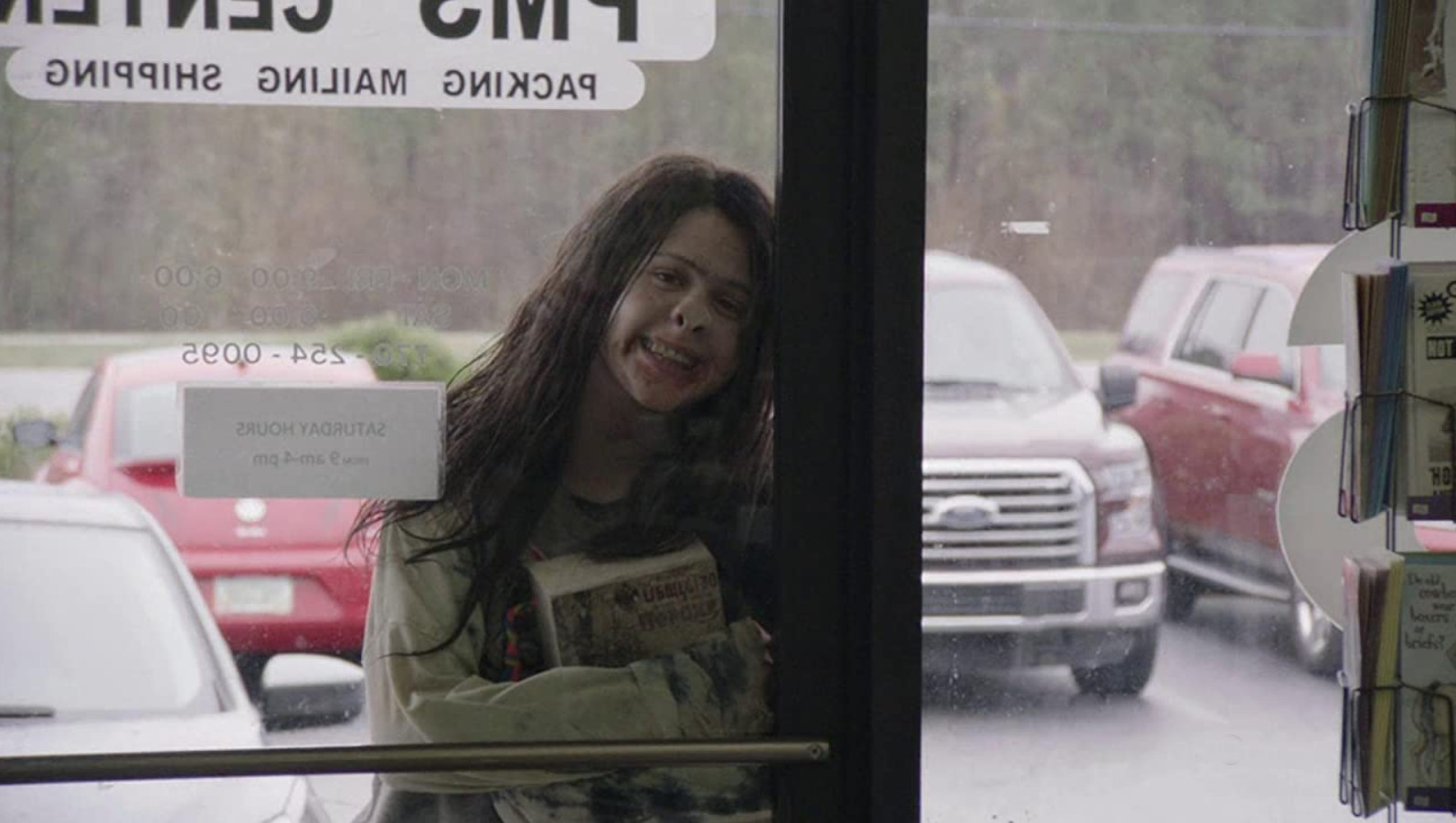
In addition to the training and running, we meet the interesting family of our pretty teenager (nicely played by Yelena Friedman, above), as well as a maybe boyfriend (Josiah Schneider, shown in photo at bottom) who appears on the scene and contributes his own likable sensibility to the proceedings. Our coach (Maggie Alexander, below, co-star of Enthusiastic Sinners) is a loner with her own checkered history. Yet the connection between the two women is made real and strong enough to push the film to its conclusion.


Both in style and content, Strider is certainly Lewis' closest-to-mainstream movie yet. This may disappoint some of his fans who prefer his more unusual, boundary-jumping approach. But I'm glad to see him at work, making a good movie of any sort.


You can find out more about the St. Louis International Film Festival by clicking the link, and learn how to view Strider via virtually streaming here.

Friday, November 13, 2020

San Antonio Film Festival unveils Zeus Kontoyannis' clever, creepy short, MR. SAM

I don't usually cover film festivals (there are simply way too many of these, with many of them simply unnecessary, to boot) but one of the short films currently being screened at the San Antonio Film Festival (running now through November 15, and again from December 9-13) sounded worth catching, and at only 28 minutes in length, not a deal-breaker should it have sucked. It doesn't, and in fact it's rather good.

MR. SAM, written and directed by Zeus Kontoyannis, turns out to be a bit less of a typical GLBT movie and much more of a necrophiliac's dream film -- a mix and mingle of Kissed, Bernie, and Six Feet Under, with a little Autopsy of Jane Doe tossed in for good measure -- but possessing a viewpoint and outcome all its own. 

Mr. Kontoyannis (shown at right) introduces us to an unusual mortician (played very well in a subdued fashion that still manages to register charisma, sadness and a bit of menace by Christropher Piccione, shown below), his mom, dad, therapist and family friends, a mother and her young daughter whom he is tutoring in math.

The filmmaker's visual style is beautifully composed and shot (the cinematographer is Joshua Echevarria), while the writing, directing and performances are, across the board, very nicely handled. 

Our titular hero, if you can use that description, lives in a near-complete fantasy world, and the most interesting thing about the film may be that he appears to be making this world work surprisingly well. (Money clearly helps matters, as usual.)


To its credit, Mr/ Sam -- neither the character nor the movie itself -- goes quite where you will expect. It is mostly quiet, graceful and relatively subtle, considering the genres its melds: mystery, horror, psychological thriller and character study. At a near-half-hour in length, it is perfectly satisfying, but it might be, too, were it expanded into full-length. Box-office-wise, that would mean concentrating on those first three genres. But content- and success-wise, it's the last of those genres that will end up counting most heavily, TrustMovies should think. 

You can find more information on the San Antonio Film Festival here, and on the movie itself and how to view it here

Wednesday, November 11, 2020

Prime Video discovery: Simone Godano's delightful AN ALMOST ORDINARY SUMMER


More than mere coincidence, almost every time TrustMovies sees the Warner Brothers logo on a film from Italy, that movie turns out to be a good one: fun, intelligent, mainstream entertainment. But when that same logo appears on an American movie, it is likely to be one of that studio's schlock blockbusters and a major waste of time for any thinking adult. How can two such divergent reactions keep occurring? Well, Italy has long been known for making wonderful films about family, which this new one -- directed by Simone Godano (shown below) and written by Giulia Louise Steigerwalt (with some input from Signore Godano) -- definitely is. 

AN ALMOST ORDINARY SUMMER (its Italian title is Croce e Delizia, which translates as Cross and Delight) tracks the journey of two Italian families in which the fathers/grandfathers of each have fallen in love (and lust) with each other. 

One family, headed by that highly talented icon of sexy smarts, Alessandro Gassman (below, left), is salt-of-the-earth working class with ultra-traditional values, while the other, under the rule of suave Fabrizio Bentivoglio (below, right), is wealthy, elitist but maybe only a tiny bit "woke."


These patres familias may be in love with each other, but the two families are definitely not. So when one grown child of each -- played by Jasmine Trinca, below left, and Filippo Scicchitano, right -- decides to work with the other to sabotage his and her parent's relationship, the movie grows consistently funnier, earthier, sadder, smarter and simply tons of fun. 


The clever screenplay lets us explore the Italian look at prejudices of all sorts, sexual to class-related, and nobody here comes out super-clean. One of the great strengths of the movie is how mixed a bag each of the characters really is. Yet thanks to the clever plotting, smart writing and excellent performances from the entire ensemble, we end up rooting for them all. 


An Almost Ordinary Summer
is mainstream and feel-good, all right, but it never loses its hold on a reality in which the divergent must be brought together somehow. Boy, we could use this in the USA these days, but instead we have Donald Trump, his lock-step Republicans, and his idiot base doing all they can to hijack this past election -- chanting  "Stop the Vote" in one state while screaming "Count the Vote" in another. Can somebody please pass out a few spare brains to these folk in need?


But I digress. If you need something lovely -- set in a gorgeous locale with sumptuous interiors, verdant seaside exteriors, and lots of delicious-looking food -- that will make you think and laugh and feel very nice indeed, Croce e Delizia  is the film for you. 

From Wolfe Releasing (and available to view via Amazon Prime), in Italian with English subtitles and running  just 100 minutes, give this Italian mainstream gem a whirl.

Monday, November 9, 2020

Streaming non-tip: Raffaello Degruttola's tiresome TRANSFERENCE: A LOVE STORY

The movie begins with a quote from the French teacher/philosopher/ religious mystic Simone Weil -- "A hurtful act is the transference to others of the degradation we bear in ourselves" -- which then plays out in the tale told by Raffaello Degruttola, who directed and also stars in the film as its very beleaguered non-hero. Interestingly, no actual writing credit is given here; instead, the end credits note "story devised and directed by" Mr. Degruttola, which could help account for the generally lame dialog.

Another bit of interest: In the film's opening and closing credits, its title is given as simply TRANSFERENCE. However, the U.S. distributor, 1091 Pictures, is calling it TRANSFERENCE: A LOVE STORY, while on the IMDB, you can find it labeled TRANSFERENCE: A BIPOLAR LOVE STORY. Further, the IMDB also lists the film as running 90 minutes, rather than the way overlong 107 that the current version lasts.


The biggest problem here is that Degruttola (above) has given us a movie filled with very attractive people who have too little to do, not much to think about, even less to say, and almost nothing to offer so that an attentive audience will want to stick around. Instead we meet a very young and pretty caregiver (Emilie Sofie Johannesen, below) working in a palliative care facility in England who meets and mates with an older but hunkily attractive male nurse (played by Degruttola). He refrains from telling her the most important information about him (his medical condition and the fact that he has stopped taking the proper medication for this), so their affair is fraught with general unpleasantness (and a whole lot of boredom, unless you are very new to the love-story genre) throughout, as we wait impatiently for his "big secret," which we've pretty much already guessed, to be revealed.


The lovers' dialog is filled with those kind of "sweet nothings" that add up to just about zero, and the film is filled with typically long stares into space by the pair as they lie in bed. The soundtrack is full of sloppy pop songs meant to stand in for missing content, and the movie's funniest moment comes toward the end as he exclaims to her, "I don't want you to see me like this!" Like what,? you'll want to ask Degruttola, since he looks and acts exactly as he has throughout the entire movie, save for one silly anger scene more than midway along. He is not, TrustMovies fears, a very versatile actor.


But on and on it goes until those 107 minutes are over and done with and relief is at hand. Somehow, I doubt that Simone Weil would approve. Transference: Whatever Kind of Love Story You Want to Call It hits home video streaming this Tuesday, November 10, for purchase, and the following Tuesday, November 17, for rental. Click here for details.

Tuesday, November 3, 2020

Digital/VODebut--Alice Winocour's PROXIMA: Let's train for Mars while trashing protocol

Few films have impressed me so much at their outset (and well beyond) before collapsing into utter stupidity by their finale as does PROXIMA, the latest from Alice Winocour, the talented woman responsible for writing Mustang and writing and directing Disorder and Augustine

Perhaps the international space program (or what passes for this in the movie) is set up differently from other space programs -- or any rigorous government program that depends on carefully adhering to high standards in order to achieve difficult results -- because what the movie's heroine Sarah (played very well by that always interesting actress Eva Green) is allowed to get away with here proves downright dumb. As this movie continues, deal-breaker follows deal-breaker until the last ridiculous event, which trumps them all.


Ms Winocour, pictured at right, tells the tale of Sarah, her "ex" Thomas, and their daughter Stella, who is both precocious and dyslexic. Sarah is in training for space travel to Mars, and as the movie opens, she's just learned she has been chosen as part of the crew. Thomas is pleased for her and happy to have charge of Stella while Sarah is gone. 

Stella (an excellent Zélie Boulant, below) is frightened of losing her mom, for good reason of course, and Sarah is, we perceive more fully as the movie moves along, wracked with guilt about leaving her daughter. How this guilt plays out, simultaneous with the training for space travel Sarah is undergoing, forms the meat of the movie 


Winocour captures well the parent-child bond (of both parents) and shows how differently this plays out when the woman has one of those give-it-everything careers, as does Sarah, in which the needs of motherhood seem in direct conflict with that career.


There is the usual male entitlement number to endure (Matt Dillon, at right, above, plays the head of Sarah's space crew), but then come those occasions when Sarah simply breaks protocol so that she can have it both ways: motherhood and space travel. Breaking this is one thing, but then we wait for the penalty for this -- which never comes. This is ludicrous, since it becomes more and more clear that having Sarah as a crew member is likely to endanger that crew.


But, hey, there must be some kind of feminist wish-fulfillment going on because it seems you actually can have it all. There are audiences out there who will buy into this sort of very weird reasoning, but TrustMovies is not among them. I am saddened because the performances are first-rate, and much of the dialog and situations are well-handled, too. 


Back in the 1960s/70s there was a movement known as "logical consequences,"in which an action has its consequence that follows logically. (Used as a parenting tool, as I recall, it may still be in vogue, although clearly it has never been activated nor even thought about by Donald Trump and his minions.)  Any sort of logical consequence for Sarah's actions is what's missing from this movie, and that lack turns a very good film into a very bad one.


From Vertical Entertainment and running 107 minutes, Proxima hits digtial streaming and VOD this Friday,. November 6. Your move. (It might help if Vertical Entertainment listed the film on its web site -- at least in the Coming Soon section.)

Saturday, October 31, 2020

Blu-ray debut for a quiet delight: Peter Sellers' only effort as director, MR. TOPAZE from 1961

What a genuine surprise is the first -- and only -- movie directed by world-famous comedian, Peter Sellers. Released in 1961, MR. TOPAZE, in which Sellers also takes the leading role, is based on the popular theatrical play by Marcel Pagnol, and along with Sellers, it boasts a cast of some Britain's finest actors, as well as a story and dialog that does them all justice. Further, it offers one of Sellers' most quiet and lovely performances -- so very different from much of that over-the-top work for which the actor now seems best remembered.


Mr. Sellers, shown above and below, plays the title role of a French schoolmaster so supremely honest (and equally poor) that he seems to sabotage any and every effort to make his way in a world of hypocritical con-men (and women), in which honesty is far from the best policy. Ah, yes: the world as we've always known it (yet remain rather loathe to admit it). Sellers' performance could not be bettered -- utterly real without ever pushing a moment beyond what it needs -- and the screenplay (by Pierre Rouve, from the great Pagnol's play) proves old-fashioned in the very best sense. It is smart but not cynical, honest (in a way that neither our hero nor his adversaries can understand), and low-key-yet-compelling in a manner that very little drama these days can manage. 


Just wait for the final few lines of dialog between Topaze and his best friend Tamise (played by the wonderful Michael Gough, at left, above, in one of his rare kindly screen performances). These lines are perfection: subdued, witty, wise, exacting and infintely sad -- Pagnol at his most marvelous.


The entire supporting cast is both well-chosen and scrupulously on-point -- from Martita Hunt (above) as a wealthy Baroness who expects Topaze to alter her grandchild's grades to Leo McKern (below), as the sleazy headmaster who demands that those grades be "adjusted." The scene between these three is exquisitely written and acted.


Herbert Lom (below, left) and Romanian actress Nadia Gray (below, right) play the villains of the piece, with Lom his usual caddishly amusing self and Ms Gray offering up a great little musical number midway along all about money (she's a famous showgirl, you see) that is as smart and entertaining as it is apt. 


Billie Whitelaw
 (below) plays Topaze's conniving love interest, the headmaster's daughter, and what seems like the entire roster of A-plus British support (from John Le Mesurier to Joan Sims and John Neville) fill out the additional cast.


As a director Sellers may not be a groundbreaker but he does just what is needed to bring Mr. Topaze to fine, exacting life. And as for Sellers as an actor, you can have Dr. Strangelove, Lolita, even Being There. This is the way I prefer to remember the guy (and to remember the work of Marcel Pagnol, too).


From Film Movement Classics and running 97 minutes, Mr. Topaze hit the street this past week on Blu-ray (in a so-so transfer of a 2K restoration, but let's be grateful for what we have), on DVD and, like most of these little-seen movies with which Film Movement continues to grace us, is available via streaming, too. Extras with the Blu-ray include a 24-page booklet about the film and its restoration by BFI Curator Vic Pratt, a video essay by Kat Ellinger on Marcel Pagnol, and an interview with Leo McKern's daughter Abigail about her father's life and career. Click here for more information on how to find and view this lovely little film.

Thursday, October 29, 2020

Barely-seen 2001 film -- Dennis Leroy Kangalee's AS AN ACT OF PROTEST -- gets streaming release worldwide

Beginning with a quote from German writer Goethe which I'd never heard -- "All men's failings I forgive in actors. No actor's failing will I forgive in men." -- AS AN ACT OF PROTEST comes complete with its own rather special history. Its press materials tell us that, since the film's 2001 world premiere at the American Black Film Festival, it has screened throughout Europe, but was never picked up for distribution until Speller Street Films' current worldwide release of the extended European version on October 30.

The mention of an "extended version" raises its own questions, as the version I was given to watch lasts just shy of two full hours. Yet on the film's IMDB site, its length is said to be two hours and twenty-four minutes -- which would appear to make that the "extended" version. So why are we critics being given the shorter version to view?

I am not complaining, however, but rather considering this as a kind of unexpected/unplanned gift because -- despite its heart and mind being in what we might call "the right place" concerning the many and consistent wrongs done to the Black community throughout the history of the USA -- this film, whether looked at as either art or entertainment, has been conceived so poorly then executed in even worse fashion by writer/director Dennis Leroy Kangalee (shown at right, he also takes the role of the theater director in the film) that it stands out as near-perfect example of how not to make a movie about this particular subject. Or any subject, really.

The subject here is Black rage and how to deal with it. God knows, this is a valid and important one, and if this brings to mind our current Black Lives Matter protests and their sometimes accompanying looting and violence, this is certainly part of the reason for the film's being "rediscovered." If only it lived up in any way to the possibilities on tap here.


The initial scene (above) offers us the curtain call of a play or performance piece that the audience seems to love beyond measure, as lead performer, a young man named Cairo (played by Che Ayende, above and below) takes his bow. The character then spends the remainder of this very long movie fretting and complaining about, well, everything. And while he has plenty to complain about, he should only have waited until the current and rotten Trump administration to know how bad things can get for Blacks and Whites and everyone on the color scale in between. 


Within the first fifteen minutes this movie proves to be so repetitive, heavy-handed and amateur in every way that TrustMovies was not at all sure he would be able to ride it out. (He did, but that was mostly out of respect for the film's kindly and reliable publicist.) The filmmaker's general routine is to have his characters say something, repeat it at least twice, and then perhaps scream it once again for good measure. When one character finally tells another to "Chill," you hope against hope that he will take that advice. (He doesn't, of course.) The dialog, peppered with gems such as "God helps those who help themselves" and "If something seems too good to be true, it probably is," ranges from mediocre to appalling, and the performers, while giving it their best, can't do much to help.


There's a Rudy Giuliani-like shit-heel mayor of New York City, a corporate plot to take over the Harlem theater at which the next play is to be performed, a girlfriend who's treated very badly by our would-be hero, a fantasy in which cops are pictured as pigs, a dreadfully unbelievable look at hypocritical Black academics and the Black bourgeoisie, and finally a reliably obvious object upon which all that Black rage can concentrate. 


Nothing works, and the saddest part of this sad and really awful movie is that its subject, now and forever, demands a film that can do that subject some justice. As an Act of Protest is such an embarrassing misfire, both now and back when it was first made, that it only seems to make the situation worse. If that is even possible.


Distributed by Speller Strteet Films and running (in the cut I saw, at least) 117 minutes, the movie becomes available worldwide via Vimeo-on-Demand tomorrow, Friday, October 30. Click here to view it and/or for further information.

Tuesday, October 27, 2020

Humans and animals in a beautiful little village in Galicia: Oliver Laxe's FIRE WILL COME

After viewing FIRE WILL COME, the new film from French-born-but-works-all-over-the-place Oliver Laxe, I am convinced that cows are the most beautiful animals in the world (though there is a sad and glorious horse here, too, along with a quiet and noble dog). 

M. Laxe (shown below), who also made Mimosas and You Are All Captains, is an oddball filmmaker, to say the least, and his latest will do nothing to counter that opinion. 

And yet this movie is so calm and beautiful in its pacing, performances and visuals that it casts an immediate spell so strong that literally nothing that happens in the film -- from raging fire to angry fighting -- can break it.

The film begins in darkness, in a forest in which trees are suddenly falling, one after another after another. (A stray comment later in the film connects this with all that has come before and after.) Then we see paperwork and hear a man commenting on the recent release of a prisoner named Amador who was jailed for pyromania.

We meet that ex-prisoner, now come home to live with his mother in a gorgeous little village in Galicia, Spain. We also meet a few of the townspeople, some of whom try to cozy up to this fellow, while others simply make fun of him ("Hey, Amador: You got a light?"). 

There is also the local veterinarian, a handsome immigrant woman who seems to be attracted to our "hero," and he to her.


That's it, really, in terms of plot, but as the movie lasts only 86 minutes and is so stunningly beautiful to look at -- Galicia is certain to top the list of post-Covid-19 travel destinations for folk who see the film (one of the characters actually comments on this area's need for more tourism!) -- the only complaints should come from action-film aficionados.


Dialog is also pretty minimal, as is any real character development. Yet so strong is Laxe's sense of who these people are, and so true seems each of the performances, it's as though the filmmaker plucked his cast from the town itself and simply used them all as they were (which, for all TrustMovies knows, he actually did). 


By the finale, we are left with the question: Did Amador start this recent fire, together with the former one? I suppose so, and yet it almost seems that the filmmaker does not care. Oddly enough, maybe neither do we. And it is not that this does not matter; it's more that perhaps there are other, more important things to consider. Laxe does not tell us, but I think he has certainly shown us, what these are.


Distributed by KimStim, this really lovely movie has its U.S theatrical premiere this Friday, October 30, in New York City at the Metrograph Virtual Cinema, then on Friday, November 6, it will open in Los Angeles at the Acropolis Virtual Cinema. To view all upcoming playdates, simply click here

Monday, October 26, 2020

The Utter-Crap-Award of the year goes to Sacha Baron Cohen's new BORAT bore

Oh, dear: What has the marriage of Candid Camera and Punk'd wrought?  Another piece of complete ordure from shitmeister Sacha Baron Cohen -- following his only-slightly-better original Borat movie and his recent overlong and overdone Who Is America cable series. His new BORAT SUBSEQUENT MOVIEFILM is as stupid and tiring as anything he's done so far but even more simple-minded and -- god, no! -- syrupy/sentimental (or maybe faux syrupy/sentimental, so its creator can, if necessary, get off the hook). 


TrustMovies
must admit to enjoying Mr. Cohen, (shown on poster, top, in mask-wear) during his early British Ali G. days, which were fresher and a lot more fun. I also bow to the man's fine acting skills. He's terrific as Abbie Hoffman in Neflix's new THE TRIAL OF THE CHICAGO 7 (which is one of 2020's best films with some of its best performances, by the way. Do not miss it), and Cohen has been excellent in any number of roles so far. But his misanthropy and repetitiveness reek and wreak so heavily in and on his recent filmmaking work that I would imagine only those who share his anger and way-too-ugly sense of humor will find much amusing here.


I admit to laughing a few times but was much more often bored and confused as to what the hell Cohen's real point might be. Making fun of us all is just fine but the right-wing, racist bigots he tries to show us (including the deranged Rudy Giuliani) come off as among the nicer and kinder folk this Borat offers up. Stupid they may be, but they're certainly polite and sometimes seem even rather pleasant. Cohen's impersonations, too, by the way, are growing ever more tired and tiresome.


Well, by all means try this one is you're a fan. Running 95 minutes, it's available now via Amazon Prime Video, -- which if you've already paid for this service anyway, remember that you are not required to actually finish watching the film.