Showing posts with label American justice. Show all posts

Sunday, October 5, 2014

DVDebut: Just fantasy (unfortunately)--Burke, Hagen & Bugliosi's scalding-but-weak doc, THE PROSECUTION OF AN AMERICAN PRESIDENT


You might imagine that if a former head-of-state, now out of office, together with the top figures in his administration, lied over and over again to his people about why it was imperative to go to war against a foreign power, declared that war and in the process killed and injured thousands upon thousands of Americans (not to mention hundreds of thousands of innocent citizens of that foreign state), he might be held responsible for his actions. If only. Denial and hypocrisy are part and parcel of humanity's body, brain and soul (see The Decent One for the most recent verification of this), so I suppose we should not expect that America would rise up against the President who did all this, for we would have to admit our own guilt, and our media's, in addition to that of our worthless former leader.

Still, the fact that the documentary under consideration here even exists is something to be grateful for. But -- damn -- I wish it were better. Based on the book by former prosecutor Vincent Bugliosi and starring Mr. Bugliosi, co-directed by David J. Burke (shown at right) and Dave Hagen, the documentary THE PROSECUTION OF AN AMERICAN PRESIDENT makes the case that George W. Bush should be tried for murder. If Bugliosi and the filmmakers had stuck with just that, this might have been a dealmaking movie. (Not that anything would have happened any differently, since President Obama is has shown himself so clearly to be every bit the bully that our former President was: supporting the powerful while attacking small, middle-eastern states and ferociously going after whistle-blowers while the former administration & the sleazebag criminal bankers who brought down our economy continue to walk free.)

When it comes to explaining why our former President is indeed a criminal who has committed murder, Bugliosi (above) marshals the evidence well, presenting plenty of it regarding the lies that were told to convince Congress and the populace of what was not at all true. Initially, the idea of prosecuting Bush for murder seems a bit far-fetched, but Bugliosi also manages a good case here -- explaining what prosecution for murder entails and then making the facts of this case fit that diagnosis.

The film begins with a bit too heavy a hand regarding Bugliosi's bona fides. But when we're told how his book was by-passed for review by virtually all our media, one sits up and takes notice. This is embarrassing at best, a kind of censorship at worst. When the prosecutor and the filmmakers move away from the case at hand to interview families (such as the above) or to show us scenes of grieving (below), we're in territory already covered by countless other films, from Fahrenheit 9/11 onwards. To which this one has little to add.

Worse, the music goes all "patriotic" and syrupy at times, with the usual flag waving and shots of the Preamble to our Constitution plastered over the background. We don't need all this, for it cheapens and distorts what is being told us, turning it into a circus of tears and sentimentality. The case here should be able to stand on its own, and I think it does.

We also get a side trip into the Brattleboro, Vermont, community (above) that tried its best to indict the President. Bugliosi says they were on the wrong track, but he admires their pluck. Will we ever see anything approaching justice done? Unlikely. The further away from events we get, the less we remember them.   But at least we have this film to remind -- and anger -- us.

The DVD of The Prosecution of an American President , from First Run Features and runing 101 minutes, hits the streets this coming Tuesday, October 7. You'd think a film like this would be on Netfix streaming, but while you can save it to your queue (those of us who still watch DVDs), there is no indication of when the service will actually obtain the documentary.

Friday, September 13, 2013

On Netflix streaming, catch up with last year's most important documentary: Eugene Jarecki's THE HOUSE I LIVE IN (and its bonus material)


The injustice of our justice system's punishment of drug-related crimes is front and center in THE HOUSE I LIVE IN, the title of which, by the time the film ends, will have taken on several meanings. If the phrase "the war on drugs" sounds familiar to you, then you 're probably primed for this richly unfolding story of a nation that has gone too far. Filmmaker Eugene Jarecki, who earlier gave us the fine documentaries Why We Fight and The Trials of Henry Kissinger, has, I think, topped even his own work with this film, showing us that the victims of this "drug war," as it is called, are our own citizens, most of the 99 per cent, whether in prison for unconscionably long terms, the families of those prisoners, or the rest of us who are paying for their often needless incarceration.

Mr. Jarecki's film (the man is shown at right) is all over the place, so it does take some time for his film to build. Yet along the way are to be found so many fascinating facts and ideas (along with the characters who give them to us) that anyone who cares about the future of our country will not be bored. From the differences in sentencing of convictions for powder and crack cocaine alone, the movie is eye-opening. But this is just a start. Jarecki is surprisingly evenhanded regarding prominent figures such as Richard Nixon, who began the war on drugs, noting that Nixon insisted on treatment as well as punishment for drug offenders. By the time we meet Kevin (I believe that is he, below) -- a man who's been given a mandatory life-without-parole for possession of three ounces of methamphetamine -- we can no longer look away from the screen nor close our ears to what everyone here is telling us -- from cops and judges to prisoners and their family members.

By the time one person notes that this drug war "is a holocaust in slow motion," you'll find it difficult to disagree because Jarecki has come at the situation from so many angles and via so many different people and professions that the big picture has no trouble emerging. We also see that this is not simply a race war, though this certainly does figure in, but primarily a class war -- as is more and more of what is going on today in these United States. As another person makes clear, "There will never emerge a shred of leadership that will change the situation, so caught up in the next election and raising money for campaigns are all our politicians."

As good as this film is, however, in demonstrating that we have a problem and what that problem is, it's the bonus material -- just over one hour of time and also available via Netflix streaming -- that actually offers an abundance of hope via some noticeably effective means of combating drugs without declaring this "war" on them and their users/sellers. The bonus material includes more time spent with the New Mexico Marshal (above) whom we meet in the film itself; a look at drugs in St. Albans, Vermont; how Providence, Rhode Island, shut down the drug markets by bringing the entire community into the picture; a video made on Anthony Johnson explaining the life of this young man prior to his sentencing; the story of Fontay, the drug dealer, and his neighborhood; an interview with Senator Jim Webb of Virginia regarding our broken criminal justice system; and the girl named Shanequa, whom we've seen only bits and pieces of in the film itself.

Taken together, the film and its bonus materials add up to 2 hours and 51 minutes of the most important documentary footage you'll be seeing anytime soon. The House I Live In, refers, among other things, to America itself -- as the final song sung by Paul Robson makes clear.

Monday, August 9, 2010

Micki Dickoff and Tony Pagano's NESHOBA: THE PRICE OF FREEDOM opens a dreadful page of U.S. history that is bleeding still


The first section of the new documentary NESHOBA: THE PRICE OF FREEDOM, from filmmakers Micki Dickoff and Tony Pagano, is so gut-wrenchingly sorrowful that it's an oddly mixed blessing when, as the movie prog-
resses, it becomes both easier to take and less effective. This may have more to do with the way in which events have played themselves out over the 46 years since the original murders around which the film is organized than with the skill of the filmmakers themselves. Still, had Dickoff and Pagano been able to maintain the passion and immediacy of their first third, they might have ended up with one of the most powerful, ground-breaking documentaries of modern times. (Or perhaps one so upsetting that viewers would squirm and head for an early exit.)

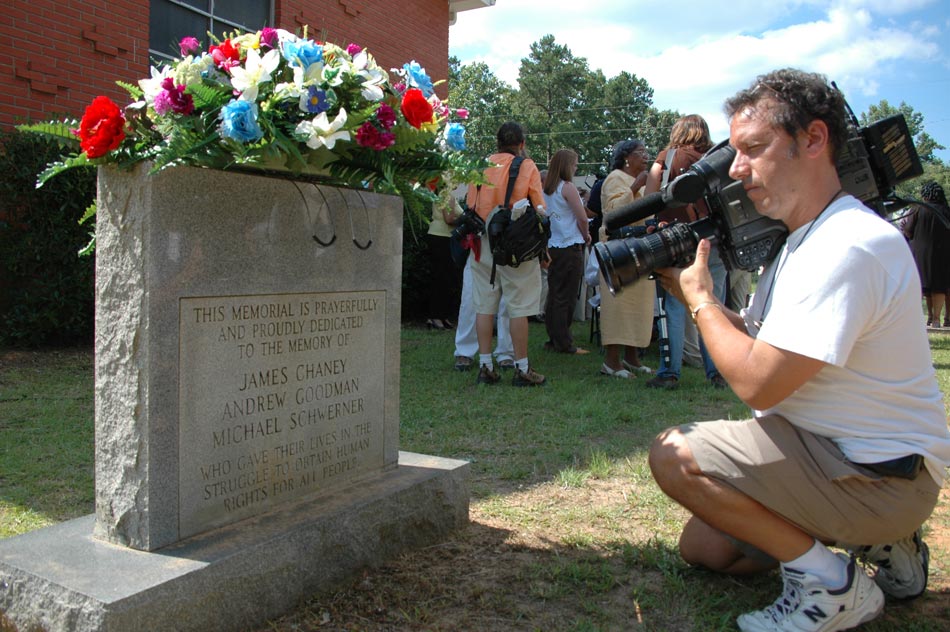
The subject is one that should spring immediately back to mind when three names are heard: James Chaney, Andrew Goodman and Michael Schwerner.  Yes, the three young civil-rights volunteer workers -- Chaney a 21-year-old local Mississippi man, Goodman (20) and Schwerner (24) both from New York -- who were cold-bloodedly murdered (above are shown their discovered remains) by the combined efforts of the local Neshoba County police department, including some lying office workers, and the Ku Klux Klan, who did the actual deed.  (This was also the alternately gussied-up and bowdlerized subject of the Hollywood narrative film Mississippi Burning.) As the young men were there to help the voter registration efforts of the local black population, a great hue and cry went up across most of the nation -- less so, of course, in our glorious southern states.

As bad as were the actual events, what followed (closely by and then over the decades) seemed even worse: a blind, sometimes blithe disregard for bringing the murderers to justice. This is the subject of Neshoba, and a circuitous one it turns out to be.  Dickoff (above, left) and Pagano (above, right) spend a lot of time with the parents of Goodman; the wife of Schwerner; and the mother (below, right), sister (below, center) and brother of Chaney. We see these people (in news clips and interviews) at the time of, first, the disappearance of the civil rights workers, then later as the deaths are uncovered, and finally at various points in recent years.

Initially the state of Mississippi refused to prosecute anyone, so the U.S. Justice Department had to prosecute eighteen people in its own 1967 trial (for depriving the three victims of their civil rights: murder tends to do that to a person), with sentences for those convicted ranging from three to ten years. One of the men not convicted, but against whom the evidence proved rather astounding, was a local preacher named Edgar Ray Killen (in yellow, below), on whom the filmmakers then concentrate during the build-up to and commencement of the 2005 trial.

All this was news of a sort a few years back, and some will remember it and its outcome, but what Dickoff and Pagano have done is explore inside and out of Neshoba county and its locals, as well as the families of the victims, and the wife and friends of the accused (and the accused himself: quite an aging and unrepentant example of what I guess we would call the old South).  All this fascinates and disturbs.

The South has changed, it becomes clear from meeting some of the current citizens of Neshoba -- whites and blacks -- who have joined together to push for the reopening of the case. But much of the old South remains, as we see, spending time with others -- most disappointingly, some younger people -- whose attitudes range from "Leave well enough alone" to "Let sleeping dogs lie."  Judging blacks as inferior, worth neither life nor time, would seem to be shockingly prevalent still. Not that it isn't in the North, of course, where convention and etiquette still maintain some hold on the open mouth.  Oh, and we don't fly the Confederate flag.

Dickoff and Pagano have given us plenty to chew on, some of which amounts to a kind of achievement worth touting, even if southern justice seems to remain to this day partially blind and deaf.  "Let the punishment fit the crime" may double as a Gilbert & Sullivan Mikado lyric and the platform for retributive justice, but by the end of this documentary, which begins with the crime and closes with the would-be punishment, it is clear that our nation has barely begun to come to terms with its own history.

Neshoba: The Price of Freedom, from First Run Features, opens theatrically this Friday, August 13, at the Cinema Village in New York City. Click the link for all currently scheduled playdates, cities and theaters.