Showing posts with label civil rights and wrongs. Show all posts

Sunday, March 8, 2015

Looking for an antidote to Ava DuVernay's Hollywood-ified Selma? Try Bill Brummel's SPLC doc SELMA: THE BRIDGE TO THE BALLOT


If you were, as was I, disappointed by Selma -- last year's fictionalized bio-pic about events leading up to that famous march to gain the Black vote in Alabama -- I highly recommend a new 40-minute documentary short on the same subject that manages to be richer and more truthful, dramatic, moving and important, simply by being concise and telling its tale in the words of some of those people who actually participated in the event.


SELMA: THE BRIDGE TO THE BALLOT is a film made by the Southern Poverty Law Center (SPLC), directed by Bill Brummel (shown at left), and narrated by Oscar-winner Octavia Spencer. Via reminiscence, fine archival footage and occasional animation, Brummel and his crew place us smack in the middle of it all, giving us an excellent understanding of why this was so important in its time and how, almost suddenly, various events coalesced into a civil rights action that became unstoppable.

Hearing the words of the participants (spoken quite well by the performers rounded up for the task) along side the moving and still shocking archival footage brings real punch to this short film, without any of the "movie" cliches -- actors who, to a man and woman, seem much more attractive than their real life counter-parts; life goosed into "drama" for purposes of telescoping; the rousing, feel-good finale -- that turn Selma into a kind of movieland pseudo-history.

Even that Oscar-winning song strikes me as rather paltry against the great music we hear in this short doc. In any case, the facts presented here tie events together quite well and include some things we didn't see in Selma: the forced march of black students out of town, the white sheriff hospitalized, torrential downpours and protesters having to sleep in the mud (there's a great shot of a pair of shoes barely held together).

The cavalier and nasty face of racism is on full display; as the protests increased, so did the brutality. At the beginning of it all, we hear from the SNCC: "The white folk here are too mean, and the black folks are too scared." Amen to that. But then, change began. This little film tells it like it was and, in the process, brings home the bacon.

Where and how can you see Selma: The Bridge to the Ballot? The film has had limited showings in both New York City and in the Los Angeles area. It is now slated to be shown to students in thousands of classrooms nationwide, with nearly 20,000 educator orders placed already. Additional community screenings will be held for moviegoers but the dates and locations have not been announced yet. For further information, contact the SPLC and/or its Teaching Tolerance web sites by clicking on the links above, or go the link here, which offers the trailer for the film, as well as details for civic organizations that work with voter registration and can order the film for free showings. 

Monday, June 17, 2013

Vittoria's MUMIA movie hits DVD, and the entire package marks a big improvement

The DVD of MUMIA: Long-Distance Revolutionary is now available from First Run Features, and it contains exactly what I found missing from this repetitive and overlong film: an encapsulation of the putrid prosecution case by the Philadelphia DA’s office against this journalist, showing up the many lies involved, along with intimidated witnesses and the despicable police in charge of the initial investigation, who were already under surveillance because of their suspected corruptions (which is why none of their testimony made the actual trial of Mumia). I believe a much stronger case can be made for the journalist’s innocence than for his guilt.

Why filmmaker Stephen Vittoria did not hack out a full half-hour of his finally too-lengthy and tiresomely pushy film (regarding how wonderful Mumia is, among other repeated points) and insert this 25-minute section – which covers what any newcomers to the case will want to know, while giving those of us already familiar with it a much-needed and helpful memory jog/update – is anybody’s guess. Whatever, you can see this excellent and concise piece of film journalism on the DVD as an “extra,” so you might want to watch it first, before going on to the actual film itself.  Directed, and well, by Mr. Vittoria, this 25-minute short quite literally makes the existence of the two-hour movie worthwhile.

Below is my original review of the film, slightlly edited and updated....

Imagine: A feel-good documentary about a guy on death row who gets his sentence lessened to life in prison! That's Mumia (the man, Mumia Abu-Jamal) and MUMIA: LONG DISTANCE REVOLUTIONARY, the new movie about him by filmmaker Stephen Vittoria. Unfortunately, there's a black hole in this project, the size of which could suck in one of the universes from the recent John Dies at the End. And the oddest thing is, Mr Vittoria has actually planned it that way. The below is from the press kit for the documentary: Unlike any other film about Mumia Abu-­‐Jamal, Mumia: Long Distance Revolutionary does not deal with Mumia’s case but rather his work as a journalist prior to and after incarceration on Pennsylvania’s death row. “I wasn’t interested in re-­hashing the same polarizing standoff between those who want Mumia to fry and those who want him free,” Vittoria states.

Well, Mr. Vittoria, shown at left, may not be interested in re-hashing Mumia's court case, but his audience most definitely is. (And who says it has to be a rehash? In the current West of Memphis, Amy Berg and her producers brought in new information that made a huge difference to the case itself.) At the very least, the filmmaker could have spent a few minutes on a precis of the case from both sides, even if he favored one of those sides. Instead we get, yes, absolutely nothing about it -- except that Amnesty International found it wanting, justice-wise. Great: Show us why.

The filmmaker's decision not to do this sinks what would otherwise have been a reasonably interesting, if repetitive movie full of glow-ing testimonials by everyone from Alice Walker and Angela Davis to Dick Gregory & Cornell West. Many of these are well-consider-ed and -spoken, but there are simply too many of them. After awhile, the movie, well-intentioned as it might be, begins to seems some sort of like a con job -- particularly given that the single thing we most want to get to the bottom of goes missing entirely.

Mr. Vittoria gives us some interesting history of the city of Philadelphia, in which "brotherly love" seems to not have been able to bridge the divide between races, and his history of Mumia's early life is worth seeing. Ditto his exploration of Mumia's career as a writer and journalist. There is plenty here that makes the movie worth a look, but the hole at its center is so staggeringly blatant and ill-conceived that it makes the documentary's execution a fumble for the record books. What a shame.

This story of a bright, articulate, talented man who may or may not have killed a police officer back in 1981 but is serving a life sentence for the deed deserves better. The one good thing that could come out of this is that the film might well send viewers back to the source material. Reading Mr. Abu-Jamal should be a healthy, salutary thing for many of us.

From First Run Features and sporting a way-too-long 120-minute running time, Mumia is available now on DVD for rental or sale from the usual suspects....

The photos above are all credited within that photo, 
except for the one of Mr. Vittoria, 
which is by Shannon Vittoria.

Monday, August 9, 2010

Micki Dickoff and Tony Pagano's NESHOBA: THE PRICE OF FREEDOM opens a dreadful page of U.S. history that is bleeding still


The first section of the new documentary NESHOBA: THE PRICE OF FREEDOM, from filmmakers Micki Dickoff and Tony Pagano, is so gut-wrenchingly sorrowful that it's an oddly mixed blessing when, as the movie prog-
resses, it becomes both easier to take and less effective. This may have more to do with the way in which events have played themselves out over the 46 years since the original murders around which the film is organized than with the skill of the filmmakers themselves. Still, had Dickoff and Pagano been able to maintain the passion and immediacy of their first third, they might have ended up with one of the most powerful, ground-breaking documentaries of modern times. (Or perhaps one so upsetting that viewers would squirm and head for an early exit.)

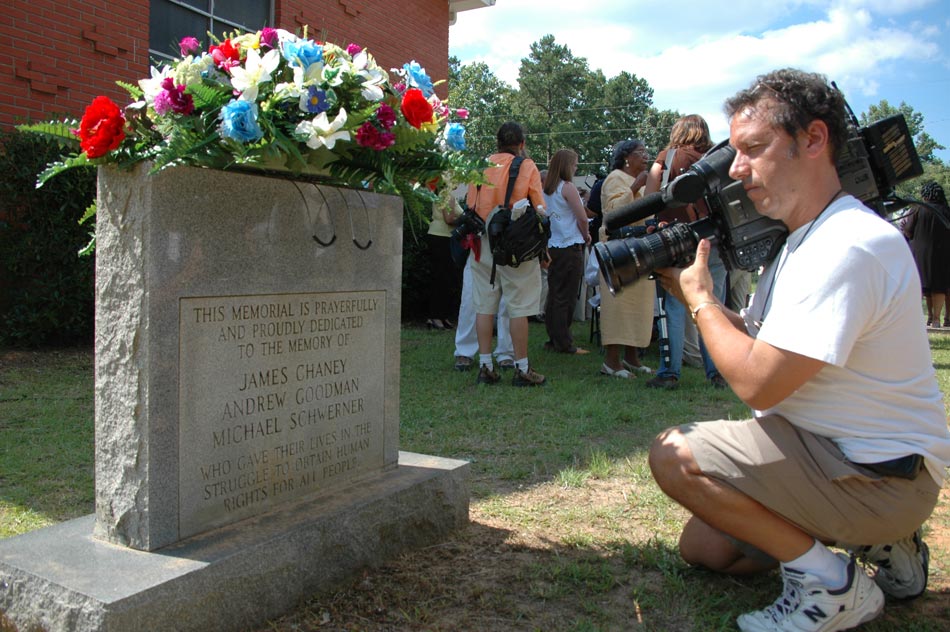
The subject is one that should spring immediately back to mind when three names are heard: James Chaney, Andrew Goodman and Michael Schwerner.  Yes, the three young civil-rights volunteer workers -- Chaney a 21-year-old local Mississippi man, Goodman (20) and Schwerner (24) both from New York -- who were cold-bloodedly murdered (above are shown their discovered remains) by the combined efforts of the local Neshoba County police department, including some lying office workers, and the Ku Klux Klan, who did the actual deed.  (This was also the alternately gussied-up and bowdlerized subject of the Hollywood narrative film Mississippi Burning.) As the young men were there to help the voter registration efforts of the local black population, a great hue and cry went up across most of the nation -- less so, of course, in our glorious southern states.

As bad as were the actual events, what followed (closely by and then over the decades) seemed even worse: a blind, sometimes blithe disregard for bringing the murderers to justice. This is the subject of Neshoba, and a circuitous one it turns out to be.  Dickoff (above, left) and Pagano (above, right) spend a lot of time with the parents of Goodman; the wife of Schwerner; and the mother (below, right), sister (below, center) and brother of Chaney. We see these people (in news clips and interviews) at the time of, first, the disappearance of the civil rights workers, then later as the deaths are uncovered, and finally at various points in recent years.

Initially the state of Mississippi refused to prosecute anyone, so the U.S. Justice Department had to prosecute eighteen people in its own 1967 trial (for depriving the three victims of their civil rights: murder tends to do that to a person), with sentences for those convicted ranging from three to ten years. One of the men not convicted, but against whom the evidence proved rather astounding, was a local preacher named Edgar Ray Killen (in yellow, below), on whom the filmmakers then concentrate during the build-up to and commencement of the 2005 trial.

All this was news of a sort a few years back, and some will remember it and its outcome, but what Dickoff and Pagano have done is explore inside and out of Neshoba county and its locals, as well as the families of the victims, and the wife and friends of the accused (and the accused himself: quite an aging and unrepentant example of what I guess we would call the old South).  All this fascinates and disturbs.

The South has changed, it becomes clear from meeting some of the current citizens of Neshoba -- whites and blacks -- who have joined together to push for the reopening of the case. But much of the old South remains, as we see, spending time with others -- most disappointingly, some younger people -- whose attitudes range from "Leave well enough alone" to "Let sleeping dogs lie."  Judging blacks as inferior, worth neither life nor time, would seem to be shockingly prevalent still. Not that it isn't in the North, of course, where convention and etiquette still maintain some hold on the open mouth.  Oh, and we don't fly the Confederate flag.

Dickoff and Pagano have given us plenty to chew on, some of which amounts to a kind of achievement worth touting, even if southern justice seems to remain to this day partially blind and deaf.  "Let the punishment fit the crime" may double as a Gilbert & Sullivan Mikado lyric and the platform for retributive justice, but by the end of this documentary, which begins with the crime and closes with the would-be punishment, it is clear that our nation has barely begun to come to terms with its own history.

Neshoba: The Price of Freedom, from First Run Features, opens theatrically this Friday, August 13, at the Cinema Village in New York City. Click the link for all currently scheduled playdates, cities and theaters.