Showing posts with label controlling mothers. Show all posts

Saturday, September 7, 2019

This time they got it right! Éric Barbier's fine film of Romain Gary's PROMISE AT DAWN


Back in 1970 director/adaptor Jules Dassin, together with stars Melina Mercouri and Assaf Dayan, took a crack at filming for the first time Romain Gary's autobiographical novel, Promise at Dawn. The results were "iffy," despite some very good scenes/moments now and again, with the can't-help-it-if-I'm-glamorous Ms Mercouri hamming it up some, as ever, even as the good-looking but talent-challenged Dayan kept threatening to disappear into the wallpaper.

The very good news this week is that the second-time-round version of the late M. Gary's "memoir" (or "autobiographical novel," as it is also known) is so much better that comparisons between the first film and the new PROMISE AT DAWN are pretty much pointless.

As adapted and directed by Éric Barbier (shown right) -- whose earlier, darkly pleasant heist film The Last Diamond certainly did not prepare me for how fine a film this one is -- the movie adheres pretty closely as best I can recall to Gary's original, while bringing to wonderful life and delight the mother and son characters that make up this unusual, alternately hilarious and moving tale.

The Russian/Polish mom is played with her usual command of everything from steely subtlety to off-the-rails humor and craziness by the splendid Charlotte Gainsbourg (above, and on poster, top), while her doted-upon offspring is handled by three excellent actors: Pawel Puchalski (below, left, as the young Romain),


Némo Schiffman (below, right) in the adolescent segment,

and finally by the terrific Pierre Niney below, left, and further below, (from Frantz and two extraordinary performances back in 2011), who plays Romain as both a young man and adult.

M. Niney and Ms Gainsbourg work together beautifully, playing off each other with understanding and great skill to turn this sometimes unsettling but more often hilarious and moving mother-son relationship into something unforgettable.

The movie moves from darkest, anti-Semitic Poland to the sun-speckled shore of Nice, from Paris to wartime London and Africa, and all the while that mother-son bond continues to grow, even as our Romain is fucking the daylights out of various young things in various locations. No matter: His heart (and ours) belongs to mommy.

Promise at Dawn is that most unusual art/mainstream movie that begins well, gets even better along the way, and then goes out with the kind of build-up and bang that should leave you surprised, smiling and maybe holding back, if not wiping away, a tear. Is the movie all that believable, and is most of what M. Gary told us even true? Probably not. But my god, did this guy know how to tell a whopping good story!

All the movie's technical aspects are first rate -- production and set design, cinematography, music, the works -- and supporting performances are as good, though much smaller (Jean-Pierre Darroussin's is especially grand), as those of the two leads.

Released here in the USA by Menemsha Films, Promise at Dawn opened this Friday, September 6, in New York City at the Quad Cinema, and should hit other cities soon, I would hope. Click here and scroll down to view any additional/upcoming playdates, cities and theaters.

Saturday, January 20, 2018

DVDebut: Taron Lexton's IN SEARCH OF FELLINI proves (very) light on the Fellini


Can a movie get by almost exclusively on charm and visual beauty at the expense of any kind believable story line? Prior to seeing IN SEARCH OF FELLINI, the first full-length film from South  African-born Taron Lexton (below), I would have thought this pretty doubtful, but after viewing his said-to-be-based-"mostly"-on-a-true-tale movie, I've got to admit the film works well enough to garner an OK rating.  As gloriously shot by Kevin Garrison in Verona, Milan, Rome and Venice, Italy (oh, yeah -- and in Ohio, too), the cinematography is often so breathtakingly beautiful that you'll be swept away long enough to forget, or maybe just ignore, the rather saccharine and unbelievable tale told here.

As written by Nancy Cartwright and Peter Kjenaas, that story is one of a young girl (played in adulthood by the very lovely Ksenia Solo, below), so pampered and secluded from real life by her mother (Maria Bello, shown at bottom, right) that the poor thing is completely unsuited for autonomous adulthood. So what does she do? She leaves her dying mother to head for Italy all by her lonesome and there to somehow meet her new hero, famed filmmaker Federico Fellini, whose movies she has suddenly discovered via a Fellini festival in her home town. (The film takes place a couple of decades back, as Fellini died in 1993.)

Too dumb to get to Rome where the filmmaker resides, she ends up in Verona, then Venice, before finally arriving at her real destination. But that's all to the good because, along the way, she and we get to view a raft of fabulous locations and also meet and fall in love with what must be the sweetest and most handsome straight male in all of Italy (Enrico Oetiker, below, with Ms Solo).

But onward she must go toward Signore Fellini, and so she also almost gets raped-while-being-filmed by a nasty hunk named (against type) Placido. Not to worry, despite its R rating, this is a feel-good movie par excellence, so when our heroine finally does encounter her hero, it is in perhaps via the most gorgeously lit and filmed restaurant scene in movie history -- with no dialog yet, so that we can instead imagine what is being shared by the two.

Yes, indeed, this is all so silly that it would defy belief -- were it not so lovely to look at. All the leads are super-attractive, and Italy, well, come on: You know how visually enchanting that country can be. So I would suggest placing you brain on hold for the film's 103 minutes and just giving yourself over to its many visual pleasures.

Inter-cut into the film are many moments from the real Fellini catalog. And while Mr. Lexton's work apes the master's, he has filmed his movie with mostly gorgeous actors, while Fellini preferred much more bizarre-looking casts. Both filmmakers give us fantasy based on reality. The master created his films from someplace deep and humane, while Lexton, whose view may be prettier, offers up what might best be called Fellini-light.

From Spotted Cow Entertainment and running 103 minutes, the movie -- after hitting VOD and digital outlets last month -- reaches DVD this coming Tuesday, January 23.

Monday, March 21, 2016

Gaye Kirschenbaum's "mom outreach" movie opens in Florida: LOOK AT US NOW, MOTHER!


Can you think of anyone in your own generation who doesn't (or didn't) have major problems reaching their parents on the important levels? Sure, there are exceptions, but almost everyone I know (including me) fills this bill. Yet here comes a middle-aged woman -- documentarian Gayle Kirschenbaum -- who determines to bridge the generation gap and actually does it, via the film under consideration here: LOOK AT US NOW, MOTHER!  The result is a small movie miracle that, while providing family history, connections, problems and pain, shows us finally how connection can be made.

Ms Kirschenbaum, shown above -- and, yes, she's Jewish, so the "nose" problem (mom wants her to have it "fixed") crops up early on and never goes away -- seems to me to be a smart, attractive and determined woman who uses her old family "film footage" to give us much of the story of this immigrant Polish/Ukraine family and how it succeeded over generations here in the USA. At the very beginning of her movie Kirschenbaum tells us via an introductory crawl: "Most of this footage was taken for home video purposes and was never intended for an audience. Nevertheless, what follows is a story I was driven to tell."

Fair enough. What follows is a remarkably balanced -- between mother and daughter --  account of older lives lived in emotional shadow (that's mom, above), with the younger versions, thanks to everything from psychology to greater social interaction and freedom for children, coming into the light, and then helping to dispense that light onto its forebears.

Beginning with the idea that she was somehow born into the wrong family (don't many of us hold this same notion?), the filmmaker shows us her parents and grandparents (the latter, just above) and gives us enough history so that we can appreciate their struggles, wins and losses. Gayle's mother, especially, seems such a typical product of her constricted era, that when we hear Gayle's thoughts about her own upbringing, we can only cringe and mostly identify.

Mom, of course, doesn't want to know from any of this. As she is dragged from visual and verbal trips down memory lane into various kinds of therapy/counseling, her response to any question is usually "I don't know" or "I don't remember." For awhile, at least. The counselors are kind but probing, and her daughter is, too. And even as we viewers begin to piece together the past and how it has led to this present, so, slowly, does mom.

The journey was certainly longer and more fraught than the 84-minute movie that condenses it, but Kirschenbaum has done an excellent job of editing (along with Alex Keipper) her film and photographs and history into an unfurling whole. Consequently we see mom beginning to take in the idea that she was a product of her own family and its problems, just as her daughter was a generation later.

The movie is often amusing, too. Mom and daughter both thankfully manage to keep their sense of humor, which they need to get through all this. Because Kirschenbaum is a documentary filmmaker, she gets to travel a lot, and so, as the movie progresses, she takes mom with her. (That's the pair in Israel, below.)

We learn something of Kirschenbaum's own history and character, too: Avoiding intimacy, her major relationship seems to be with her pet dog. Initially, the film is filled with ideas of guilt and recrimination and attempts at forgiveness. Slowly, though, it turns into an ongoing journey of discovery on both sides of the generation gap, of seeing the past in a different light, and of beginning to experience life through another's eyes for a change.

That mom can finally allow herself to do this is pretty exceptional, I think. Initially she comes across as a something of a self-righteous monster; by film's end, she's exposed as the vulnerable woman who coped with life as best she could and is now learning new ways to cope more healthily.

Moms, grandmas and grandkids should flock to this movie -- hell, dads and sons ought to, as well, but, as usual, it will be harder to get the guys there (tell 'em it's an action movie!). Once word-of-mouth gets out, theaters will fill.

Look at Us Now, Mother, a small, honest film that achieves exactly what it sets out to do, opens this Friday, March 25, here in South Florida in Boca Raton (where Gayle's mom actually lives!) at the Regal Shadowood and the Living Room Theaters; in Delray Beach at The Movies of Delray; and at The Last Picture Show in Tamarac. Come April 8, it will open in New York City (at the Village East Cinema) and in Los Angeles at
Laemmle's Monica Film Center and Town Center 5. Click here to see all currently scheduled playdates, cities and theaters.

Tuesday, June 30, 2015

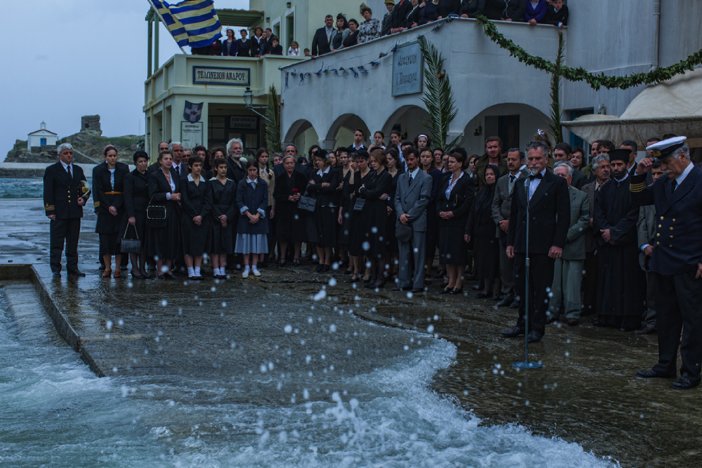
She -- and the sea -- loom large in Pantelis Voulgaris' family melodrama, LITTLE ENGLAND


Waves crash and family members hash out their anger and stress in the gorgeous new Greek film that opens in several art theaters around the country in the coming weeks. LITTLE ENGLAND is the name of the movie, and its director, Pantelis Voulgaris (shown below), though he has been working in this field for fifty years, was unknown to me until now. I'm most happy to have made his acquaintance, however, because this new film of his is worth seeing for a number of reasons.

First off, there's some truly glorious scenery in the background (cinematography by Simos Sarketzis), while the foreground is often filled with a groups of actors, also unknown to me till now, who fill the screen with enough charisma and smart performances to keep us interested throughout most of the movie's somewhat overlong running time (132 minutes).

The place is Greece; the time 1930; the characters are mostly mothers -- present and future -- while the plot encompasses a sorry tale of horrific control by one mother of the lives of her two daughters well into adulthood, as she forces them to marry for money rather than love and thus begins a chain of events that grows more awful as the movie progresses.

This special kind of mom-induced betrayal produces and an even more special vengeance that, while it is certainly and darkly melodramatic, proves also damned riveting and quietly horrifying.

We move from the 1930s through the end of World War II, and watch as the women of the family and village respond to the deprivations caused by their men making a living from the eternal sea -- which provides abundance and death in pretty much equal measure.

This is a women's movie in both the usual sense of the term and because it allows us to see and identify with these women more fully than does the usual brand of melodrama. We may hate this mother-to-end-all-mothers, but we can't pretend not to understand her or her motivations.

And when the climax comes, about three-quarters of the way along, it's both shocking and symbolic, paving the way for the measured and equally dark denouement.

We don't get many Greek movies released here in the USA. Of late, they've mostly consisted of the deliberately vague but quite interesting work of Yorgos Lanthimos (Alps and Dogtooth). So having the opportunity to savor this old fashioned and dark melodrama, with its fine writing, direction and performances should prove bracing and fun for foreign film aficionados.

Little England (the title has to do with a ship as well as a state of mind), from Corinth Films, opens this Sunday, July 5, here in Miami at the Tower Theater, Other upcoming dates, cities and theaters can be found by clicking here and scrolling down.

Friday, April 10, 2015

Time-waster worth a watch: Anthony Burns' hot-and-heavy family satire, HOME SWEET HELL


Garnering a lowly 6% on Rotten Tomatoes, this odd, dark, often bloody comedy satire on a particular wife and mother's need for a storybook life, HOME SWEET HELL -- out now on Blu-ray, DVD and VOD and digital platforms -- turns out to be a bit better than you've heard, mostly thanks to its good cast, and the surprise in finally seeing that odd actress Katherine Heigl in the kind of role she was evidently born to play. Too heavy of face and feature to fit neatly into the typical romantic comedy mode (in which she first came to our notice) and a bit too heavy-handed in her delivery to make those movies, which ought to have been more light-footed, work to their best advantage, here Heigl comes into her own.

The plot involves an uber-controlling wife (Heigl, above, left) whose hubby (the always interesting and versatile Patrick Wilson, above, center) is finally driven into the arms of that "other woman" (Jordana Brewster, below), who turns out to offer a good deal more than meets the eye. Mayhem ensues.

The leads are fine, and the film includes funny, loosey-goosey perfor-mances from the likes of Kevin McKidd, Jim Belushi and A.J. Buckley. The screenplay, credited to a trio of writers, gets its points across swiftly if a bit heavily, as does the direction by Anthony Burns (Skateland). But in an over-the-top movie like this one, that may be the better solution to bringing home the bacon economically and entertainingly.

Ms Heigl is a revelation, in any case -- beginning like a simply too-fired-up wife and mom and slowly morphing into something fierce, frightening and funny. The character loses us and then wins us back by virtue of the actress' all-stops-out performance. This movie -- from Sony/Stage 6 and running 97 minutes -- may be silly, but it won't bore you.

Friday, November 2, 2012

Guyana time, as Shundell Prasad takes us to an exotic locale via FESTIVAL OF LIGHTS

We don't see that many movies about -- or coming out of -- Guyana, so, for that reason alone, Trust
Movies was interested in viewing FESTIVAL OF LIGHTS, the first narrative film from Shundell Prasad, a young woman who has previously made a couple of documentar-ies. On the plus side, the film offer an ini-tially exotic setting, is relatively colorful and features some good performances from actors both known (Jimi MistryAidan Quinn) and unknown (the rest of the cast).

That's the extent of the positive. On the negative side is just about every-thing else: for starters, plot, characterization, dialog and common sense. If you are going to set your film in a country like Guyana, and  begin it with a lovely scene that takes place during the titular Festival of Lights, and then almost immed-iately move to a scene of enormous violence in which the lives of an entire family are threa-tened, how about giving viewers a little explana-tion of what is going on? Ms Prasad, shown at right, perhaps not want-ing to expose her viewers to too much exposition, elects to leave us totally in the dark.

Not only do we not know what is happening to that poor neighbor family (or why), we're also left wondering why our own little nuclear trio (above) -- mom, dad and daughter -- must leave the country immediately. Politics as usual? Criminal activity? Maybe an evil dictatorship? A little context, please.

In any case, mom and little daughter Reshma are allowed to emigrate to the USA, but not dad, and after a couple of perfunctory "oh, how hard it is for new immigrants!" scenes, mom (the very elegant and beautiful Ritu Singh Pande in her first screen role, above) is suddenly married to her corporate boss (Mr. Quinn) and little Reshma has turned into a very hot and rebellious teenager (Melinda Shankar, below).

The plot, such as it is, involves much mother-daughter tsuris, father idolization, boyfriend trouble, rape and getting into New York Uni-versity by sporting very poor grades. Then it's back to Guyana to find Dad (Mr. Mistry, below), where the movie really falls apart.

As a writer/director, Ms Prasad appears to have little under-standing of how to build suspense or even to clue us in on how and why the bad guys (prison guards, warden and government officials) intend to manage their nefarious deeds. Suddenly we have everything from drugs and guns to prison breaks and double dealing, but who is doing what to whom and why is up for grabs. As silly as this section seems, when we're back in America again, silly goes exponential.

These final sections indicate Ms Prasad as the kind of filmmaker who, if a situation is needed to further her plot, she will damn well make it occur, believable or not. Does Dad need to be at a certain special event? Fine, he'll be there. Must the FBI be kept away from that same event? Sorry. boys, you're out!

The filmmaker's penchant for control-no-matter-what also extends to characterization. These characters, particularly those played by Mr. Quinn and Ms Pande, seem to swivel on a dime to fit whatever new situation is needed. All this does not make for much viewer credence, but I hope that our filmmaker will learn from her mistakes for the next time 'round.

Festival of Lights opens this Friday, November 2, in New York City at the AMC Village 7 theater (the recent Manhattan flood situation permitting), and on the following Friday, November 9, in the Los Angeles area at Laemmle's Noho 7.