Showing posts with label Women's movies. Show all posts

Tuesday, June 30, 2015

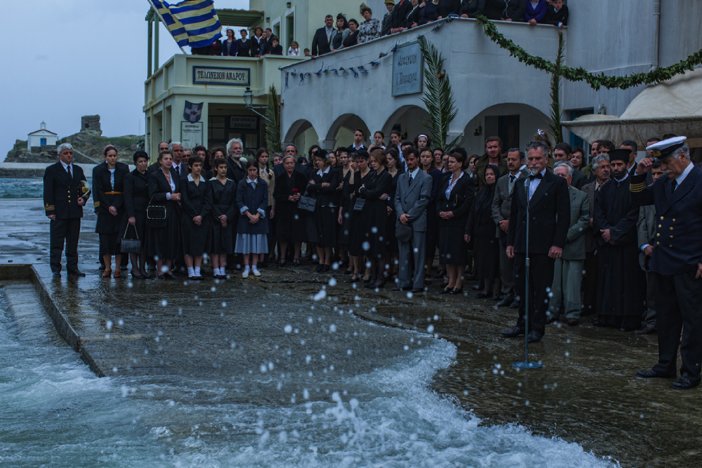
She -- and the sea -- loom large in Pantelis Voulgaris' family melodrama, LITTLE ENGLAND


Waves crash and family members hash out their anger and stress in the gorgeous new Greek film that opens in several art theaters around the country in the coming weeks. LITTLE ENGLAND is the name of the movie, and its director, Pantelis Voulgaris (shown below), though he has been working in this field for fifty years, was unknown to me until now. I'm most happy to have made his acquaintance, however, because this new film of his is worth seeing for a number of reasons.

First off, there's some truly glorious scenery in the background (cinematography by Simos Sarketzis), while the foreground is often filled with a groups of actors, also unknown to me till now, who fill the screen with enough charisma and smart performances to keep us interested throughout most of the movie's somewhat overlong running time (132 minutes).

The place is Greece; the time 1930; the characters are mostly mothers -- present and future -- while the plot encompasses a sorry tale of horrific control by one mother of the lives of her two daughters well into adulthood, as she forces them to marry for money rather than love and thus begins a chain of events that grows more awful as the movie progresses.

This special kind of mom-induced betrayal produces and an even more special vengeance that, while it is certainly and darkly melodramatic, proves also damned riveting and quietly horrifying.

We move from the 1930s through the end of World War II, and watch as the women of the family and village respond to the deprivations caused by their men making a living from the eternal sea -- which provides abundance and death in pretty much equal measure.

This is a women's movie in both the usual sense of the term and because it allows us to see and identify with these women more fully than does the usual brand of melodrama. We may hate this mother-to-end-all-mothers, but we can't pretend not to understand her or her motivations.

And when the climax comes, about three-quarters of the way along, it's both shocking and symbolic, paving the way for the measured and equally dark denouement.

We don't get many Greek movies released here in the USA. Of late, they've mostly consisted of the deliberately vague but quite interesting work of Yorgos Lanthimos (Alps and Dogtooth). So having the opportunity to savor this old fashioned and dark melodrama, with its fine writing, direction and performances should prove bracing and fun for foreign film aficionados.

Little England (the title has to do with a ship as well as a state of mind), from Corinth Films, opens this Sunday, July 5, here in Miami at the Tower Theater, Other upcoming dates, cities and theaters can be found by clicking here and scrolling down.

Monday, September 1, 2014

Signe Baumane's ROCKS IN MY POCKETS: dark tales animated with colorful, ironic joie de vivre


A rather bizarre surprise, given its subject and themes -- women, education, suicide, depression, insanity and possible coping mechanisms -- ROCKS IN MY POCKET, the new animated film (her first full-length) from award-winning filmmaker Signe Baumane, proves a genuinely interesting and different kind of animated movie. This one is very time-and place-specific: Latvia in the early and later part of the century past. It is also a movie that is almost completely narrated by its protagonist: a young woman trying to ferret out her own identity and place in the world, even as she investigates the history and place of her grandmother in that same, stifling, what-will-the-neighbors-say? culture in which she has come of age.

Ms Baumane (shown at left) uses, I believe, her own heavily-accented Latvian voice to narrate her movie, and it is quite a winning one, bringing a sometimes wicked sense of humor, tartness and irony to the sound track. That voice is also sheerly enjoyable to hear, making what could be a rather heavy-going narration more of a pleasure than you might expect, had a typically American voice narrated the proceedings.

The animation, too, while made of fairly simple line drawings in various media, is so colorfully shaded and vividly imagined -- characters morphing into animal versions of themselves, a chicken wearing high heels -- that much of it gives extraordinary viewing pleasure.

The movie concentrates most on Signe herself (above, right), though it gives ample time to her grandmother (below, left) and to a number of other characters, mostly female but occasionally male.

There's cousin Linda (below, as a would-be bridal bird), the smart, beautiful and successful girl who grows into an utterly crazy young woman,

along with little Irbe (below) who hears voices intent on giving her perhaps not the best advice.

Craziness does seem to run in this family, and Baumane tracks it as best she can. She comes down hard on a society that favors conformism, laziness, the male prerogative, and the politically correct attitude -- which of course changes as one country after another conquers little Latvia.

The movie is "adult" in the best sense -- not overly sexual, though desire and need do figure in -- and more about sheer survival and making progress in a society in which women were supposed to be male "help-meets" and baby producers above all else.

If the lessons our heroine finally learns turn out to be less than profound -- friendship is a fine outlet by which to share life's pain; follow your dream and do what you most need to; take your drugs to help stave off their highs and lows of the bi-polar personality -- at least our girl seems to have come by these lessons honestly and via some hard work. Plus, the animation gives us all this in a most fertile and imaginative manner.

Rocks in My Pockets -- the title refers to what you'll need if you plan to drown yourself properly -- from Zeitgeist Films and running 89 minutes, opens this Wednesday, September 3, here in New York City at the IFC Center, and the following Friday, September 12, in Los Angeles at Laemmle's Royal theater. To view all currently scheduled playdates, with cities and theaters listed, simply click here.

Saturday, December 28, 2013

Good, raucous fun (for awhile) -- Preston & Overbey's femme-fest, THAT'S WHAT SHE SAID

The new movie, THAT'S WHAT SHE SAID, directed by crack actress Carrie Preston and written (her first) by another actress, Kellie Overbey, gets off to a great start with some increasingly funny, ribald dialog from the mouths of a couple of excellent performers, Anne Heche and Marcia Debonis, soon to be joined by a third, the very funny and here quite piquant, Alia Shawkat. As the opening credits roll, we see a montage of NYC women, coupled to the dialog between Heche and Debonis. The talk is crass, very funny and very sexual. And the visuals are all women, all the time. The men, when they appear, are seen from the rear, in slight or partial profile, or if frontal, then very piecemeal.

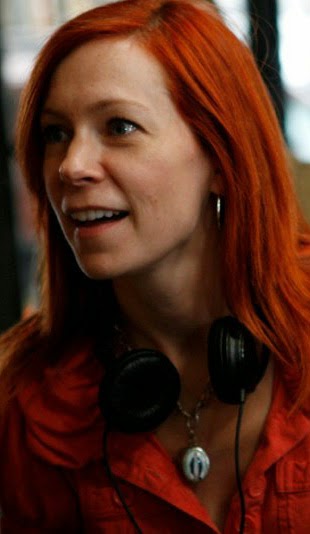
This directorial touch makes its point lightly and rather charmingly, without hammering it home: We're in for a chick flick of sorts, so hang on. We do, but the results overall prove a little less than we expected, considering the film's first half hour, which is both written and directed with smarts and style, as it sets up the current situation, while giving us some history of the two women. Heche (rough, gruff and ready) is helping Debonis (a good-hearted, plus-sized sweetie) prepare for an important date. Ms Preston (shown at right) directs with energy and pizzazz and the first big scene, set inside a coffee/latte haven, is terrific -- cleverly paced and wittily, foul-mouthedly written by Ms Overbey (shown below).

When Heche's back is momentarily turned, Debonis, in her standard "helper" mode, picks up a sad and sobbing young woman (Shawkat) with man trouble. Shawkat's real affliction, however, is something else entirely, which leads to some over-the-top, funny (but not quite funny enough) further business. What cast and crew here seem to be going for is a modern-day, all-women, screwball comedy, with a higher sex quotient than we're used to seeing/hearing. For a time this work pretty well, but once the complications and coincidences start piling up, the humor doesn't quite reach the same level, and the seams start to show.

Too bad, because the actresses -- both leads and supporting players -- are talented and very game (that's Heche, below left; Debonis, below right; and Shawkat above), but the screenplay seems to run down even as it proceeds. The finale, however, with five femmes in a bar, sitting around a table talking, manages to be sweet and, yes, a little moving, considering all that's come before.

That's What She Said, a Phase 4 film release running just 84 minutes, is available to stream now on Netflix and Amazon Instant Video, and to rent or purchase on DVD.

Sunday, June 9, 2013

Open Roads 2013: In Maria Sole Tognazzi's I TRAVEL ALONE, a smart woman matures

Sure to be one of the more popular films in this year's Opens Roads, the new work by Maria Sole Tognazzi is -- in terms of both entertainment and audience apprecia-tion/understanding -- quite a bit more successful than her last work seen in this annual series back in 2009, The Man Who Loves. It's a lot lighter, too -- in theme and on its feet -- than the earlier and darker romantic drama. Best of all, perhaps, for audiences who love to travel but these days can't afford so much of it, I TRAVEL ALONE provides 85 minutes of nearly non-stop reveling at five-star hotels, from Gstaad to Marrakesh, Berlin and some eye-popping Italian locations of which TrustMovies had never seen nor heard.

The film's leading character, Irene, played by the wonderful Margherita Buy (shown below, also in this year's Discovery at Dawn) is one of those "mystery guests" that drive hotels, restaurants and retailers crazy by pretending to be a regular customer but then checking and rating everything from the cleanliness of the room (and staff) to, well, you'll find out quickly, as Ms Tognazzi, shown at right, opens her film with a terrific little segment on some of the things to look for in grading your typical five-star hotel.

As much as Irene loves her work -- and as good as she is at it (her boss keeps piling more hotels on her because, as he notes, the other girls fall in love or marry or get pregnant) -- her own personal life is not so much a mess as barely there.

Her sister and brother-in-law (lovely performances from Fabrizia Sacchi and GianMarcoTognazzi, shown respectively, left and right, above), and their kids (below, whom Irene babysits now and then and actually takes on one of her "rating" trips, at which the kids prove pretty good!) keep her occupied but, as sis points out, it's often as though Irene is not really there.

Her best friend of 20 years is a love-and-sex relationship that didn't work out, played by Stefano Accorsi (below, with whom Ms Buy starred some dozen years ago in Ignorant Fairies),

who is suddenly involved with a woman (Alessia Barela, below) who seems more than merely a one-night-stand, and so Irene squeezes herself into this relationship, as well -- all the while traveling and grading and doing it in first-class fashion.

Watch Irene's concern at one particular hotel switch to a younger couple -- clearly out of their element in this swank environment -- and later see and hear her confront the hotel manager, and you'll view an egalitarian woman at the top of her game, quietly and correctly nailing to the wall the hotel and its supposed service.

The above scene is extremely well written, as is much of the movie, especially the meeting of and the relationship that develops between Irene and a well-known anthropologist, played beautifully by Britain's Lesley Manville (above, right, and below, left).

That relationship and its result set off a change in our heroine. Fortunately, it is one that doesn't presage huge growth or life-shaking consequences. It simply trips a switch that leads to some re-thinking and a little interesting action.

Some might call I Travel Alone feminist. Ms Tognazzi certainly has the concerns of women on her mind, but she doesn't slight nor condescend to her male characters. I'd call the film humanist. I'd also call it a very good movie. It's like taking a wonderful vacation during which your mind and eye get a lot to savor.

One caveat:  Since Irene visits so many hotels, after which in each case she confronts the management and thus gives away her identity, wouldn't she -- and her credit card -- soon be tagged as a "mystery guest"? (She clearly needs, like Jason Bourne, a bunch of different identities, passports and credit cards in order to do her job properly.)

If you don't get the opportunity to see the film during Open Roads -- last evening's showing was sold out, but there is one more on Wednesday, June 12 at 9pm -- don't fret. Yet. I am told that the film may be picked up by one of several foreign-film distributors, and perhaps with a change-of-name to A Five-Star Life. I can understand going for a more mainstream, up-tempo title, but, really, I Travel Alone works quite well, as is. In any case, I'll have more to say, if and when the film opens up commercially. Meanwhile, check out the remaining Open Roads programs by clicking here.

Wednesday, October 10, 2012

Black women's movie: Ava DuVernay's MIDDLE OF NOWHERE opens in theaters


Where is that new generation of black filmmakers we keep looking -- hoping -- for?  Maybe it's TrustMovies' own too-blinkered view, but he isn't seeing nearly as many nor as adept a group as he had once expected. Barry Jenkins' easy, charming Medicine for Melancholy back in 2008 seemed to indicate a new voice, but Jenkins doesn't appear to have done much since then. Likewise Tanya Hamilton's Night Catches Us (2010) offered some good opportunities to explore Black/U.S. history that were not always used as well as they might have been, and though the movie appeared promising, Hamilton hasn't made anything since. For my money Lee Daniels would seem to be as competent and creative -- if awfully given to exploitation -- a filmmaker as we've currently got. Until Denzel decides to direct again, at least.

Now comes a new movie by a black filmmaker, Ava DuVernay (shown at left) that tackles current and almost-middle-class life among blacks, with the emphasis on the women: two sisters, Ruby (Emayatzy Corinealdi, shown below) and Rosie (Edwina Findley) and their mother Ruth (the veteran actress Lorraine Toussaint). It is Ruby, however, around whom the movie revolves. As it opens, she is being told by her hubby Derek (about to go into prison for what looks like some years to come) that she should leave him and start her life anew. We don't hear Stand By Your Man on the soundtrack, but this is exactly what Ruby decides to do, and unfortunately the resulting film makes her look a bit more like a clueless dope than a supportive, caring wife.

Derek is played by the very hot young actor Omari Hardwick (below, left), so for the sexual quotient alone, one can understand Ruby's decision. Also, as DuVernay digs deeper into family history, we see that there's a rebellious streak in both daughters that comes from their too-constricting mother. Yet the filmmaker has decided to leave out all past history between Ruby and Derek, so that we can only wonder why this supposedly intelligent young woman who planned to become a nurse would forsake everything to rally around a man she so clearly does not know.

Further, by the time the filmmaker decides to show us what happened to land Derek in prison, it's something so basic and obvious that Ruby's standing by him seems even more loony. Consequently the movie appears to grow more oddly manipulative as it goes on. Why does Ruby continue on this path? Does she want to show her mother up as wrong? Or prove to herself that she can change her wayward hubby?  We get some hints here and there, but not enough to finally put us in Ruby's corner -- where we need to be, if the movie is to work on any level.

This problem becomes particularly apparent when the woman finds herself attracted to a bus driver on her local route (David Oyelowo, above, left, and below, right), who is clearly smitten with her. As writer and director, DuVernay paints her heroine into a corner from which there seems to be no escape. There's a long voice-over speech at the finale which left me not a little confused. I asked a couple of critic compatriots (one black, one white) what this meant: One couldn't even remember the speech, the other seemed as confused as I.

The acting is as fine as can be expected, considering the confusion on hand. Ms Corinealdi is pert and thoughtful, and Mr. Oyelowo is particularly good. When you compare his performance here with that of The Paperboy (which opened last week), you'll quickly see the surprising range of which this actor is capable. But what, I wonder, is the filmmaker trying to tell us? The fact that life is hard -- emotionally and economically -- for everyone we see. That's believable enough, and at this point, things only grow harder from year to year. As for these women, their plight is every bit as problemed by movie's end as it was at the beginning. If anything, it's worse, and so far as we can see, in too many ways, Ruby is as much responsible for her plight as is anyone else.

The film, from Participant Media and running 99 minutes, opens this Friday, October 12, in New York City (AMC Empire 25), Los Angeles (Sundance Cinema @ Sunset and Rave 18--The Bridge), Atlanta (Landmark Midtown), DC (Regal Gallery Place) and Philadelphia (U.A. Riverview) -- with more cities to come in the following weeks. Click here to see all currently scheduled playdates, with cities and theaters.