Showing posts with label suicide. Show all posts

Sunday, July 8, 2018

MABOROSI: Early, much-loved movie from Hirokazu Kore-eda gets Blu-ray/DVD debut


I first encountered the work of Japanese filmmaker Hirokazu Kore-eda (shown below) via his marvelous After Life, a bizarre, philosophic and enchantingly original riff on the post-death experience. Since then I've seen each of his subsequent films (those released here in the USA, at least) and enjoyed every one of them. Yet the movie that brought him to international attention -- MABOROSI, his first narrative film released in 1995, three years prior to After Life -- I am only now catching up with, due to its at last getting a Blu-ray/DVD release, thanks to Milestone Films.

The film is worth the wait. Not surprisingly Maborosi, which refers to a kind of strange light sometimes seen at sea, deals with so many of the themes that are clearly important to its director: family, loss, love and responsibility. Even more interestingly, TrustMovies thinks, is that fact that all these themes are dealt with in a manner even more graceful, subtle and quiet than in any of Hirokazu's later films (which are themselves pretty graceful, subtle and quiet).

While the director usually writes his original screenplays (or occasionally bases one on a manga), with Maborosi, he worked from a screenplay by Yoshihita Ogita (adapted from the novel by Teru Miyamoto). Whether he was deliberately more careful in adhering to the screenplay or it simply worked out this way, his movie is almost exquisitely calm, composed, placid and beautiful.

In telling a tale of disappearance and death, family and obligation, the director makes a rare visual poetry out of loss, grief and only very painful, difficult renewal.

Beginning with the disappearance of a much loved grandmother (above) and then all too soon the apparent suicide of a beloved husband and best friend (below), our heroine, Yumiko (Makiko Esumi), barely able to shoulder the co-responsibility of caring for a young child before her loss, now is forced to do it all nearly alone.

Still, new life beckons, and Yumiko accepts it, as a new husband and his daughter joins her and her little son, bringing them to a small, strange and beautiful -- if pretty desolate -- seaside town.

The movie relies even more on its visuals than on its rather sparse dialog to guide us along, and because those visuals are so beautifully composed (the cinematography is by Nasao Nakabori), we follow effortlessly. And though we are told of those illusory seafaring lights, the film itself is so full of odd, dark and beautiful lighting effects (as above and below) that it very nearly becomes its own "Maborosi."

Our heroine (as well as we viewers) wants nothing more than explanation. We expect that things -- important things -- will be revealed. Nothing ever is. Perhaps that is the point: Nothing conclusive can be revealed.

Yes, the past is always present and always will be -- until memory leaves us. The point is not allowing that past to engulf us but rather moving ahead. All of the filmmaker's work seems to underscore this. The beauty and poetry he gives us in the process is what makes that work so special.

From The Milestone Cinematheque and running 110 minutes. Maborosi arrives on Blu-ray/DVD  this coming Tuesday, July 10 -- for purchase and (I hope) rental.

Tuesday, February 6, 2018

Insanity handled with inventiveness, sadness and glee in Jason James' ENTANGLEMENT


We've seen a number of "crazy love" stories down the decades but few have come to the problem with quite the oddball enthusiasm and determination to figure out the puzzle as ENTANGLEMENT, a new indie film opening in a limited theatrical run this week. As directed by Jason James, shown below, and written by Jason Filiatrault, the movie begins with a suicide attempt interrupted by the doorbell and proceeds from this alternately scary/goofy premise onward to even more frightening and funny matters.

The writer and his director have conceived their film as a kind of gleeful look at possible insanity from a mass of differing -- but mostly amusing -- angles. While this may put off folk who feel that mental illness/suicide should never be treated amusingly and/or cavalierly, TrustMovies must admit that he sometimes finds this can work rather well. (And as a former suicide-attempt, many decades ago, he feels he has a right to his opinion.)

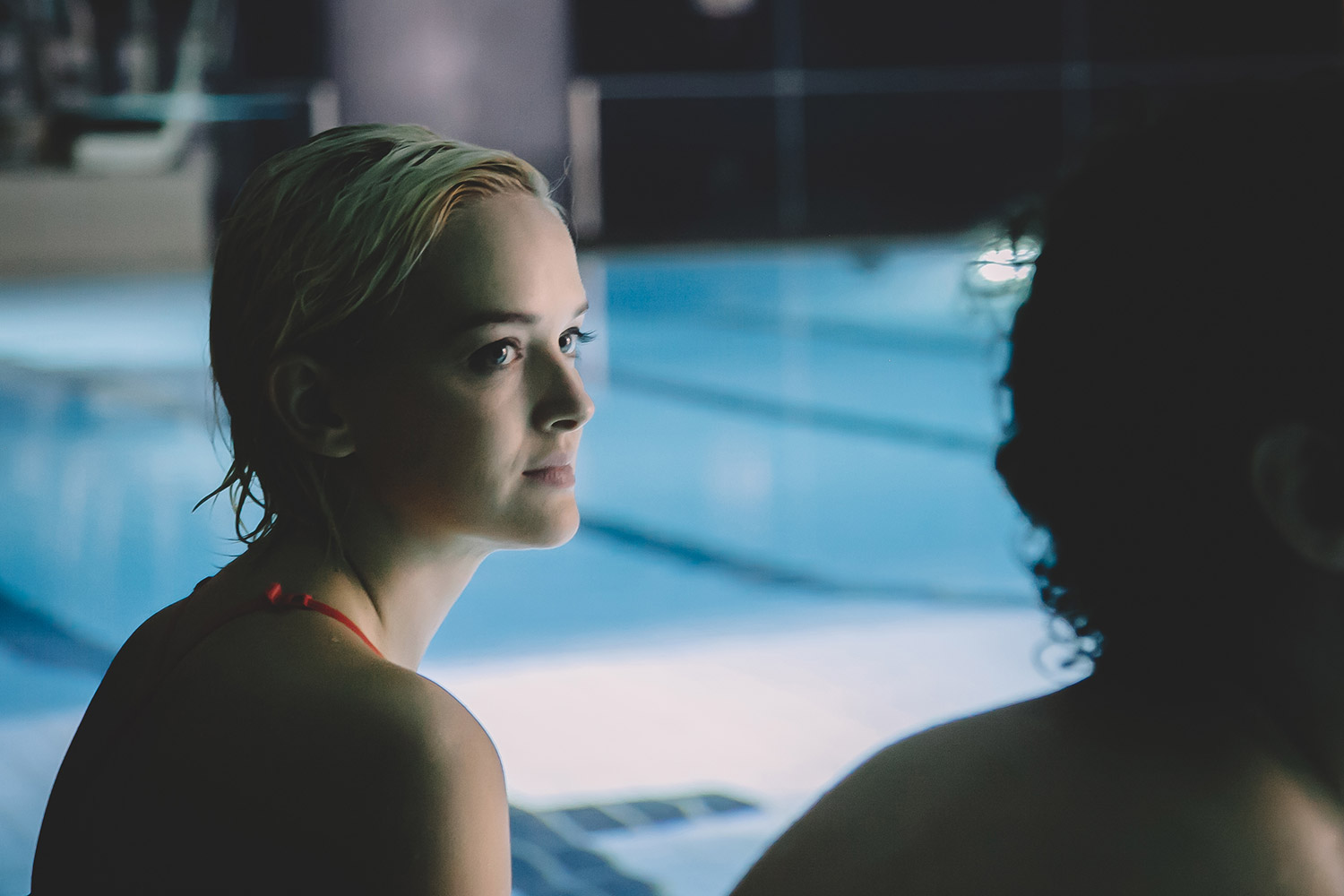
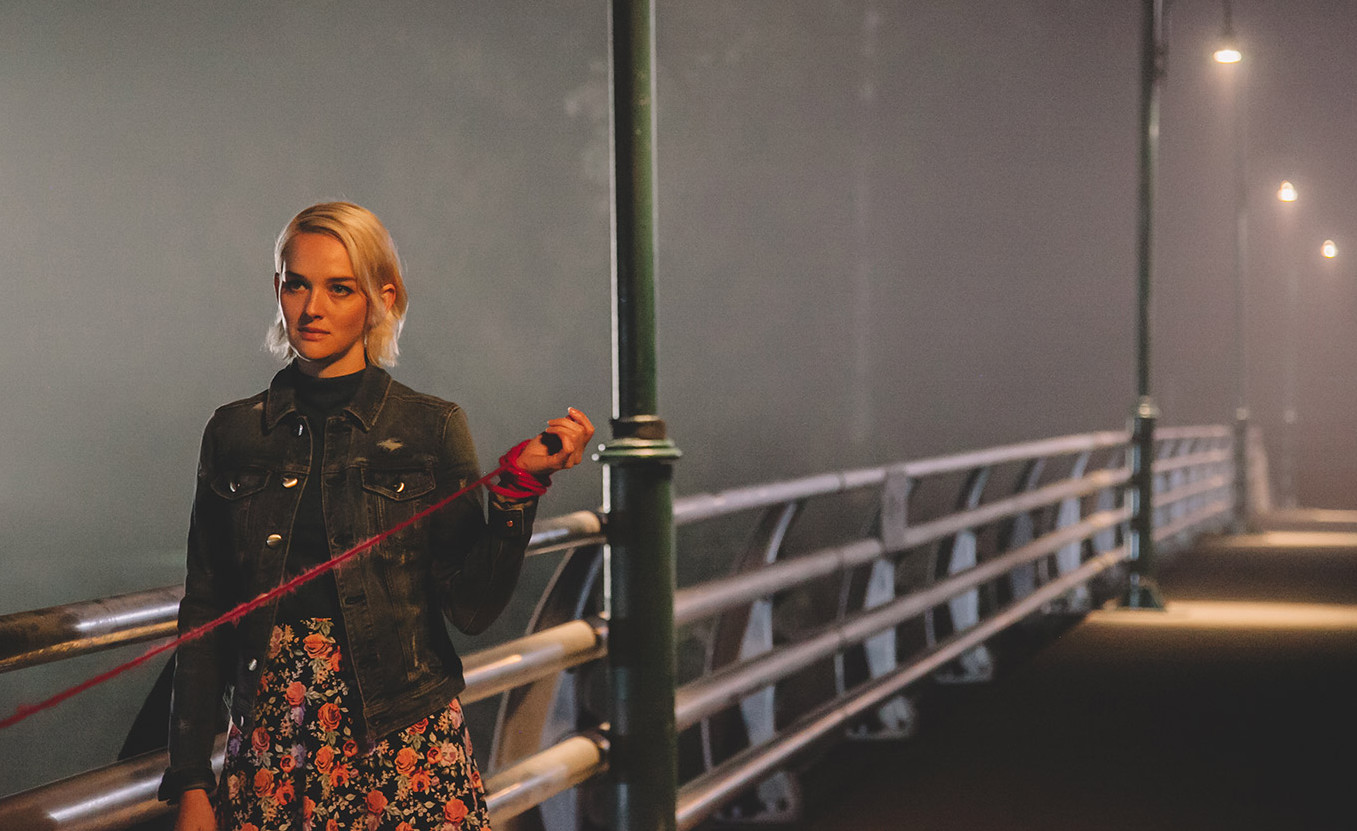
Entanglement uses everything from bits of physics (it possesses its own version of "string theory": see poster at top and the photos toward the bottom), friendship, fantasy (complete with some charming animation), parenting and an almost-adopted sibling to tell the tale of a grown man named Ben -- played by the always interesting and goofy Thomas Middleditch, shown at top and below -- who has a load of trouble coming to terms with things like growing up and accepting responsibility.

Into his life comes a very pretty mystery woman named Hanna, who just may be that nearly-adopted sister. Hanna is played by the versatile and ever-commanding Jess Weixler, who here turns in another first-rate performance that keeps us, and Ben, on our toes. By turns charming, sexy, sweet and bizarre, Weixler has seldom seemed as alluring and/or maybe a little dangerous (except, of course, in Teeth).

Also on hand but relegated to background material -- as so often happens in films to any poor young woman who carries an unrequited torch for the hero -- is a young and pretty neighbor of Ben's named Tabby. Fortunately Tabby is played with enough wit and charm by Diana Bang, below, right, to keep her character in the foreground after all.

These three leads pretty much keep the movie on its oddball course, as we slip and slide along with Ben, finding our way toward unraveling the entanglement that is his mind and life. The movie has connections aplenty, even including that delivery man who rings the doorbell initially and finally appears again in what very well might be a more important role.

Fortunately our two Jasons do not work with a heavy hand. These connections and possibilities are suggested rather than belabored, and the movie comes to its conclusion more quickly, confidently and lightly than you may expect.

Performances are all they need be to brings this rather delicate, bordering-on-precious fable to life. Mr. Middleditch (of Silicon Valley and The Bronze) uses his innate goofiness abetted by just enough charm and appeal to make a pretty good hero of Ben, while Weixler and Bang offer interesting versions of woman as both help-meet and hindrance.

From Dark Star Pictures and running a just-right 85 minutes, Entanglement opens this Friday, February 9, in ten cities across the country, including New York (at the Cinema Village) and Los Angeles (at Laemmle's Monica Film Center). To see all currently scheduled playdates, cities and theaters, click here and then scroll down. And if you're not near any of these ten cities, the film will also be streaming on many of the usual outlets, as well.

Tuesday, October 10, 2017

In Lana Wilson's THE DEPARTURE we meet a one-man suicide prevention center who also makes house calls


The documentary begins in what looks like a club where our hero is dancing up a storm. Then we see him on a motorbike heading out to the countryside and... home. His? Whose? Now he's praying and writing and dressing like... a monk? Yes. Or maybe a teacher. Or both. Soon he is saying to a group of students, "Welcome to The Departure," and training the class regarding what it is like to die. This exercise is a marvelous one, at the end of which, "This is death," he tells the class. Then he's farming (rice, maybe?), after which he's back home with his... wife, child and mother?

All the above questions or surmises will be answered or borne out in the course of an 87-minute documentary titled THE DEPARTURE, directed and co-written (with David Teague) by Lana Wilson (of After Tiller), shown at right. Ittetsu Nemoto, we soon learn, has gone from being a Japanese punk rocker leading a band to near-death to a fellow who, when his mother notices a want-ad for a priest (yes!), she encourages him to apply. He does, and the rest, as they say, is both history and a little mystery. Nemoto turns out to be a one-man suicide prevention center, and he also makes house calls!

For all the good that our guy may be doing in terms of his students (this, it seems to me, is called into question, perhaps unintentionally, by the film as it goes along), it is soon clear that Mr. Nemoto, below, has not at all left behind the self-destructive habits that almost killed him in late adolescence.

"There has to be a meaning in life," someone -- I think it was one of those students -- notes during the course of this doc. As a response, "The river has no meaning," Nemoto reminds them. Yeah? Tell that to the fish who live it in or the folk who drink from it. And while our priest's help and advice to his would-be suicides does appear of some encouragement to those disciples (below), it also seems awfully generalized and non-specific. And even when it is specific -- "Think what your suicide would do to your children!" -- at most this seems ultra-obvious, standard stuff. But then, I may be approaching all this from a westernized standpoint; my understanding of eastern cultures is clearly limited.

Still, I do find it odd that a documentary that begins so well, with so much surprise and seeming importance, would dwindle down to a meandering, "whatever" kind of journey of would-be profundity that eventually simply stops rather than actually concluding. One wonders, given Nemoto's doctor's prognosis (which we are privy to in the course of the film), if this unusual Buddhist priest/monk is even still alive today.

From Matson Films, The Departure opens this Friday, October 13, in New York City at the Metrograph theater, and on Friday, October 20 in the Los Angeles area at Laemmle's Monica Film Center. In the weeks to come, the documentary will open in another 20 cities across the country. Click here to see all currently scheduled playdates and theaters.

Saturday, August 6, 2016

DVDebut: A teen suicide cult forms in a small Wales town in Jeppe Rønde's BRIDGEND


The kids may be suicidal in the small town of Bridgend, Wales, but it's the adults who would appear to be criminally negligent in the 2015 movie, BRIDGEND, that made its DVDebut last month. Beginning with a few moments in the woods that stagger in their simplicity and emotional jolt (this is the boy-and-his-dog scene to end them all), the movie then zeroes in on a father/daughter who are returning to the little town, after years away.

As directed and co-written by Danish filmmaker (best known for documentaries) Jeppe Rønde, shown at left, the movie offers up a generational divide more immense than even usual: the adults here are hypocritical, useless, unfeeling, drunken shits who seem to have no clue about anything. Their kids may be the product of all this, but what in the world has induced them to form this seeming "suicide cult"? After viewing this too-long movie, I suspect that Mr. Rønde hasn't a clue. And neither will you. But he has turned what evidently is a movie based on real events -- as the end credits inform us, there were 79 suicides in this town between 2007 and 2012, with more occurring even now -- into a would-be noirish horror film that defies credibility, common sense and intelligent moviemaking. (The line "Everything is going to be OK" has rarely sounded stupider than it does here.)

The filmmaker does manage to engross us for maybe the first half-hour, as one suicide, then another, occurs and we fear for our heroine. But then she gets sucked into the "cult" far too easily, and we begin to wonder why the townspeople, including the police department (our heroine's father, played by Steven Waddington, above, is even on the force!) are doing little to nothing about all this.

Our girl (played by Hannah Murray, above and on poster, top) is busy all the while with various males in the cult. One tries to kills her, another to rape her, but she has fallen for Jamie (Josh O'Connor, below, rutting), a very problemed cult member who can't seem to decide on much of anything -- or stick with it, once he does.

Mr. Rønde enjoys teasing us with weirdness and some nudity and enough creepy scenes to keep us watching. But eventually the movie begins to feel like nonstop vamping, as the screenwriters search for something, anything, to keep us interested. But even on a rudimentary level the movie begins to make no sense.

The town's adults seem to have zero control over their kids, nor do they appear to have any interest in obtaining it. Events are simply arbitrary, with their consequences practically nil. The townspeople, including the families we see, barely have a nodding acquaintance with each other.

Those notorious Bridgend suicides deserve a better memorial this this -- the biggest piece of crap I've seen all year. From Kimstim and being released to home video by Icarus FilmsBridgend -- in English and running 104 minutes -- is available now for purchase and maybe rental.

Wednesday, March 23, 2016

French film buff heaven: Huppert & Depardieu ground Guillaume Nicloux's VALLEY OF LOVE


An ex-Californian like me does not tend to think of "love" when he ponders Death Valley, located in the eastern part of the state near the Nevada border and considered by many to be the hottest place on earth. Yet that must have been the primary thing on the mind of French director Guillaume Nicloux when he titled his new film, which takes place there, VALLEY OF LOVE. What a strange and commanding -- the latter adjective thanks in large part to its two stars, Isabelle Huppert and Gérard Depardieu -- movie this is!

M. Nicloux, shown at left, has been making odd movies for nearly three decades now, very few of which I've seen (it's more the mainstream/arthouse foreign films that find their way into distribution over here). One of my favorites of his is the very dark and disturbing Hanging Offense (Cette femme-là), which I caught at one of the FSLC's Rendezvous-With French Cinemas more than a decade ago. In his new film, which he both wrote and directed (this filmmaker usually writes -- or at least co-writes or adapts -- all his work), a character named Isabelle and another named Gérard meet in Death Valley because their recently deceased son (he was a suicide) has written them each a letter asking them to come to this sunken, sweltering place, where he promises, if they arrive, he will, too.

Right: How would grieving parents -- even if, as it seems, they were not very good parents -- be able not to follow these instructions?  The actors appear to be playing some version of themselves here, and many of us will know that M. Depardieu lost his eldest son, Guillaume, to an untimely death from pneumonia at aged 37. Ms Huppert, so far as I know (TrustMovies tends not to much follow the personal lives of actors), has not lost a child, but she played a woman who is in the process of doing just that in the 2012 film, Dormant Beauty). Further, because these two French icons first worked together on Going Places (1974) and then again in Loulou (1980), the stage would seem set for something strangely personal, if nothing else.

The characters, Isabelle (above) and Gérard (below), do meet near the beginning of Valley of Love, and for the next 90 minutes, they spar and bond and break to spar again. The chemistry between these two is just about perfect. It's nothing hugely charismatic or showy, however, but rather the chemistry found in something closer to people who have known each other -- and very well -- over a long period of time. The behavior here is spot-on in terms of how former spouses act/react off each other.

That behavior mostly carries the movie, once Nicloux's slender plot is unveiled. What happens can be interpreted, I think, in various ways. The most obvious is that, yes, something otherworldly has taken place. But one might also say that these two highly vulnerable people have been somehow high-jacked -- self-brainwashed -- into belief.

Either way (or via some other theory), the movie works, thanks to the simplicity and truth in the actor's performances. If the death of a child is the worst thing that can happen to a parent (I think it is), when that death is by suicide, this takes the situation into a realm beyond measure.

Yet that valley of the title seems somehow correct by film's end. Was that what the couple's son was attempting to provide the two? However you choose to view what happens here, the actors and M. Nicloux take us on the kind of metaphysical/mystical/geographical trip that you very rarely encounter, and for this alone, the film is worth seeing.

The vistas, as you might expect, and often breathtaking, and the movie offers up a palpable sense of transporting heat. The small supporting cast is fine, too, but the film belong to its iconic stars.

Valley of Love, from Strand Releasing, opens this Friday, March 25, in New York City at the Film Society of Lincoln Center and Los Angeles at Laemmle's Royal. In the weeks to come, it will hit another ten cities and theaters. (Click here and then click on Screenings to see all currently scheduled playdates, cities and theaters.) In any case, Strand usually and eventually offers DVD and streaming opportunities, so hang on, those of you who do not live near any of these dozen cities.

Monday, September 1, 2014

Signe Baumane's ROCKS IN MY POCKETS: dark tales animated with colorful, ironic joie de vivre


A rather bizarre surprise, given its subject and themes -- women, education, suicide, depression, insanity and possible coping mechanisms -- ROCKS IN MY POCKET, the new animated film (her first full-length) from award-winning filmmaker Signe Baumane, proves a genuinely interesting and different kind of animated movie. This one is very time-and place-specific: Latvia in the early and later part of the century past. It is also a movie that is almost completely narrated by its protagonist: a young woman trying to ferret out her own identity and place in the world, even as she investigates the history and place of her grandmother in that same, stifling, what-will-the-neighbors-say? culture in which she has come of age.

Ms Baumane (shown at left) uses, I believe, her own heavily-accented Latvian voice to narrate her movie, and it is quite a winning one, bringing a sometimes wicked sense of humor, tartness and irony to the sound track. That voice is also sheerly enjoyable to hear, making what could be a rather heavy-going narration more of a pleasure than you might expect, had a typically American voice narrated the proceedings.

The animation, too, while made of fairly simple line drawings in various media, is so colorfully shaded and vividly imagined -- characters morphing into animal versions of themselves, a chicken wearing high heels -- that much of it gives extraordinary viewing pleasure.

The movie concentrates most on Signe herself (above, right), though it gives ample time to her grandmother (below, left) and to a number of other characters, mostly female but occasionally male.

There's cousin Linda (below, as a would-be bridal bird), the smart, beautiful and successful girl who grows into an utterly crazy young woman,

along with little Irbe (below) who hears voices intent on giving her perhaps not the best advice.

Craziness does seem to run in this family, and Baumane tracks it as best she can. She comes down hard on a society that favors conformism, laziness, the male prerogative, and the politically correct attitude -- which of course changes as one country after another conquers little Latvia.

The movie is "adult" in the best sense -- not overly sexual, though desire and need do figure in -- and more about sheer survival and making progress in a society in which women were supposed to be male "help-meets" and baby producers above all else.

If the lessons our heroine finally learns turn out to be less than profound -- friendship is a fine outlet by which to share life's pain; follow your dream and do what you most need to; take your drugs to help stave off their highs and lows of the bi-polar personality -- at least our girl seems to have come by these lessons honestly and via some hard work. Plus, the animation gives us all this in a most fertile and imaginative manner.

Rocks in My Pockets -- the title refers to what you'll need if you plan to drown yourself properly -- from Zeitgeist Films and running 89 minutes, opens this Wednesday, September 3, here in New York City at the IFC Center, and the following Friday, September 12, in Los Angeles at Laemmle's Royal theater. To view all currently scheduled playdates, with cities and theaters listed, simply click here.

Tuesday, December 21, 2010

News flash: Peter Liechti's award-winning doc THE SOUND OF INSECTS is no doc at all


Marketing, I guess, really is all. Being billed as some kind of a documentary (it won the 2009 European Film Award in that category), THE SOUND OF INSECTS: Record of a Mummy -- a film from Swiss filmmaker Peter Liechti (shown below) who, in this case has adapted, written, directed, produced, and handled the cinema-tography -- is not a documentary at all. Not since On the Bowery -- which at least had a true documentary feel, was shot on location and used actual "alkies" as its actors -- won its doc award, has anything so dead-wrong occur-red in the land of the fête. (OK: The Blind Side was nominated for Best Picture. But Liechti's film actually won.) Before seeing the movie and imagining that it had anything to do with the documentary format, I'd considered the European Film Awards to be a cut above our own. That notion has now been laid to rest.

According to its press release, The Sound of Insects "blurs the line between documentary and fiction," a phrase we've been hearing more and more of late. But surely this is true only if someone has no idea of the meaning of the words "blur," "line," "documentary" and "fiction."  This film is based on a novel.  A novel! (Speaking of meanings.) And a novel
written by a Japanese man, at that (and set, I imagine, in Japan): so much for verite of location. It's subject: a man who takes to the woods and commits suicide. (No spoiler here: the film begins with the removal of his corpse.) So this is a documentary? Then one might think our filmmaker would by now have been arrested. But of course not. This movie is about as "fictional" as you can get.

Even if you consider the movie to be "a profound inquiry into the art of representation" that "probes the ever-elusive and mystifying line between life and death" (that press release again), all movies -- good, bad and indifferent -- makes a stab at the former, while countless one (most recently Hereafter, Shutter Island and several films in the ongoing Spanish Cinema Now series) are happily probing the latter. OK: So much for the marketing of the movie. How is it as cinema? Interesting. Not bad. Though not particularly award-worthy, either, TrustMovies thinks.

Using (yes!) a heavy-duty documentary style -- which is hardly the same thing a being a documentary -- Liechti introduces us to his protagonist, a fellow of middle-age determined to starve himself to death over a period of, he hopes, a very few weeks.  Death, it turns out, takes longer. We see parts of him, as he himself would, looking at his own hands and legs. We become acutely aware of the world around us/him, particularly of sounds, as the symptoms of starvation becomes more intense. There's a nod to eastern culture, spirituality and the like, but this seems not nearly thought out enough by the character nor the filmmaker.

We learn very little about our fellow -- who does not seem to have led a particularly fascinating life -- and this helps drag the film down. I'd have preferred spending my hour-and-a-half with someone more interesting -- but then that person would have been a good deal less likely to commit suicide at this relatively young age. The visuals are rudimentary -- much is as they would be if we were there in the tent that the protagonist has built -- and the attempts by the director to go into fantasy and heightened states of reality are not very successful. You certainly see what Liechti is trying for, but that's about it.

The film does encourage you to consider what its protagonist is attempting and how this might play out, together with what dreams, thoughts and feelings would arise as death draws nearer. This, of course, is enough to send the majority of most audiences running for the hills. But a few fearless souls may opt for the ride. We don't get this kind of film all that often, so attention must be paid. Just don't expect a documentary.

The Sound of Insects, from Lorber Films, is opening at a Manhattan cinema venue I've never before mentioned: the Rubin Museum (150 West 17th St. between 6th and 7th Avenues), beginning Wednesday, December 22, at 7pm.  Click here for all screening dates and times (there are only ten of these, so if this post has piqued your interest, reserve now).