Showing posts with label modern Russian history. Show all posts

Friday, October 11, 2019

DVDebut for Jessica Gorter's doc, 900 DAYS: Myth & Reality of the Siege of Leningrad


Says the old man to the old woman, after turning off their TV set: "It's better to watch an empty screen than to watch this comedy." The "comedy" to which he's referring is the current (well, current when this 2011 documentary was filmed, at least) Russian television coverage "honoring" those "heroes" of the famous Siege of Leningrad by the Nazi Germans during World War II.

Why this fellow, himself a siege survivor, is so angry and caustic will be revealed, again and again, during the course of the 77-minute documentary, 900 DAYS: MYTH & REALITY OF THE SIEGE OF LENINGRAD, from Netherlands-born filmmaker Jessica Gorter.

Though made much before the current and seemingly worldwide siege of idiot nationalism had taken such firm hold, Ms Gorter's movie (the filmmaker is shown, left) offers a fine tonic of anti-nationalism -- from wherever state that foolish form of patriotism comes.

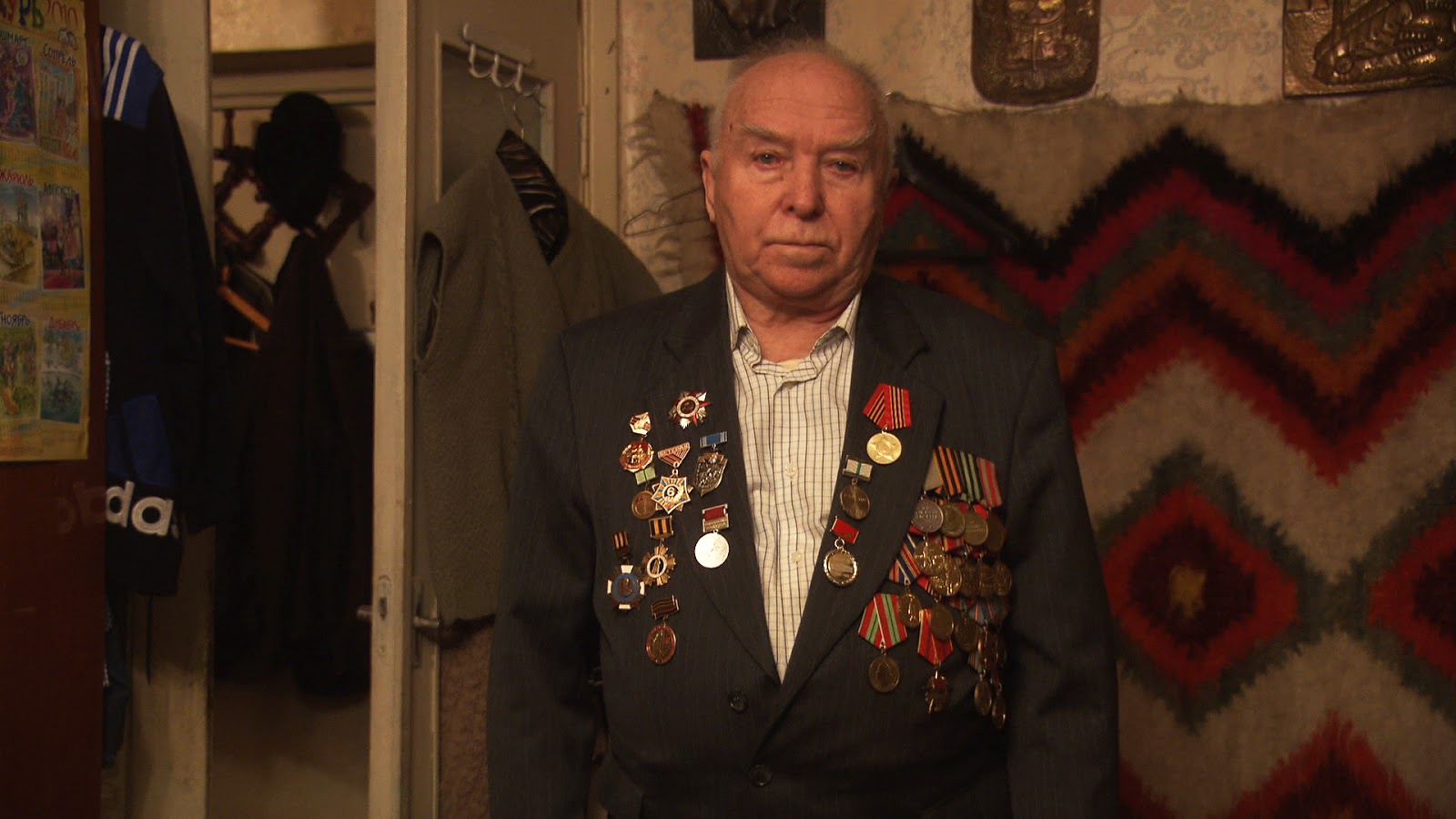
In this case, it's Russia, with its pompous rhetoric, ego-driven oligarchs, and stupid military parades full of medal-laden men marching in what might as well be goose-step -- for all the difference there is between Nazism and whatever fascism tickles your fancy. (The fellow below, as you'll learn, wears his own medals with a certain irony.)

Most of the folk we meet in Gorter's documentary are pretty old -- who but the very elderly survivors would remain alive well into the 21st Century? -- but they are still remarkably cogent and fiesty. The man below, together with his wife, has plenty to say in his quiet, serious manner (she's more open and talkative, but no less intelligent),

while the sad woman below seems still to be reeling from those early-life events that changed everything for her. Though remaining a major cat-lover throughout her life, as you'll soon see, she also tells us the story behind that strange painting of a cat and a pair of killers, shown to the left of her, that TrustMovies suspects you will not easily forget.

Gorter's film is full of -- besides these aged talking heads -- archival footage of the Stalingrad Siege that ought to give a pretty fair picture of what went on there, from the corpses in the streets (as below) to the relentless Russian propaganda (still going on today) that cast the citizens of the doomed metropolis as heroes rather than the victims they clearly were. And victims not only of the Nazis but of their own despicable government.

You'll hear about everything from cannibalism (complete with statistics of the time regrading the large percentage of cannibals that were not members of the Communist Party!) to the eating of one's own household pets, and you'll witness some very interesting conflicts among these survivors concerning the good deeds of old Joe Stalin. In one bizarre scene, shot during a tour being given to school children regarding this famous siege, one young fellow faints dead away as a particular visual is shown on the effects of dystrophy.

You should come away from this relatively short but piercing and absolutely necessary documentary with a new-found appreciation of what the people of Leningrad endured -- along with disgust at how their own government let them die back then and continues, in its quest toward absolute nationalism, to betray them even today.

From Icarus Home Video, in Dutch and Russian with English subtitles, 900 Days: Myth & Reality of the Siege of Leningrad will make its U.S. debut on home video (DVD and VOD) this coming Tuesday, October 15 -- for purchase and/or rental.

Monday, September 1, 2014

Signe Baumane's ROCKS IN MY POCKETS: dark tales animated with colorful, ironic joie de vivre


A rather bizarre surprise, given its subject and themes -- women, education, suicide, depression, insanity and possible coping mechanisms -- ROCKS IN MY POCKET, the new animated film (her first full-length) from award-winning filmmaker Signe Baumane, proves a genuinely interesting and different kind of animated movie. This one is very time-and place-specific: Latvia in the early and later part of the century past. It is also a movie that is almost completely narrated by its protagonist: a young woman trying to ferret out her own identity and place in the world, even as she investigates the history and place of her grandmother in that same, stifling, what-will-the-neighbors-say? culture in which she has come of age.

Ms Baumane (shown at left) uses, I believe, her own heavily-accented Latvian voice to narrate her movie, and it is quite a winning one, bringing a sometimes wicked sense of humor, tartness and irony to the sound track. That voice is also sheerly enjoyable to hear, making what could be a rather heavy-going narration more of a pleasure than you might expect, had a typically American voice narrated the proceedings.

The animation, too, while made of fairly simple line drawings in various media, is so colorfully shaded and vividly imagined -- characters morphing into animal versions of themselves, a chicken wearing high heels -- that much of it gives extraordinary viewing pleasure.

The movie concentrates most on Signe herself (above, right), though it gives ample time to her grandmother (below, left) and to a number of other characters, mostly female but occasionally male.

There's cousin Linda (below, as a would-be bridal bird), the smart, beautiful and successful girl who grows into an utterly crazy young woman,

along with little Irbe (below) who hears voices intent on giving her perhaps not the best advice.

Craziness does seem to run in this family, and Baumane tracks it as best she can. She comes down hard on a society that favors conformism, laziness, the male prerogative, and the politically correct attitude -- which of course changes as one country after another conquers little Latvia.

The movie is "adult" in the best sense -- not overly sexual, though desire and need do figure in -- and more about sheer survival and making progress in a society in which women were supposed to be male "help-meets" and baby producers above all else.

If the lessons our heroine finally learns turn out to be less than profound -- friendship is a fine outlet by which to share life's pain; follow your dream and do what you most need to; take your drugs to help stave off their highs and lows of the bi-polar personality -- at least our girl seems to have come by these lessons honestly and via some hard work. Plus, the animation gives us all this in a most fertile and imaginative manner.

Rocks in My Pockets -- the title refers to what you'll need if you plan to drown yourself properly -- from Zeitgeist Films and running 89 minutes, opens this Wednesday, September 3, here in New York City at the IFC Center, and the following Friday, September 12, in Los Angeles at Laemmle's Royal theater. To view all currently scheduled playdates, with cities and theaters listed, simply click here.

Tuesday, July 10, 2012

Meet a Russian throwback: Julia Ivanova's FAMILY PORTRAIT IN BLACK AND WHITE

Family. What a loaded word. And how varied are the situations used to cover that word. One of the odder and more problematic families you're likely to meet this -- maybe any -- year can be found in the new documentary from Russo-Canadian filmmaker Julia Ivanova, who wrote, directed, shot and edited FAMILY PORTRAIT IN BLACK AND WHITE (her brother Boris Ivanov produced it). In it we meet Olga Nenya, a middle-aged woman who lives in the Ukraine and has 27 children, only four of whom (all now adults) are hers biologically. The other 23 have been adopted over the years, and of those, 16 are bi-racial -- in a country that is 99.9% white. (The hearts of many of those 99.9, however, if we can believe what comes from their foul mouths, are black as pitch.)

Mrs. Nenya's heart may not be so lily-white, either. One of the strengths of this most interesting and thought-provoking documentary is that, while never overtly pushing or prying, it still manages to get beneath the skin of its protagonists, including Nenya and a number of her children. Filmed over a three-year period during which the filmmaker, shown at right, and her crew spent two months in 2008, two more months in 2009 and a final month in 2010 with their subjects, because of this wide space of time, we are able to see the children grow and mature, problems crop up and then sort themselves out (or not) and attitudes change.

The film begins on a ugly note; footage of the cretinous slobberings of a group of skinheads (eastern Europe is notoriously racist). These people appear again during the movie and what they say about what they do (and how the local police -- some of them, anyway -- approve of this) is horrible, certainly terrifying for any person of color stuck in this country. Yet Olga (shown above, back row, center, as well as three photos below) and her crew of kids seem safe enough -- if they stick to the "plantation," as it were.

It's on this plantation that most of the problems arise. The kids, white and colored get along with each other quite well; it's with Olga, as the children grow and mature, that divisions crack the happy facade. Kiril, the oldest boy (above) -- intelligent and surprisingly autonomous -- wants to pursue a school for and a career in arts and music. Olga has other ideas. The results of their clash has consequences intended and not.

Sergey (above, right) a white child, comes from bad foster parents, and his words of praise for Olga strike home as both truthful and deeply felt. "My other foster mom was unfair. She ate meat and potatoes, while we had overcooked pasta with sugar. This mom eats what we eat!"

Some children, Andrey and Maxim are two such, have learning disabilities and/or anger management problems and so must go to special schools or be placed for a time in a psychiatric hospital. To see Andrey sobbing because mom must leave him is heartbreaking. Later, to hear him talk about the "treatment" they gave him at the hospital is more like horrifying.

For whatever reason, we hear about and get to know more of the boys than the girls, though we do see plenty of the girls (as in the shot above). Their stories may not have seemed as forceful or telling as that of the boys, or perhaps the filmmakers do not see them in as much danger from crazy white Ukrainian "machismo" as are the males.

What we do see, however, are some of the adoptive Italian families with whom the kids spend a part of their summer each year and who want to permanently adopt these children. Maxim is clearly in love with his adoptive Italian father (above) and grand-dad (below) but as he is only nine, Olga will not let him be adopted to Italy. She calls these Italians "strangers," but is asked how they can still be considered strangers after several summers of parenting. (This seems to be one of the only times the filmmaker intrudes with a question or objection.)

Eighteen-year-old Anya (shown below with her adoptive Italian family) is happy to leave permanently for Italy, which Olga sees as a betrayal. But the girl is of age, so it becomes her choice, and she makes it. And yet, on balance, I can't imagine that most viewers will not find Olga and her work worthwhile and helpful to the kids, and to the country she and they occupy.

Young Kiril hits it on the nose, I think, when he tells the filmmakers, "Our family resembles a totalitarian, Soviet regime. And that's how our mother likes it." Olga is a throwback to a former time, the period in which she herself grew up and which, on some level, she clearly identifies with -- and misses.

Family Portrait in Black and White -- 85 minutes from First Pond Entertainment -- opens this Friday, July 13, in New York City at the AMC Empire 25, with a limited national release to follow.


Monday, November 28, 2011

KHODORKOVSKY: Cyril Tuschi's look at the Russian oligarch & country's ex-richest man

I happened to read Steve Dollar's review of KHODORKOVSKY for Greencine earlier this week and was surprised to learn that Mr. Dollar was a complete newcomer to this Russian ex-oligarch/ex-richest man in the country. As Dollar himself explains it in his review, "In my blinkered perception of international affairs, I'd never even heard of Khodorkovsky. But that actually makes the documentary more fun to watch." I think he's absolutely right. TrustMovies has followed the Khodorkovsky story over the past several years -- and gosh darned if this movie about him didn't simply go over much of what I already knew. I kept waiting for some really juicy (or just interesting) additional information, but not a lot was forthcoming. And yet...

The documentary's writer/director, German filmmaker Cyril Tuschi (shown at right), probably made the correct decision in aiming for the audience who knows little to nothing about this unusual man -- and maybe little to nothing abut the state of Russia today: an iron-fist-inside-an-ever-more-threadbare-velvet-glove dictatorship. Is absolutely everyone easily "bought" in today's version of old Russia? Or maybe they're simply frightened into submission? With the few crusading journalists assassinated (or in danger of same), truth seems to be having as difficult a time rearing its little head as it did it those halcyon days of Pravda.

In any case, and in brief, Mr. Khodorkovsly (above) -- a few years back the richest man in Russia (and among the richest in the world) due to his ownership in the petroleum company Yukos -- ran afoul of current "dictator" (let's call a spade a garden tool) Vladimir Putin. Charges against him seemed (and still seem) bogus by any fair and just standard of which I'm aware, but he was tried, convicted and recently re-convicted of even more ridiculous charges (we'll leave the movie to fill you in with details).

All of this has been mulled over by our own media at some length, so filmmaker Tuschi tries to further interest us by combining some nice animation with his story (see poster, top), classing up his documentary with beautifully framed opening and closing shots and also -- the most interesting portion for me -- delving into the archives for some shots of Mr. Big as a boy, or at least as a very young man (above and below).

We hear from his mother and first wife and later from his eldest son (studying here in the USA), though nothing much that anyone says seems groundbreaking.  In fact, the biggest surprise in the movie is the "pet" that is evidently owned by one of the interviewees and is being fed during his interview (no spoilers here, either). And we see some interesting memorabilia (yup -- that's war criminal George and wife Laura, shown center, below).

Like a good documentarian, Mr. Tuschi tries his best to snag an interview with Putin (the famous caption from The New Yorker cartoon, "How about never. Is never good for you?", should come to mind here), but he does manage to speak with Ilya Yashim, an opposition politician. who tells us that Khodorkovsky has a bright future ahead. "He still says exactly what he said five years ago, and for that he deserves respect." (Particularly when, in our own country, politicians can't recall what they said five days ago -- or, if it's during a Republican debate, five minutes ago.)

The money shot, as it were, comes with the in-person interview that Tuschi finally obtains with his subject (that's K is in a glass booth, above). This, together with a couple of other pieces of interviews toward the finale -- one of which answers the question of why the man did not flee his country to safety elsewhere when he was given the opportunity -- gives us the picture of Khodorkovsky that I believe the filmmaker wants us to keep and cherish. And which I am certainly ready to do. This man is the rare, real thing: a genuine Russian patriot.

Khodorkovsky, from Kino Lorber Films (111 minutes), opens this Wednesday, November 30, for a two-week run at Film Forum in New York City. For screening times at FF,click here. To see a listing of all upcoming playdates, click here and then scroll down to the bottom of the screen.

Monday, March 21, 2011

Robin Hessman's MY PERESTROIKA: Up-close-and-personal with the Soviet nation

The first thing we see (shown immedi-ately below) in MY PERESTROIKA -- the alternately enchanting, depres-sing and surprising documentary from Robin Hessman -- is one of those typi-cally ridiculous parades/displays, complete with fresh-faced children, de-signed to convince the world, not to mention the Russian people, how fabu-lous it is living under the Communist regime, circa 1977. Of course, we think: business as usual. And then the narration begins, and we learn that, even then, it had become clear to many Russians that Communism was on its last legs. Once we meet and spend some time with the five middle-aged protagonists of the film, so similar are so many of their thoughts and feelings, not to mention the prime events that make up their lives, that it soon seems as though we could be listening to our own friends and neighbors -- except that these folk are speaking in a noticeably foreign tongue.

Further, if the Russian people themselves were deluded by their government, so were we by our own, especially in how we were told about the horrors of growing up in Russia. Granted, this documentary, that covers the last generation of children to come of age under Communism and tracks them into adulthood, deals with a very bourgeoise group of kids/adults. I doubt that Russian's poor would find all that much in common with the lives on display here. Nor would America's poor, I suggest, discover a lot of similarity to most of our documentaries that deal with middle-class pursuits.

What Ms Hessman (pictured at right) has given us, in addition to a very interesting slice of personal histories, then and now, is an eye-opening look at what unites us despite -- maybe because of -- the pronoun-cements of our "great leaders." As do so many of the best films from (or that cover) for-eign soil, whether narrative or docu-mentary, this one slips us into the shoes of the other. You might say that My Perestroika makes Russians of us all.  (All us middle-class viewers, at least.)

The filmmaker weaves present and past beautifully together via old footage and new, found photos and reminiscences that her subjects seem -- if not happy, at least -- willing to share. Lyuba (above) and her husband Borya (below, left) now teach at the same school in which they were pupils decades ago, while their son Mark (below, right) also attends there.

Andrei -- below, shown attending the grand opening of one of his exclusive men's shops, at which are sold only French shirts and ties -- is clearly the most "well-off" of the group. His "distance" is shown not only in his fairly luxuriant surroundings, but via his attitude on just about everything that's discussed here. (His "take" on voting should particularly resonate with today's Americans.)

Olga, below, always the prettiest girl in the class, has had one of those lives that seem to have peaked in or soon after school days; her story is in some ways the most depressing due to the extremes she has known. Yet she perseveres with resilience and something akin to spirit.

Remember the kid who was always the outsider?  The one who would either remain that way or maybe blossom into some kind of creative computer genius. Ruslan (below, right) the last of Hessman's group seems to have remained dedicated to his music (he had a fairly successful band for several years) but now plays in subways, does the occasional nostalgia event and lives and works pretty much "off the books." He also has a son (below, left), and his quiet talk with the boy about "fitting in" and getting through the doludrums of schools days, is one of the film's highlights.

What we don't get from My Perestroka is any step-by-step progress through modern Russian history. If you've kept abreast at all, however, there is enough explanation here that you should have little trouble figuring things out and understanding the ideas and feeling of these five and their families, even if certain events seems a tad glossed over. (Were the supermarkets and stores, empty of food and clothing after the fall of Communism as Capitalism was haltingly embraced, really so easily worked around?)

Still, there's enough in this 87-minute movie to keep intelligent audiences glued to the screen and wondering, maybe for the first time, what it might have been like had they grown up Russian during the final quarter of the century past.  My Perestroika, from International Film Circuit, opens this Wednesday, March 23, in New York at IFC Center. The film will also be playing around the country in a dozen major cities (and on one small island) in the months to come. Click here for dates and locations.

All photos above courtesy of Red Square Productions.