Showing posts with label immigration and emigrants. Show all posts

Friday, July 12, 2019

Blu-ray debut for Mitchell Leisen's memorable romantic melodrama, HOLD BACK THE DAWN


Mitchell Leisen (1898-1972) remains one of Hollywood's more under-appreciated directors, even though he worked consistently and very well in a number of popular genres, particularly during the 20-year period between 1934 and 1953, when he was responsible for helming such semi-classics as Easy LivingLady in the Dark,  Midnight, and To Each His Own -- among a number of others. Up there with his finest efforts is the excellent romantic melodrama, HOLD BACK THE DAWN, a film with such an unusual framework that it must have surprised and delighted movie-goers no end, when it was released in 1941.

Mr. Leisen, shown at left, not only directed this one, but he acts in it, too -- playing, yes, a movie director at Paramount Studios (the company that released Hold Back the Dawn), whom the lead character, played by Charles Boyer, seeks out for help during the section that begins and finally frames the movie.

Mr. Boyer (below, left) plays a European immigrant of somewhat shady background who is trying to get into the United States legally -- but via any means necessary.  Gosh: Trade European for Latin American, and how very timely the movie becomes!

After re-connecting with an old dance partner/good-time girl (played by Paulette Goddard, below, right) and hearing from her about how easy the whole thing could be if he simply married an American woman, Boyer realizes that he has just met one -- though under not the best of circumstances.

That would, of course, be co-star Olivia de Havilland (below), whom Boyer then quickly re-meets, while making certain he is using all that fine French charm for which the actor was duly famous. Was there ever a French-born-and-raised actor so popular with the American public in Hollywood films? I don't think so. Maurice Chevalier managed a degree of it (never more so than in his later years) and Alain Delon certainly tried. But Boyer nailed it. TrustMovies suspects this was as much due to his excellent command of English, without too heavy an accent, as to his being very good looking.

Ms de Havilland -- playing one of her many variations on the prim and proper (while romantic and passionate underneath) heroine -- and M. Boyer are terrific together, quickly pulling the audience in to their initially charming affection and finally into something much deeper. The very good screenplay, from a story by Ketti Frings, balances smart repartee with genuine feeling and is credited to multi-Oscar winners Charles Brackett and Billy Wilder.

Ms Goddard is her usual wise and sexy self, while the entire supporting cast (including a lovely turn by Rosemary DeCamp) does the movie proud. Leisen, ever the professional, does an expert job as both director and supporting actor. He calibrates every scene in exactly the manner needed, and helps bring superlative performances from both his leading players and those in even the smallest roles.

The filmmaker is as good with sly (and more obvious) humor as he is with the large romantic gesture, and the result is one of the most satisfying Hollywood romances on record. You end up, rightly so, rooting for everyone here. And they absolutely deserve it.

The new Blu-ray transfer, via Arrow Academy and distributed in the USA by MVD Entertainment Group, is a treat, as are the several bonus features, including a newly filmed video appreciation by film critic Geoff Andrew. The Blu-ray will hit the street this coming Tuesday, July 16 -- for purchase and (I would hope somewhere) rental, too.

Wednesday, November 25, 2015

With BROOKLYN, John Crowley and Nick Hornby come close to touching pure movie joy


BROOKLYN will knock your socks off. But so quietly and gently that you'll imagine you're still wearing them. It is difficult to explain how and why this movie is so special, but allow me to try.

First off, in the midst of our horrific modern world -- ISIS murderers abroad and hate-filled, stupid Republican Presidential "front-runners" funded by corporations and the wealthy bent on turning us all into minimum-wage slaves here at home -- Brooklyn exists as a reminder of an earlier, lost time. So, yes, this is nostalgia. But it's nostalgia done right, in which actions have consequences and the themes of family, homeland, coming-of-age, and the meaning of autonomy are treated seriously.

Secondly, in their actress/star, Saoirse Ronan (shown on poster, top; above, right; and variously, below), director John Crowley (at right) and screenwriter Nick Hornby have a winner and the strongest contender I have seen so far for the Best Actress "Oscar." Ms Ronan -- never a showy actress and, while quite attractive, no great beauty, either -- possesses the ability to display the kind of cool and collected inner strength that most actors would give up a year of Botox to be able to understand and use. But there it is in full view here -- in her speech, movement, face -- displayed in ways that none but the finest actors can muster. In every role -- from I Could Never Be Your Woman and Atonement through The Way BackHanna and Violet & Daisy to the more recent The Grand Budapest Hotel, Ronan shines differently and brightly. Here, at last, she becomes the movie's spine.

Fortunately, this actress is surrounded by other fine performers that bring fully to life a past time and place, together with the people who inhabited it. The tale is of a young woman in Ireland smack at the moment of mid-last century, with seemingly no real opportunities ahead of her. Consequently, her sister and her local parish priest arrange for her emigration to America -- to Brooklyn, where most of the Irish seem to have ended up.

On the way there. Eilis (that is her name) endures a seasick sea voyage (above), and once she arrives, she is homesick to near distraction and feels greatly out of place. But as helped by a kindly local priest (a nice change of pace for Jim Broadbent), employed at a posh department store, and stationed in a rooming house for young women run by a delightful Julie Walters (below, center), our girl begins to blossom, if just a bit. (The scenes around the dinner table at that rooming house are so wonderfully real, alert and on-the-mark that you may feel you've stumbled into a legitimate theater piece and are suddenly watching live actors.)

Then love enters the picture -- personified by a young Italian kid who likes Irish girls. As played to perfection by Emory Cohen (below), who brings such an unusual combination of sweet masculinity and savvy decency to his role, this performance becomes an indelible portrait of first love.

How director Crowley -- who, by the way, has so far given us nothing but excellent, under-seen, independent films (Intermission, Boy A, Is Anybody There? and Closed Circuit) -- brings all this to fruition is key. He never pushes, but instead allows Hornby's excellent, full-of-specifics screenplay to keep things on track by making every moment count. It would seem that Crowley has at last connected with a subject that will resonate hugely with the masses -- and then done that subject full justice.

The odd thing about Brooklyn is that so much works out so well for our heroine that one might wonder along the way just where the "conflict" will come from. Interestingly, it arrives directly from Eilis herself as she returns to Ireland to visit mom and finds herself more than a little attracted to her former home and its people.

Holding the film together is Ms Ronan, who simply gleams with hope and promise. And strength. This actress will pull you into her world like nothing you'll have seen, then hold you in her strong, clear gaze until you imagine that, yes, anything is possible, after all. And you may feel, as though for the first time (certainly at the movies after a very long dry spell) real, radiant joy for characters you have come to love.

Brooklyn, from Fox Searchlight and running 111 minutes, opens today in South Florida and elsewhere. Click here, then scroll down and click on THEATER LISTINGS to find a theater near you in just about any state on the map. Your friends are probably already telling you that this is the movie to see. If not yet, they soon will be.

Tuesday, April 12, 2011

Zeina Durra takes Mumblecore international with THE IMPERIALISTS ARE STILL ALIVE!

Is there a chic word, something in the mode of Eurotrash, for those wealthy folk descended upon New York City who hail from the middle east? Don't offer Terrorist-Trash: That's too easy, far too all-encompassing and not very nice. Still, terrorist chic is certainly a noticeable part of the theme, events and even the opening segment of Zeina Durra's new movie THE IMPERI-ALISTS ARE STILL ALIVE! -- in which mumblecore meets the international set.

"Let's be transgressive!" Ms Durra (shown at left) seems to be saying from her opening moments (and onwards) -- in which her ever-gorgeous and voluptuous star Elodie Bouchez sets up a photo shoot that features Muslim women, the veil and weaponry. Then we're off for drinks with friends, only to discover that one of those friend's fiancé has been whisked away on a "rendition" plane. Or has he?  Since the friend seems alternately drunk/paranoid, we're not so sure. But then our heroine may be a bit paranoid, too. As would any intelligent middle-easterner living in the USA today.

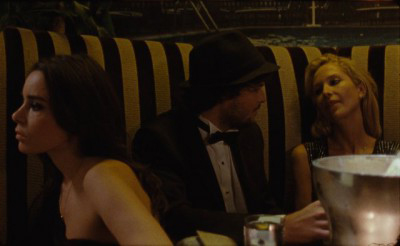
Ms Bouchez (above), charisma intact, pretty much holds the movie together, as she moves from place (photo studio) to place (swank bar) to place (second floor of a Chinese restaurant, below, where you can get -- just like Alice's -- anything you want). Ms Durra keeps the focus smartly on her star, who, as usual, delivers. Evidently a kind of stand-in for the director, Bouchez appears in every scene.

Along the way, she picks up a young grad student from Mexico (below, left) played by José María de Tavira, star of Tear This Heart Out); the two take to each other, so he sticks around. But he, like everyone else in the film, save Ms Bouchez, is simply sort of "there." Nobody here seems to have much of an agenda or interest. The dialog is "real," often deadly so (at this point in her career, writing is not Ms Durra's strong suit): not strong enough for satire, nor specific enough for genuine importance. Incidents pile up, the movie meanders and then simply ends.

A few points are scored along the way -- with an Arab cab driver in whose vehicle Bouchez rides, at the photo shoot that open the film. Do excessive money, privilege and time on one's hands make an "imperialist"? It would seem so from what we see here. I am not at all sure this is the lesson Ms Durra wants us to go home with, though I'm afraid we will. For we have seen the imperialist, and he is us (if we're of the mumblecore persuasion, that is).

The Imperialists Are Still Alive!, from Sundance Selects, opens this Friday, April 15, in New York City at the IFC Center. It has also been playing for the past six weeks via VOD from Sundance Selects.

Monday, September 20, 2010

2501 MIGRANTS: A JOURNEY--a different immigrant/emigrant film from Yolanda Cruz


Quite literally art about the "immigrant" problem -- though in this case the problem is with the emigrants: where they come from, rather than where they're going -- 2501 MIGRANTS: A JOURNEY, is a new documentary from filmmaker Yolanda Cruz (shown below). In it, she introduces us to Mexican artist Alejandro Santiago from the state of Oaxaca (Ms Cruz also hails from there), a middle-aged, middle-class (if such a description actually can be used about Mexico) family man who supports that family via his art, and who decided a couple of years back to create an enormous art installation of 2,501 life-size sculptures showing and dedicated to each individual who had left his village of Teococuilco over time to immigrate to the USA.

The art as "art" is impressive enough: big and powerful and primitive -- with the machete swipes to the clay among its most interesting features -- but the project itself is unusual and important.  Santiago (shown below, sculpting) tells us that he had always come back to his village during some celebration or other, and so for years was unaware of any problem. Only when he returned one day during a non-celebratory time did he realize what a ghost town Teococuilco had become, due to so many of its citizens leaving to pursue the chance to work in North America.  Ms Cruz then explores what happens to these "lost" citizens.  Often, it is not pretty.

Many of them die en route to the USA and their families then must pay for the bodies being shipped back to Mexico to be buried. Most surprising, to me at least, was learning how much these emigrants, once settled in the USA, do for their former community: sending money back home (local banks are filled with this income) to the point that these emigrants feel that they should have the major say in what happens to and in their former home.  We also meet and watch many of the workers in Santiago's studio -- young boys and girls, men and women -- whom he trains and who learn a skill via his training and their work.

One charming note is sounded when the artist learns that he must keep these young people in their "element," so he imports farm animals for them to care for -- which also helps the kids feel more at home. This provides some moments of pure joy, particularly one in which a little donkey cavorts with some dogs on the property.

We watch as the sculptures grows -- and then suddenly are destroyed due to a major rainfall and flooding.  2501 Migrants: a journey is a kind of "reverse" immigrant story -- told from the point of view of the place and people left behind -- and as such it occupies an original and thought-provoking niche in the current "immigration" discussion.  The conclusion takes us to the actual exhibition of the statues in Monterrey.  Seeing these marvelous sculptures lined up in the outdoors -- on the green grass with the blue sky and billowy clouds behind them -- is beautiful indeed.

The hour-long documentary DVD (from Cinema Libre Studio), complete with an array of interesting extras, is available now for sale or rental.