Showing posts with label retrospectives. Show all posts

Monday, May 30, 2016

Thom Andersen's THE THOUGHTS THAT ONCE WE HAD debuts at Anthology Film Archives


Noted documentarian Thom Andersen calls his new work, THE THOUGHTS THAT ONCE WE HAD, "a personal history of cinema." Boy, is it ever. It is also, as will come as no surprise to those who love Andersen's work -- his Los Angeles Plays Itself, which I just watched for the second time in preparation for covering his new film, still holds up as the best documentary I've ever seen about my own home town -- so full of ideas, connections and sheer love of cinema that it should prove irresistible to any cinephile. Another terrific film of his, Red Hollywood, along with the rest of his work, will be shown during an Andersen retrospective that opens this Friday, June 3, at Anthology Film Archives in New York City.

Andersen, shown above, is smart and fast, bouncing around from film to film, period to period, in somewhat chronological order. He credits as his major inspiration (and quotes freely from) a French philosopher named Gilles Deleuze, whose work I do not know. (After seeing and enjoying Andersen's film, in which Deleuze is heavily used, I should find out more about this fellow and his writing.)

What, for TrustMovies, makes the documentary most unusual is that so many of the film clips used are new to me. They're not at all what I'm used to seeing. And even when they are sometimes better known, the way Andersen presents and juxtaposes them makes for thought-provoking, troubling and intellectually stimulating viewing.

From the silents, with their reflective faces (above and below), through talkies and into color (and finally a whiff or two of the musical), the filmmaker whisks us along. Suddenly we're seeing the bombing of North Korea ("No repentance. Not even an acknowledgment"), along with Hiroshima and Vietnam. "Did we have it in for the yellow race?" Andersen wonders. "The past," he notes, "must be redeemed." As always with this filmmaker, the sense of justice deferred comes across mightily.

We see Hitler visiting a conquered Paris and Maurice Chevalier singing Sweeping the Clouds Away. If only. There's a comparison of Hank Ballard and Chubby Checker and their Twists, and then a good portion devoted to the various types of comedy -- from Harry Langdon to Laurel & Hardy and The Marx Brothers.

Ah -- then we view some crime, which is so often "delivered up as a gift." And horror. And an odd-but-endearing tribute to a little know (by me, anyway) actor named Timothy Carey. And Brando, of course. Do you know who was Ludwig Wittgenstein's favorite actress? (I'm not telling: You'll have to see this film to find out.) We do see those amazing clips of Jack Smith's favorite star, Maria Montez.

Andersen himself owns up to loving Debra Paget (above) best of all. So did I, actually, along with early Joan Collins. (I thought Ms Paget was so gorgeous and sexy that I've often wondered why I didn't turn out a bit straighter.)  I'd also never seen the clip he uses of Paget dancing in a costume that seems awfully racy for its time.

The Thoughts That Once We Had grows ever better, crazier and more rapturous as it goes along. That search for justice continues, too. I think we even view, toward the end, Austrian journalist/novelist Joseph Roth reading in German? (No, it's not: See the welcome comment below this post.) And Christina Rossetti gets one of the last words -- if not the last visual.  Just as with Los Angeles Plays Itself and my favorite DemyThe Young Girls of Rochefort, I'll want to see this film again in a few years. Probably every few years. What a movie documentarian Mr. Andersen is!

His newest work, along with a retrospective of his other films, opens this Friday, June 3 and runs through Sunday, June 12, in New York City at Anthology Film Archives. You can find the complete schedule by clicking here. Los Angeles Plays Itself, by the way, is also available for DVD rental at Netflix. For awhile you could even stream it, though that option is no longer currently open. Maybe it'll come back again at some point. Meanwhile, get to AFA for a very good time in an intelligent, thought-provoking movieland. 

Sunday, May 15, 2016

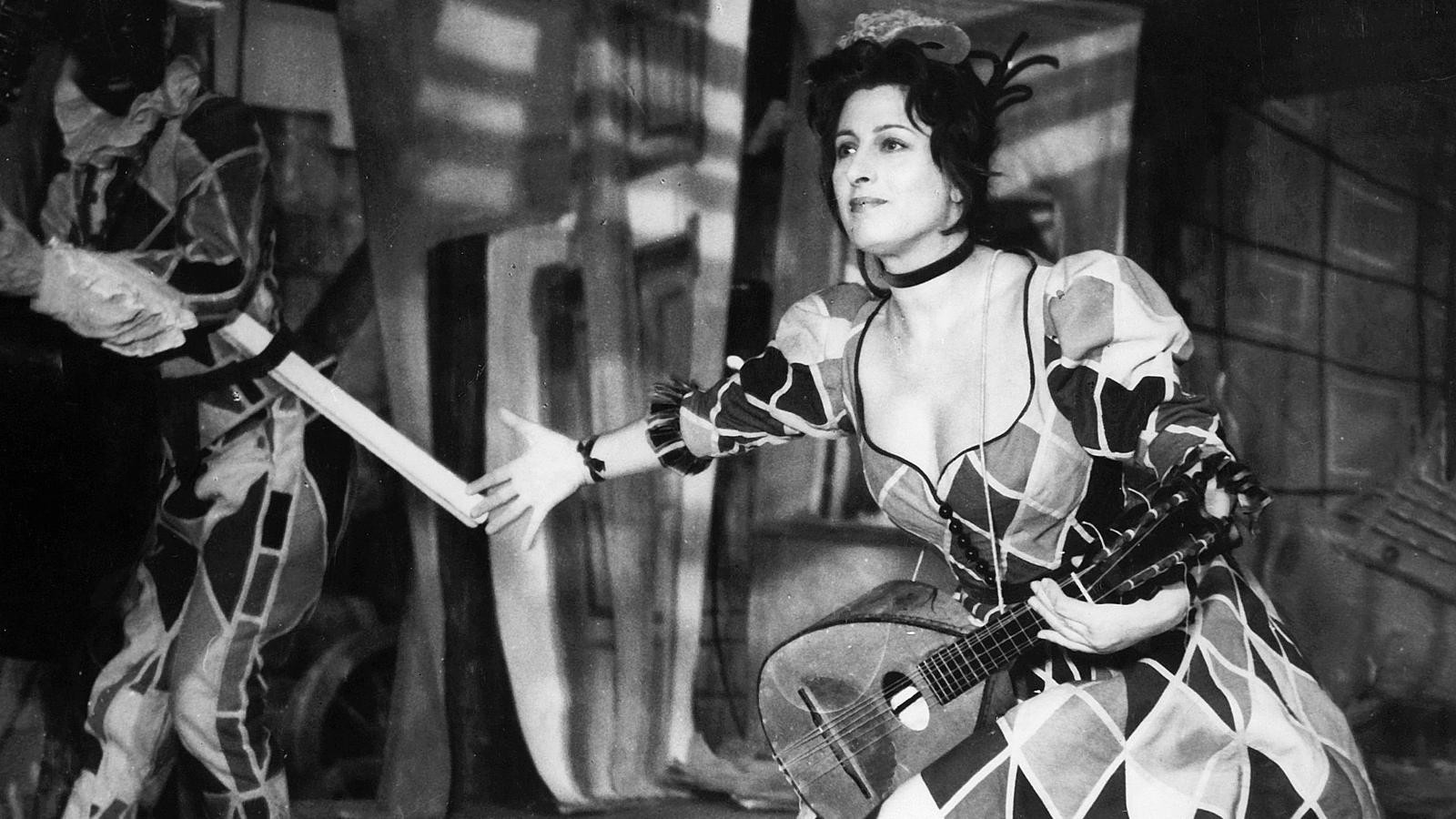
The magnificent Magnani is back--in 24 films-- & the Film Society of Lincoln Center's got her!


The more TrustMovies sees of that late, great Italian actress Anna Magnani (1908-1973), shown above and below, the better he appreciates her. As a kid who grew up only on the Hollywood stars and starlets, he initially found Ms Magnani both too real and not beautiful enough for his youthful taste. Fortunately that taste expanded and deepened once he discovered foreign films, New York City, and venues like the Film Society of Lincoln Center -- not coincidentally the place where the new and (from what TM can tell) most complete retrospective of Magnani's work to be seen here in the USA is soon to be shown. Truly, this is the kind of retrospective that make him sorry he had to leave New York.

If you have never seen the great Magnani in a movie like Rome Open City (Roma città aperta), shown above, here's your chance. This one brought the actress to international attention, and its power remains complete, from Magnani's amazing performance right through to the film's shocking, memorable conclusion, featuring a scene you are unlikely to ever forget.

The actress worked with some of the best directors in the world --from Rossellini to Renoir, Visconti to Lattuada, Monicelli to Fellini, Pasolini to De Sica. And when she worked with secondary (or less) directors here in the States -- say, Stanley Kramer or Daniel Mann, whose The Rose Tattoo is shown above: and, yes, that's Burt Lancaster on the right -- their work seemed, well, somehow elevated by hers. Perhaps watching her superb work helped them rise to the occasion.

You can see -- starting this Wednesday, May 18, here at the FSLC's La Magnani retrospective, co-resented with ​​Istituto Luce Cinecittà (click the FSLC link above to see the entire schedule) --  films by all these men, all starring Anna Magnani, and all worth seeing, some of them over and over again. This woman is a joy to watch. (The still above is from The Passionate Thief.  And yes, that's a very young Ben Gazzara at right.)

What makes Magnani so great is her ability to alternately radiate passion, intensity, sexuality, charm, humor, strength and fragility while remaining real at every moment. I can't recall seeing a false moment in all of her work. And it doesn't matter how bad, how ludicrous a script may sometimes be: She takes it and makes it her own. And damned if we don't buy it -- and her -- even if the movie itself, we might later admit, somewhat sucks. (The still above is from one of her early Post-War movies, Peddlin' in Society.)

Now residing long distance here in Florida, I requested a number of movies for review, but the only one I was able to receive and view in DVD-screener format was Luchino Visconti's delightful comic melodrama BELLISSIMA, in which Magnani plays one of the great "stage mother" characters of all time, determined to get her little daughter into the movies. Watching this one, you can not help but understand how the director eventually came to stage operas -- so operatic and oh-my-god-Italian! is this movie.

So lively and energetic (to put it mildly) are all the performances -- especially Magnani's -- that Bellissima eventually defines a certain part of the Italian character (specifically as seen, I suspect, post-World War II). And when, at last, the movie gives the actress a breather -- in the form of a scene in seclusion by the water, in which she finally drops her "front" and relaxes a bit, as she is seduced by the film's sleazy-but-glowing con man (Walter Chiari), something magical happens and we see a whole new character emerge. Granted, it's one that goes back into its armored shell soon after, but, still, what a scene this is!

Bellissima is a treat not to be missed, as is the opportunity to see so many of this great actress' best performances in such a wide variety of film genres. Would that this were a traveling retrospective. But unlike other, more stationery works of art, movie series such as the Magnani retro don't seem to travel much. When they're as good as this one, however, they ought to.

Among the other films I'd highly recommend are Renoir's The Golden Coach (above), Pasolini's Mamma Roma, and William Dieterle's Volcano. But it's those smaller, lesser-known (here in the USA, anyway) works that I'd give up an aged, left testicle to view. Ah, well. Maybe someday. But if you live in the tri-state area, lucky you can actually get to this landmark series.

La Magnani makes it's 15-day debut at the Walter Reade Theater (my favorite place to watch a movie in all the world) this Wednesday, May 18, through Wednesday, June 1. Again, you can view the entire schedule of films by clicking here, and then clicking on each individual movie for the many further details.

Wednesday, November 4, 2015

Mathieu Amalric retrospective! This fine and surprisingly versatile French actor gets his day in the New York sun -- at FIAF and AFA


It's no secret that the silver screen can make ordinary men look ten feet tall. This seems particularly true in the case of petit Frenchman Mathieu Amalric, whose work TrustMovies has been following for nearly 25 years now and which is currently receiving a well-earned retrospective at both the French Institute/ Alliance Française (FIAF) and Anthology Film Archives (AFA). This actor, who, over the years, has expanded into the roles of writer, director, producer (and even once as cinematographer), takes versatility to new levels. Possessed of a face and body that can appear rather elfin and often quite cute, the actor has managed to essay roles as diverse as killers, lovers, comics, crazies, the works. He's even played, in Quantum of Solace, a memorable James Bond villain.

While the current retrospectives don't come near accounting for his (according to the IMDB) 106 credits, they do give us quite a varied taste of his work as actor, writer and director. Amalric, who turned 50 years old just last month, has amassed quite a resume over the decades, and it should prove a pleasure for New Yorkers to partake of his multi-faceted work over the coming month (or, in the case of FIAF, two).

You can find the FIAF schedule here, which includes a theatrical project Amalric is performing in New York, as well as a number of his films which will be on view during FIAF's popilar CinéSalon showings during November and December.

The AFA schedule, which began last week (apologies for a tardy posting!) can be found here. So head out to either or both of these venues to revel in the work of this unique and consistently surprising Renaissance Man.

Saturday, September 27, 2014

At FIAF's CinéSalon, a month of the films of the late Alain Resnais: Time, Memory, Imagination


In the spirit of French ciné-clubs and literary salons, FIAF’s CinéSalon program -- pairing an engaging film with a post-screening wine reception, with each evening screening thoughtfully introduced by a high-profile personality in the arts -- will begin a new series on September 30 (continuing throughout all of October) that honors the late, great filmmaker Alain Resnais (shown, right, at work toward the end of his career, and below in former times). M. Resnais, who died earlier this year just short of his 92nd birthday, while a seminal figure of the French New Wave, was not, like so many of his contemporaries, an alumnus of the film journal Cahiers du Cinema. In the words of the CinéSalon literature, Resnais "existed closer to Left Bank intellectualism, well outside of the sphere of filmmakers like Jean-Luc Godard, Francois Truffaut, and Jacques Rivette, with a dedication to formalism, modernist concerns, and social and political issues not found in the work of his fellow innovators. Focusing repeatedly on themes of time and memory, Resnais drew from the well of serious literature to offer a singular philosophical and artistic vantage point, employing enigmatic narrative structures, lush cinematography, and lyrical editing patterns to create some of the most provocative and controversial work of the period."

TrustMovies has now seen just about every film -- save most of the early documentaries -- that this fellow made, and has looked forward to each new one with great anticipation. Resnais never made an uninteresting movie; even his least successful -- try 1989's I Want to Go Home, written by Jules Feiffer! -- were crazy, fascinating fun. With the new restoration of his second masterpiece, Hiroshima Mon Amour (Night and Fog was his first), together with his newest (and last) work, Life of Riley,(Aimer, boire et chanter) both about to make their U.S. debut during the current New York Film Festival, this proves a most opportune time for a mini-Resnais retrospective.

Even more important, to celebrate Resnais, the five films to be shown at FIAF's Florence Gould Hall could not have been better chosen to give a sense of the breadth and depth of this man's work. Below is a listing of the films -- with FIAF's comments on the films followed by short paragraph with TrustMovie's take on each --  together with the date and times of their screenings. Don't miss this wonderful opportunity to discover, or more probably view again, five true masterworks.


Alain Resnais: 
Time, Memory & Imagination
•••••••••••••••••••••••••••••••••••••••••••••••••

Je t’aime je t’aime 
Tuesday, September 30 at 4 & 7:30pm 
35mm 1968. Color. 94 min. With Claude Rich, Anouk Ferjac, Olga Georges-Picot, Alain MacMoy. In French with English subtitles. 

Claude Ridder has nothing left to lose when two strangers recruit him to be the first human participant in their time travel experiment. Sent back one year Claude revisits a past love. But reality becomes opaque as his vague memories mesh with his current experiences in Resnais’ ahead-of-its-time drama. “One of Mr. Resnais’s lesser-known masterworks”—The New York Times

TrustMovies had not seen this relatively early Resnais until now, and what a "find" it is. What fun it is, too, seeing actor Claude Rich (above and below) again as a young man. Here, M. Resnais, always the playful guy, had quite a novel idea about time travel: Going back to the past is simply a matter of accessing memory! The time travel involves the workplace and vacations, loneliness and solitude, even suicide, murder and -- yes -- mice! Mostly, though, it's about guilt, and that utterly messy situation we call love. A film that was way ahead of its time, Je t'aime, je t'aime will still keep you alert and jumping as you watch it today.
A free wine reception following each screening.

The 7:30pm screening will be introduced by director Radley Metzger.
About Radley Metzger: Writer, Producer, Director Radley Metzger was most recently the subject of a retrospective at the Film Society of Lincoln Center, which included his cult classics Score, Camille 2000, The Image, and many others. Metzger also received a retrospective at the Museum of the Moving Image. He has lectured at the Museum of Modern Art, and at Eastman House in Rochester, New York.

 •••••••••••••••••••••••••••••••••••••••••••••••

Mon oncle d’Amérique 
Tuesday, October 7 at 4 & 7:30pm 
35mm 1980. Color and B&W. 125 min. With Gérard Depardieu, Nicole Garcia, Roger Pierre, Nelly Borgeaud. In French with English subtitles.

Professor Henri Laborit uses the stories of three people—René, a manager at a textile factory; Janine, an actress; Jean, a writer and politician—to explore issues such as survival, combat, punishment, and anxiety in this didactic comedy that earned Resnais the Grand Prize at the 1980 Cannes Film Festival. “An exhilarating fiction!”—The New York Times

One of my favorite of all the Resnais films, I've seen this several times over the decades. It's so full of ideas and humor and surprise that everything seems to tumble over itself into strangeness and delight. A good cast help things, too, and yes, there are mice once again. Not to be missed if you haven't seen it; and if it's been awhile, you'll probably want to give the film another viewing,

Free wine reception following each screening.
7:30pm screening will be introduced by neuroscientist Leah Kelly.
About Leah Kelly: New York-based neuroscientist Leah Kelly is currently at Rockefeller University where she uses electrophysiology and optogenetics to map the neural circuitry underlying appetite. She has consulted and spoken on various projects at the intersection of art and science for organizations including the Palais de Tokyo and Villa Gillet, and is currently making a short film about synesthesia.

 ••••••••••••••••••••••••••••••••••••••••••••••••

Wild Grass 
(Les Herbes Folles)
Tuesday, October 14 at 4 & 7:30pm 
35mm 2009. Color. 104 min. With André Dussolier, Sabine Azéma, Emmanuelle Devos, Anne Consigny. In French with English subtitles. 

Wild Grass tells the story of Georges, a middle-aged married man with a fixation on the attractive, mysterious Marguerite. Adapted from the novel by Christian Gailly. “An extravagant, self-deconstructing, hugely entertaining story of unrequited love.”—The Independent 

My favorite of Resnais' recent work, this adorable, bizarre, challenging film is chock-a-block with ideas and imagination, and is especially gorgeous visually. My original review of the film can be found here, and if you managed to miss its theatrical run or the fine Blu-ray disc, then by all means get to FIAF for a look-see.

Free wine reception following each screening.
The 7:30pm screening will be introduced by Lucius Barre, a colleague of Alain Resnais.
About Lucius Barre: An expert on strategic planning and management of promotional campaigns for new films, filmmakers and companies, Lucius Barre has worked with renowned filmmakers such as Pedro Almodovar, Errol Morris, and Luc and Jean Pierre Dardenne. He worked closely with Alain Resnais for the Cannes premiere and US release of Wild Grass.

••••••••••••••••••••••••••••••••••••••••••••••••••

Muriel (Muriel ou le temps d’un retour)
Tuesday, October 21 at 4 & 7:30pm 
35mm 1963. Color. 117 min. With Delphine Seyrig, Jean-Pierre Kérien, Nita Klein. In French with English subtitles. 
Historical trauma is synonymous with personal intrigue in the coastal town of Boulogne when Hélène is visited by a past lover, Alphonse, and her stepson Bernard is haunted by the memory of a girl named Muriel, whom he encountered while doing military service in Algeria. “Subtle, precise, and wrench-ing”—Chicago Reader

When I first saw Muriel at the time of its initial U.S. release, I found it slow and confusing. I was far too young and untutored and thoughtless, really, to deal with a movie this good. When I saw it again, 30 years later, I was overcome. What a film! It may be the filmmaker's best. Dealing with memory and history, and featuring a landmark performance by one of the great actresses of our time, Delphine Seyrig, the film is a keeper in, oh, so many ways.

Free wine reception following each screening.
The 7:30pm guest speaker remains to be announced.

•••••••••••••••••••••••••••••••••••••••••••••••

Providence 
Tuesday, October 28 at 4 & 7:30pm 
DCP 1977. Color. 99 min. With Dirk Bogarde, Ellen Burstyn, John Gielgud, David Warner and Elaine Strich. In English. 

On the eve of his 78th birthday, Clive Langham conceives his last novel as he reminisces about past experiences with members of his family. But is Clive more accurately depicting others or himself? “Splendid and elliptical”—The New York Times Winner of 8 César Awards, including Best Film, Best Director, and Best Screenplay

Providence is another of Resnais' movies that I have not seen since it first opened in the USA. (I have been told that the quality of the video reproductions were simply not good enough for this beautifully shot and produced movie, so I am eager to view the new DCP version that FIAF will screen.) What I recall best about this film are its superb performances from the spectacular cast (listed above) and how it so masterfully weaves present and past. I am most eager to see and savor this film once again.

Free wine reception following each screening.
The 7:30pm screening will be introduced by author, Olivier Barrot.
About Olivier Barrot: A prominent figure in French culture, Olivier Barrot is a journalist, author and television personality. He hosts the daily literary program “Un livre un jour” on France 3 and TV5. His most recent books are Ciné Club (2010), Tout feu tout flamme, La Revue Blanche, and Le Fils Perdu (all in 2012). For the past six years, he has hosted French Literature in the Making at New York University.

••••••••••••••••••••••••••••••••••••••••••••••••
Related Events 


Hiroshima Mon Amour
Friday, October 10, 6pm, Walter Reade Theater 
(165 West 65th Street, north side, upper level) 
DCP Alain Resnais, 1959. Black & White. 92 min. With Emmanuelle Riva, Eiji Okada. In French, Japanese, and English with English subtitles.  

From the FIAF Press release: This modernist masterwork began as a documentary commission from Daiei Studios, secured for Alain Resnais by producer Anatole Dauman. Resnais decided that the bombing of Hiroshima and its impact needed fiction, brought Marguerite Duras onto the project, and worked with her to create a story—of a French film actress (Amour Oscar-nominated Emmanuelle Riva) who goes to Hiroshima to make a film and has an affair with a Japanese architect (Eiji Okada)—that would exist “in two tenses… the present and the past coexist.”

Few films have had such a lasting, wide-ranging impact. Hiroshima, mon amour is a devastating experience on every level: visually, sonically, emotionally, intellectually. Thanks to a new 4K restoration, it can now be seen and heard, once again, in its full glory. Restoration by Argos Films, Fondation Groupama Gan, Fondation Technicolor, and Cineteca Bologna, with support from the CNC. A Rialto Pictures release.


US PREMIERE The Life of Riley
(Aimer, boire et chanter)
Friday, October 10, 9pm, Walter Reade Theater (165 West 65th Street, north side, upper level) Saturday, October 11, 2pm, Francesca Beale Theater, Elinor Bunin Munroe Film Center (144 West 65th Street, south side) DCP Alain Resnais, 2014. Color. 108 min. With André Dussolier, Sabine Azéma, Michel Vuillermoz, Hippolyte Girardot, Sandrine Kiberlain, Caroline Silhol In French with English subtitles. 

I'll havesomething to say about this film during the week of its theatrical opening. Meanwhile, here's the FIAF "take" on it: Adapted from Alan Ayckbourn’s Relatively Speaking, Life of Riley, the final work by Alain Resnais, is the story of three couples in the English countryside who learn that their close mutual friend is terminally ill. Yet that story is only half the movie, a giddily unsettling meditation on mortality and the strange sensation of simply being alive and going on, feeling by feeling, action by action.

The swift, fleeting encounters between various combinations of characters (played by Resnais regulars André Dussollier and Sabine Azéma—the director’s wife—along with Michel Vuillermoz, Hippolyte Girardot, Sandrine Kiberlain, and Caroline Silhol) take place on extremely stylized sets, and they are punctuated with close-ups set against comic-strip grids, and broken up by images of the real English countryside. Funny but haunting, Life of Riley is a moving, graceful, and surprisingly affirmative farewell to life from a truly great artist. A Kino Lorber release.

Both films are presented as part of the 52nd New York Film Festival.
For more information, visit filmlinc.org.

••••••••••••••••••••••••••••••••••••••••••••••••••••••
En coulisses Cinema Workshops 5:45–7:15pm
To complement the series, FIAF’s Language Center is pleased to offer En coulisses, a series of film appreciation workshops before each 7:30pm screening. After the workshop, students view the film and enjoy a post-screening get-together with a glass of wine. For more information visit: www.fiaf.org/frenchclasses/frenchworkshops-film.shtml

•••••••••••••••••••••••••••••••••••••••••••••••••••••••
About FIAF
The French Institute Alliance Française (FIAF) is New York’s premiere French cultural and language center. FIAF's mission is to create and offer New Yorkers innovative and unique programs in education and the arts that explore the evolving diversity and richness of French cultures. FIAF seeks to generate new ideas and promote cross cultural dialogue through partnerships and new platforms of expression. www.fiaf.org Merci! Special thanks to Anne-Catherine Louvet (Institut français), Mathieu Fournet (Cultural Services of the French Embassy), Michael Piaker and Michael Di Certo (Sony Pictures Classics), Laura Coxson (Janus Films), and Jake Perlin (The Film Desk). CinéSalon is made possible by the Institut français, the Cultural Services of the French Embassy & the NY State Council on the Arts with the support of Governor Andrew Cuomo & the NY State Legislature. CinéSalon is sponsored by Air France and Delta Air Lines, BNP Paribas, Nespresso, and Sofitel. Wine courtesy of Xavier Wine Company, the exclusive CinéSalon wine sponsor. FIAF Fall 2014 Season Sponsors: Air France and Delta Air Lines, the official airlines of FIAF; Cultural Services of the French Embassy; Florence Gould Foundation; Institut français; National Endowment for the Arts, Art Works; New York State Council on the Arts; NYC Department of Cultural Affairs; French-American Fund for Contemporary Theater, a program of FACE; The Peter Jay Sharp Foundation; and Laura Pels International Foundation for Theater.

••••••••••••••••••••••••••••••••••••••••••••••••••••••
JUST THE FACTS, PLEASE
What: CinéSalon: Alain Resnais: Time, Memory & Imagination
When: Times and titles detailed above. Where: FIAF – Florence Gould Hall, 55 East 59th Street (between Park & Madison Avenues)
Admission: $13; $7 students; Free for FIAF Members Tickets: 800 982 2787
fiaf.org Information: 212 355 6160
fiaf.org Transportation: 4, 5, 6, N, R and Q to 59th Street & Lexington Avenue F to 63rd Street & Lexington Avenue; E to 53rd Street & 5th Avenue Bus - M1, M2, M3, M4, Q32 to 59th Street; M5 to 58th Street

Thursday, February 28, 2013

THE UNSPEAKABLE ACT: Dan Sallitt's remarkable movie about the "I" word opens in NYC at Anthology Film Archives

This week two excellent films open in New York that feature crackerjack performances by their leading ladies, both a little older than the characters they play, but both able to nail these characters amazingly well. Yesterday we covered Perla Haney-Jardine in Future Weather; today it's Tallie Medel, performing in her first full-length feature, THE UNSPEAKABLE ACT. And, yes, we're talking about incest here, though it's a word barely spoken (I think the brother and sister use the initial only, if that, during their conversations).

The man who made this terrifically engaging, intelligent and unusual motion picture is a fellow named Dan Sallitt. This is the first of his films I've seen, but if the others are anywhere near this level, I'm an instant convert. The first thing thing that impresses about this movie is how insistent writer/director Sallitt is in making character trump event or action. I believe in literally all movies I've seen that deal with incest (most recently Daniel & Ana Delta and No Tengas Miedo) the event turns out the be-all and end-all of the situation and film. This is understandable, as incest is such a taboo subject -- which makes it, of course, all the more transgressively alluring for some filmmakers and audiences to confront. But then it becomes all the more difficult to avoid exploitation.

Sallitt manages this avoidance extremely well. He absolutely hits his subject head on, but because he and Ms Medel (shown above) have placed us so firmly inside the mind and heart of his heroine (and to a much lesser extent, her older brother -- played by newcomer Sky Hirschkron, below), we actually come to care more about the people here than the event itself. And if your reaction is, at this point, "Well, of course we would!" then stop yourself. Achieving this reaction simply cannot be as easy as we may imagine, for human beings generally want the excitement and thrill that goes along with anything "naughty."

Sallitt offers us the family first, and if this particular family (below) seems a little odd, well, whose isn't? There's a loss of a father figure, early on, which seems to have had its effect on mom (Aundrea Fares, center, left, below) as has the departure of her eldest son, now at university. The remaining two daughters and the younger brother have adjusted pretty well -- except for this extreme closeness between the one sibling pair, which, as daughter Jackie makes clear, the other family members either choose to ignore or haven't fully noticed.

The family's house (below) is quite lovely, too; these folk live in a gorgeous, verdant community, where Jackie is doing well enough in school. When brother Matthew leaves for college, however, and the two must be apart, the girl takes a tumble.

Mom manages to get her daughter to a therapist, and, lordy lord, it's a good one. The sessions scenes are among the best I've seen on film: smart, real, and most surprising of all, these show us, without undue exposition and about as well as has yet been put on film or video, how therapy slowly works.

There's more, and all of it is about as well thought-out and presented as you could want. Sallitt takes his cues, I think, mostly from documentary film (and has been pointed out elsewhere, from the late Eric Rohmer). While this helps the reality quotient, some of the performances (never that of Ms Medel) can at times seem a bit stilted. And yet, with this particular group of people, stilted is just about what you would expect.

By the finale, you'll be amazed and heartened. The filmmaker has addressed his subject directly, and taken us and his heroine on quite a journey. The Unspeakable Act is one of the most deeply, deeply satisfying movies I have seen in a long while. It begins performances today, Thursday, February 28, at Anthology Film Archives, where it plays, in tandem with a short repertoire of Sallitt's other three films, through March 7 (his other films plays through March 8). Click here for tickets and here for directions.

Sunday, February 3, 2013

FIAF's CinemaTuesdays offers a February full of the wild-card wonders of Leos Carax

If the title of The French Institute Alliance Française's latest CinemaTuesdays offering -- When Boy Meets Girl: The Cinema of Leos Carax, which FIAF tells us is the first ever U.S. retrospective of this increasingly renowned French director -- sounds a bit like Andy Hardy, worry not: M. Carax is a French filmmaker, remember, so any Andy he gives us is likely to be doing some full-frontal fucking, among other transgressive things. (Transgressive for current American movie screens, I mean. The real thing is rather well-entrenched by now.) In the 33 years since his first film film appeared, Carax has made but five full-length features, four shorts, and one segment (Merde) from the tri-part, three-director movie Tokyo.

Of these, only three of the shorts -- Strangulation Blues, My Last Minute and 42 One Dream Rush -- are missing from this retrospective, which includes all of his full-lengthers, in addition to Merde and the short, Sans titre. Carax (shown at left) is a filmmaker who certainly goes his own way, dividing critics and audiences in the process, although his latest work Holy Motors, which is a part of this retrospective, seems to have garnered more international praise than any of his other films and has proven quite popular, as well. (It is fun and, as is all his work, bizarre.) So maybe we're finally beginning to get used to this guy. His newest film also features an extension of that fabulously creepy character -- once again played by Carax's muse, the great Denis Lavant (below) -- from his segment film, Merde, now a doing full-length job.

If you are unfamiliar with the oeuvre of Carax, here's your chance to see it in fairly quick succession and on the big screen. If you already know some of his work, you can now catch up with most of the rest. And if, like me, you've seen it all (or almost all), there's always sloppy seconds to enjoy.

Here's the complete schedule for the series, curated by Marie Losier, which includes a personal appearance by M. Carax to introduce Holy Motors at the 7pm screening on February 26, followed by a Q&A at the end of that screening.


When Boy Meets Girl : 
The Cinema of Leos Carax

Bad Blood (Mauvais sang)
Tuesday, February 5 at 12:30, 4 & 7:30pm.
Leos Carax, 1986. Color. 116 min.
With Michel Piccoli, Juliette Binoche, and Denis Lavant
In French with English Subtitles
An intoxicating swirl of science fiction and noir that earned Carax the Prix Louis-Delluc, Mauvais sang is set in a stark near future where those who have loveless sex are afflicted with disease. When Alex (Lavant) is hired by two criminals to steal the vaccine that could stop the epidemic, he finds himself smitten with one of their mistresses.
“In his second feature…Carax lives up to his billing as ‘the natural heir of Jean-Luc Godard.’”—The New York Times
Presented as part of FIAF’s First Tuesdays. See fiaf.org/tuesday for info.
•••••••••••••••••••


Lovers on the Bridge (Les amants du Pont-Neuf)
Friday, February 8 at 7:30pm
Leos Carax, 1991. Color. 125 min.
With Juliette Binoche, Denis Lavant, and Michael Grüber
In French with English Subtitles.
Legendarily beset by production delays, Lovers on the Bridge was greeted with wide acclaim upon its eventual release. Set at and around the famed Pont Neuf, the film chronicles the love between a young addict and a painter who is losing her sight, capturing their messy interdependency and ecstatic tenderness.
*Note: Screening rescheduled from its original time of Tuesday, February 26
••••••••••••••••••••


SHORT & FEATURE
Merde
Tuesday, February 12 at 12:30, 4 & 7:30pm
Leos Carax, 2008. Color. 35 min.
With Denis Lavant, Jean-François Balmer, and Julie Dreyfus
In French and Japanese with English Subtitles.
In Merde, Carax delivers an anarchic character study of a raving, unclassifiable creature (Lavant) who demands to be addressed as “Merde.” This darkly funny short, released as part of Tokyo!, a trio of shorts set in the titular city featuring new work by Michel Gondry and Bong Joon-ho in addition to Carax, serves as a precursor for Holy Motors, where “Monsieur Merde” reappears.
SCREENED WITH:
Boy Meets Girl
Tuesday, February 12 at 12:30, 4 & 7:30pm
Leos Carax, 1984. B&W. 100 min.
With Denis Lavant and Mireille Perrier
In French with English Subtitles
Due for military service and miserable from a recent break-up, Alex, a young filmmaker, finds comfort in the company of a similarly suffering teenage girl. Prone to documenting the tiniest details and searching for romance on a grand scale, Alex is reminiscent of Carax himself, whose debut here is a celebration of cinema and idiosyncrasy
     "Charming first feature,"  -- The New York Times.
••••••••••••••••••••


SHORT & FEATURE
Sans titre
Tuesday, February 19 at 12:30, 4 & 7:30pm
Leos Carax, 1997. Color. 9min.
With Guillaume Depardieu, Yekaterina Golubeva, and Catherine Deneuve
In French with English Subtitles.
When the Cannes Film Festival asked Carax to produce a filmic postcard that would update people on the status of his upcoming project, he responded with this abstract experimental short, a synthesis of clips from films and music (Night of the Hunter, Leonard Cohen) and footage from his then-unreleased Pola X.
SCREENED WITH:
Pola X
Tuesday, February 19 at 12:30, 4 & 7:30pm
Leos Carax, 1999. Color. 134min.
With Guillaume Depardieu, Yekaterina Golubeva, and Catherine Deneuve
In French with English Subtitles. Screening at Florence Gould Hall.
Living in a countryside castle with his mother, a bourgeois writer enjoys a carefree life until he is confronted by a woman claiming to be his sister. With life thrown into disarray, the man plunges into a relationship with her, turning his back on both his mother and his fiancée. Shocking, explicit, yet still steeped in the romance of Carax’s other work.

"Pola X has enough fireworks to keep you in your seat. When it's over, you'll know you've had an experience." -- Stephen Holden, The New York Times.
•••••••••••••••••••

Holy Motors
Tuesday, February 26 at 12 & 4:30pm
Leos Carax, 2012. Color. 115 min.
With Denis Lavant, Édith Scob, Eva Mendes and Kylie Minogue
In French and English with English Subtitles
Carax’s first feature in more than a decade confirms the originality of his vision as well as the talents of longtime collaborator Denis Lavant. In the nocturnal hours, Monsieur Oscar appears to live many lives—exacting murderer, doting father, ogre-like savage—but it’s unclear which is exactly real. And if he is merely acting, then whom is he acting for? Hallucinatory, vital filmmaking.
The New York Times Critics’ Pick

“A gripping surrealist odyssey that makes most other films look very buttoned-up.“—The Guardian (UK)


MEET THE DIRECTOR!
acclaimed director Leos Carax presents Holy Motors and participates in a Q&A following the screening. Moderated by Richard Brody, The New Yorker film critic.
Holy Motors
Tuesday, February 26 at 7pm
*Note: Screening rescheduled from Friday, February 8.

•••••••••••••••••••••
About FIAF
FIAF's mission is to create and offer New Yorkers innovative and unique programs in education and the arts that explore the evolving diversity and richness of French cultures. FIAF seeks to generate new ideas and promote cross cultural dialogue through partnerships and new platforms of expression. www.fiaf.org
Merci!
Special thanks to Leos Carax, Joan Dupont, Oleg and Dima Dubson, Marison Martinez, Amaury Augé, and Unifrance.
Cinema programs are made possible by Institut français, Unifrance, the Cultural Services of the French Embassy, the French Ministry of Foreign Affairs, the New York State Council on the Arts with the support of Governor Andrew Cuomo and the New York State Legislature.
CinémaTuesdays is sponsored by American Airlines, The Official Airline of FIAF; Lancôme, Nespresso, and TV5MONDE.
FIAF would like to thank the following winter season sponsors:
American Airlines, the official airline of FIAF; OpenSkies, the Cultural Services of the French Embassy; Florence Gould Foundation; Institut français; New York State Council on the Arts; New York City Department of Cultural Affairs; The Peter Jay Sharp Foundation, and Robert de Rothschild.

•••••••••••••••••••••
QUICK CHECKLIST OF WHAT YOU NEED TO KNOW
What:  When Boy Meets Girl: The Cinema of Leos Carax
When: CinemaTuesdays, February 5th through 26
Where: FIAF -- Florence Gould Hall an Tinker Auditorium
               55 E. 59th St. (between Park and Madison Aves.)
Admission: $10; $7 students; free for FIAF members ($2 in advance)
Tickets: www.fiaf.org or 800-982-2787
Information: www. fiaf.org or 212-355-6160
Transportation: Subway -- 4, 5, 6, N, R & Q to 59th St. & Lexington Ave.
Buses: M1, M2, Mc, M4, Q31 to 59th St., M5 to 58th St., 
and from Queens: Q32 to 60th & Madison.