Showing posts with label therapy. Show all posts

Wednesday, April 28, 2021

Roy Andersson is back -- and treading water -- with ABOUT ENDLESSNESS

They're all here, once again, those special pleasures of viewing a film by Swedish master Roy Andersson: the stationary camera, perfect compositions, elegance, ugliness, humor (dry, dark), and above all quietude -- even amidst what would normally be considered a terribly trying time (a modern-day Christ being persecuted as he carries his cross uphill in one of those uber-sanitary Scandinavian towns). 

Beginning with a Chagall-like image (above) of a man and woman floating in the sky, Andersson's newest, ABOUT ENDLESSNESS, is only his fourth full-length film in 20 years. None of these are what you'd call lengthy (maybe 95 or 100 minutes), and his new one lasts but 78. 

Yet for TrustMovies, this one seems the longest, thanks to a certain repetition and sameness that have clearly set in to the filmmaker's work (Mr. Andersson is shown at right). Not that his situations are the same (though they are often pretty similar), but his themes -- from religion, war, commerce, communication (or the lack of it), and a populace that is at best utterly brainwashed -- remain front and center, with little new to be said about any of these. 

What the filmmaker has done, I think, is to pare down each of his segments more and more to what is currently coming very close to the bone. (Andersson has always been a minimalist; he's simply more so now.)


He's right, of course, in that society is certainly not changing (except for the worse), but then neither is his own vision. And since there are usually a few years inserted between his last and the debut of his latest, we're more primed for yet another chapter of Andersson-ville.


And so as About Endlessness was unspooling, I found myself, as ever, engaged with the simultaneous beauty/ugliness of it all. At the same time, my mind wandered back to his first (and still best) full-length film, Songs From the Second Floor, and how much more deeply, movingly, often shockingly, these same themes were rendered.


Well, society certainly ain't changing ('cept for the worse), so can you blame a filmmaker for staying his course? (Even treading water, Roy Andersson puts most other movie-makers to shame in so many ways.) And if we perceive an awful lot of state-sanctioned, by-rote behavior here, I can also tell you that the likes of Adolf Hitler makes an appearance, as well.


The refrain, "I saw a man..." (or sometimes a woman) occurs often here, as do forms of love and even thermodynamics. And if I can detect any really special loathing of Andersson's, it just might be toward psychotherapy and its practitioners (maybe even toward the entire medical profession). 


I might suggest that it's time for Andersson to move on, but as the world appears to be arriving at its  end, in its own not-so-good time, perhaps it is this filmmaker who is the best choice to help us properly embrace it all.


From Magnolia Pictures, in Swedish with English subtitles (damn few, actually; fast, snappy dialog is not Mr. Andersson's thing) and running 78 minutes, About Endlessness opens theatrically this Friday, April 30 in limited release. (It will not be challenging Godzilla and King Kong for the box-office crown.) Click here for more information on the film and its theatrical and/or digital-viewing venues.

Tuesday, September 8, 2020

Justine Triet's crazy/masterful SIBYL is this year's must-see movie for and about shrinks

For all of us who've wondered down the decades just how much of a "real" life that person might have who has been acting as our psychiatrist or psychotherapist -- with whom s/he is involved, what kind of a life they have, and even how crazy they themselves might possibly be -- have I got a new movie for you! 

That this is also a film about film-making, acting, creating and directing should only add to the enticement. SIBYL is co-written and directed by Justine Triet (shown below) and it ought more firmly than ever place both its director and its star, Virginie Efira, on the international movie map.

Ms Triet takes in an array of characters and situations, weaving these together with a fine combo of skill and originality, while using time past and present so speedily and smartly that you will barely have the opportunity to take a breath without risk of missing something vital. 

Without giving away too much, the tale begins as therapist Sibyl (Efira, below) tells her own shrink that she wants to finally concentrate on writing a novel and so will give up many of her current patients in the process. He tries to dissuade her, to little avail, and we see the pain that this causes some patients, even as Sibyl receives a call from a new patient, an actress named Margot, who is desperate for help. 


It becomes increasingly clear that Sibyl herself is in need of more therapy, as is just about everyone around her, though part of  the irony of this very interesting film is that is also becomes clear that therapists/therapy can end up offering more than solving problems -- even if there is at least one patient who Sibyl has certainly been able to help.


Via that desperate actress (another very fine performance from Adèle Exarchopoulos, above), we meet her lover and co-star (Gaspard Ulliel, below, left), his lover and the film's director (Sandra Hüller, below, right) and assorted crew members, and then we go to the shoot on that famous island of Stromboli -- which becomes the movies's high point (for us, if not for the characters and the film-within-the-film).


Triet's understanding of (and sharp sense of humor about) actors and acting, psychiatry and human nature, together with the especially fine performances she draws from her entire cast -- including Laure Calamy, who plays Sibyl's sister, Niels Schneider (below) as her former lover, and Paul Hamy as her current hubby -- makes the film even more of a pleasure, as well as something of a tease. A nod also to Arthur Harari, who plays Sibyl's therapist and who co-wrote this unusual screenplay.


TrustMovies would imagine that Sibyl will become the go-to movie for all kinds of therapists, maybe some of their patients, and certainly for actors and movie-makers. It is a French film, remember, so do not expect all the loose ends tied up neatly. Better to simply savor the conundrums the film explores, smartly and often humorously -- about identity, performance and the uses/misuses of the therapeutic process.


From Music Box Films, in mostly French with English subtitles (and unfortunately in some heavily-accented English that could have used subtitles of its own) and running a nice 101 minutes, Sibyl opens in virtual theaters this Friday, September 11. Click here then scroll down to click on Theatrical Engagements to learn how you can view the film.

Wednesday, August 21, 2013

SHORT TERM 12: Brie Larson breaks out, as does fine new filmmaker Destin Cretton

The conversation that opens SHORT TERM 12 -- a new and bracing slice-of-(foster-care)-life from the gifted young filmmaker Destin Cretton -- is wonderfully indicative of what's to come. In it, a few young people stand around chatting about some things we don't fully understand but that seem pretty funny and odd, even enjoyable on some level. Then something very weird happens, after which we quickly catch on to what's happening here.

We're at (and soon inside) a foster-care facility in some large city (L.A. maybe?) where the young people are allowed to stay for only a limited time. Once we see these kids and the truly caring staff who oversees them, we can easily understand why they don't want to leave and, as that time draws near, they start acting out, frightened and unsure of what is to come. Filmmaker Destin Cretton, shown at left, who earlier gave us a short version of the film, as well as last year's I Am Not a Hipster, tosses us in media res and lets us catch on as we will. He threads his narrative with the necessary exposition so cunningly that we're eating it up even as we're breathlessly keeping up with what's going on.

The characters and their situation do double duty as the plot. Workers at the foster-care home -- Grace, played by Brie Larson, above (currently seen to good effect in The Spectacular Now), in what has to be her breakout role (actresses would kill for a part this juicy!), and Mason (an excellent John Gallagher Jr., below, of Margaret and Whatever Works) -- are also lovers who have what appears to be a truly meaningful relationship, even if Grace can't seem to "share" important things very well.

So far as the young people go, all of those at the short-term home look like kids you'd want to help and would grow to care about. Two of them and their stories stand out. Marcus (played by a real find named Keith Stanfield, below, right, with Ms Larson) is the kid about to leave -- and quite frightened at this prospect,

while Jayden (Kaitlin Dever, below) is a troubled youngster with a powerful father whose situation and response to it brings everything, including the relationship of Grace and Mason, to a head. In telling his story, Mr. Cretton places behavior front and center and lets everything flow from that. With a cast this talented, coupled to a screenplay and dialog -- semi-improvised or not, I don't know -- that seem spot-on, the story practically tells itself and only very rarely do its seams show.

The movie demonstrates, in a manner similar to the under-seen It's Kind of a Funny Story, how fair and loving care of patients can work toward growth and the assumption of responsibility in their movement toward autonomy.

This is no small achievement on its own terms. Couple it to acting, writing and direction of a high order -- there's even a bit of brilliant rap poetry along the way -- and you have one of the year's finest films. As happens in only the best of movies, this one often seems like life itself unfurling.

Short Term 12, via Cinedigm and running 96 minutes, opens this Friday in New York City (at the Landmark Sunshine Cinema and the Elinor Bunin Munroe Film Center) and in Los Angeles at the Arclight Hollywood and The Landmark. In the weeks to come the film will have a limited rollout across the entire country. Click here then scroll down to see all currently scheduled playdates, with cities and theaters listed.

Wednesday, March 6, 2013

Sprague Theobald's THE OTHER SIDE OF THE ICE gives us family and adventure

An embarrassing documentary by a fellow whose bona fides would not appear to include filmmaking, THE OTHER SIDE OF THE ICE tracks a trek by the film-maker, together with members of his family and a few outsider crewmen, across the infamous Northwest Passage that has, over time, taken a lot of explorers' and seamen's lives. What supposedly makes this film special is its combination of family tale and life-threatening adventure. If only.

Sprague Theobald, shown at right, seems like an intelligent enough man who certainly possess seafaring skills. And his decision to light out from Newport, Rhode Island, toward more northern climes could have resulted in an interesting film. The reason that it does not is due to Theobald's almost complete inability to understand what an audience needs and wants to know. This guy consistently feeds us too little of one thing and too much of the other. And then vice-versa. If we're going to probe family problems, lets do it, for Christ sake. But instead we get a moment here (his stepson was angry at him for walking out), a moment there (his step- daughter is having problems with her boyfriend, who's also a crew member) and then a little seawater and ice. Some cocktail.
These people all talk a blue streak, including Theobald, who, from the first, keeps insisting on how dangerous and frightening the whole trip is/was. And then we get visuals, often accompanied by somewhat dramatic music, that certainly don't show us much about why all this should be so.

From the first, the family and crew set to arguing, tiresomely. After a few minutes we're ready to bail. Then they calm down a bit, but once they find themselves stuck in the ice, they start up all over again, and in the process, bore us silly.

Along the way, we do get an occasional look at some interesting scenery, beautifully photographed, and we also realize that we're indeed going where few others have been. That ought to provide something, but as a filmmaker, Theobald has no idea how to create any real drama. Talking about how frightening something is simply does not make it so.

Off and on, we get some clichés, too: "Mother Nature rules." Yup. We can't disagree with that. When the filmmaker/narrator tells us that the trip has brought the family together so that they have formed a bond, we're glad, but we certainly haven't witnessed it, except in the most rudimentary manner. Once the passage through the Passage has been accomplished, a scene of celebration with a cake is, again, thoroughly undramatic.

This trip may have been useful and good therapy for family members, but it has done bupkis for us. At one point, we are told that the ocean seemed to be saying, "Don't ever come back. You have pressed your luck." Who'd have imagined the ocean would make such a fine film critic?

The Other Side of the Ice, thankfully running just 77 minutes, opens this Friday, March 8, at the Quad Cinema and will appear, one would imagine, eventually on DVD, VOD and/or streaming.

Thursday, February 28, 2013

THE UNSPEAKABLE ACT: Dan Sallitt's remarkable movie about the "I" word opens in NYC at Anthology Film Archives

This week two excellent films open in New York that feature crackerjack performances by their leading ladies, both a little older than the characters they play, but both able to nail these characters amazingly well. Yesterday we covered Perla Haney-Jardine in Future Weather; today it's Tallie Medel, performing in her first full-length feature, THE UNSPEAKABLE ACT. And, yes, we're talking about incest here, though it's a word barely spoken (I think the brother and sister use the initial only, if that, during their conversations).

The man who made this terrifically engaging, intelligent and unusual motion picture is a fellow named Dan Sallitt. This is the first of his films I've seen, but if the others are anywhere near this level, I'm an instant convert. The first thing thing that impresses about this movie is how insistent writer/director Sallitt is in making character trump event or action. I believe in literally all movies I've seen that deal with incest (most recently Daniel & Ana,  Delta and No Tengas Miedo) the event turns out the be-all and end-all of the situation and film. This is understandable, as incest is such a taboo subject -- which makes it, of course, all the more transgressively alluring for some filmmakers and audiences to confront. But then it becomes all the more difficult to avoid exploitation.

Sallitt manages this avoidance extremely well. He absolutely hits his subject head on, but because he and Ms Medel (shown above) have placed us so firmly inside the mind and heart of his heroine (and to a much lesser extent, her older brother -- played by newcomer Sky Hirschkron, below), we actually come to care more about the people here than the event itself. And if your reaction is, at this point, "Well, of course we would!" then stop yourself. Achieving this reaction simply cannot be as easy as we may imagine, for human beings generally want the excitement and thrill that goes along with anything "naughty."

Sallitt offers us the family first, and if this particular family (below) seems a little odd, well, whose isn't? There's a loss of a father figure, early on, which seems to have had its effect on mom (Aundrea Fares, center, left, below) as has the departure of her eldest son, now at university. The remaining two daughters and the younger brother have adjusted pretty well -- except for this extreme closeness between the one sibling pair, which, as daughter Jackie makes clear, the other family members either choose to ignore or haven't fully noticed.

The family's house (below) is quite lovely, too; these folk live in a gorgeous, verdant community, where Jackie is doing well enough in school. When brother Matthew leaves for college, however, and the two must be apart, the girl takes a tumble.

Mom manages to get her daughter to a therapist, and, lordy lord, it's a good one. The sessions scenes are among the best I've seen on film: smart, real, and most surprising of all, these show us, without undue exposition and about as well as has yet been put on film or video, how therapy slowly works.

There's more, and all of it is about as well thought-out and presented as you could want. Sallitt takes his cues, I think, mostly from documentary film (and has been pointed out elsewhere, from the late Eric Rohmer). While this helps the reality quotient, some of the performances (never that of Ms Medel) can at times seem a bit stilted. And yet, with this particular group of people, stilted is just about what you would expect.

By the finale, you'll be amazed and heartened. The filmmaker has addressed his subject directly, and taken us and his heroine on quite a journey. The Unspeakable Act is one of the most deeply, deeply satisfying movies I have seen in a long while. It begins performances today, Thursday, February 28, at Anthology Film Archives, where it plays, in tandem with a short repertoire of Sallitt's other three films, through March 7 (his other films plays through March 8). Click here for tickets and here for directions.

Thursday, February 7, 2013

SIDE EFFECTS opens: Steven Soderbergh's so-so (and supposed) swan song to cinema

Damn us critics! We're always claiming we want something new (at least sort-of new, which is about as much as can be seen, under this sun). But then when we get it, we don't much care for it. I'm afraid that's the case with TrustMovies and SIDE EFFECTS, the new and quite spiffily outfitted film from Steven Soderbergh, the noted director who has told us that this will be his final film, though not neces-sarily the end of his output. In a very interesting conversation with this director pub-lished recently, the filmmaker makes it clear that he's quite willing to work in cable television and maybe other venues in which the format is more to his liking. But no more "cinema." (Oh, well -- Frank Sinatra was always giving "final" concerts, too, so who knows?)

I've long run hot and cold to Mr. Soderbergh's output (the director is shown at right), and I'm only lukewarm to this latest/last work. Though it has a lot going for it initially and up to maybe the halfway point, eventually it falls apart due to the unbelievable shenanigans set before us in almost "shorthand" manner to make everything go click-click-click into its clockwork-like finale. People's behavior suddenly turns on a dime and characters who were, oh, so smart now appear awfully dumb in order to bring the movie home. I cannot get more specific without giving away spoilers, and part of the movie's fun is how it quietly morphs from genre to genre to genre, becoming by its end something entirely different from what you imagined you were viewing at its beginning.

This clever genre-mashing has been done previously, but not, I think, as quietly and un-showily as Soderbergh manages it. If only he and particularly the film's screenwriter, Scott Z. Burns, had found a way to handle it all so that everything did not click into place without using what seems like every tried-and-true movie method -- making one character suddenly jealous of another, using the old hidden-recorder trick -- in its rush to completion. By trying to turn something interestingly nuanced into near-mainstream fodder, the movie ends up a neither-fish-nor-fowl concoction.

So lets get back to the good stuff, of which there is plenty, starting with the filmmakers' look at today's society and its dependence upon pharmaceuticals to solve problems, together with how easily doctors are willing to jump into bed with the companies that make those pharmaceuticals. Especially commendable is how Side Effects -- such a telling and inclusive title -- incorporates everything from the behavior of society's public servants to Wall Street's bumps (and grinds) into such an effectively sleazy scenario.

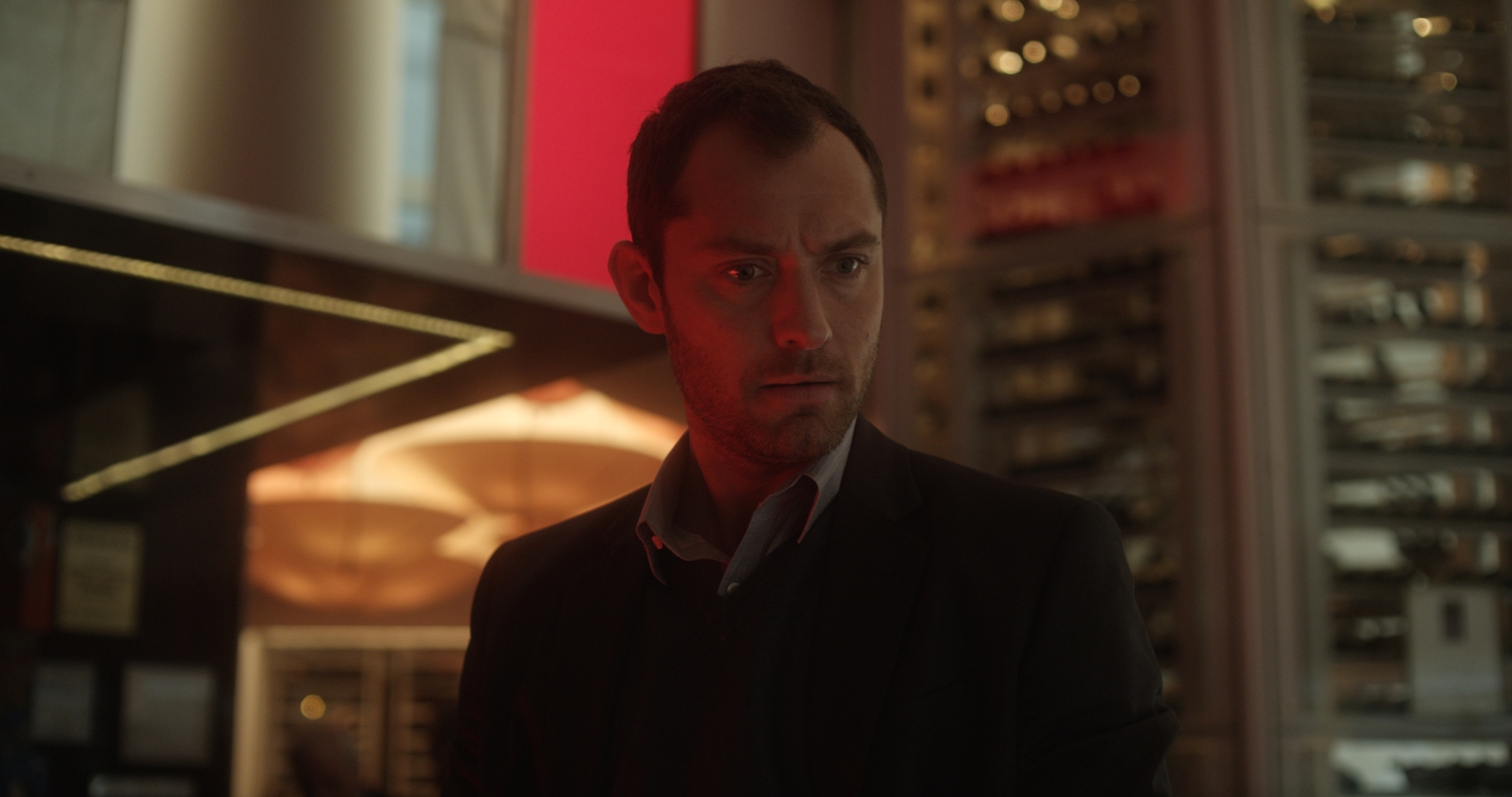
The movie's cast is part of the good stuff, as well, and, yes indeed, they all deliver. Jude Law, above, moving smartly into middle-age roles, makes a very believable therapist and johnny-come-lately protagonist.

Catherine Zeta-Jones is aces as another therapist (both her character and Law's have treated the movie's initial protagonist) who goes from bright and sunny (above) to something a bit more complex. Channing Tatum, below, hot off the Soderbergh hit (but again, only so-so in my book), Magic Mike, is here a bit wasted (in a couple of senses of that word) but he is absolutely confined by the movie's script and so does what he can valiantly enough.

More than any other cast member, it's Rooney Mara (below and at bottom) who delivers the film's knockout performance. It's not enough that she envelopes us with her neediness and sadness, but then she... ah, you'll see. Though I was disappointed in the movie overall, I have to recommend it for Mara's work alone.

Supporting roles are cast and handled expertly down the line. Everyone from Mamie Gummer (the wife of a business friend) and Polly Draper (Mara's understanding boss) to Vinessa Shaw (Law's significant other), Ann Dowd (Tatum's mom), and Peter Friedman and Laila Robins as Law's business partners) do a spot-on job.

Side Effects, from Open Road films, opens wide tomorrow, Friday, February 8. To find out where, click here and then click on BUY TICKETS NOW.